El Camino Real Texas Master Naturalist Take Historic Tour

by Carolyn Henderson

The El Camino Real Texas Master Naturalist took a trip Saturday to a major Texas historical site and got a side of beautiful nature along with it. The tour of Washington on the Brazos was both informative and beautiful. 
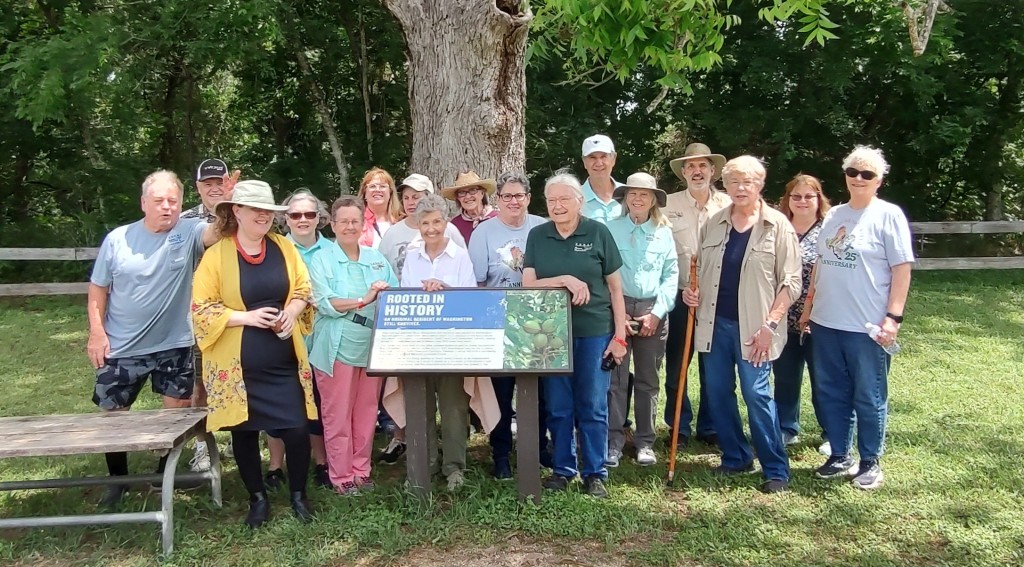
Master Naturalists under pecan tree
Group photo in front of famous pecan tree, including Master Naturalists and friends

The Texas Historical Commission has taken over management of the state park and is doing some major renovation on the facilities. The museum manager led the group through a lesson in the most major event in Texas history, and added information on how nature played a role in the events at the site. Sam Houston and delegates from every major city in Texas at the time met there to sign the Texas Declaration of Independence on March 2, 1836. The site was the capitol of Texas for several years, too. Lack of a railroad did it in in favor of Austin. 

There is currently an archeological dig that will be made visible to visitors once it’s complete. Several buildings have been reconstructed based on descriptions by visitors there to sign the declaration. The only original structure left from the 1830s is a water well. It was built with stone. The park sits on the Brazos River, which is why it was chosen to be the meeting site. At the time there was a ferry running to the site. There are also some paving bricks left from the original town. Nature took its toll on the main path to the river, and washed it out and away eventually. Another original, and somewhat old structure is still there, too. It is the pillars that marked the entrance to the original park. They are going to serve as the entryway into the archeological dig for visitors. 

The grounds, which have grown over the years, have been given over to nature. They are covered in native grasses, wildflowers and trees. The commission has to replant only the  state flower – Texas Bluebonnets – because people trample them while taking their pictures in them which disrupts the  natural reseeding. All the others manage to come back on their own. 
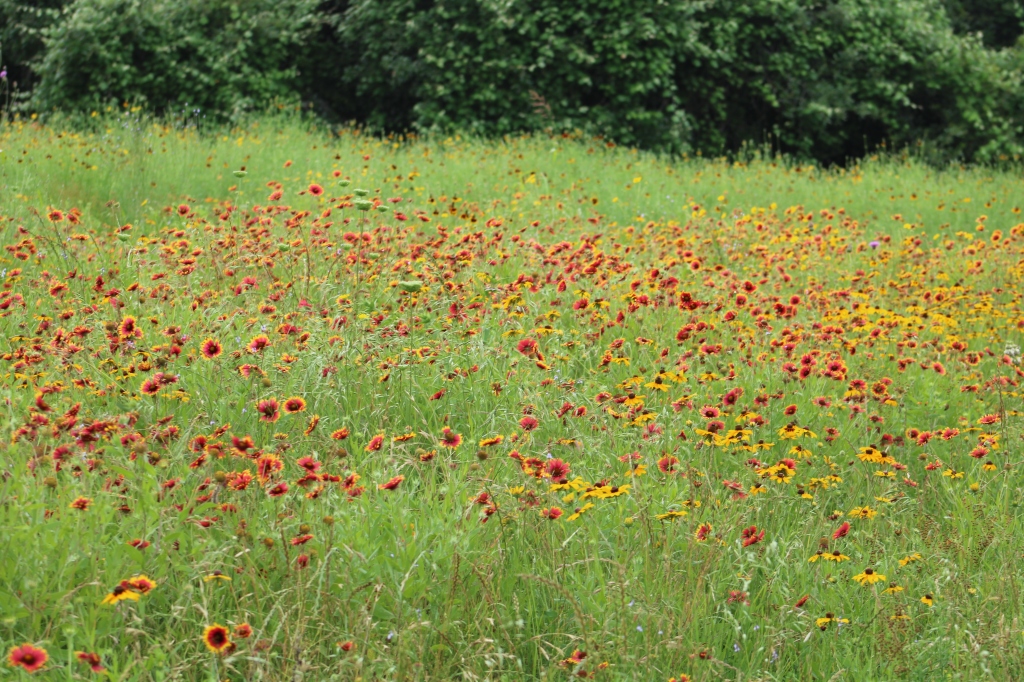
wildflowers
Wildflowers, mostly Indian blanket and black-eyed Susans.

There is a particularly notable Pecan tree on the grounds near the river (see photo above). It is the oldest documented pecan tree in the state of Texas. The delegates met under it during the 17 days it took to get the declaration written and signed. Ironically, it was discovered recently that it is not a native Texas pecan tree. Scientist ran DNA tests on it and discovered it originated in northern Mexico. It is assumed it came with early settlers from Mexico or perhaps missionaries that came up from Mexico sometime well before 1836. It was a pretty good size by then. If you go to the web site for Washington on the Brazos, you can order saplings from the tree. Costs for it are used by the commission to renovate the facilities. 
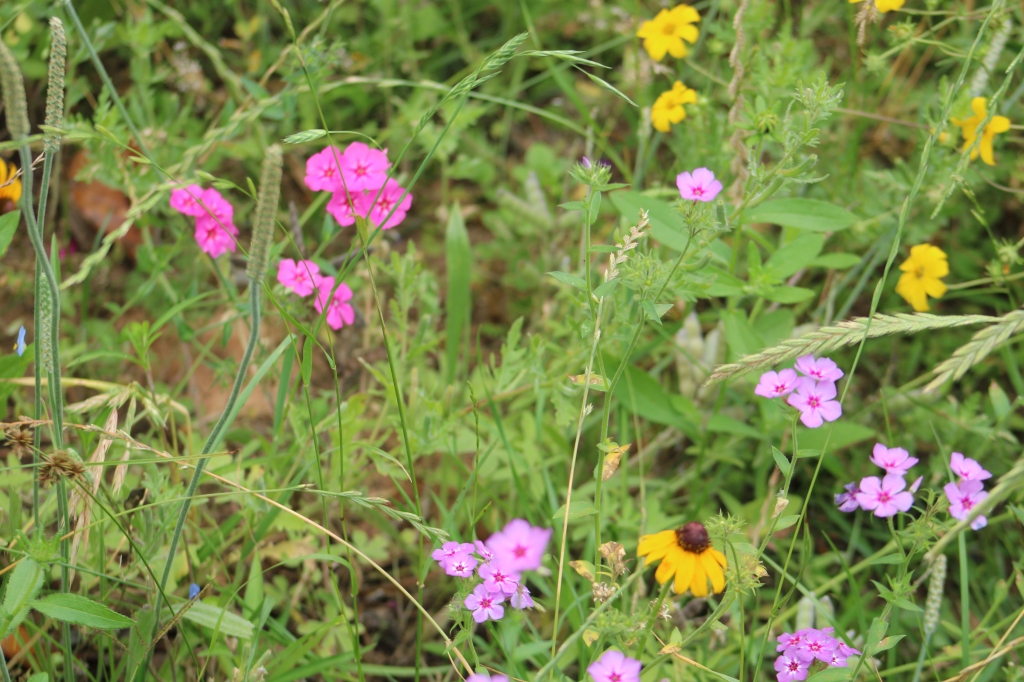
wildflowers
Drummond’s phlox, clasping coneflower, and Engelmann daisies.

Catherine Johnson, organizer of the trip, organized a picnic under the pavilions to round out the trip. It is a trip worth taking, especially if you take a side trip to Independence, Texas nearby. 
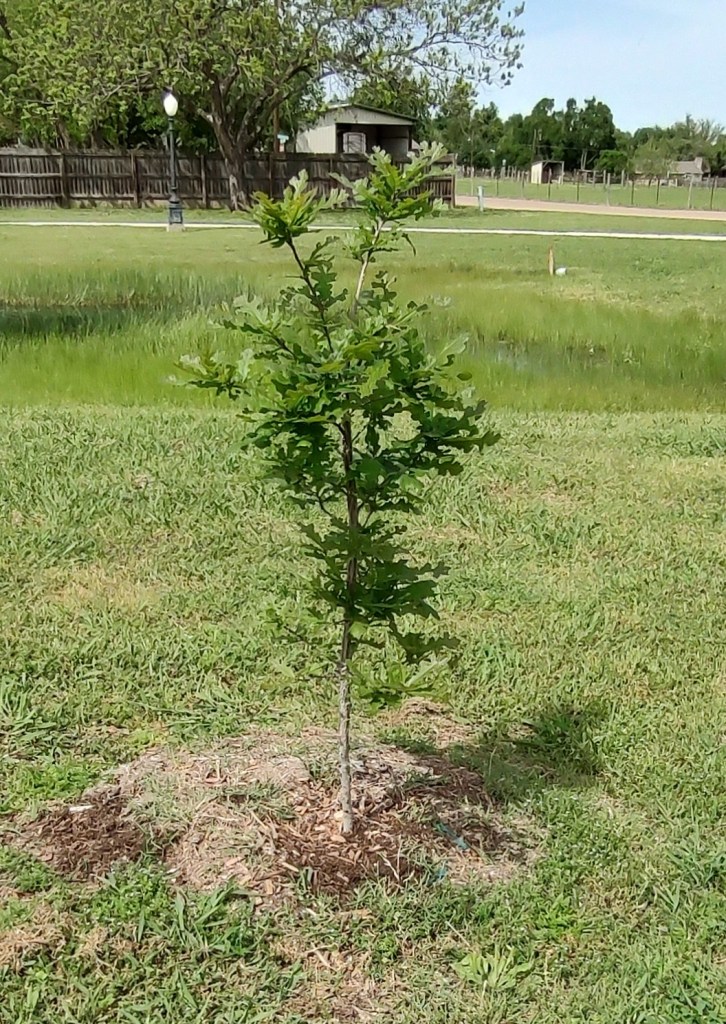
Happy (Belated) Earth Day

by Carolyn Henderson

Happy Earth Day! Plant something native to our area in honor of it.

Last year a small group of us planted three Bur Oaks in Cameron parks in honor of the day. Two of them survived and are now thriving.

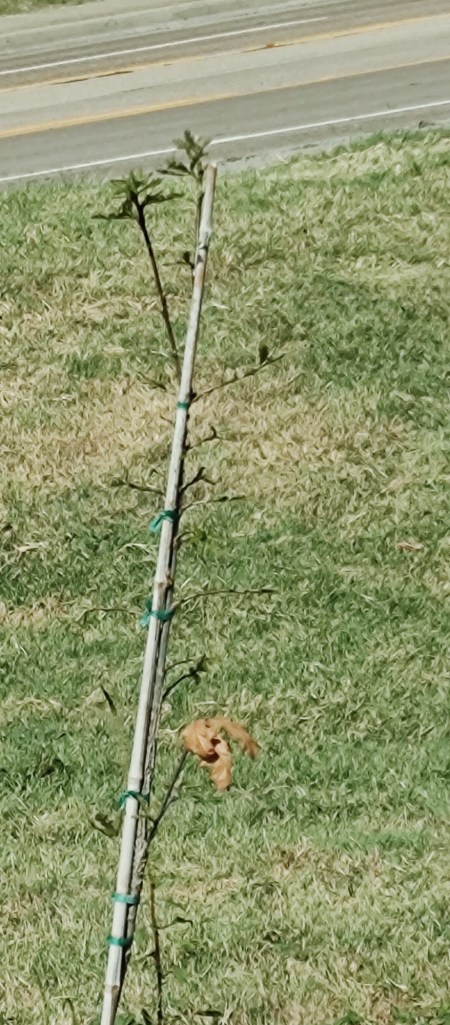
The photo is from the one at Orchard Park. We replaced a tree that went down in the freeze of 2023 there. The other surviving tree is at Wilson Ledbetter Park. It needs a little help being upright because of a major hit by that big storm we had right after we planted them, but it is already growing new ones to make up for it.

I watered the Orchard Park tree and Liz Lewis watered the Wilson Ledbetter Park tree. Liz went to see her tree at least three times a week, and she is still working on it. I have left mine to fend for itself. Watering a Bur Oak for its first year is enough for it to establish itself, it seems. Hint: they are both planted close to bodies of water. 

Chapter Eclipse Day Gathering a Success

By Carolyn Henderson

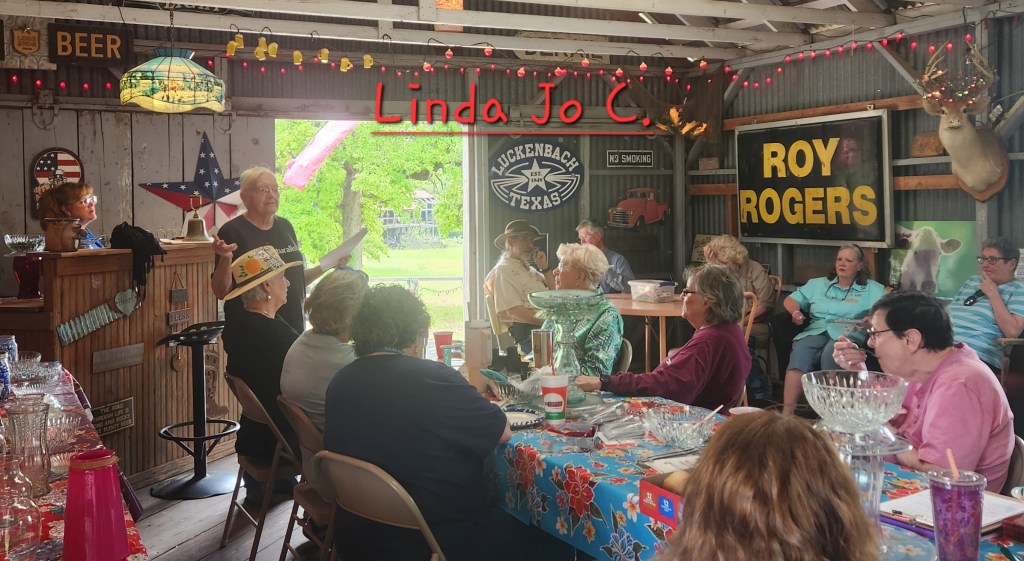
Clouds parted and the view was stunning of the Solar Eclipse. El Camino Real chapter members gathered at a member’s place to watch the event together as well as do a few projects – and of course eat. 

There were 16 members and 7 guests who met at Jackie Thornton’s Party Barn near Minerva Monday. Jackie had everything ready to go including materials to make bee watering stations and Wren nests. 

Working on projects
Carolyn sharing information
Connie sharing information

Debi Harris used gourds to make the Wren nests, and members put a little personalization on them. Jackie told everyone how to create the bee watering stations. Several creative pieces went home with members.

Training was then provided by Carolyn, Connie Anderle, and Linda Jo Conn on the eclipse. Carolyn provided facts, including the one that predicts another total solar eclipse will not occur in our area for 350 years. Connie provided safety information on viewing eclipses, and Linda Jo discussed how animals react to eclipses. 

Linda Jo sharing information

After eating a large lunch, members set up outside in a wildflower-covered field and cheered when the clouds parted, making the eclipse visible. Everyone sat and watched for over an hour as the moon edged its way between the earth and sun. 

Eclipse watchers

Everyone stopped all noise, to hear what nature would do as the totality came close. Before it was complete, but it was growing darker, birds, frogs and crickets began to make their noises that they normally do at dawn and dusk. At the darkest point, nearby coyotes howled for a minute or two. It was measurably cooler, too. 

Getting toward total eclipse!

Several members were seeing colors – pink and blue – at the most covered point, too. I found out last night that it was solar flares making the colors. 

I did not use the correct filter on my camera, so my photos show those colors, among other oddities. It was a once in a lifetime experience – unless you are willing to travel to see another one. 

Of course, Linda Jo took some time for iNaturalist observations

Total Solar Eclipse of 2024

by Carolyn Henderson

This solar eclipse of totality in Milam County is a rare event. They actually occur about every 18 months somewhere in the world, but it can take lifetimes before one occurs here again. There won’t be another total eclipse in the USA until August 23, 2044. The last time there was an eclipse of totality in this area (Austin to be specific) was 1397. That’s right, 1397, according to the Austin American Statesman.

Microsoft 365 stock photo

The total event will take up to 3 hours to complete. The actual total eclipse will last approximately 4 minutes, give or take 30 seconds. Where totality occurs, it will be completely dark for 4 ½ minutes. For those of us in the path of totality, which is 100 miles wide, we will see somewhere between 2 ½ minutes to 3 ½ minutes of total darkness. Our location is not at 100%, but we are only about 30 miles off, which gives us a full 3 minutes of chill bump-raising darkness.

According to NASA Astrophysicist Alex Young, the hype is true. He has seen 4 total solar eclipses. He says that every time he’s experienced one, he gets chills, like goosebumps, and all the hair on his arms stood up. He says he feels like a rush of adrenaline is washing over him. “Getting cold and getting dark happens so quickly that your mind is confused,” Young said.

So how long does the whole thing take? According to the National Solar Observatory, it will take about 2 hours and 45 minutes from start to finish. The moon moving in front of the sun will take more than an hour to complete. And then it’ll take more than an hour for the moon to completely move off the sun.

The best time to view this one in totality here will be 12:15 p.m. to 1:44 pm. Give or take a few minutes. It starts at 12:15 to12:30 and totality ends at 1:45ish.

So what’s the difference between the April 8, 2024 eclipse and the October 2023 eclipse that was best seen in South Texas? The October 2023 eclipse was an annular eclipse. An annular eclipse only partially covers the sun which creates the “ring of fire” effect. The eclipse today is a total eclipse. If you are in the “path of totality” (that’s the 100 mile wide path), you will see total darkness. As stated earlier, the time it stays totally dark depends on how far away from center you are.

According to NASA, a total eclipse needs the moon to be at just the right “eliptic” to the Sun. The eliptic is the apparent path of the Sun across the sky. The moon’s orbital tilt is why we don’t have solar eclipses during every new moon. The new moon is usually too high or too low to block out the sun. In an annular eclipse, the moon is too far from Earth to entirely block the Sun.

When a new moon passes between the Earth and Sun and the eliptic angle is right, a total eclipse occurs. During the eclipse, the moon’s shadow is cast upon the earth and travels across the surface at an estimated 1,950 mph, according to scientist in a Washington Post story. So if anyone is intending to try to keep up with it on the 195-mile stretch of  Interstate 35 between Austin and Dallas, good luck with that. All of that is in the “Path of Totality”.

Nearly 32 million people live in the Path of Totality. This one will cross the homes of more people in Texas alone than the last cross-country eclipse of 2017. It is projected to last longer, too.

If you miss this one, it won’t happen again in our area until Feb. 25, 2343. That’s 340 years away.

Above all else, wear eye cover that meets the requirements for certification by the government. There should be the following on the eyewear: ISO 12312-2:2015 Certification. Looking directly at the sun too long at any time can harm your eyes. It is particularly harmful during eclipses.

Two out of Three isn’t Bad for the Bur Oaks

By Carolyn Henderson

Anyone remember planting the three Bur Oaks in Cameron parks last April? Two of the three are doing great.

About 10 members and friends planted them in Wilson-Ledbetter Park, Cameron City Park, and Orchard Park in honor of Earth Day. The trees at Orchard Park and Wilson-Ledbetter Park are growing, which indicates they will survive. Cameron City Park tree has mysteriously died.

Orchard Park

Both of the living trees were planted close to the bodies of water in each park, and then Liz Lewis and I proceeded to water them every week. They both survived a very heavy wind in a storm the day after we planted them. The wind bent both of them toward the ground. It practically laid the Wilson-Ledbetter Park Bur Oak on the ground. Michelle and Oscar Lopez and I went out to check on them and found it. We staked it upright to a degree. The top part is alive, but it really seems to be coming back from the ground.

Wilson-Ledbetter tree

The Orchard Park oak also was found leaning from the storm, and I pushed it back in place. Then the heat wave set in on the area. Liz and I took water to the three at least once a week. We used cat litter jugs to carry it. The City Park oak had lost all its leaves early on, but resprouted them in two weeks. I labeled that transplant shock. I was watering it once a week.

Orchard Park tree.

Later, I was told someone else (not a member) was watering the tree regularly. I drive by it frequently. It had green leaves on it until one day it didn’t. It was dead at that time. It is a mystery why it died. I have left it there for now, just in case it sprouts from the bottom like the Wilson Ledbetter oak has done.

City Park tree.

I’d like to plant Redbuds out a Wilson-Ledbetter, but it might be too much to water.


Note from Sue Ann Kendall: I had a bur oak in my yard in Round Rock. It lost its leaves each winter. Maybe that’s what’s going on in the City Park tree. If they all resprout in spring, do cut the sprouts from the base so the trees will have one trunk. If they don’t, encourage one trunk to regrow.

Just thoughts. I could be wrong. it happens.