Turks Caps Still Blooming (at least pre-freeze this week)

By Carolyn Henderson

Turks Caps are easy to grow from the little red apple-looking seed pods they put out in late fall. I have verified that through an experiment I decided to undertake last December 2022. 

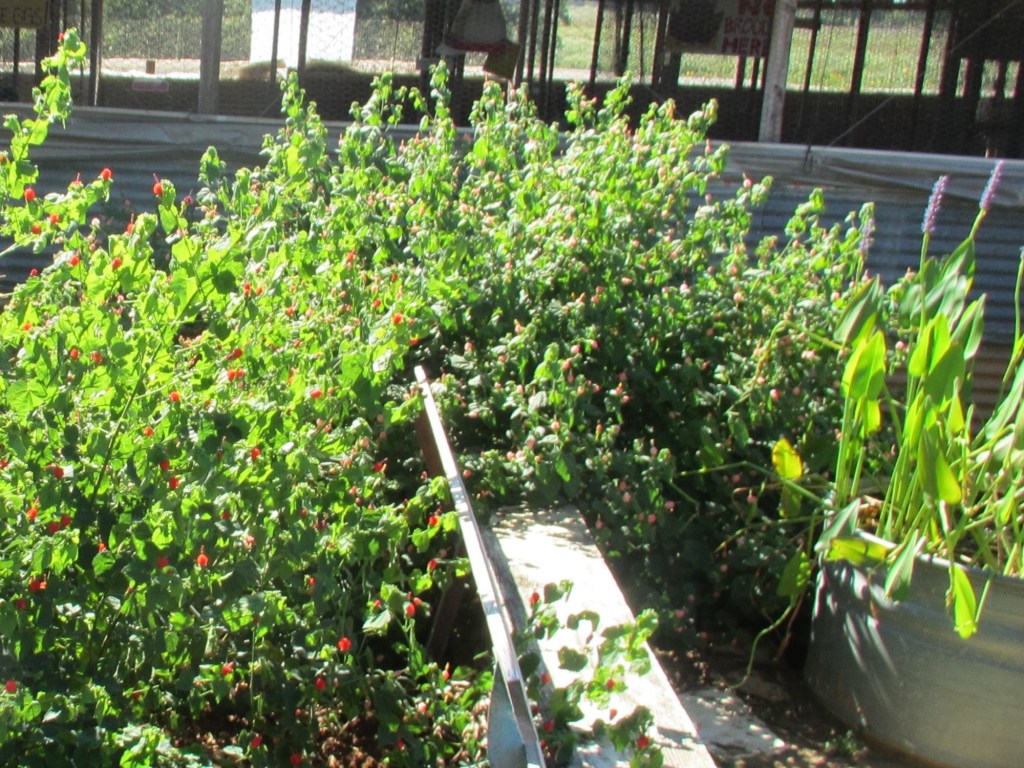
I harvested the seed pods from a very large, pink Turks Cap at the El Camino Real Master Naturalist Wildscape at the Bird and Bee Farm on FM 334 with the hope of growing some in my yard. Turks Caps naturally have a vivid red flower. These had been modified to bloom a light pink. The one at the wildscapesits right next to an even bigger Red Turks Cap.

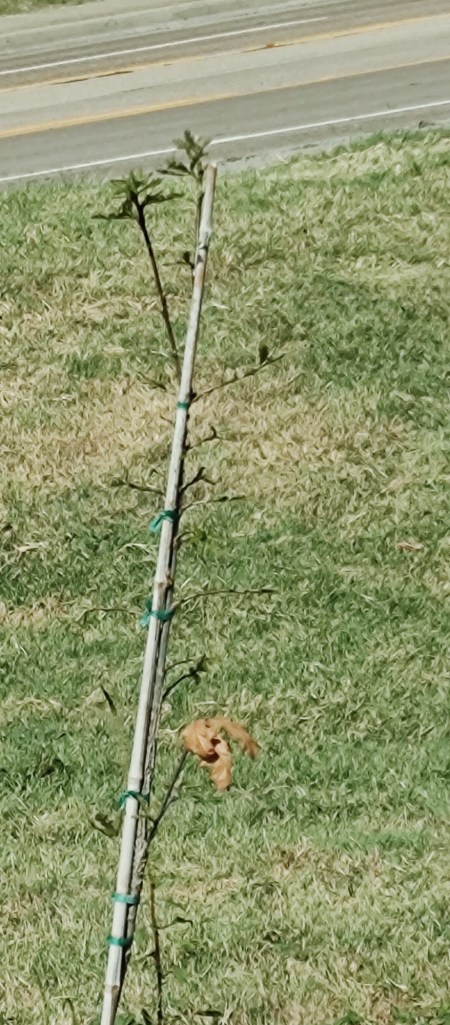
I googled how to process the seed pods. It was recommended to put them in the refrigerator whole until late February or early March. In late February of 2023, I then did as recommended and removed the seeds from the red pod. Each pod produced quite a few seeds. I planted 16 of them in seed starter packs. I should add that I also took a baby plant from the Pink Turks Cap and put it in a pot at the same time I took the seed pods. I planted one full pod in the flower bed where I intended to put all of them. It is a heavily shaded bed which Turks Caps are known to like. The potted one was getting 6 hours of sun a day.

All of them grew. The potted one grew very tall since it had a head start, I think, and bloomed a lot. Butterflies and bees are very fond of the blooms. I moved the starter plants to a flower bed in my front yard in late March. The full pod plant grew at a faster pace than the seeded plants, but all of them did grow. They grew the most in the shadiest part of the bed. 

The whole pod plant bloomed first of the ones in the bed. About half of the others bloomed in the fall. The blooms were all pink – at first. To my surprise, I went to water them one day, and one in the shadiest part of the bed was also blooming red at the same time it was blooming pink. The potted plant had pink blooms throughout the season. The others native gene pool came through. It would appear that they can be planted in any manner I tried.

All of them were still alive up to the freeze. I fully expect them to come back in the spring – even a small one my son weedeated down because he thought it was a weed. It re-sprouted quickly. What I really want to see is what color they bloom.

Wildscape Awash in Butterflies

by Carolyn Henderson

Cloudless Sulphur butterfly

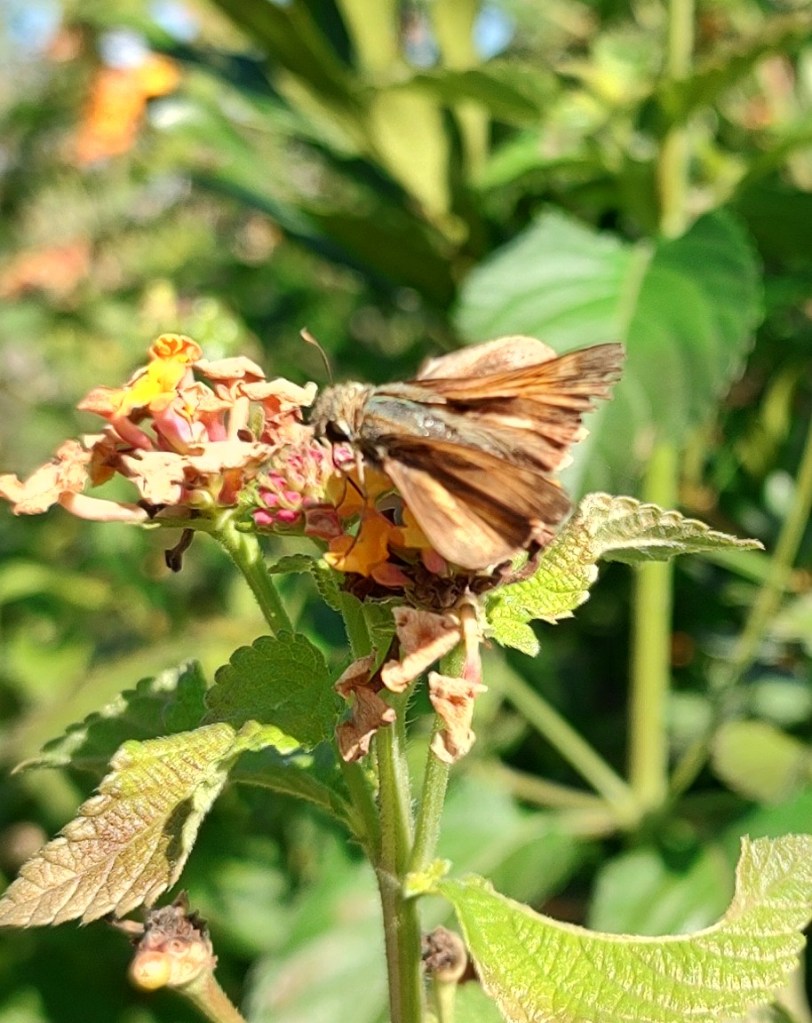
Butterflies were feasting on the abundance of blooming plants Saturday during the annual El Camino Real chapter Texas Master Naturalist Nature Days. 

We did have a nice number of people, but we were overwhelmed by butterflies and bees. I got photos of nine different butterflies and a few more types were seen by members. We saw one emerging from its chrysalis, but most were gorging on the many, many different blooms. 

I wasn’t the only photographer. A teenage girl was also taking many photographs. Her younger sister was collecting blooms.

If you’d like to see the many butterflies, bees, grasshoppers and blooms, Nature Days continues Saturday, November 11, from 10 am to noon. It’s located at the Bird and Bee Farm at 1369 County Road 334, Rockdale, TX 76567.

Gulf Fritillary Lifecycle Up Close and Personal

by Carolyn Henderson and Sue Ann Kendall

By coincidence, two different groups of El Camino Real Texas Master Naturalist members got to witness the lifecycle of the Gulf Fritillary butterfly (Dione vanillae) up close and in person on Saturday, November 4. Here are our stories.

From Carolyn Henderson

Six members of our chapter got to see a Gulf Fritilary emerge from its chrysalis Saturday at the El Camino Real Texas Master Naturalist Nature Day aththe Wildscape project.

The chrysalis was on the gate entrance to the Wildscape. Donna Lewis noticed it and Carolyn Henderson took the photos.

Traffic through the gate was heavy, but the butterfly managed to hang on and make its debut. The first photo was right after it got out. It was still wet. The second photo was taken about an hour later. It was still getting its bearings. 


From Sue Ann Kendall

Coincidentally, I was camping at Buescher State Park near Smithville/Bastrop this weekend. I had taken many long hikes, led a guided nature walk with a group of people from a church, and made many iNat observations. But my best observation was made less than ten feet from our RV, while relaxing and knitting. Go figure.

My campsite view was of a mixed deciduous forest with a lake behind it. There was a lot of yaupon holly, oaks, hackberries, beautyberries, and cypress. Just a mile or so west start the loblolly pines.

We’re in a very woodsy campsite with lots of birds (very loud pileated woodpeckers for example) and I also enjoyed many butterflies wandering around, like sulphurs and red admirals. But one Gulf Fritillary was extra fun to watch. It spent a LOT of time right in front of me, at first on some straggler daisies (that stuff is EVERYWHERE), but then on a vine that I somehow had overlooked when I was taking note of what plants were growing at the campsite.

I watched as the butterfly kept landing on different parts of the leaves of the vine. I was a little slow that morning and wondered why it was so interesting, since there were no flowers on the vine. It dawned on me that the plant resembled a passion vine.

There’s a clue to the butterfly’s mission in this photo.

After the butterfly left, I went in to get a photo of the plant to identify it on iNat. That’s the photo above. I quickly realized there was more going on. Two caterpillars were munching away at one of the leaves.

Hmmmm.

I rushed back to my chair to investigate. The plant turned out to be the yellow passionvine (Passiflora lutea) that Linda Jo is always looking for on hikes. Hooray! And the caterpillars were Gulf fritillary caterpillars. Suddenly, the butterfly’s mission was clear. She was laying eggs. See the tiny yellow dot in the photo of the passionvine?

So, between Carolyn’s group and me, we’ve pretty much seen the entire lifecycle of the Gulf Fritillary!

Here’s what I learned from Wikipedia, which confirms all the things we’ve sen:

The caterpillar food plants–also called the host plants–for gulf fritillaries are members of the genus Passiflora. The adult butterflies use nectar from many flowers, including Lantana plants. The Passiflora host plants are frequently called passion vines; in some Texan counties where this butterfly’s population is high, gulf fritillaries will feed on specific species such as Passiflora lutea and Passiflora affinis. These passion vine plants are suitable host plants as they provide a good structure for larval host habitats which enables young populations of gulf fritillaries to be sufficiently nurtured and protected. The role of host plants is also integral to the oviposition of gulf fritillaries, as the female butterflies lay their eggs on or near the host plant.[8][9]

https://en.wikipedia.org/wiki/Gulf_fritillary

New Birds to Me (or at least my yard)

by Carolyn Henderson

My yard has been visited by a few birds I’ve never seen live and in person before, and one I’ve seen before, but not at my house this summer. The addition of a bird bath seems to have been the big draw. 

I don’t normally put out feeders or water because I have a cat that will kill and eat birds. I’ve had many birds despite that because I have blooming plants and big trees. Due to the long hot, dry summer, I felt compelled to at least get them some water. And they came to use it.

Daily it attracted a family of American Robins. It was common to see four to five of them together in the bath. They’ve been around a while though. They like to play in the sprinkler when I run it. Blue Jays, Cardinals and Mockingbirds used it too. Those are all common here. Doves – both White-winged and Inca – also used it. 

Before I got the bird bath, I found a pretty good size fledgling trying to fly from the ground. I’d never seen one like it before. After putting the cat in the house until I knew it could fly, I put it on iNaturalist. It was not a good photo because the baby was in constant flapping motion. I identified it as a juvenile Yellow-billed Cuckoo. I thought I had to be wrong, but it was verified. Then I found an adult sitting in the tree. It was a first for me and my yard. 

Blog editor notes that these are most easily identified by sound. It sounds like the jungle noise in a Tarzan movie.

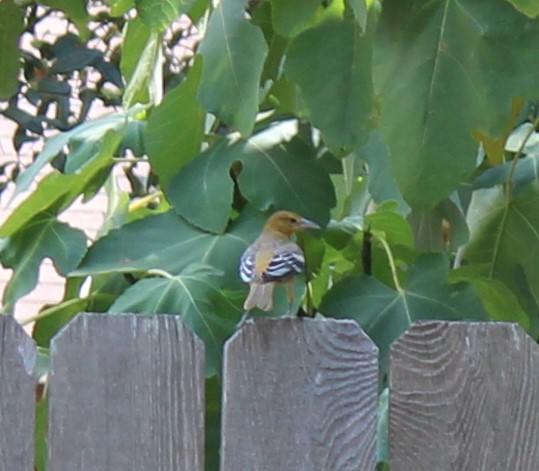
Once the bird bath went in, a Baltimore Oriole showed up. It’s a female with a lot of bright yellow feathers. I had never seen one of those before either. I had it verified on iNaturalist, also. There is another Oriole that looks somewhat like it, but not exactly, so I was glad to get it verified. Based on a poll at our monthly Master Naturalist meeting this week, quite a few people saw these Orioles for the first time this year. Bird Lady of Milam County Ann Collins gets them regularly, though.

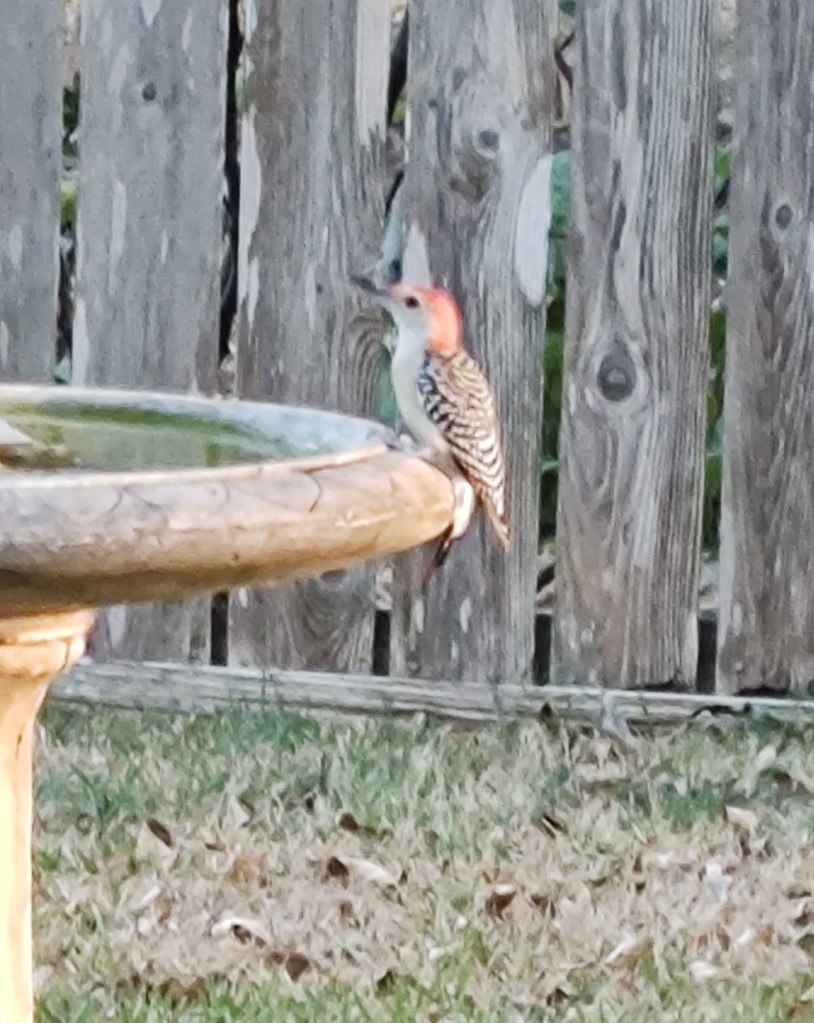
I also had a Red-bellied Woodpecker come to the bird bath and Ash tree. I’ve seen those before, but never in my yard. They have been here before because the holes are in my tree. 

All the photos are taken through a window in my house, so they aren’t great. But the birds sit still when I’m on the other side of it.

Oriole from the back

Finally, I’ve included a photo of a mystery bird. It was in a large vacant lot near my house. I took the photo with my phone. It was too far away to get a good shot. But I’m wondering if anyone can identify it. It hasn’t been identified on iNaturalist yet. 

Since the rain started two days ago, the birds have not needed the bird bath. 

Hummingbirds: Feeders Aren’t Necessary to Attract Them

by Carolyn Henderson

The only time that I find being outside tolerable during this long heat wave/drought is early morning or late evening. I think Hummingbirds agree with me. And I don’t feed them intentionally. 

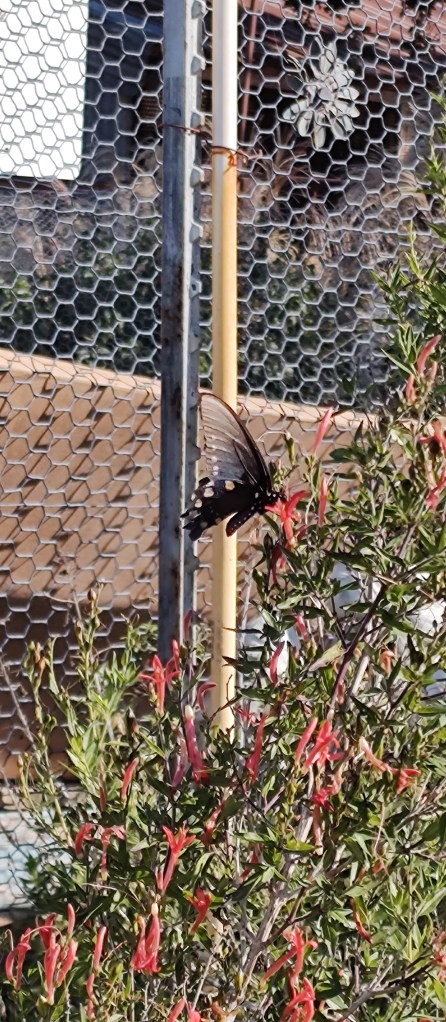
I stopped putting out bird food of any sort several years ago after I saw my sometimes-outside cat, with a Hummingbird then a Yellow Rumped Warbler in his mouth. I decided to limit his pickings as much as possible. However, I did plant a Mexican Honeysuckle bush from the El Camino Real Texas Master Naturalist Wildscape, and I also have a Fiery Hummingbird Bush (also called a Fire Bush) that was here when I bought the house. They both are in full bloom now, and Hummingbirds and several types of butterflies are very fond of feeding on them. The multitude of wasps that I have nesting at my house like them, too. 

These two bushes, my Crape Myrtle and a couple of Mexican Hats are all in bloom now. These plants are heat wave tolerant, feeding birds, butterflies, Western Honeybees, and three types of wasps. I only see the Hummingbirds in the very early morning and evening. They come in groups of three to four. I believe they are the Ruby Throated version. Three of them have white undersides and one, that I finally got a photo of this morning, looks to be Ruby Throated (according to iNaturalist). I’ve been trying to get photos of them for a few weeks, but I never have my camera ready at the right time. It seems that if they see that I have seen them, they head for the tallest trees. 

Hummingbird zooming in on Fiery Hummingbird Bush

The Crape Myrtle, which bloomed late this year, attracts mostly wasps and honeybees. I normally have a Texas Purple Sage in bloom that the bees really like, but it has not put out more than 5 or 6 blooms a few times. The Mexican Hats are just about done for the year. Luckily for the feeders, the Mexican Honeysuckle Bush and Fiery Hummingbird Bush bloom until it freezes – which may not occur this year. 

I must say, being able to watch the birds and butterflies eat without having to frequently clean out the feeder is nice. They really like my new bird bath, too. They, along with Robins, Blue Jays, Doves, Cardinals, and Mockingbirds have become very fond of it. They drink it and cool themselves off in it.