A few days ago, I was headed out to the back pasture when I walked right up to a tiny Pocket Gopher with his little back end up in the air as he was digging in the ground.
Dirt was flying everywhere. He must have gotten out in the open because there was no tunnel to dive into.
I’m thinking… buddy you need to watch what you’re doing or one of my dogs will get you because you are not paying attention.
So I reached down and touched him on his little tail.
Lordy mercy…he jumped up and started running around my boot barking at me.
I was laughing so hard.
I had my camera in my pocket so I took a photo of him. He was really telling me what he thought.
Angry little pocket gopher!
And no, I never kill these little creatures, even though they eat things in my garden. They aerate the soil and add organic matter to the areas where they are. So they do some good for us.
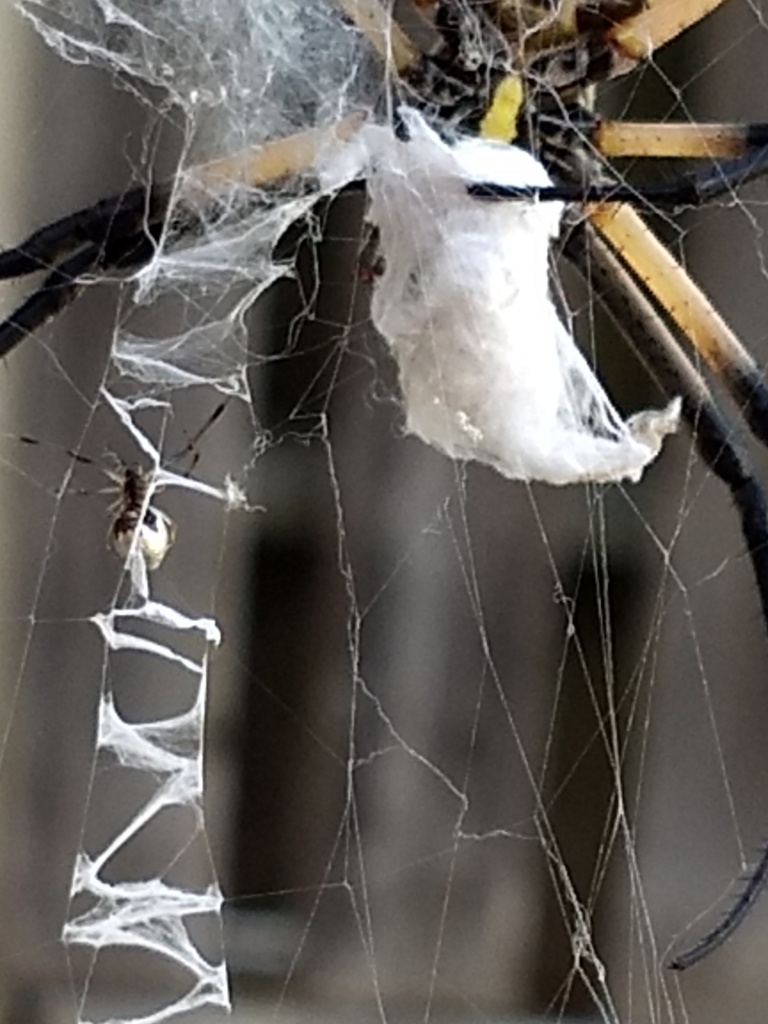
I have developed a relationship with a Yellow Garden Spider over the spring and summer this year, all courtesy of a tomato plant. Then, a kleptoparasitic Theridiidae genera intruded. This illustrated that big does not always win.
This large yellow spider (pictured) showed up on my tomato plant (I only planted one) when it reached about two feet tall, sometime in April. It set up house, via a web, and seemed to just stay parked there. It never moved off the web nor did it bother my plant. The tomatoes grew all around it, and I picked them without problem. The growing spider and I were coexisting on friendly terms. I eventually posted it on iNaturalist, and it reached research grade. The tomato plant has become spindly and leaves are turning brown. I normally would have removed it by now, but I didn’t want to remove the spider’s home.
On Wednesday, my son noticed some very small, metallic spiders on the web with the big one. The big spider had snared and wrapped its daily catch in webbing, and these little spiders were attempting to get at it. You can see it in the pictures.
The big spider has something tasty. The tiny one wants it.
I thought at first that they were recently hatched babies of the big spider, but I was wrong. I posted a picture on iNaturalist and a helpful identifier who goes by chuuuuung said the little spider is a kleptoparasitic Theridiidae genera – a thieving parasite. The little thieves were going to work on the big spider’s catch. (We are trying to get a video to attach, so come back later if you see this message.)
I have left them both alone. Nature is nature, and you definitely don’t always win if you are larger. Today (8-6), the garden spider caught a good size wasp and wrapped it up. The Theridiidae were waiting in the outer reaches of the web to take their shot at it. Meanwhile, the tomato plant is growing more tomatoes.
Just the other day, I was in my garden and leaned against an oak tree with my hand. Something heavy and wet then scooted across my hand. Boy, I pulled my hand back just in time to see the biggest lizard looking thing I ever saw in my garden!
Broad-headed skink, iNaturalist photo by (c) Alan R. Biggs. Creative Commons.
After I composed myself, I looked a little closer to the beast. It was the biggest skink I ever came across. It climbed up to the higher parts of the tree and ducked inside a hole.
It turned out to be a Broad-headed Skink (Plestiodon laticeps). This fellow likes dead trees usually near a forest environment. That makes another good use for a snag (dead tree).
[I wrote a similar piece for my personal blog, but thought it might be good to also have it appear here.]
This being a big year for the hoppers, I thought I’d learn more about the ones here at the Hermits’ Rest, and I’ve been sharing some photos here and there, and did a post on their cool names. I am not able to get them by net (even though I keep saying I’ll buy one, I forget), so most of my photos are rather blurry, but I’ve had fun identifying them, with help from my expert friend and student Master Naturalist, Eric N., on iNaturalist.
Most of the grasshoppers you see around the ranch are boopedons, a name you just have to love. More on them later.
By the dark color and size, I now know this is a male.
I did find a really pretty grasshopper (if you think they can be pretty) with a cool name over by our church office on Friday. These are the Obscure Bird grasshoppers (Schistocerca obscura). The stripes on their backs and the dots on their legs make them very striking.
Quite obscure!
Blurry grasshoppers
Back at the ranch, today I went on a hunt, and only found one grasshopper-like insects that weren’t Boopedon (to be precise, the prairie boopie, the best name ever), a katydid.
Not a boopie
Not a boopie? WRONG! It’s a female
It turns out that male and female prairie boopies (Boopedon gracile) look very different, so what I’d thought was a different species, was, indeed, just a female of the same species. I learned this when I FINALLY found a detailed article on them.
I also learned that “Prairie boopies are typically found in dense grasses, including prairies, rangeland, and savanna habitats. In Oklahoma, this species was reported to be more abundant in overgrazed prairies than natural ones.” (This is from Grasshoppers of the Western US, a really interesting site.) I’m happy to know they aren’t officially classified as pests (unless you hate grasshoppers, I guess).
Anyhow, as I went about observing away, I realized the front field was a like a sea, with little bobbing boopie boats on it.
Every brown thing you see is a grasshopper. Bobbing boopies.
Then I noticed that they were very fond of the nightshade plants next to the driveway.
Twelve boopies jumped off this plant when I took another step closer.
I quickly realized these grasshoppers are at the height of adulthood. Most of them were mating. They don’t need privacy (being grasshoppers). You can see how different the female looks in this picture.
That’s four of them. And do you see why I am annoyed all the rain skirted us today?
As I walk along, I tend to send boopies flying away (but only males, because I just learned the females are flightless!). Here’s video proof. Warning: I think I sing. Lucky for you it’s only 35 seconds long.
Other than how hard these guys feel when they hit me as I drive Hilda, I’ve gotten fond of these guys. Both Vlassic and the chickens love to eat them, and at the moment I don’t have any tender plants they will kill.
It’s been fun watching them grow, and I guess somewhere out there will soon be a lot of grasshopper eggs. I’ll have to look those up next…sigh, no I won’t. I’m crushed: “Little is known about the reproduction of prairie boopies” (from the above web link). Well, we have plenty of them here, even though they apparently aren’t often found in high densities (I beg to differ).
I’d call that a high density.
I guess I’ll be booping along now. That’s all I know about the prairie boopie. I lie. They are also known as the graceful range grasshopper, and were identified by Rehn in 1904.




 Nature Along the El Camino Real