Hiking the Rancheria Grande

by Carolyn Henderson

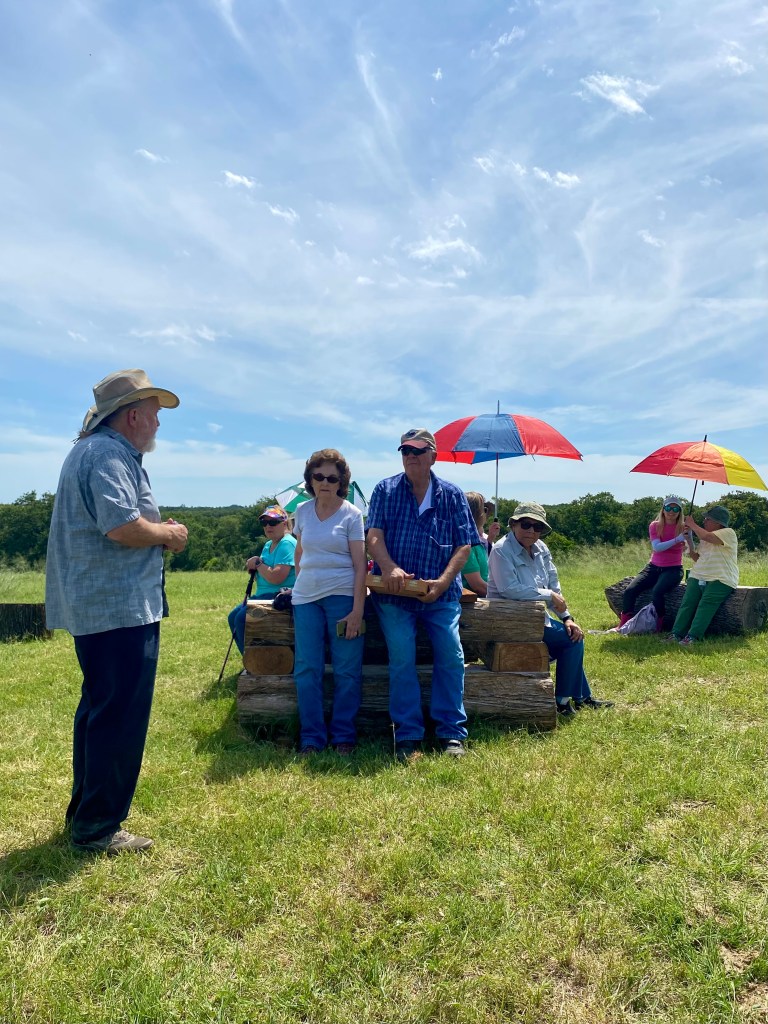
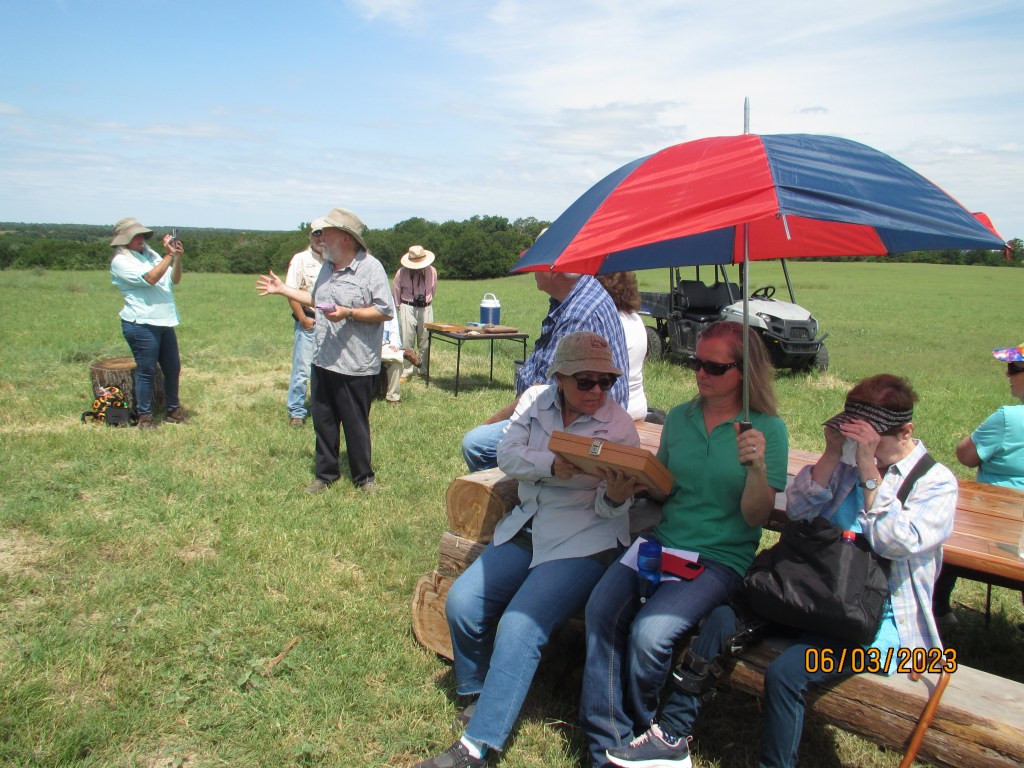
To walk where Spanish settlers walked hundreds of years ago and native tribes lived their lives, even thousands of years ago is an inspiring experience. Members of the El Camino Real chapter Texas Master Naturalist and El Camino Real de los Tejas National Trail Association got to experience it firsthand Saturday in a guided tour of a trail in development.

The group after their hike

The trail is part of the El Camino Real Trail that spans a good part of Texas. The part travelled Saturday, June 2, runs across the Cedar Hill Preserve, owned by Mike and Joyce Conner, and the Baumann Ranch. The Conner property is being developed as a native flora and fauna preserve, and the adjoining Baumann ranch is still a working cattle ranch. It is now part of the National Trail Association, and it is being prepared for study and hiking for organized groups in the future.
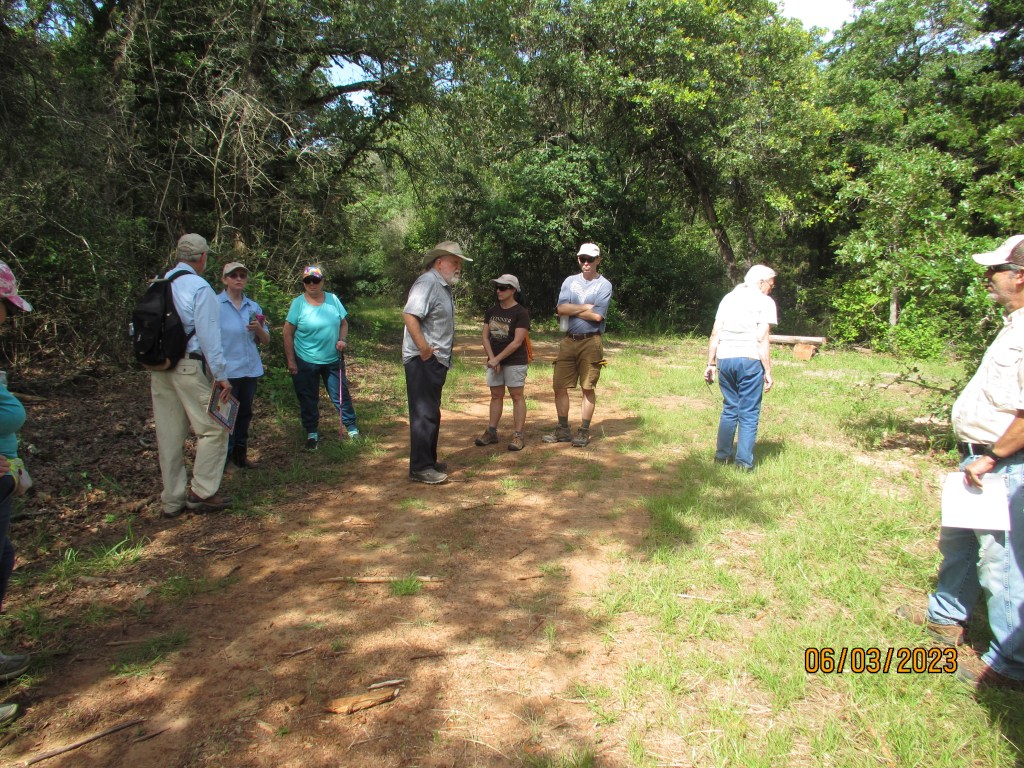
The trail head

The wet swales were probably formed by water traveling in a path through the area in wet seasons then later used by travelers.
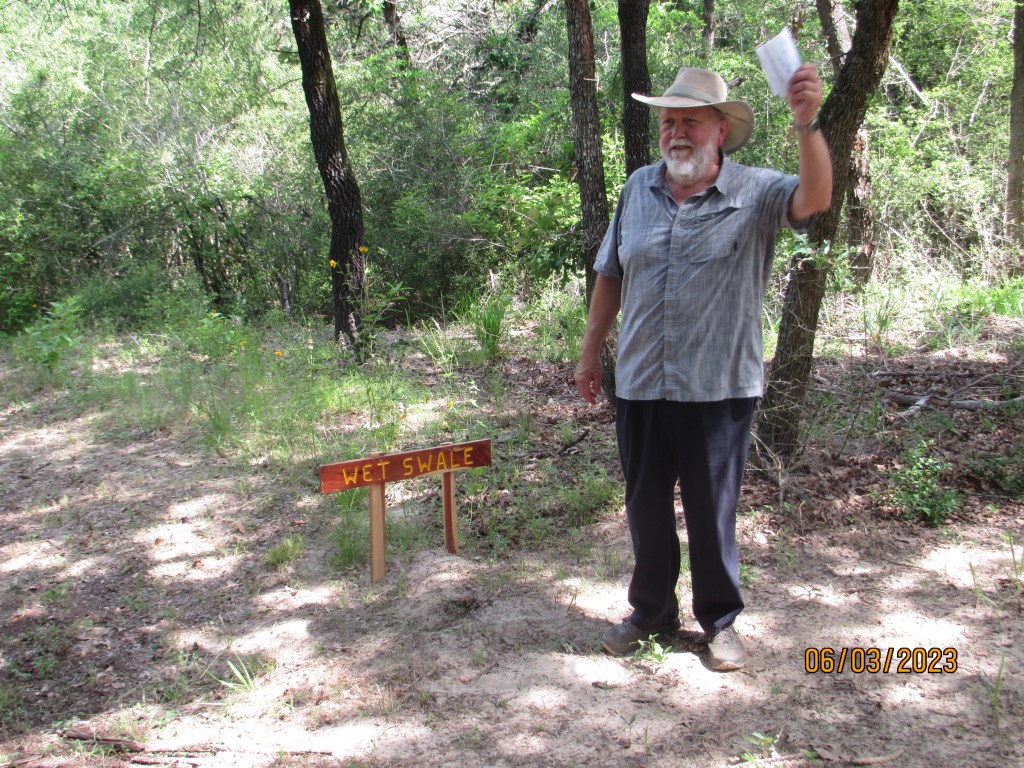
Mike Conner talks about the wet swale

The trail head begins in a woody area on sandy loam soil complete with a fancy new outhouse somewhat like your grandparents had in this area. In many areas a hiker can actually see the trodden
path taken by Spaniards and Native Americans dating back hundreds and probably thousands of years ago. They are most discernable by swales that bank the path. A swale is a buildup of land running along each side of the ancient trail. It looks a bit like a street curb might look today. There are both dry swales and wet swales. The dry swales were strictly roads/paths taken by travelers.

Dry Swale (photo by Michelle Lopez)

There also are signal trees believed to have been formed by the native tribes to give direction
then later used by the Spaniards. Artifacts from both groups have been identified by archaeologists
studying the area. Post Oak trees primarily were used to form these trees.

Signal Tree

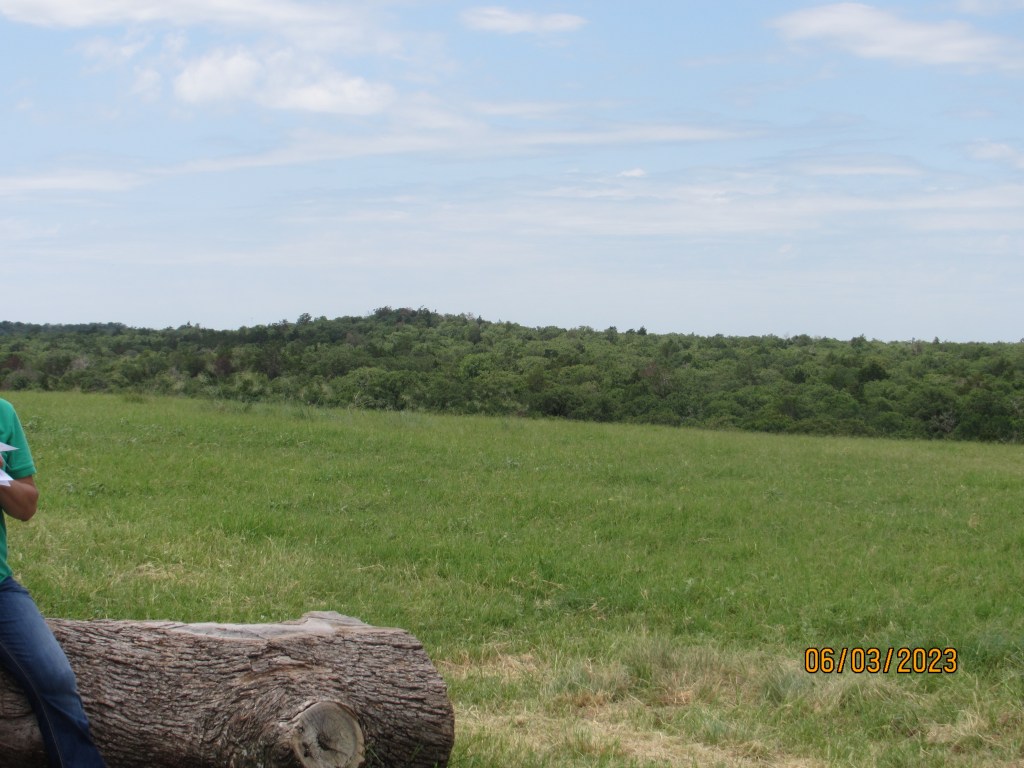
When you come out of the wooded area, you are then on an uphill stretch to reach the very high hilltop. The top of the hill is like a meadow looking out at the woods below and nearby hills or “mountains.” Sugar Loaf Mountain is very near and visible from this hilltop. It is believed that this hilltop where we were was a village for a native tribe or tribes over the years. Tonkawa artifacts have been identified from the area. There was a great deal of speculation by the hikers that the different tribes sent smoke signals to each other from these hill tops. A visit to Sugar Loaf Mountain has long been a rite of passage for area high schoolers.
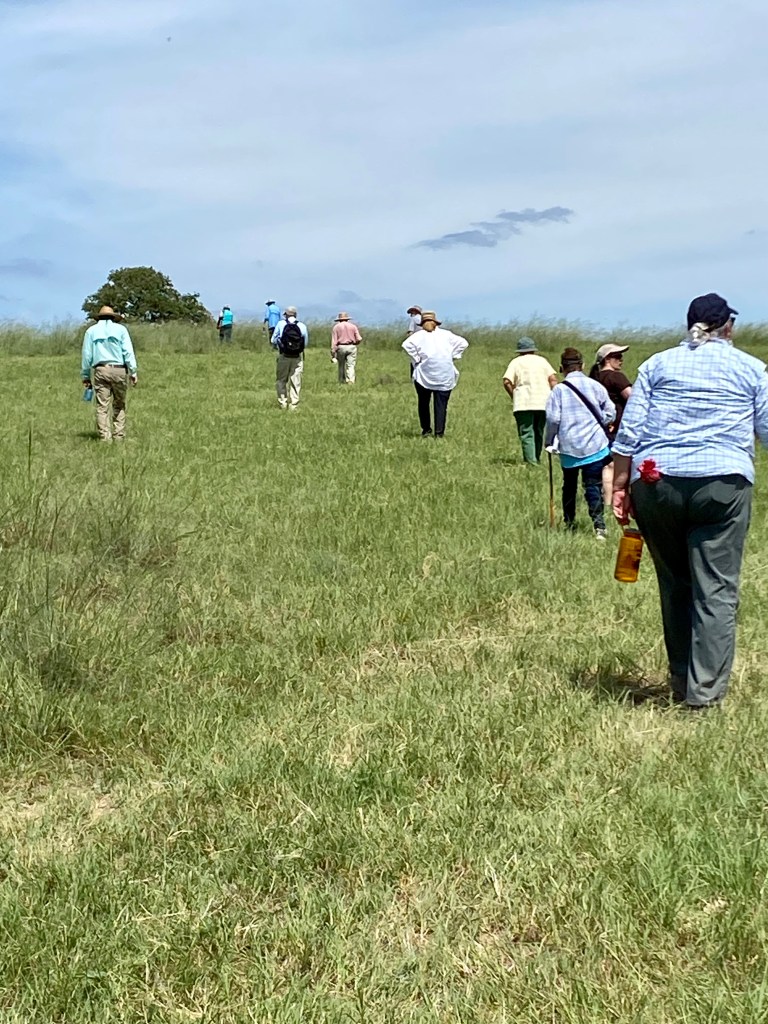
This area is part of the Rancheria Grande Los Brazos de Dios. An archaeological dig in the area around Alligator Creek and Pin Oak Creeks, both of which cross these properties, a few years ago found evidence of very early Spanish settlements.

Trail loop

Mike Conner and Dr. John Pruett, tour guides for the adventure, and Mr. and Mrs. Baumann, explained the history and discoveries while the rest of us recovered from the climb. Joyce Conner etched a map of the trail into a homemade tabletop. It sits at the top of the hill.

Joyce Conner’s tabletop map

Going downhill was easier, but one could certainly feel the rising midday temperature. An appreciation of what people had to go through to get anywhere hundreds and thousands of years ago is brought home when hiking this trail.

The Baughmans (center)

There is a book titled The Archaeology of Rancheria Grande Los Brazos de Dios, written by Sergio A. Iruegas, archeologist, and Melinda T. Iruegas, about the discoveries in the area. It is currently out of print, but there are copies at the Cameron and Rockdale libraries. If you own land in that area, you may be sitting on artifacts.

Mike Conner talks about the trail

Addendum

by Mike Conner

I would like to clear up a little confusion about swales.

Swales are u-shaped, linear depressions in the ground formed by many years of foot and hoof steps. They are never formed by water but may be damaged by water once they are formed. This is happening to some extent to Hidden Swale. Both the Dry and Wet Swales have been certified by archeologists to have been used during Spanish colonial times but may have been used for thousands of years before. The somewhat confusing names for these two swales come from the fact that the Dry Swale leads directly to the historic village site and cuts through a small valley that would only be passable is fairly dry weather. The Wet Swale leads in a less direct route to the historic village site that goes around the edge of the valley and would be passable in wet weather.

Reduce and Reuse Plastic, but Don’t Recycle

by Mike Conner

The following are my opinions, based on a good bit of reading but not rigorous research.

Paper, steel, modern-tin, aluminum, and glass cause minimal harm if they are “lost” into the environment. (Roadside non-plastic trash is more an esthetic issue than an environmental issue.) Many chemicals and metals are also harmful, but these should not be present in household recycling.

Plastic on the other hand causes lots of problems if it is “lost” into the environment.

Tiny, micro, and nano particles of plastic are polluting our food, soil, and water to a remarkable extent. Much of this comes from Styrofoam which quickly breaks down into micro pieces that don’t further decompose. A lot comes come coatings that break down into “forever” chemicals. Pretty much all plastic breaks down in the ocean into smaller and smaller pieces, but these pieces remain plastic; they don’t decompose.

Plastic film, complex shapes (like the harness for a six-pack of cans, or a net, or a tangle of string or rope), and small, swallowable parts are causing lots of harm to wildlife, especially in the oceans.

Plastic recycling barely works. Most estimates guess that only about 10% of recycled plastic is actually recycled and the rest is discarded. Actually, the percentage is much lower for everything but standard plastic drink bottles. Plastic bottles are more readily recycled because they are easy to identify and because they are all made from the same somewhat-recyclable plastic. Note that they are, sadly, not very reusable, as cleaning them causes them to start leaching chemicals into their contents.

In North America (including the USA) there are essentially no open public trash dumps. Here we have landfills, which are regulated, and modern ones are quite well designed and managed. The rest of the world, and especially the countries to which recycling materials are shipped, still heavily rely on open trash dumps, many located near rivers. These dumps, plus fishing fleets, account for most of the plastic that pollutes many rivers and all oceans.

In the US it seems that the processing stream for recycled plastic is poorly documented, but it is estimated that about 40% of US recycled plastic is still shipped overseas. So, when you recycle plastic, you have two possibilities:

1) It gets sent to a US-based recycler, where a small percentage is recycled, and most is disposed of in a well-managed landfill. In this case, you have increased the energy cost of disposing of your plastic with the benefit that some may have been saved from going into a well-managed landfill.

2) It gets shipped overseas, where the vast majority of it will end up in an open dump, and a good fraction will end up polluting the environment.

So, my conclusion is that we should recycle everything we can (especially things like electronics that contain heavy metals and bad chemicals) except plastic. I think the case for recycling plastic drink bottles is borderline, but for everything else it is better to put plastic in the trash.  And, of course, we should avoid single-use plastic when reasonable to do so. (The case for some plastic packaging (like shopping bags and containers) is complex, as sometimes the environmental cost of non-plastic packaging is considerably higher.)

And always remember that recycling is the last term in — reduce, reuse, and recycle.

An article with some interesting background information about landfills and municipal recycling is: This California city asked where its recycling went. The answer wasn’t pretty.  

Hiking the El Camino de los Tejas National Historic Trail in Milam County

By Joyce and Mike Conner

Figure 1: Part of the Previously Discovered Trail

On Saturday, March 9, 2019, thirteen students; their teacher, Dr. Nichole Wiedemann, from the University of Texas School of Architecture; and Steven Gonzales, Director of El Camino Real de los Tejas National Historic Trail Association (ELCAT), arrived at Cedar Hill Ranch in Gause to hike a small part of El Camino de los Tejas National Historic Trail.

Figure 2: Dr. Estell Meets the UT Students

There they met Dr. Lucile Estell who explained how she and the late historian Joy Graham worked to get the approximately 2580 miles of trail nationally recognized as the 19th National Historic Trail in the United States in 2004 and then subsequently worked to get signage placed throughout most of Milam County. (Dr. Estell has authored/co-authored several books including El Camino Real de lost Tejas (Images of America) and Historic Bridges of Milam County; and served on the board of ELCAT for many years since its beginning, including as president and vice-president.)

Continue reading “Hiking the El Camino de los Tejas National Historic Trail in Milam County”