Things Flying Over My Head

by Sue Ann Kendall

This summer hasn’t been as bad in the heat and rain department as last summer, so I’m not complaining one bit. But there sure have been some interesting developments in the sky, many directly over my head.

hawk
Some overhead things are cool, like this Red-tailed Hawk I got to listen to yesterday.

I’ll start with the most interesting one. For the past week or two I’d been noticing a lot of honeybees around my legs. It seemed like the earth was buzzing. Upon closer examination, I saw dozens of bees crawling on the tiny blossoms of the grass (I think it’s Dallis grass) that is blooming now. The bees were all very busy, zipping from flower to flower (not leisurely sipping as they usually do), and they were loaded with pollen.

This went on for a few days. Yesterday, there was no buzzing as I walked along the field in my daily bird-watching patrol. Then, late in the afternoon I was over by the trees listening to a Yellow-billed Cuckoo when I heard something that sounded like one of those annoying drones people fly these days. I looked up and didn’t see a drone. I saw a large mass of tiny things moving along at a rapid clip. It was hundreds and hundreds of bees swarming. I guess they were moving on to better pastures. I’m not sure where their hive was before, because I hadn’t heard one in a couple of years. I hope they find a nice new dead tree!

FAKE NEWS! The blog software generated this image when I asked for “swarm of flying bees.” I don’t think they actually swarm in a giant ball.

Moving along, I’ve also been dealing with birds overhead, specifically the beautiful but omnipresent Barn Swallows. Now, normally they hang out on our porches, building mud nests, raising babies and pooping. They also eat numerous insects, so they get to stay (also it’s ILLEGAL to mess with a nest of wild birds; you can ask Mike Mitchell about it if you don’t believe me). We coexist just fine, looking into or out of the windows at each other, and enjoying the swimming pool area.

Swallows on the pond.

However, lately, the little darlings have not been at all happy with me. They aren’t nesting anymore, just flying around the ponds and in the air catching food. They are always there, and for some reason they resent my presence. When I go for my morning or afternoon walks, I often hear a very loud CHIRP, with a Doppler effect as the chirper moves away. The swallows ambush me from behind, for the most part, but occasionally they fly right at me and veer off just before they make contact with my head.

There are so many!

I have absolutely no clue as to why they are dive-bombing me. I’ve had Mockingbirds and Red-winged Blackbirds do this when they are nesting nearby. But, hey, do they think I want to home in on their mosquitos?

Creepy? Why, yes, it is. Never trust AI to draw an insect. Or a horse. They always have five legs.

Other things in the sky have been more benign. I was a bit surprised to see both Black and Turkey Vultures in the air and in my trees until I realized the Mighty Hunter (Goldie the Great Dane) had eliminated yet another armadillo that had wandered into the fenced-in area. I wish they’d read my signs that say “Armadillos and Possums: Keep out! Killer Dog! This means YOU!”

Other flying friends include the usual Green Herons, Great Blue Herons, and Great Egrets, along with some hardy butterflies and a smaller-than-usual number of dragonflies. I’m going to pretend the flying Differential grasshoppers don’t exist.

Yep, the skies around here are busy. Always look up in case bees or swallows are coming for you!

It looks so peaceful out there…but it’s NOT!

Pollinators in Peril

by Alan E. Rudd

Photos by Michelle Lopez and Carolyn Henderson

The Rockdale Rotary Club was treated to an excellent presentation on Thursday, April 20 in celebration of the upcoming Earth Day. 

The science lesson started off with Keegan Nichols, a PhD candidate in the Entomology Dept at Texas A&M University. Mr. Nichols works and teaches at the Rangel Bee Lab on the A&M campus and his dissertation research concerns the ecology and genetics of honeybees in Saudi Arabia. Keegan presented the big picture of just how many native bee species there are in Texas and how European honeybees have integrated into the North American insect world since they were brought over by colonists in the 1600’s. I am not even going to try to convey the depth of knowledge that this future professor displayed in a 20-minute slot, but our Chapter President astutely asked him to come to Cameron and teach for the entire El Camino Real crew in the near future.

Keegan Nichols, from Texas &M, talks about bees

Carolyn Henderson took over the show where Mr. Nichols left off and utilized a question-and-answer format that queried the audience with “did you know this about bees?”  She started off with easy questions then (as a former Jr High teacher is wont to do) moved onto the harder trivia to make us think. The group ended off this segment considering the factoid that “garlic planted in a garden repels bees.”  Surely not even Italian bees?

El Camino Real Texas Master Naturalists and attendees

Donna Lewis was the next El Camino Real Master Naturalist to take the stage and presented a Master Gardener’s view of how to garden for the benefit of pollinators. The photos and information slides flowed seamlessly the entire day as Michele Lopez ran the PowerPoint for Donna and Keegan Nichols.  Donna’s well-polished speaking skills and screen graphics showed the use of native plants in a yard environment and how we can create an oasis for insects and birds.

Donna Lewis discusses her information

Batting clean-up for the El Camino Real Team was switch-hitter Jackie Thornton. She presented “show and tell” items for bee watering stations and masonry bee nesting habitats that can be made by hand. I never fail to be impressed with every one of our ECRMN members that have worked as professional educators. Jackie was in full “Principal Mode,” demonstrating these things to get young people involved and excited about science and the natural world.  She also showed her love of education by encouraging the adults in the audience to read several authors whose books she had on display.

Attendees enjoy the door prizes

I got to attend this event because work was delayed due to rain, but Catherine Johnson, Sandy Dworaczyk, and Don Travis also showed up to support the speakers and represent our chapter.  The Rockdale Rotary Club was welcoming and the hospitality at the Patterson Community Center is representative of what makes Milam County such a special place. The Bird and Bee farm donated jars of Honey that were the prime door prizes, and with their usual good luck Catherine and Sandy won flowers and artwork in the drawing.

It was a fun day!

Alternatives to Feeding Sugar Water to Honey Bees

by Donna Lewis and Mary M Reed, Chief Apiary Inspector, Texas Apiary Inspection Service

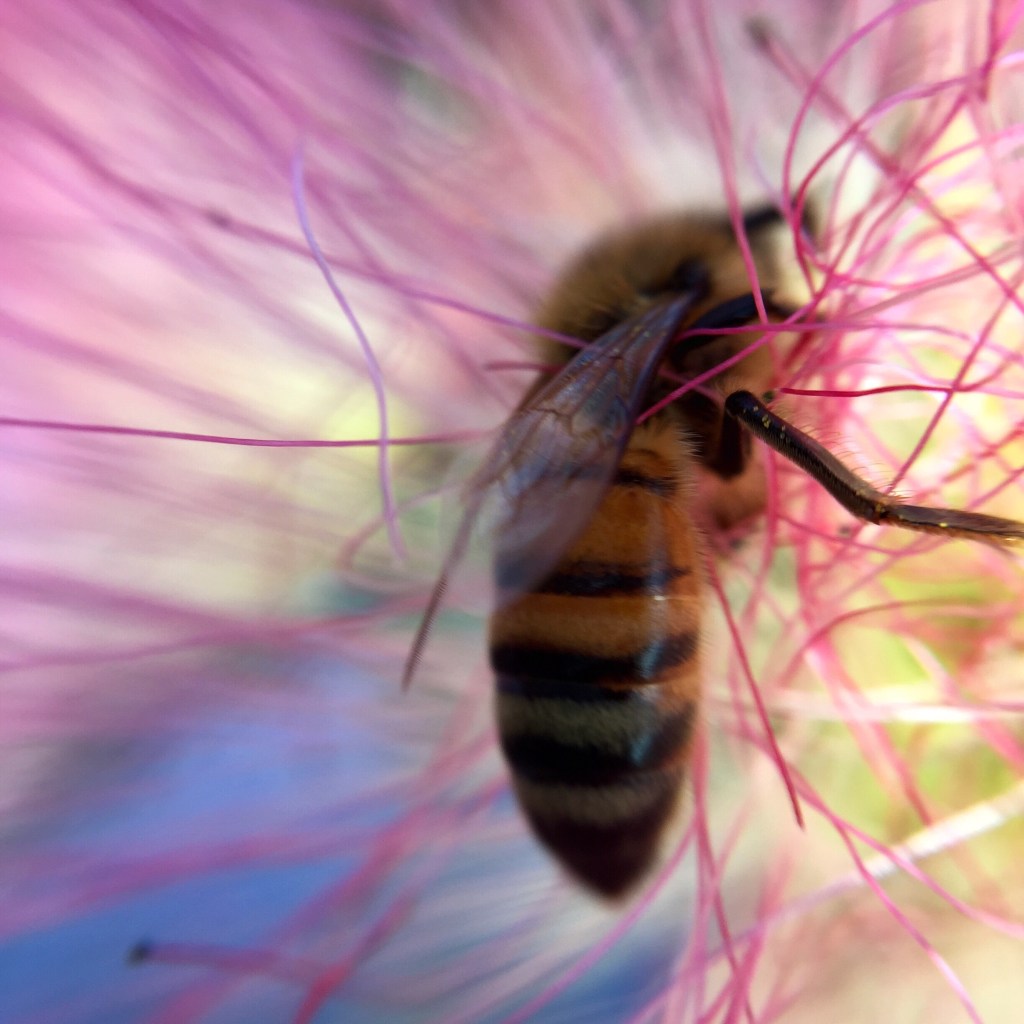
You may have read Donna’s recent post about feeding honeybees on her property. She got to wondering if the sugar water she was putting out was a good idea, so she contacted Mary Reed at Texas A&M, who has spoken to our chapter before, for more information. It’s so great that we Master Naturalists can contact credible resources like Mary Reed when we have questions. Their email exchange starts below the beautiful image of a bee.

Sue Ann Kendall

Image from @Wire13 via Twenty20

Donna

I wanted to ask about something I thought was OK, but after looking at some web sites, I may be wrong. I do not want to give incorrect information out on our blog.

So, is putting out sugar water for honey bee’s bad?

Mary

Thanks for reaching out! Feeding sugar to honey bees is a method beekeepers use to strengthen their colonies as needed. It gives honey bees the energy they need to generate wax to build the comb, conduct tasks in the hive, and forage for resources in the surrounding area. 

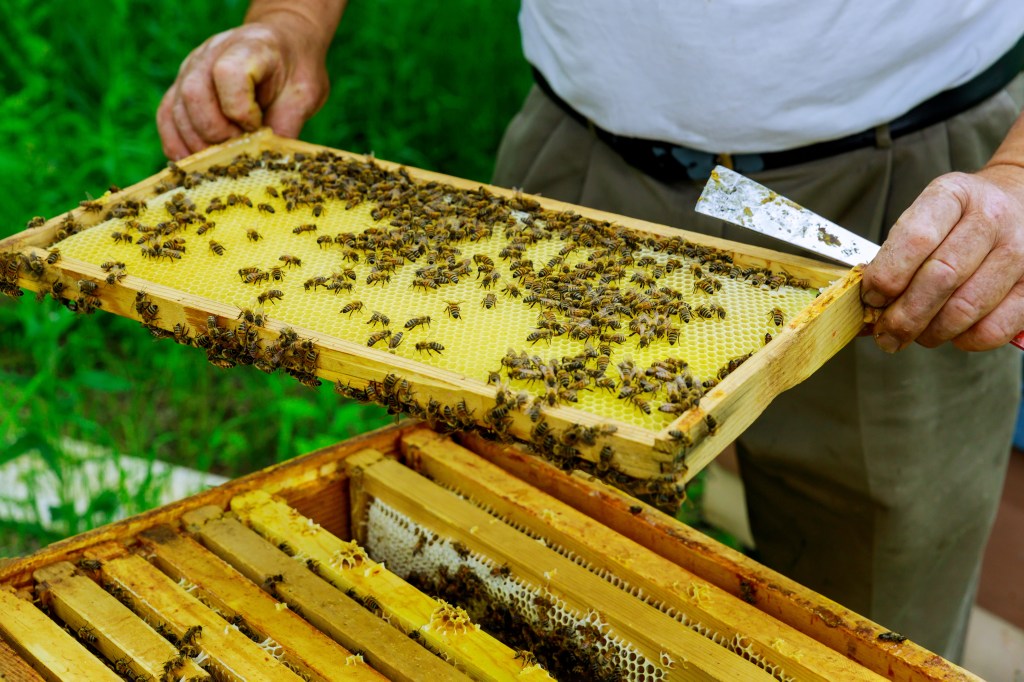
It is recommended that if a beekeeper is going to feed their hives sugar water that they use in-hive feeders rather than open feeding. In-hive feeders help prevent robbing behavior from other colonies, and it cuts down on the possibility of disease transmission. Open feeding (i.e., placing sugar water out in a bucket, tray, etc.) increases the likelihood of disease transmission amongst hives in the area. 

Beekeepers know what they’re doing! Image from @photovs via Twenty20.

It’s also possible to see a flurry of bees coming to this open resource at certain times of the year when other nectar resources are not available. This can be alarming to some and is a potential public safety issue. 

If your readers are interested in providing a resource for bees, my best recommendation is to plant a variety of flowering plants that bloom in succession over the year. The successive blooming periods provide bees a reliable food source throughout the year. It’s fairly common in Texas to have nutritional dearths, meaning there are periods of time where there is little to no natural resources for bees to feed on, so having a succession of blooms available really helps. 

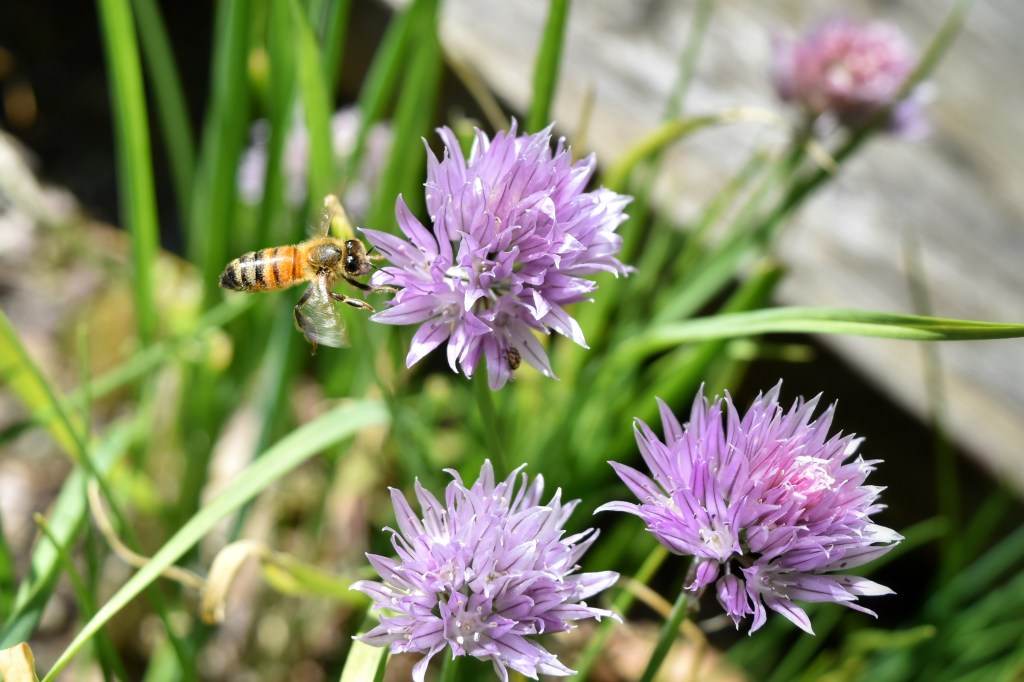
Bees like chive blossoms as much as we do, and they can appear when it’s chilly out. Image from @Anyra via Twenty20.

The other benefit to having a variety of flowering plants is that it also provides a diversity of nutrients to bees. The nutritional content of pollen can vary from plant to plant, and bees need this variety for their overall health.

I probably went way beyond what you were expecting for this question, but I hope this information is helpful.  If you need anything else, please don’t hesitate to reach out!

Donna

I think I will discontinue with the sugar water and just do what I always do and provide lots of shallow water containers for them.

In the near future I hope we can meet again and share more knowledge about our pollinator friends with our chapter and the public.

Mary

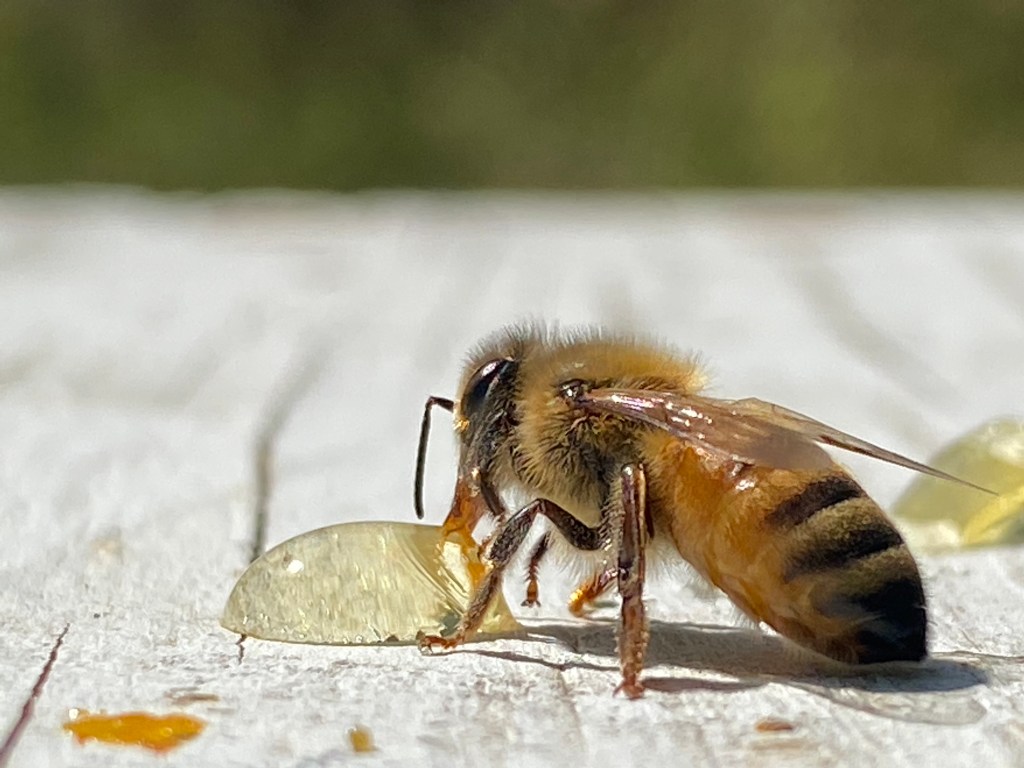
No problem! I’m happy to help out any time.  To be honest, providing a consistent water resource for bees is one of the best things you can do. We don’t often think about how insects need and utilize water for their own survival, but for bees it’s especially important when it comes to thermoregulating their hive. 

Yum! Photo by @billyves12 via Twenty20.

I like to provide some type of water resource year round, but especially in the warmer months when bees are using the water to cool down their hives.

The Last Bumblebee for Autumn

By Donna Lewis

The last week in November, I found this bumblebee on a fall aster in my garden.

After looking at the bee chart, I believe it to be a Bombus variabilis.

If someone is better at identifying bees, let me know if I am incorrect.

I asked it to move its wings so I could look at its body, but I guess I can’t speak bee language. Anyway, it was a beauty as far as bees go.

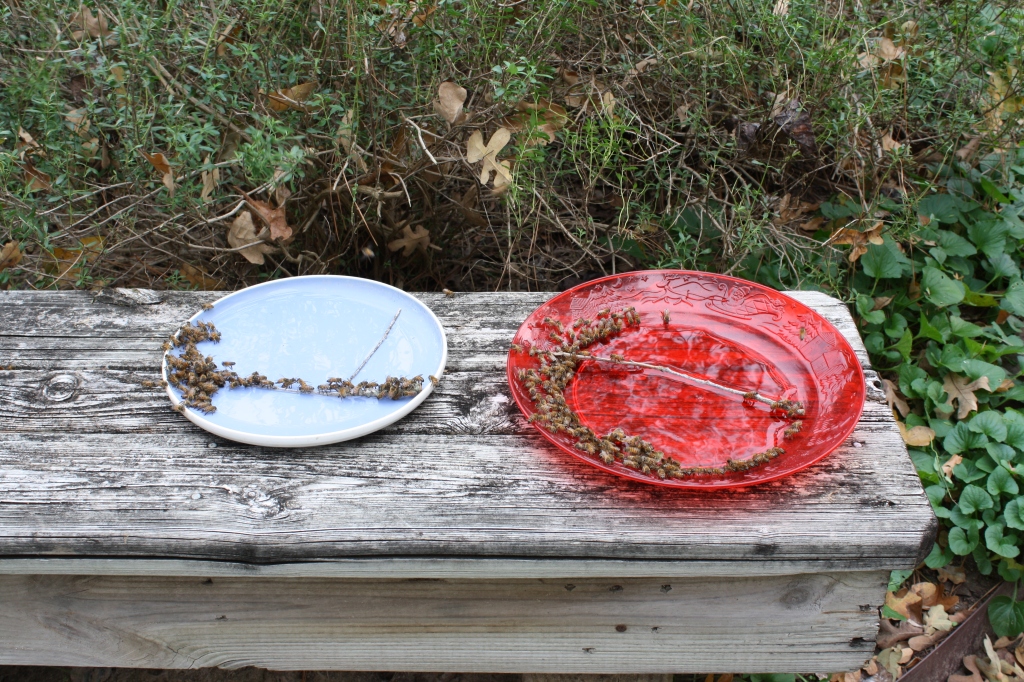
It has since gotten cooler, so I am only seeing honeybees right now. I have been putting out some sugar water for them, since there are no flowers still in the pasture or my garden. They are also in need of water, since we are still in a drought.

Honeybees enjoying their treats

All creatures need water. So just the simple act of keeping water out can help our nature friends. We are all charged with caring for the wild things.