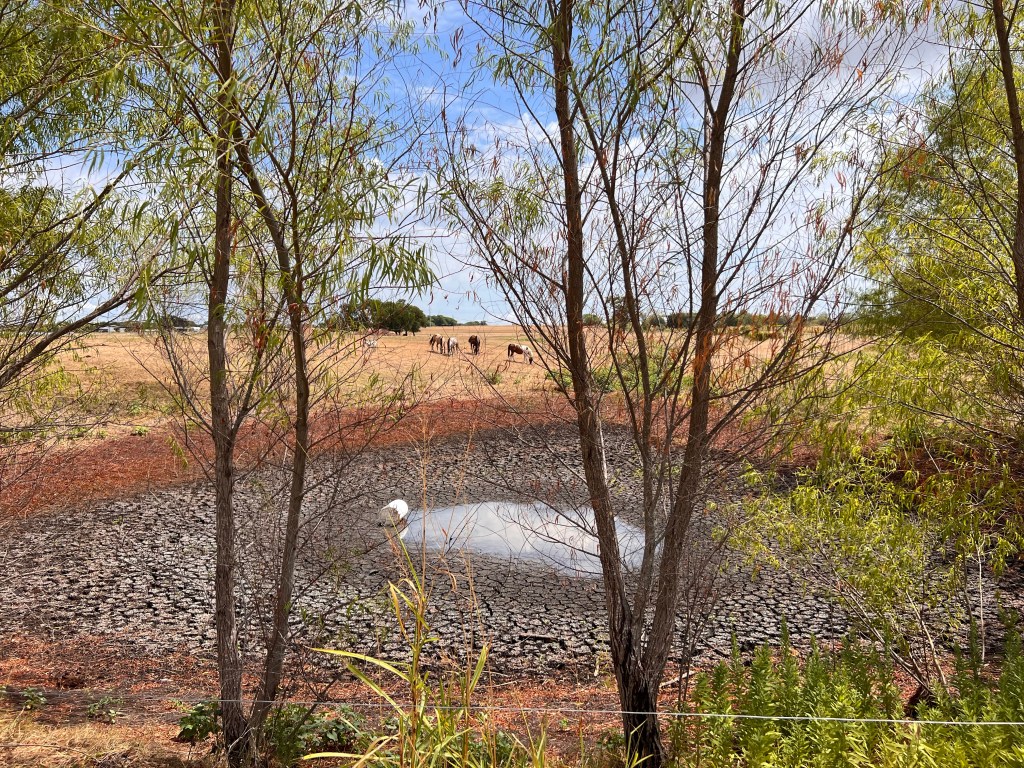
Over here in northern Milam County, we’ve had some rain three days in a row, which has been a welcome relief after pretty much nothing since May. Today there was even a little bit of rain in our front pond (tank in Texan), which had dried up completely as of last week. This was too late for all the fish, who made all the egrets and herons happy as they all died. I assume more will show up.
Last weekAfter the rain
Today I went out around our ranch, the Hermits’ Rest, to see what had made it through the drought. Was anything blooming? What insects are still there?
This made me very happy yesterday.
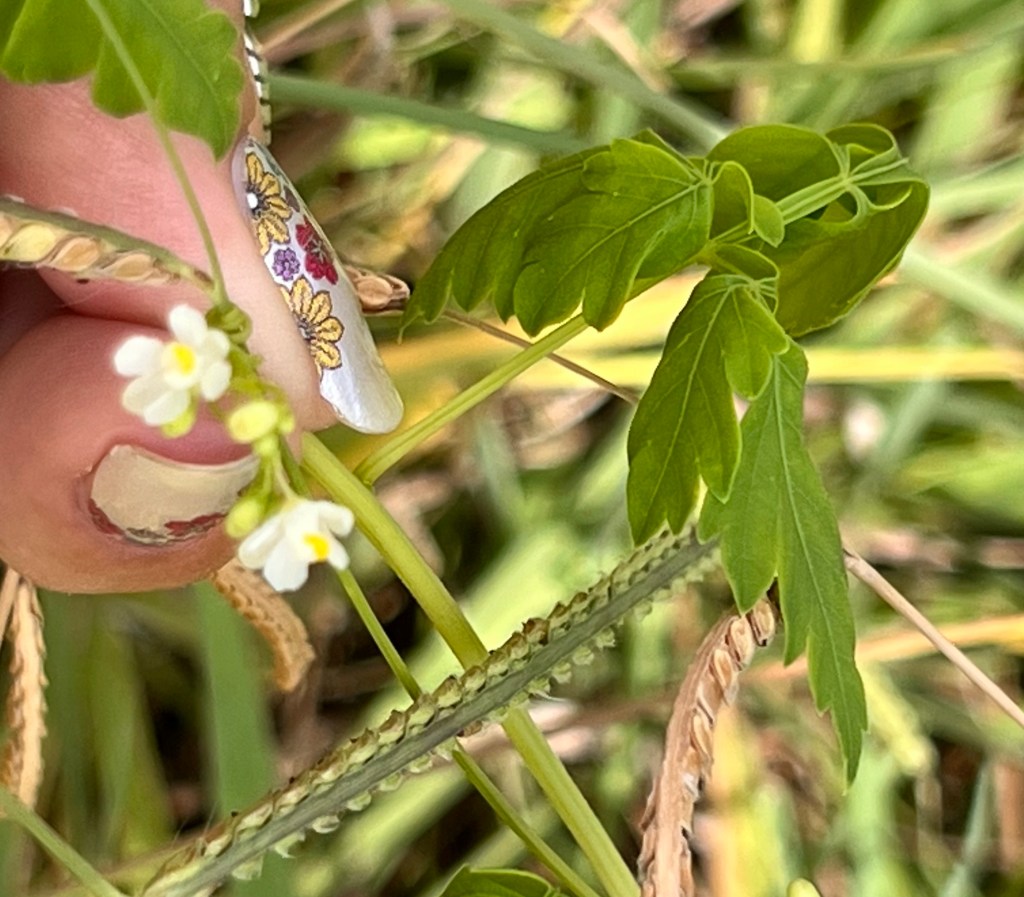
I can tell you that the bees survived just fine, and you can thank some humble plants for that. The turkey tangle frogfruit (Phyla nodiflora) has not stopped blooming and has formed mats where the grass once was. Bees and wasps are all over it. The other plant that’s attracting so many bees you can hear it from a distance is the scarlet toothcup (Ammannia coccinea). Now, the latter is a bog plant, as is its friend the floating primrose-willow (Ludwigia peploides). We seem to have some kind of springy area that has supported them all summer, to the delight of the flying insects.
FrogfruittoothcupprimroseThe bees’ friends
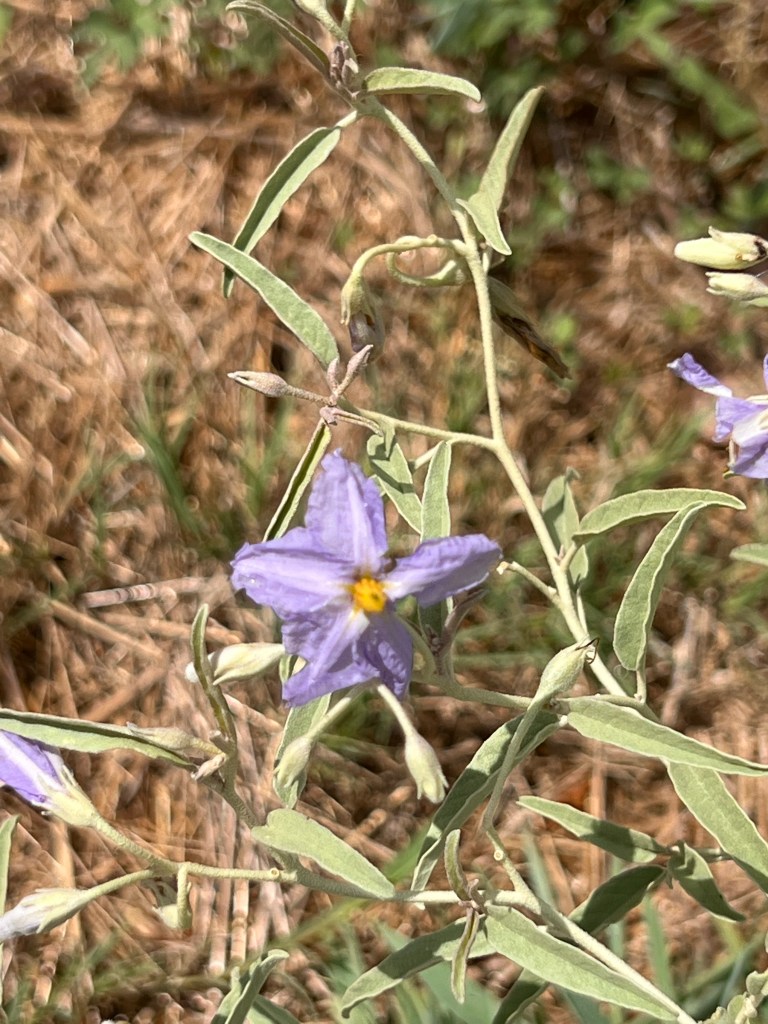
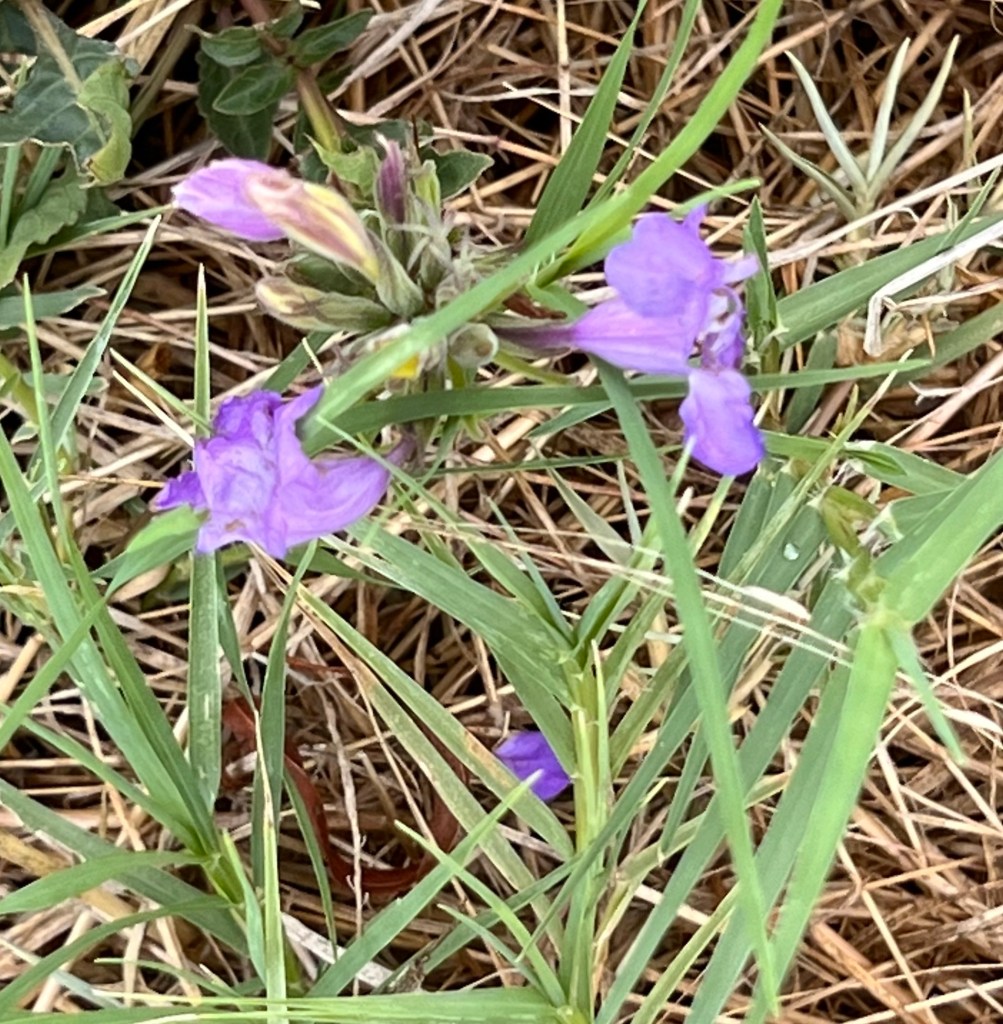
Other plants have been thriving. Of course, the silverleaf nightshade (Solanum elaeagnifolium) is fine. It’s like iron. In fact, some of them have fruit large enough that they look like cherry tomatoes! I wouldn’t eat them, though. I don’t trust anything named “nightshade.” The lesser balloon vine (Cardiospermum halicacabum), which just loves our ranch, is also plugging along happily. There are so many of the vines in the dried-up bed of Walker’s Creek that it smells like a Bed, Bath and Beyond store! I had no idea how fragrant those tiny flowers were until I encountered thousands of them in a confined space! The other thriving plant is the violet ruellia (Ruellia nudiflora), which is having a great year, according to Linda Jo Conn, our iNaturalist approval maven. One of our rental houses seems to have a purple carpet in the yard. Way to go, little flowers!
nightshadeballoon vineruellia (eaten by grasshoppers)
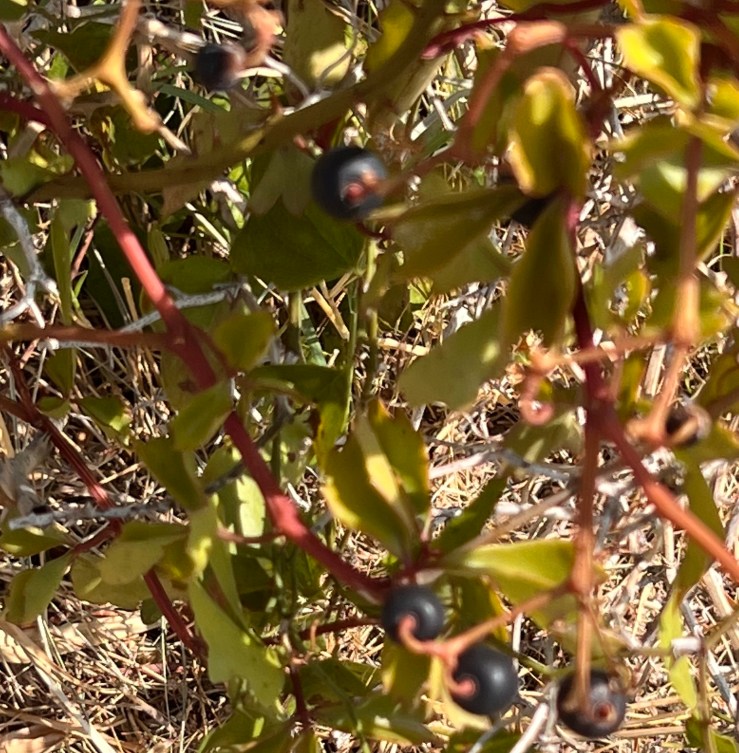
One more happy vine is the sorrelvine (Cissus trifolioata), which is more numerous than the smilax this year. It has some healthy-looking fruit, which I learned just this year is related to the grapes (none of which fruited here this year).
Blurry, but you get the idea
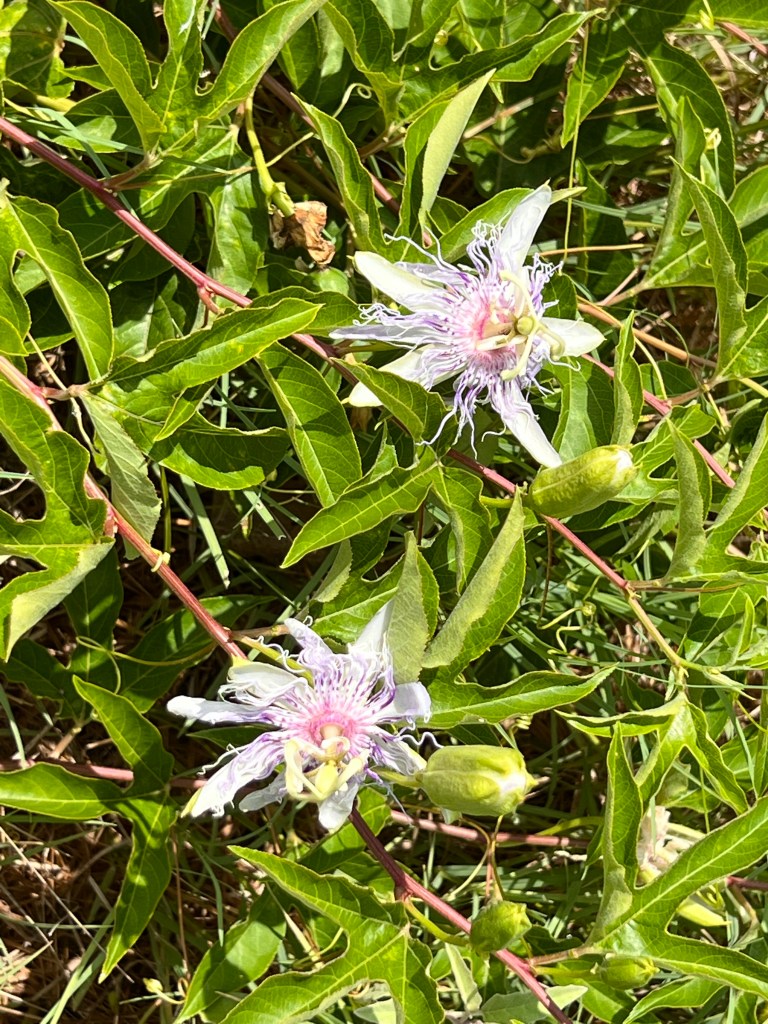
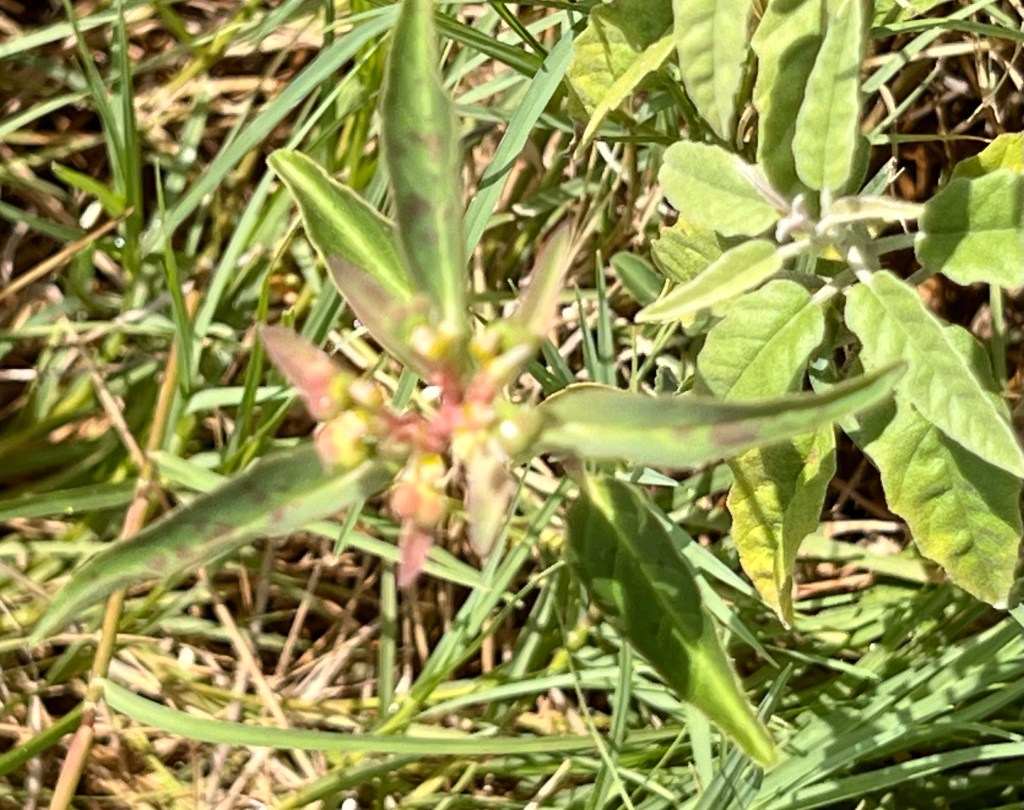
A few of our usual summer stalwarts are barely hanging on, though. There are many passion vines, but the flowers were looking pretty straggly until after the rain. They finally look normal. I have found one sad little Texas bindweed (Concolvulus equitans), a couple of prairie coneflowers/Mexican hats (Ratbida columnfera) (my photo is too blurry to share), a few velvetweed (Oenothera curtiflora), and sparse Lindheier’s doveweed (Croton lindheimeri) (it’s usually everywhere – in fact, my chickens had a tree version last year by the time it got cold). And there’s vervain (Verbena halei) and green poinsettia (the native one Euphorbia dentata).
passion vinebindweeddoveweed, with water dropletsvelvetweedvervainpoinsettia (poorly focused)
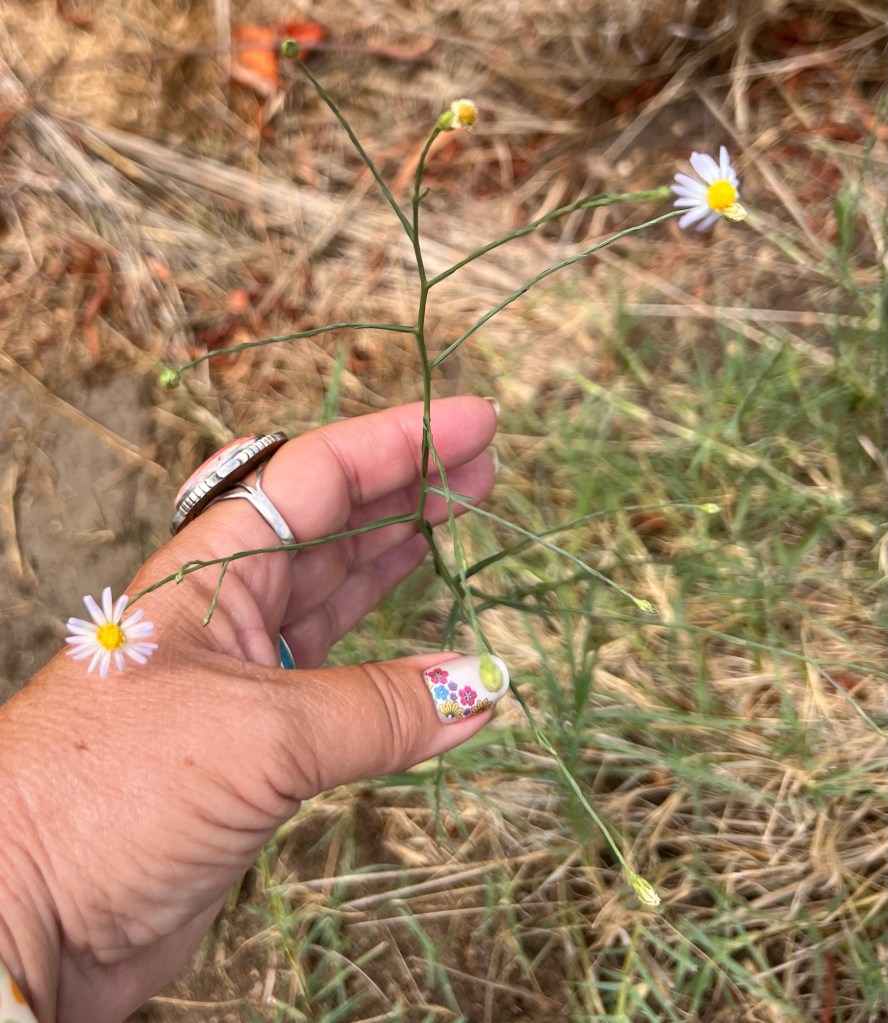
Two plants are here in large numbers, but I didn’t recognize them at first. The asters (Synphyotrichum sp.) and the broomweed (Amphiachris dracunculoides) have had all their foliage eaten by the eight gazillion grasshoppers of the season, so it wasn’t until I found a few sad little blossoms that I realized what they were. Yes, it was a fine year for differential grasshoppers, obscure bird grasshoppers, and prairie boopies (look them up, I’m tired of typing in Latin).
no leaves on the astersno leaves on the broomweed
Speaking of insects, in addition to the grasshoppers, we’ve had lots of dragonflies and damselflies this summer, and a variety of small crickets (not the usual giant annoying ones). The chickens love them all. The cicadas Donna wrote about recently are few and far between, but I’ve heard them.
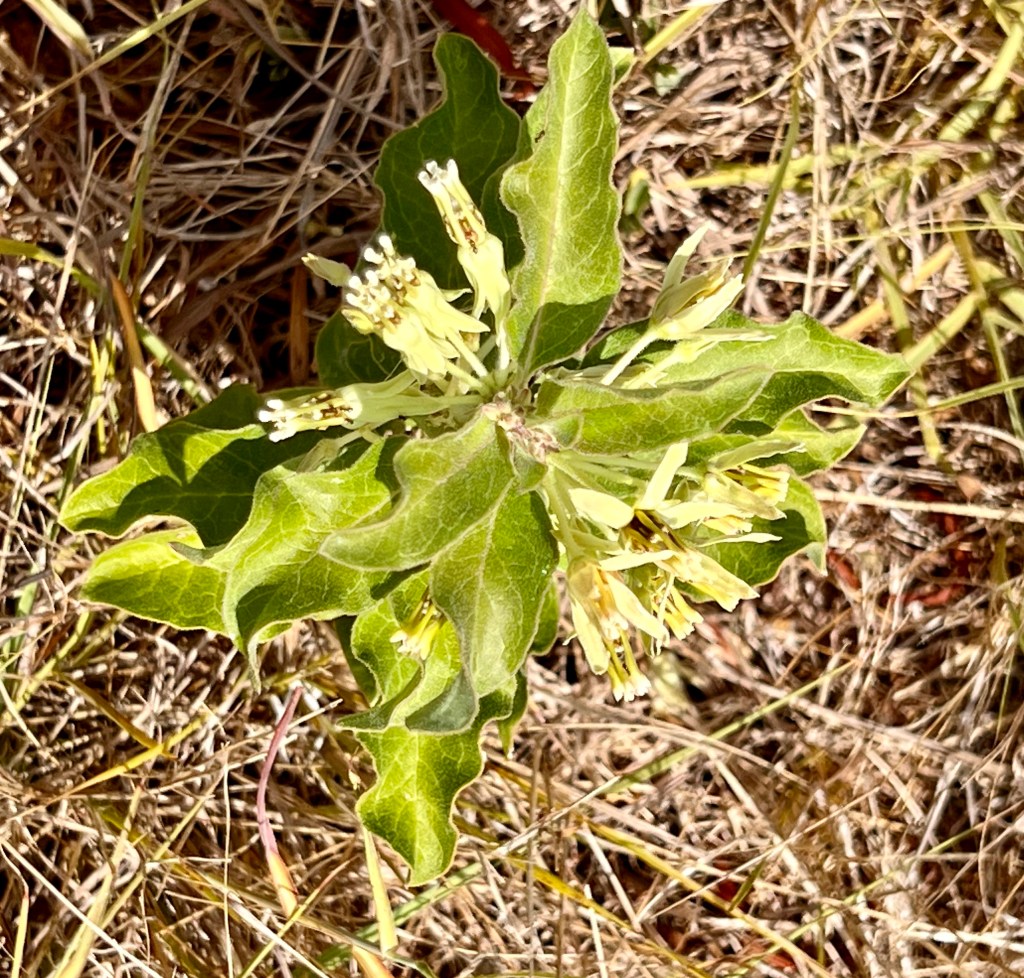
One way I’m hoping we are attracting insects is the number of milkweed plants on the ranch. I’m happy to see lots and lots of zyzotes milkweed (Asclepias oenotheroides) and a good number of green antelope horn (Asclepias viridis) out in the fields. Even better, I’ve seen many dispersed seeds. Come on over, monarchs!
zyzotesantelope horn
I’m glad some of our plants and animals have made it through the summer. I will be interested to see how many trees we lose in this drought. The previous one was very hard on the older trees on our property, which slowly keeled over from 2012-2015. I hope you got rain where you are, but not too much. Some of our chapter members had a hard time in the past couple of days. We are due for more rain, but I won’t complain. I miss the ponds and my horses miss the grass!
by Donna Lewis; photos by Michelle Lopez and Carolyn Henderson
I hope all of you have been hearing what I am hearing during the late afternoon mostly, a sound that brings back many wonderful childhood memories of summer, cool nights, and my parents and grandparents, who I miss every day.
Superb Dog-Day Cicada photo by chapter member Michelle Lopez.
There is something endearing to their song. The cicadas sing from tree to tree.
It is only the males who sing. They will burst out of a hole in the ground and then shed their skins where a new body will come from. The skins are left behind for kids to find, hanging them on their clothes and maybe their pets. At least that’s what I did. My Dachshund thought it was great. When it finally fell off, my dog ate it. Awful, but I’m sure it was not harmful.
The cicadas here in Texas have a life cycle of about 3 to 5 years on average.
The periodical cicadas live from 13 to 17 years and are more common in the north.
If you are walking and one of these fellows hit you, they can put an eye out. They are like the bulldog of the insect world, and go forth headfirst when flying. They try to get to the trees for safety.
Nature is so full of wondrous things. There are as many different varieties as there are stars in the skies.
So just go outside and enjoy nature.
Another of the same cicada, taken in June by Carolyn Henderson.
Story by Sue Ann Kendall, photos by Carolyn Henderson
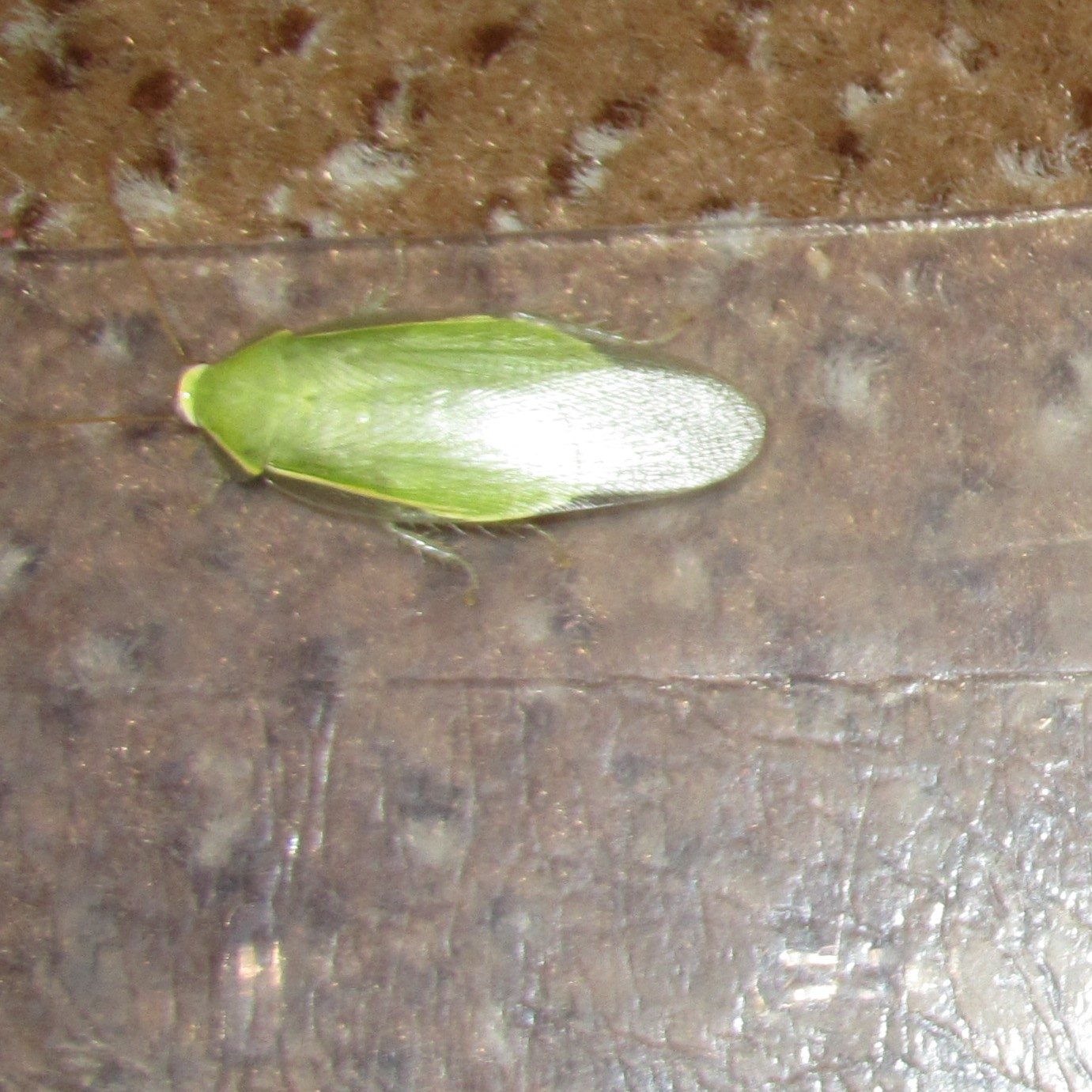
Carolyn Henderson, our Chapter President, spotted an unusual insect in her house last week. Being a Master Naturalist, she didn’t squish it. Of course, she photographed it. Neither she nor any of her friends had ever seen one of these little green creatures before.
Not your usual cockroach.
She looked it up on iNaturalist, and even though none of us had seen one before, sure enough, it’s common around here; it just doesn’t usually visit our houses, a trait we all appreciate. Here’s what she read about the unusual green banana or Cuban cockroach (originally from Wikipedia):
“Panchlora nivea, the Cuban cockroach or green banana cockroach,[2] is a small species of cockroach found in Cuba and the Caribbean, and along the Gulf Coast from Florida to Texas, and has been observed as far north as Summerville, South Carolina. It is found in subtropical or tropical climates.
“The females can grow up to 24 mm and the smaller males are 12 to 15 mm long. It is winged and a strong flier, pale green to yellowish green in color, with a yellow line running up the sides. The nymphs are brown or black in color and are burrowers.
“It is usually an outdoor species and is rarely found indoors, so is not considered a pest. The adults can often be found in shrubbery, trees, and plants. The young can be found under logs and other debris. It is often attracted to both indoor and outdoor lights and it is mainly a nocturnal species.
“It is often a popular pet roach due to its relatively pleasant green color, and because it is not an invasive indoor species. It is also used as food for other pets. [emphasis mine]”
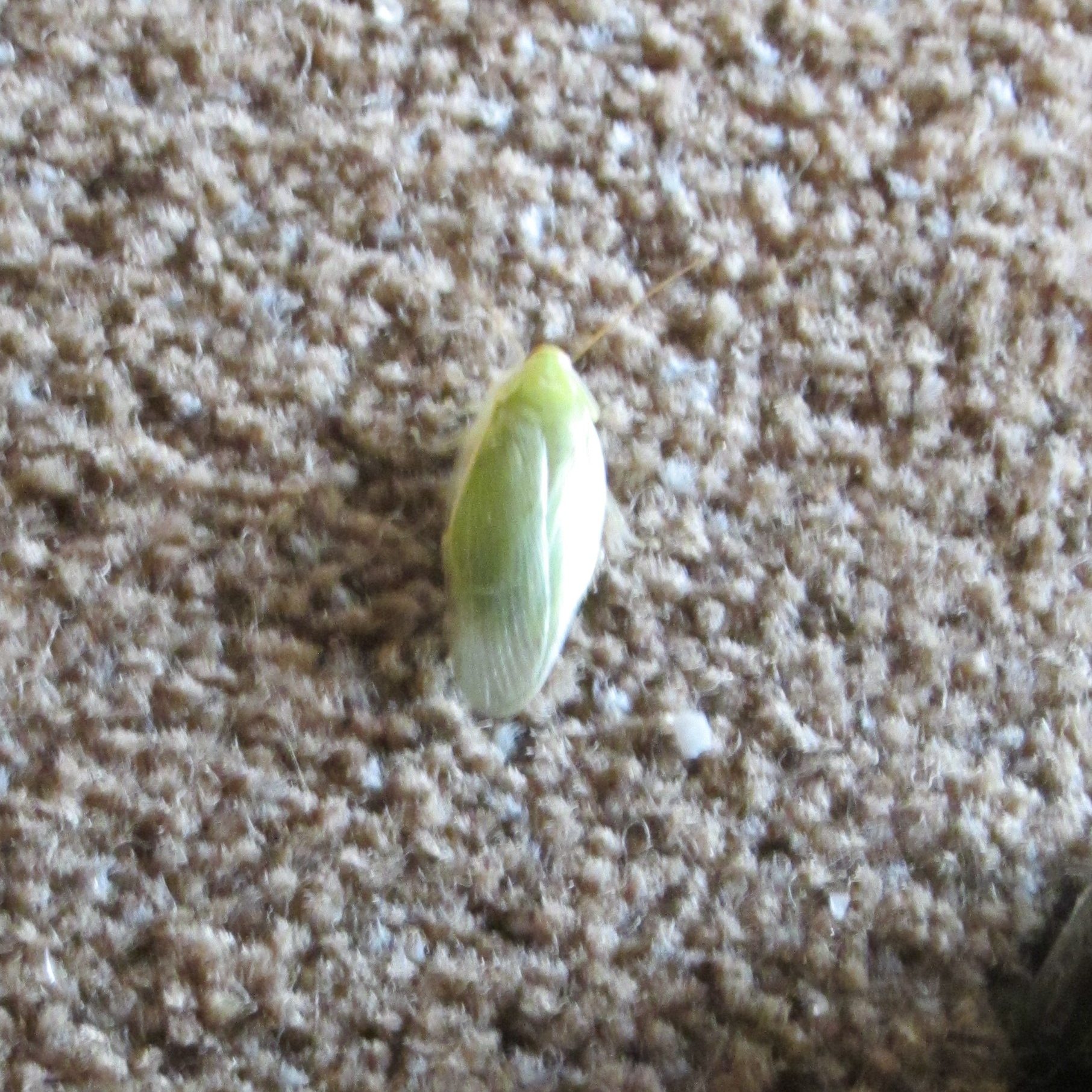
Cute?
That last part is interesting. I guess Carolyn had a new pet! The color is “relatively pleasant.” I think I’ll let them live outside, but it sure is interesting to know they live here! Let us know if you run across any in your nocturnal excursions.
So, I saw the following story online today (see screenshots from Facebook below). Some time ago, I’d likely have blown it off as a pretty farfetched tale. But I couldn’t help but think about an incident I experienced at my house a couple of years ago.
This story brought to mind about me seeing a wasp nest on our RV bumper about sixty feet from our house. I was worried about somebody getting stung, so I told Hubs that we should probably do something about them. So, he takes his handy pliers and pulls it off the bumper, as nothing was on it at the time. Then, he laid it on a little table by our porch swing that was 60 feet away from and out of sight of the RV bumper it came off. After that, we pretty much forgot about it.
Later that evening I happened to look over there and saw about three or four wasps back on it lying on that little table far away from that bumper we pulled it from. I was amazed that they’d looked for it and found it in a totally different place than it was supposed to be.
So, do I think this bee story is farfetched? I think not.
I think insects have way more sense than we realize. After all, we don’t know what we don’t know.
[saw]
To learn more about insects and all the other nature in Milam County, consider signing up for our next class! Contact ElCaminoRealMasterNaturalist@gmail.com and we’ll get you in touch with our new class team.
I have been accused of having too many boats. Anybody that loves the water and understands that water transport has been a vital part of human existence, should naturally be attracted to boats and boating. It is after all deep in the human psyche to want to cross the waters and see what is on the other shore, and for most of human history bridges have been few and far between.
There is no such thing as too many boats!
On June 20, 2022, my son Adam (36 years old USAF veteran) and I checked waterdata.usgs.gov and noted that Lake Whitney flood gates were being opened every night allowing a 4000 cubic feet per second (cfs) gush of water to proceed toward the coast and downstream users. Even though most rivers in Texas have been at extremely low flow rates all spring and summer, this water management strategy kept the Brazos River at a nice steady flow from Waco to the Gulf of Mexico, and perfect for canoe travel.
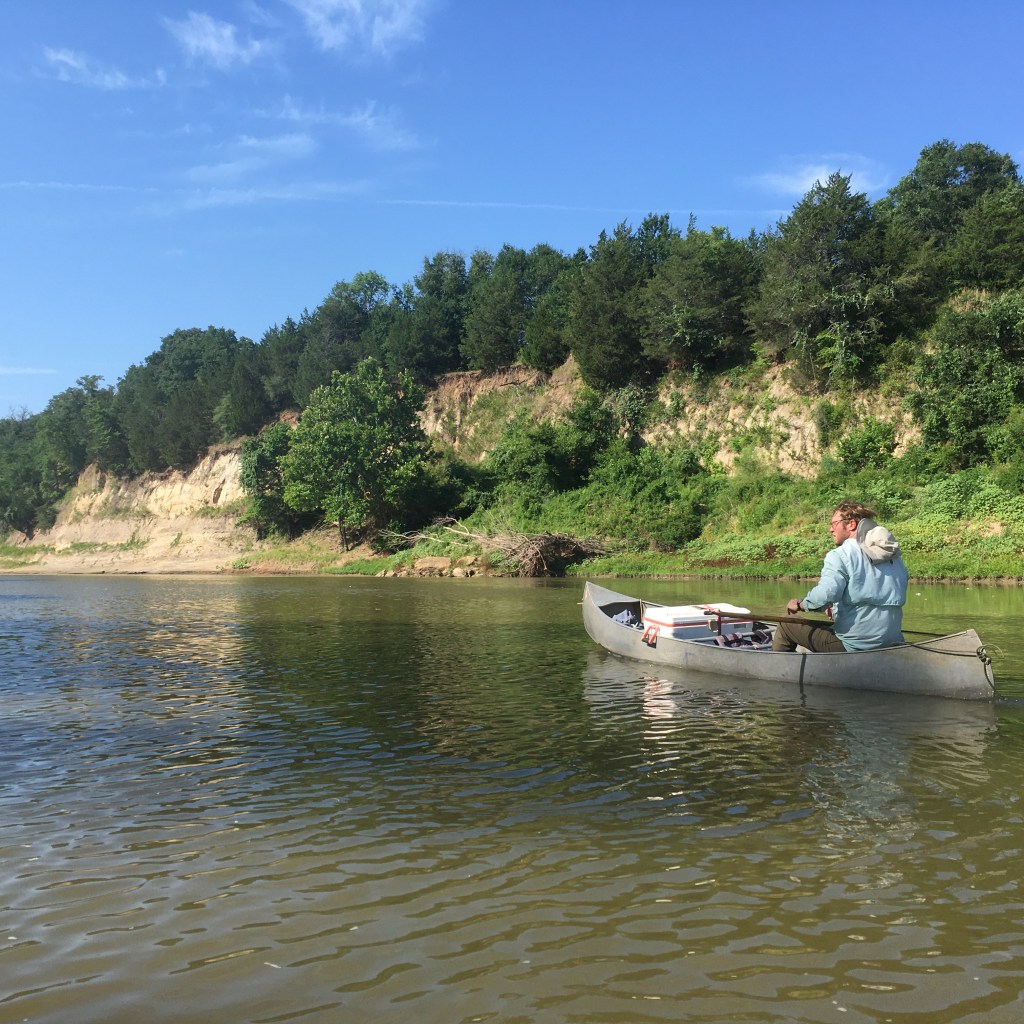
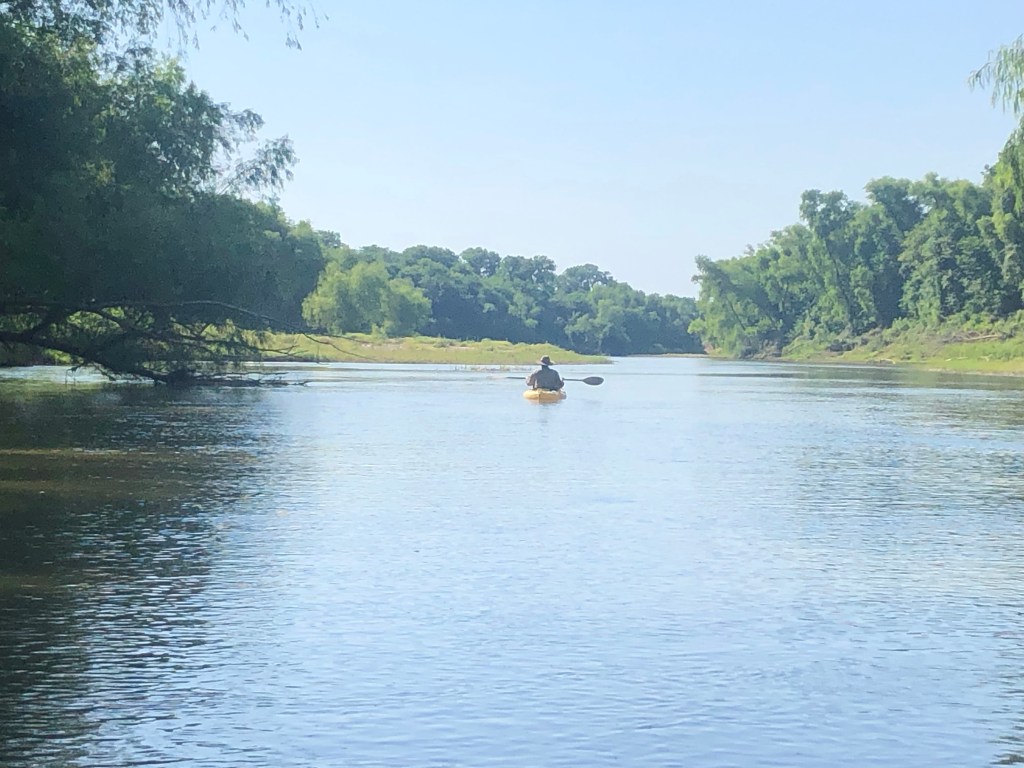
The canoe
We had scouted a reach of river that borders Milam and Robertson County from Google Earth photographs and by examining the access points at several highway crossings. This was a stretch of the Brazos I had never been on and pulling under the FM 979 bridge west of Calvert was the beginning of a very special day. Angie was the shuttle driver. She took command of the truck after we unloaded my 1982 Grumman canoe, and an Ocean Kayak. We estimated that we could cover the 16 miles of river by 3 pm and that was the default rendezvous time at the next highway bridge on FM 485 near Hearne.
The only person we saw the entire day was a young man in a small motor boat at the launch point under the 979 bridge. We talked as three boaters should, about the river conditions, his cat-fishing success, and marveled that we had common friends down in Somerville. This polite young man named Austin said he is alone most of the year fishing this stretch of river that is blocked upstream and downstream by large rock structures that prevent most motorized boating. I was somewhat unnerved by the fact that he was surprised that we thought we could make it all the way to FM 485 Angie had already spun wheels in the gravel to go shopping in Bryan so there really was nothing left to do but head downriver.
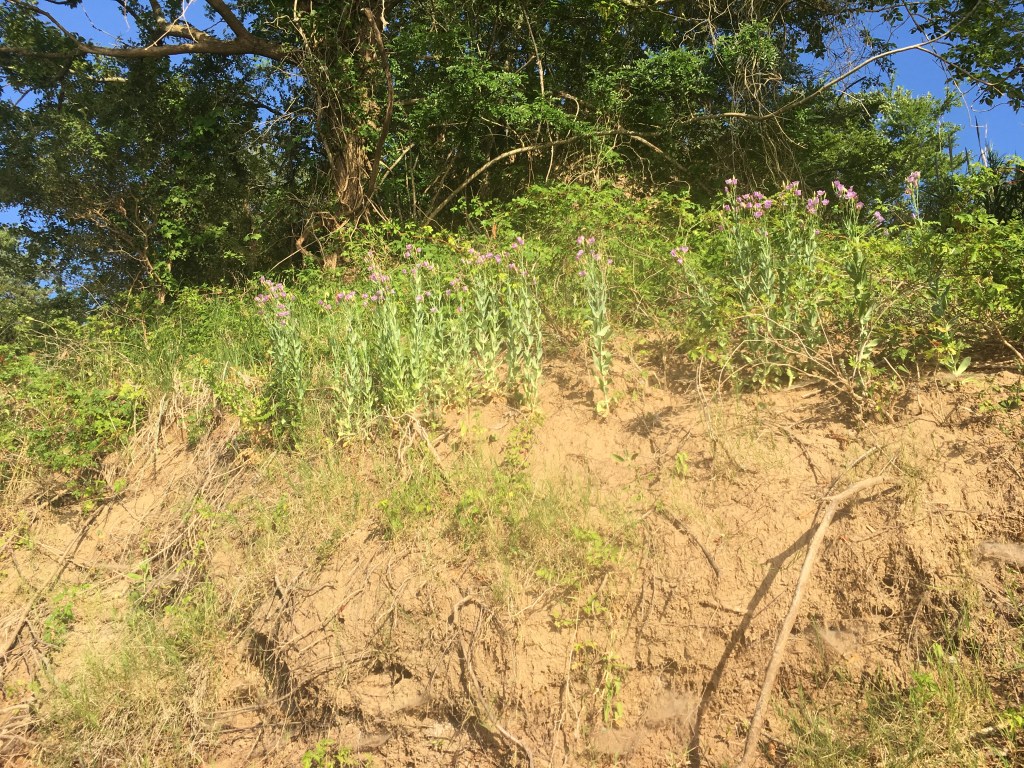
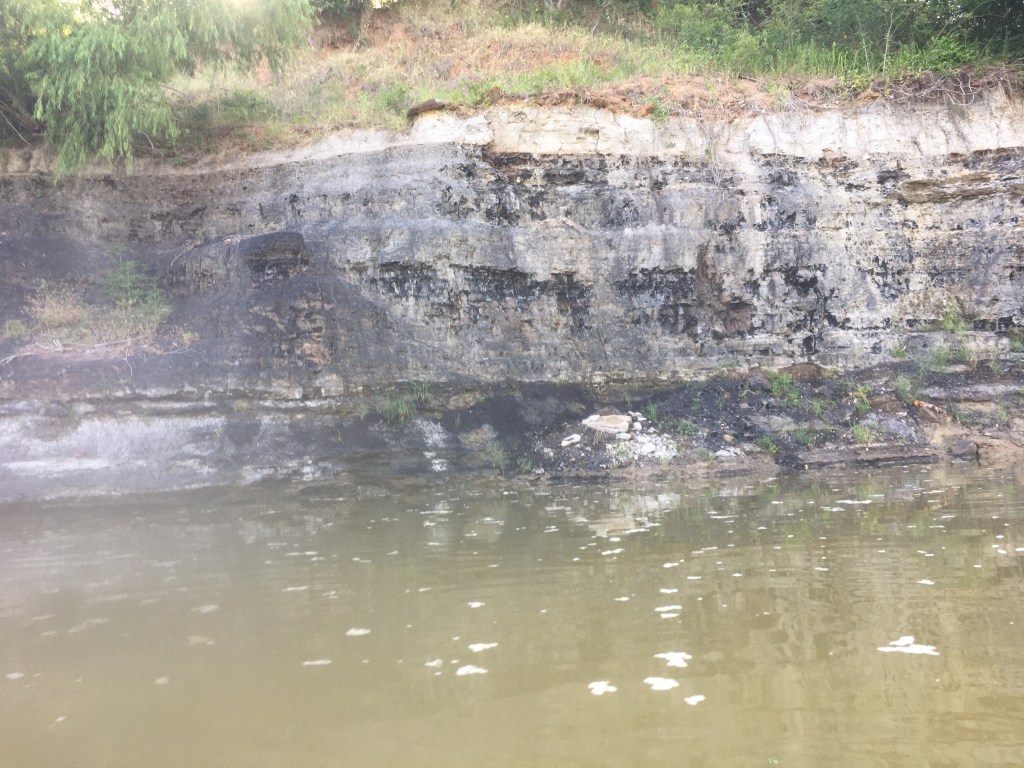
We paddled in the shade of very large cottonwood trees, Texas ash, and black willows that form a high green curtain on both banks of the river. It would be 100 degrees later in the day, but the first three hours were delightful. At a rocky riffle less than a mile from the bridge two bald eagles launched from their observation posts and crisscrossed the river in front of us. I observed blue bells flowering on a clay embankment on the Milam County side. Spotted gar and alligator gar were surfacing alongside the boats most of the day, and you could distinguish them by their different skin color patterns in the moderately clear water. We passed through one location where the river cut through deep clay banks that sandwiched a 15-20-foot-thick vein of lignite. Spring water flowed from above the lignite seam and dripped into the river with and audible trickle. On this 16 river-mile reach we observed no less than seven spring-water inflow locations. The dripping and flowing spots alike felt to be about 70 degrees F to the touch of a hand when the river water was in the high 80s. One spring I estimated was running 6-8 gallons per minute and dropped at an angle where you could paddle under it and catch water in a canteen. I just filled my hat and then enjoyed an impromptu cold shower on river right. I carry large sponges to bail the canoe out when this indulgence strikes me.
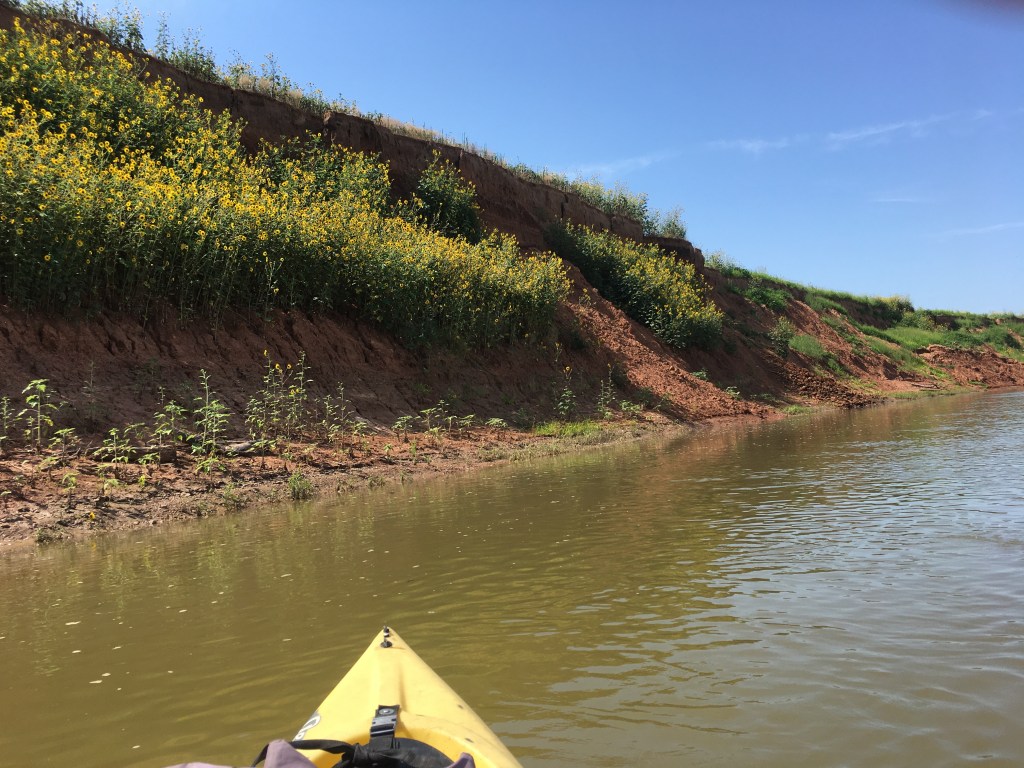
The kayak
We did see cattle tracks, beaver sign, feral hog rooting, and wallow sites, but did not see a single human footprint the whole way. We found and picked up exactly two pieces of litter (a Gatorade bottle and a soda can). There were three tractor tires that had obviously washed down decades ago from farm operations just out of sight through the trees, but it was a joy to paddle a track where the trappings of modern society were not in plain view.
The large sweeping bends of the Brazos River produce huge sand bars on the inside of each curve. One on river right (the Milam County side) appeared to be 80-100 acres in size and was dotted with mussel or clam shells of many species. What a great camping spot to pitch a tent in the soft sand. Invariably these sand bars are across from a steep soil bank into which the river is carving and eroding away the deep alluvial deposits of red sand and clay. I searched with my eyes for evidence of bones protruding from these crumbling soil banks. Mastodon skeletons have been discovered by boaters in just such a search pattern. I seem to remember one excavation in the 1980s by Dr Gentry Steele, a Texas A&M professor that was alerted to a fossil find by river paddlers.
If I’d had a talented birder along (especially one with perfect pitch who knew birds by sound) it would have been a good time to listen and learn. I know the sound of painted bunting males as they are abundant around my home is Burleson County. Buntings were singing in the jungle along the river though on this day I never caught sight of one on either shore. Much other birdsong emanated from the trees and tangled vines, but I could not interpret the notes nor the silence between the notes.
Blue herons love to hunt in the shallow riffles on the Brazos. They were present in cadres of 8-12 individuals and were never happy to see us approaching. I thought it was odd that we saw only one white heron all day. Cliff swallows were fledging young from nest holes that were burrowed into the crumbling red soil of one high bank on the Robertson County side (river left). I have seen them nesting on rock overhangs on the Rio Grande, but this display showed how they could have a nesting colony on the lower Brazos before the advent of concrete bridges that serve them so well these days.
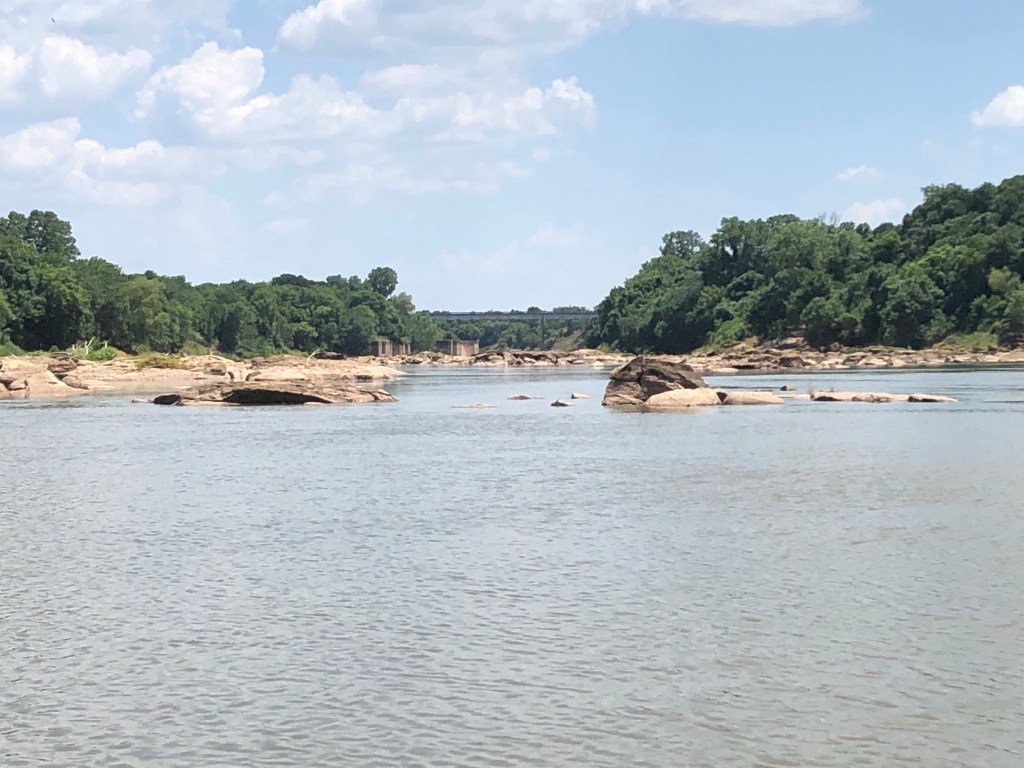
The end of the river run brought us to a massive rock structure about ¾ mile upstream of the FM 485 bridge. This sandstone formation blocks the path of the Brazos and eons of the wear and tear of flowing water have not been able to dramatically alter its presence.
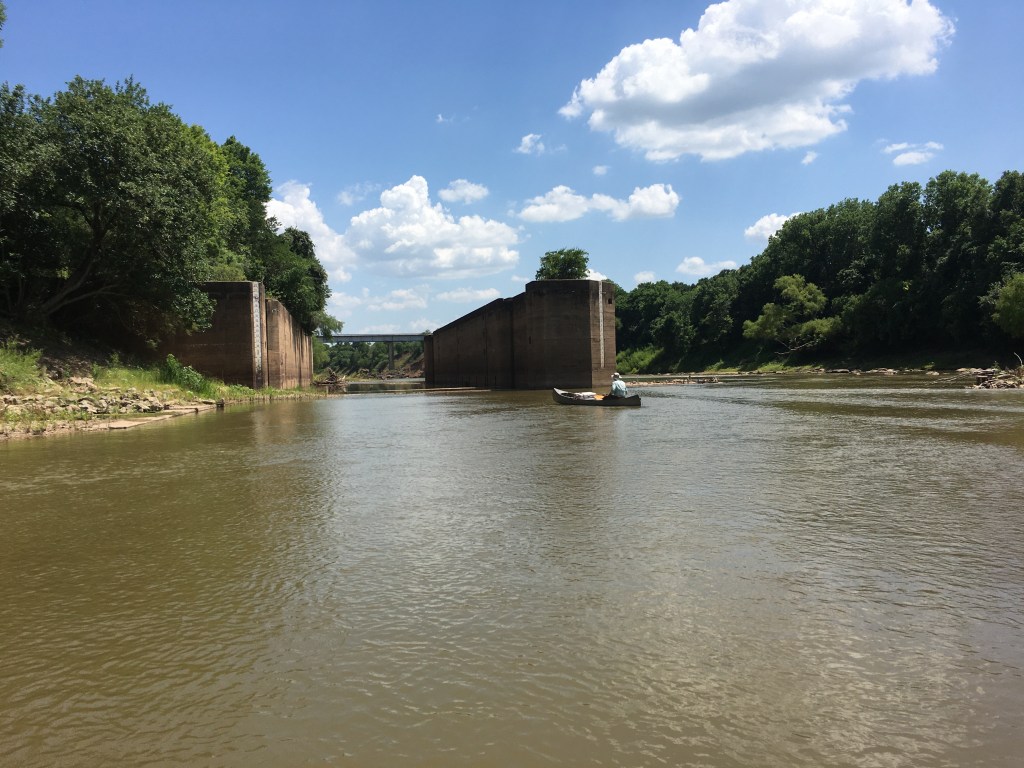
In the late 1800s US government officials toyed with the idea that the Brazos River should be fitted with locks and dams such that steamboats could be run from the coast to Waco, Texas. Paddle-wheel steamboats of earlier decades could power upstream from Freeport all the way to Washington on the Brazos. A rock formation known as Hidalgo Falls blocked any meaningful traffic further upstream. The lock and dam proposal was shelved in the 1890s because railroads were doing a capable job of moving freight about the country. The idea was revisited, however, and circa 1905 construction was started on several of the proposed eight locks and dams. It seems a flood wrecked much of the work within a few months and another attempt after WWI saw Lock #1 (Hidalgo Falls), Lock #3 (Port Sullivan now FM 485), and Lock #8 at Waco, all earnestly under construction.
Lock # 8 at Waco in fact was completed and stood proudly until a massive flood in 1923 bypassed this man-made obstruction as the river rerouted itself. This same flood also apparently clobbered #3 and #1 as it lumbered to the Gulf. When I spoke with Eric Neubauer about this story, he mentioned having seen the lock and dam on a Google Earth image still present in the middle of a farmer’s field near Waco. At any rate the Feds abandoned the project 99 years ago and the remains of three structures are all that is left of that early attempt at freight hauling on the Brazos.
So, back to that sandstone structure that I approached with trepidation. The 800 cfs of water flow was chaotic and looked dangerous to me. A good pathway through the rocks was not clear. As commander of this expedition, I stood on a mid-river boulder that resembled a giant biscuit. Without hesitating, Adam paddled past me through a maze of other giant biscuits (if I were allowed to name this formation today it would be Pillsbury Falls).
Working my way through in the kayak I saw Adam had cleared the formation in the Grumman using several daring maneuvers. He was a combat airlift pilot so supplying him with a canoe built by a company that made WWII fighters just emboldened the pair to run the rapids pell-mell. The entire formation was perhaps 275 yards in length with multiple passages. It would be quite a nasty spot to traverse at 1800 cfs.
Directly below Pillsbury Falls was what remains of Lock #3 that was abandoned almost a century ago. This massive concrete structure dwarfs all human traffic on the river and clearly will stand for thousands of years. Watching the water flow through its 23-foot-high walls and across its perfectly flat concrete bottom made me wonder about the crew of engineers and laborers that strove to build this structure. Some of their equipment is a tangle of steel and wood downstream and near the current highway bridge. I don’t want to have to go through those upstream boulders at high water, but it would be fun to go shooting through that giant concrete lock one day.
After pulling the boats out under FM 485 bridge, we took a quick shampoo/shower with buckets of well water from the back of the truck. Changing into dry, clean clothes we were off to Coats Grocery in beautiful downtown Gause for ice cream. And the problem about “too many boats?” You either have enough to do the job or you don’t. No Problem.












 Nature Along the El Camino Real