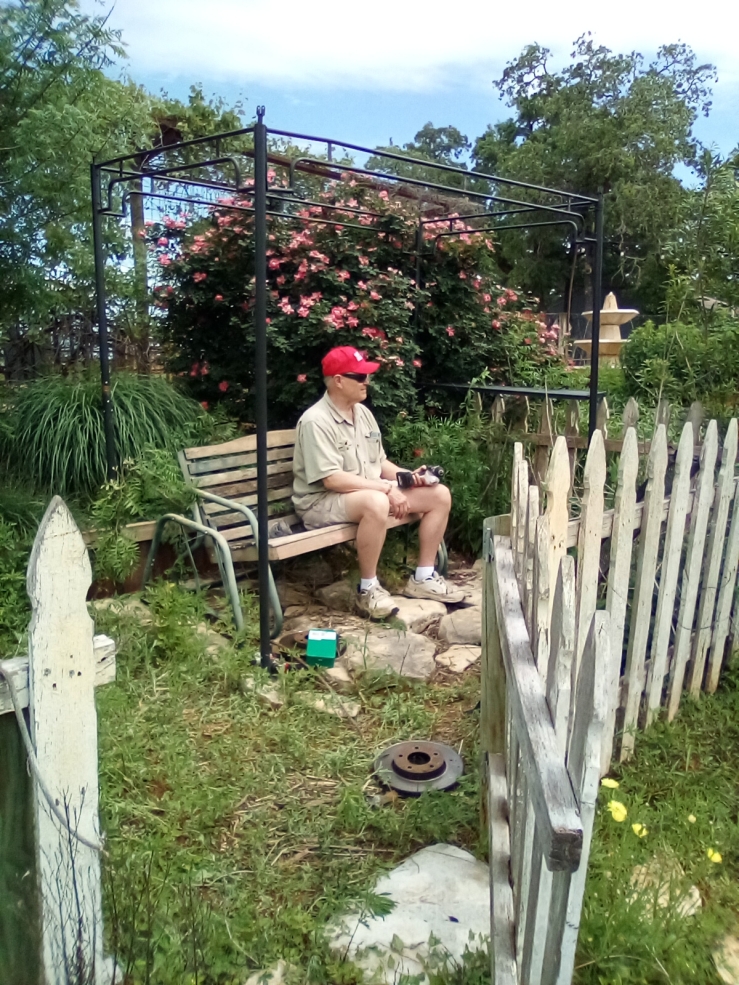
A friend to the Master Naturalists assembled a second donated used arbor that will provide another shaded garden room.
The new arbor
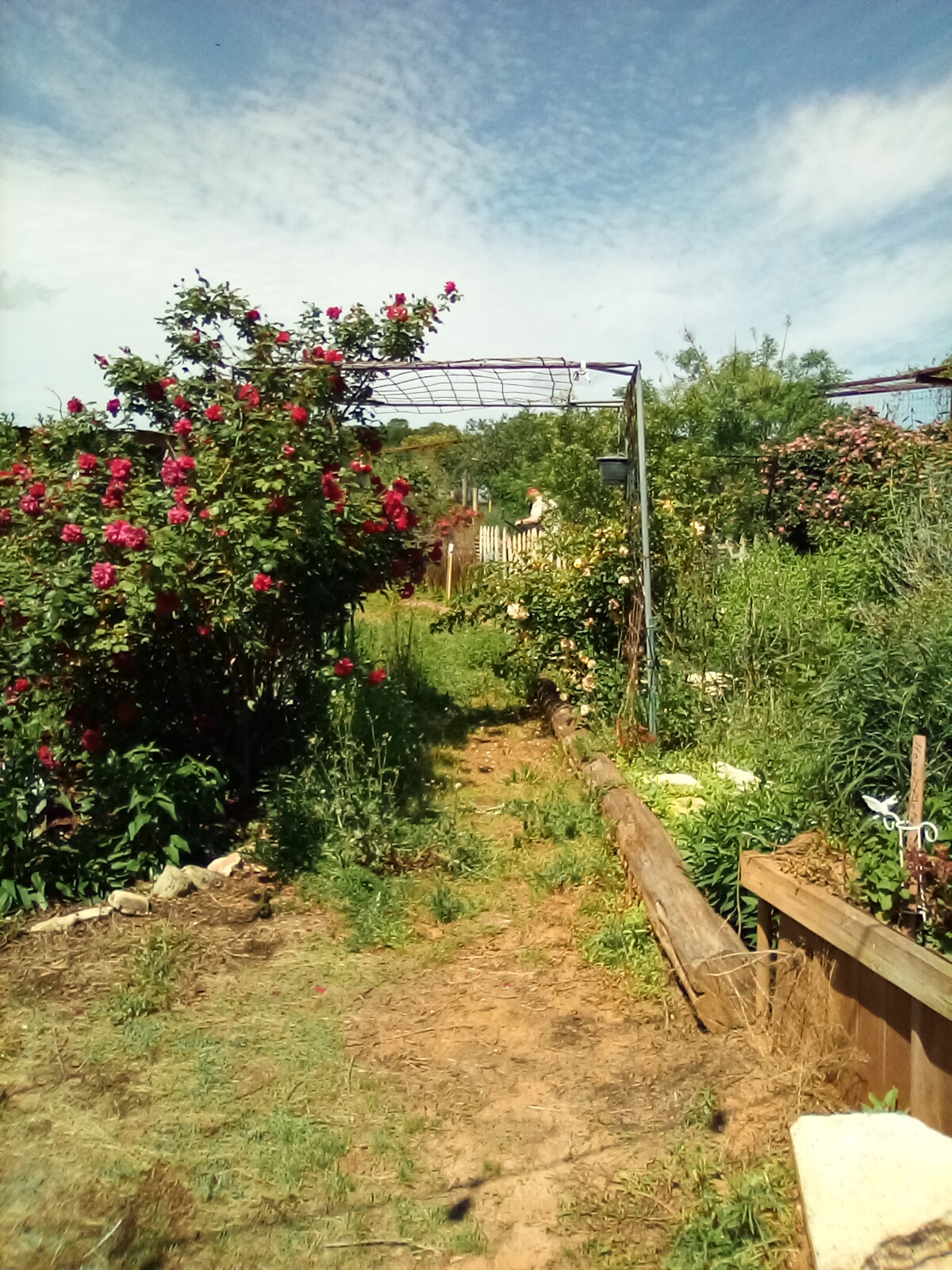
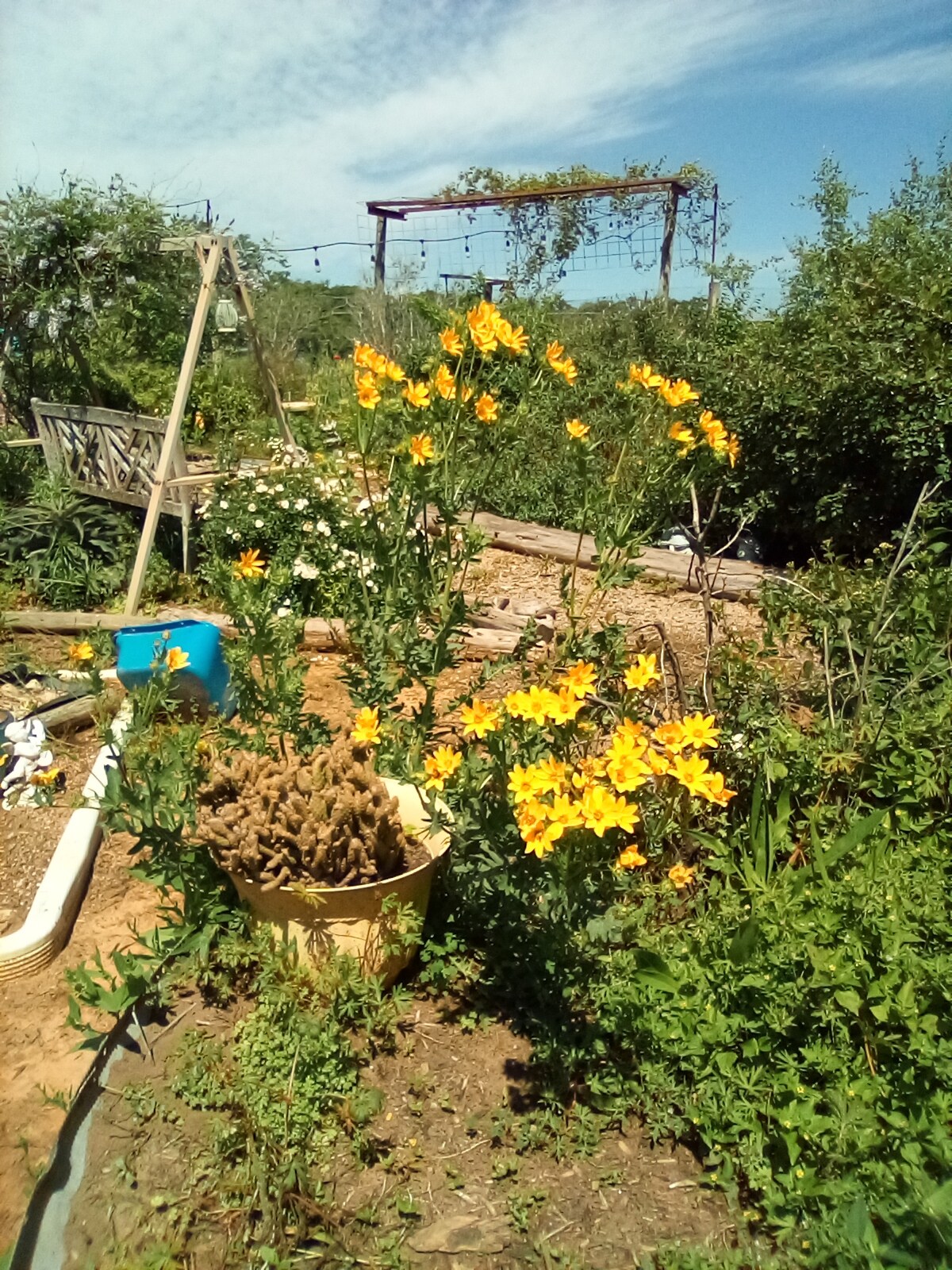
There are still plenty of wildflowers and spring bloomers and Natives gearing up for summer and the fall. Take a walk on the wild side before more is removed to make way for upcoming events!
Please don’t tell her I said so, because then she will know I’m on to her plot, but I think Linda Jo Conn is trying to kill me… (If I’m murdered, Linda jo didn’t do it – there are plenty of other suspects!)
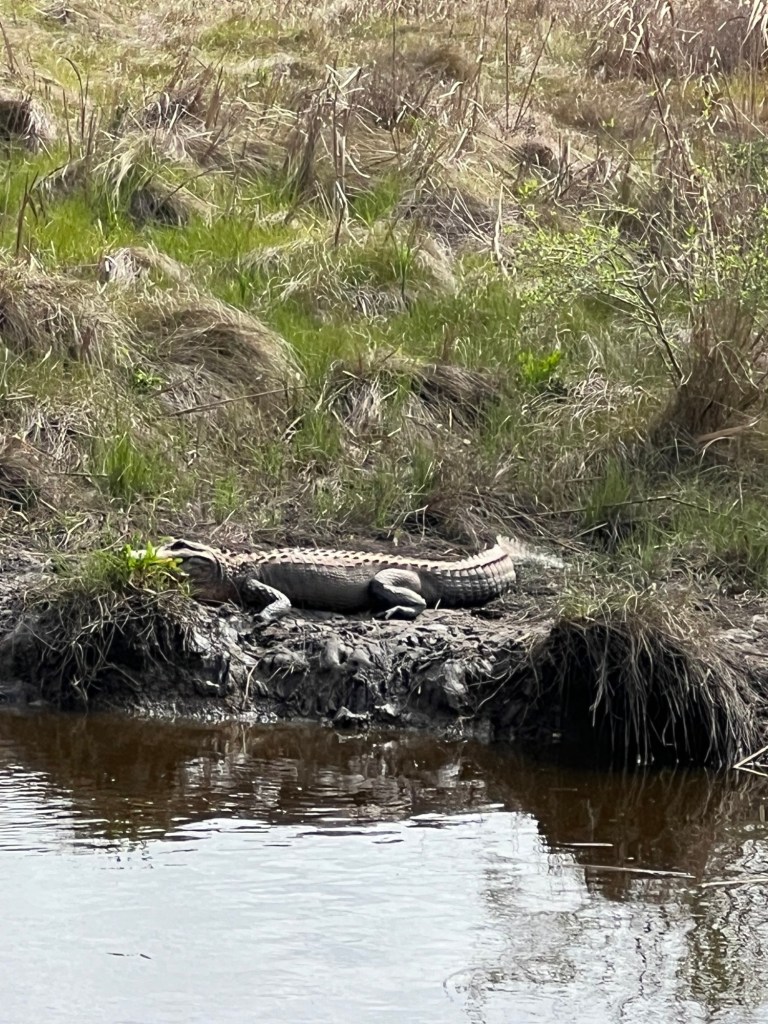
LJ and I recently embarked on a three-day marathon trip to my beloved East Texas – Big Thicket National Preserve. First on the agenda was the forty-two (42!) American alligators sunning themselves in the shallows of Shoulders Pond. You drive around this circle of a canal and note what you see.
Gators!
Second most exciting was the huge number of White Ibis spending the winter there. It could have easily been 50-60 or more. There were lots of coots, great egrets, great blues, little blues, snowy egrets, reddish egrets, gulls, and red-winged blackbirds.
After the drive, which took over two hours, we walked one of the trails. Even so far south not much was blooming. There were quite a few plums and maybe some pear trees, the invasive kind! Perhaps a few weeks later everything will be in bloom and there will be more birds. Put it on your bucket list!
An hour drive later we arrived at our luxury hotel in Kountze, my old home town, a real bargain at $66 a night! They had the cleanest towels I’ve ever seen! Not a joke. Really nice folks run the place, and it has a free breakfast and good maid service.
After a good night’s rest and supper at the local Dairy Queen, we drove north to the Geraldine Watson Preserve. My heart lives there. In my next life I will come back a Geraldine wannabe! They had done a recent burn trying to get rid of the invasive sphagnum moss and whatever is encroaching on the fantastic boardwalk. Everything here is maintained by the association of dedicated volunteers.
There were remnants of pitcher plants, and I got a really good picture of the remains of creatures left after the plant had dined on them. Cool!
Pitcher plants
There was lots of other interesting stuff – more to come – such as orchids, mushrooms, wildflowers, and birds. Do NOT fail to spend a morning there if you are in the area.
Geraldine wrote two books before she died. One is somewhat technical, about the geology of the area. One is about her adventures living in the area. It’s the best one in my humble opinion.
Next, we went on a drive on the Gore Store Road (try saying that fast three times!). Sadly, they are harvesting pines for lumber there – quite a few scary trucks loaded to the gills with long, tall, used-to-be-majestic trees. It was scary to drive behind them. A man who lives in the area tried to make a citizens’ arrest on us for trespassing on a vacant lot. Luckily, LJ talked him out of it. But we had to sacrifice a half hour charming him and convincing him we only wanted pictures. In the end, he even let us take a few shots on his property. There was very little worth reporting on the Gore Store Road – we never did find the store.
Lunch was at the barbeque place in Warren. It’s the best place to eat in the area and run by a very nice family. Friendly folks.
Off to the Sundew Trail. If you didn’t know, sundews are another carnivorous plant in the thicket. Again, not much was blooming. There is a great boardwalk and they have installed ten information stations that talk to you about what you are seeing. The best sighting was a brown green anole. You hardly ever see them colored.
Supper was an orange – too tired to eat.
Next day was Village Creek Park in Lumberton. There are very pretty cabins to rent. Homeward bound!
I went to sleep at 6:00 pm, was awake a few hours in the night, then slept until 7:00 am! I still think she’s after me. What do you think?
Does anybody besides me have a mushroom bucket list? I don’t need to see a “Death Angel” (might be Angel of Death or one that glows in black light, although that would be really interesting. No, my bucket list is only one deep, a bird’s nest fungi. I’ve seen pictures but figured I’d have to go to eastern Canada or the jungles of Belize to see one.
Well, wouldn’t you know it! I’m wandering around in my wildflower meadow, in my nightgown and robe, in the cool damp morning. I’m doing a bit of “belly botany” getting a picture of the very first winecup of the season. I’ve been keeping a sharp eye out for them. I knew they were coming and wanted to add them to my growing list f flowering plants to satisfy the sweet lady at the appraisal office. I do pollinators, critters, and plants for my wildlife exemption, and I’ll do just about anything to make the folks at the Appraisal District happy. Someday I’ll have to show the Master Naturalists my scrapbooks and journals.
Anyway, I see what I think is a small mushroom cap. But it isn’t! It’s a tiny cup about the size of my little fingernail. Inside the cup is a bunch of little charcoal gray “eggs.” Wow! Is this a fairy’s bird nest? Maybe a lost leprechaun’s? I would have jumped straight up in surprise, delight, and amazement, but at my age I can’t manage that sort of thing anymore!
Ta da!
As I gazed in awe, I realized there were bunches of them all over the place. I dug one out of the ground with a toothpick-sized stick and reverently laid it in my palm. Gosh! Don’t you love your camera phone? There was a kind of bulb or knot at the base of the cup. I tried carefully knocking off the damp soil from the tangle of roots. That wasn’t working out very well, so I took my precious treasure into my potting shed and started washing it. Let me remind you, this thing is the size of my little fingernail – tiny!
I feel like I just discovered Cleopatra’s tomb – really! The detail on this little bit of magic is simply unbelievable.
Side view
The world we live in is filled with wonderful, magical, delightful structures if we only take the time and get down on our hands and knees and look.
Part that was underground.
Don’t forget to take your phone camera!
I looked them up online, of course, and they are used in Chinese medicine. There are lots of benefits: anti-viral, anti-inflammatory, anti-microbial. Treatment for tuberculosis, asthma, skin problems, stomach troubles. It’s even used against aging.
Tiny!
There was a lot of information on how to get rid of them. I can’t even begin to know why. They are very tiny! So much hidden wonder and magic. For a mere $630.00 you can purchase them for home use. 4.8 stars! You can even buy bird’s nest mushroom tea.
Clouds parted and the view was stunning of the Solar Eclipse. El Camino Real chapter members gathered at a member’s place to watch the event together as well as do a few projects – and of course eat.
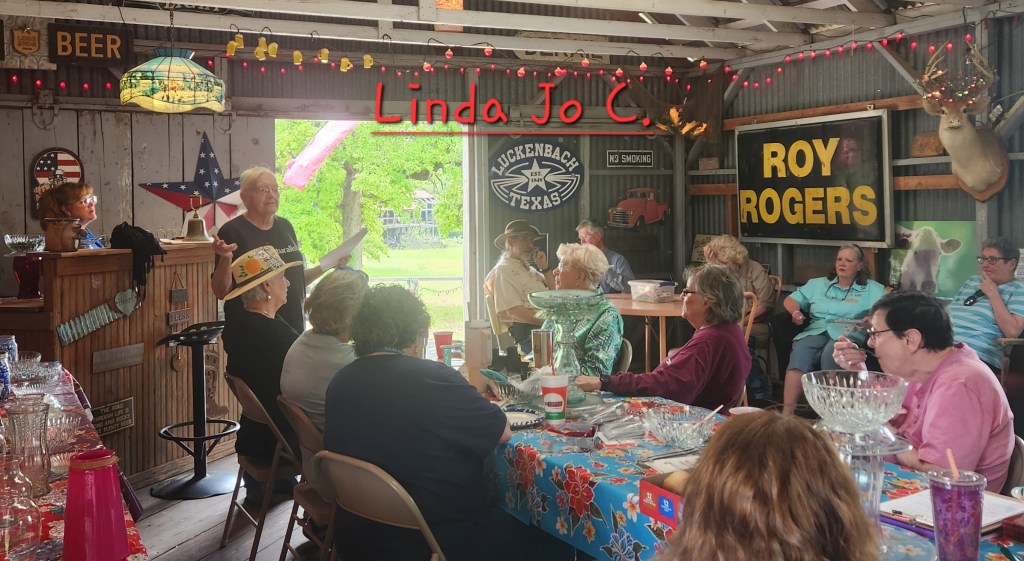
There were 16 members and 7 guests who met at Jackie Thornton’s Party Barn near Minerva Monday. Jackie had everything ready to go including materials to make bee watering stations and Wren nests.
Working on projectsCarolyn sharing informationConnie sharing information
Debi Harris used gourds to make the Wren nests, and members put a little personalization on them. Jackie told everyone how to create the bee watering stations. Several creative pieces went home with members.
Training was then provided by Carolyn, Connie Anderle, and Linda Jo Conn on the eclipse. Carolyn provided facts, including the one that predicts another total solar eclipse will not occur in our area for 350 years. Connie provided safety information on viewing eclipses, and Linda Jo discussed how animals react to eclipses.
Linda Jo sharing information
After eating a large lunch, members set up outside in a wildflower-covered field and cheered when the clouds parted, making the eclipse visible. Everyone sat and watched for over an hour as the moon edged its way between the earth and sun.
Eclipse watchers
Everyone stopped all noise, to hear what nature would do as the totality came close. Before it was complete, but it was growing darker, birds, frogs and crickets began to make their noises that they normally do at dawn and dusk. At the darkest point, nearby coyotes howled for a minute or two. It was measurably cooler, too.
Getting toward total eclipse!
Several members were seeing colors – pink and blue – at the most covered point, too. I found out last night that it was solar flares making the colors.
Carolyn’s photo with a plane in itCarolyn’s photo with a streak that could be a meteor
I did not use the correct filter on my camera, so my photos show those colors, among other oddities. It was a once in a lifetime experience – unless you are willing to travel to see another one.
Of course, Linda Jo took some time for iNaturalist observations
[This article appeared in the Cameron Herald, Thursday, April 4, 2024]
A local member of the El Camino Real chapter of Texas Master Naturalist is putting Milam County on the scientific map in spider identification. Eric Neubauer, now considered a local Rabid Wolf Spider expert, discovered a kind of Wolf Spider that has never been identified anywhere.
Eric Neubauer
Neubauer discovered the new spider and named it Hogna Incognita while studying the biodiversity of his place out near Davilla in 2019. He had just moved to Texas from Pennsylvania and bought a few acres in that area. When he realized the place was covered in what are commonly called Wolf Spiders, he felt compelled to identify all of them.
The newspaper article
There are many kinds of Wolf Spiders, but after two years of trying to identify the Hogna Incognita without success, he believed that he had found a new, unidentified, as yet unnamed spider. “It’s amazing that a spider that big, that common had not been identified already,” said Neubauer.
He started using iNaturalist, an internet vehicle to identify all living things all over the world, in 2019. Only 4 people had an active interest in Wolf Spiders on the site. Neubauer went through 13,000 Wolf Spider observations on several different identification sites. None were his spider. The first identification of Wolf Spiders in Milam County goes back to 1904 when Texas was still a popular place for biologist to study all types of living things.
Hogna incognita– photo by Eric Neubauer
After extensive studying, he came to strongly believe that he had a new one that had never been mentioned in scientific literature. The Hogna Incognita has a relative that looks similar to it, but it doesn’t look exactly like it. The “cousin” is commonly called the Hogna Antalucana. He believes the incognita was thought to be the antalucana because they had one similar trait.
Neubauer began giving presentations on Wolf Spiders to fellow Master Naturalist. In 2021, convinced it was a new one, He put up a “note” on it on the Bug Guide web site. The curator of the site agreed that it was a new species.
After some statewide presentations by Neubauer in 2023, Tarleton Professor Russell Pfau read the presentations and offered to help Neubauer with definitive evidence of its uniqueness. Pfau did extensive DNA testing on both the incognita and antalucana. Neubauer and Pfau caught some of each type in several stages of development – including all the spiderlings on the mother’s back. Pfau has managed to raise them from infancy to adulthood. The raising of them showed difference between the two from birth to adulthood.
Just weeks ago, Pfau notified Neubauer that the two spiders did indeed have different DNA. He had found an unidentified Wolf Spider.
“Hearing that the DNA test verified what I was sure I’d found – I was more excited than I thought I would be,” said Neubauer, who is normally very stoic.
Neubauer would like to stress that Wolf Spiders are harmless. They may bite, but it’s not poisonous or painful. “I’d rather be bitten by a Wolf Spider than a mosquito,” he said. They offer some benefits out in the blacklands, too. The incognita is mostly in the blacklands and some surrounding areas, so if you’re in Milam County you probably have them.
If you’d like to read the original report, you can find it on the El Camino Real Texas Master Naturalist web site https://txmn.org/elcamino/ . You also can look up Wolf Spiders on www.inaturalist.org.







 Nature Along the El Camino Real