Imagine this…. eight women sharing two bathrooms in a cabin in the woods. Awakening early Saturday morning, I was in dire need of a toilet and both bathrooms were occupied. After climbing down from the top bunk, I really began to feel pressure.
Sassafras Cabin at Camp Allen Conference and Retreat Center
Thank goodness, the first Advanced Training Class I had attended on Friday afternoon at the 2012 Master Naturalist State Meeting at Camp Allen in Navasota proved invaluable to my comfort and sanity. “Techniques for Teaching Leave No Trace Principles to Urban and Suburban Audiences” was the official class title, although a more descriptive sub-title given by the instructor was, “How to Teach Soccer Moms to Pooh in the Woods”.
Many urban and suburban people have trouble relieving themselves in the outdoors when recognizable restroom facilities are not available. Showing them simple ways to be prepared to fully enjoy the experience of being in the “back country” can be part of our enablement and education process. Necessary supplies listed by the instructor were: a small Zip lock bag, a wet wipe, and on occasion, a hand trowel.
Saturday morning, I was a Master Naturalist needing relief! I knew there were no plastic bags in the cabin cabinets, so I pulled an empty Kraft Shredded Cheese bag from the trash can. A couple of squares of Kleenex from the box on a side table in the living area sufficed for wet wipes. A six- to eight-inch deep hole to bury solid waste was not necessary at the moment for what I needed to do, so the trowel was not required.
Quickly donning jacket and shoes, I ventured out into the chill and walked into the darkness. The encroachment of the woods and my internal pressure precluded taking the prescribed 100 steps away from the cabin. Thirty steps did just fine. Blessed relief! The evidence was deposited in the cabin trash can.
I was fortunate my first training class gave me the information and permission to be able to make myself comfortable. I also became aware of the difficulty many would-be nature enthusiasts may have enjoying the outdoors because of the apparent lack of restroom facilities.
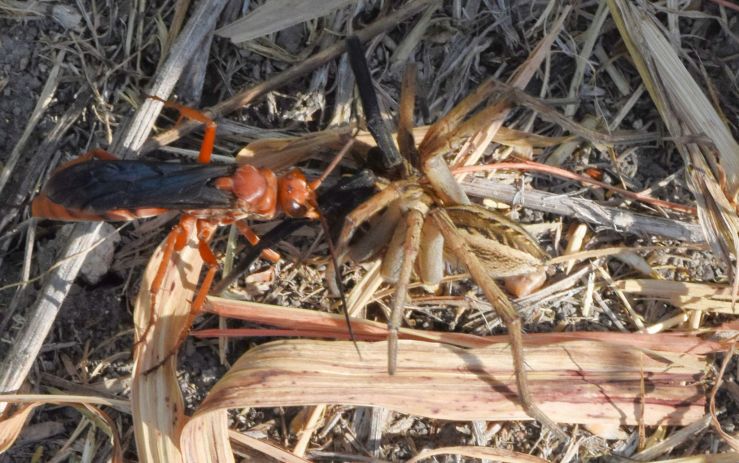
You’d think a Rabid Wolf Spider would be king of its domain. By the end of last week many had reached their prime and would be thinking about reproduction, but not this one, which was destined to become food for a spider wasp’s offspring instead.
Wolf spider played by Rabidosa rabida. Spider wasp played by Tachypompilus ferrugineus. Note that The forelegs of some Rabid Wolf Spiders blacken as they become adults.
I arrived with my camera as the wasp was dragging the paralyzed spider toward its nest. Unfortunately the early morning light was bad and the wasp was fast, so most of the photos were poorly lit and out of focus. Thus, I have to tell most of my story with words.
This is what I saw. The wasp was dragging the spider along. The wasp dropped the spider several times and appeared to wander around before returning. At first I thought it saw me as a threat and was taking evasive action, but as I watched it reach its destination, I realized how entirely focused it had been on the task at hand.
Bonus photo of a rabid wolf spider, by Sue Ann Kendall.
Wasps don’t have eyes in the back of their heads, so it couldn’t see where it was going while dragging the spider. Every time it dropped the spider, it had gone back to find the opening of its nest to reorient itself as it returned to the spider. It made no sense to drag the spider a long way and then find out it was in the wrong direction.
After dragging the spider about four feet and a couple of final yanks, the wasp and then the spider disappeared under the house skirting.
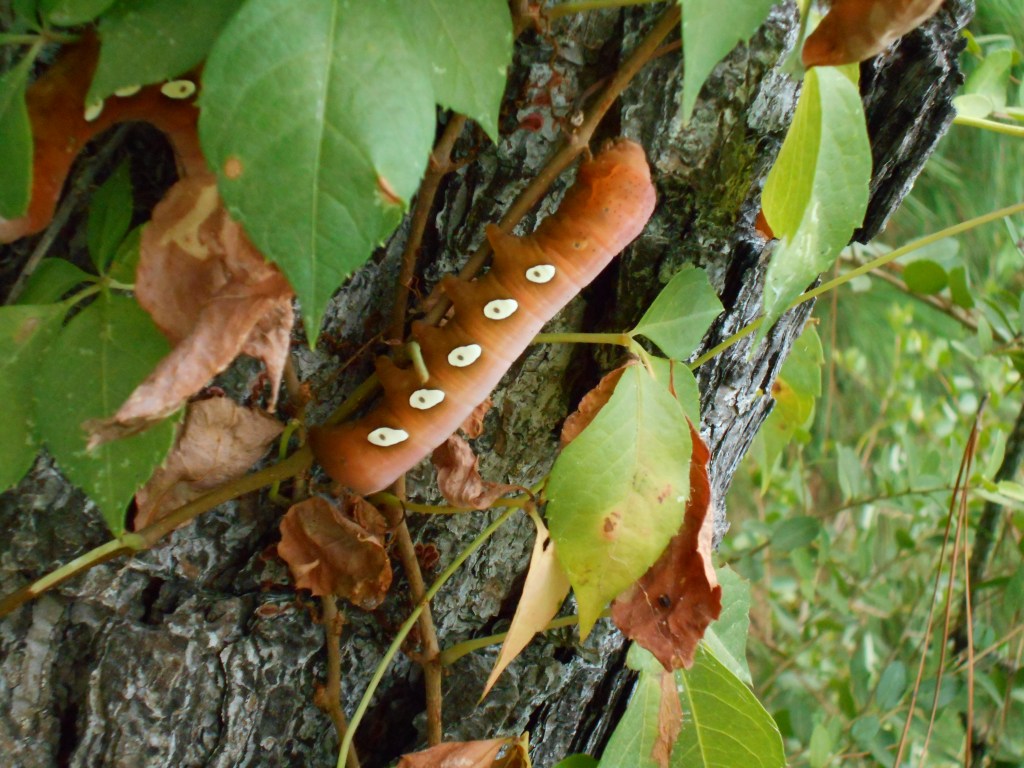
This Pandora Sphinx was a very interesting caterpillar I found one day while walking around our place.
Pandora sphinx moth from 2015.
It’s rust colored, very fat with bright yellow almost tear-drop eye patches. I had never seen one before or since then. I was excited to find it.
It was eating leaves on a Virginia Creeper vine, a vine with five leaves.
Here’s a picture of Virginia creeper taken by Ann Collins from iNaturalist (Creative Commons copyright).
The Virginia Creeper is a great native vine to have around. It tolerates most soil conditions and climates It has many uses for wildlife, and can be used as a vine in gardens.
Many birds such as Bluebirds, Titmice, Cedar Waxwings, Robins, Chickadees, and more love its berries. Several species of Moths and Butterflies use it as a host plant.
This is also the vine that created the saying we were taught as children.
Leaves of 3 leave it be, leaves of 5 let it thrive….
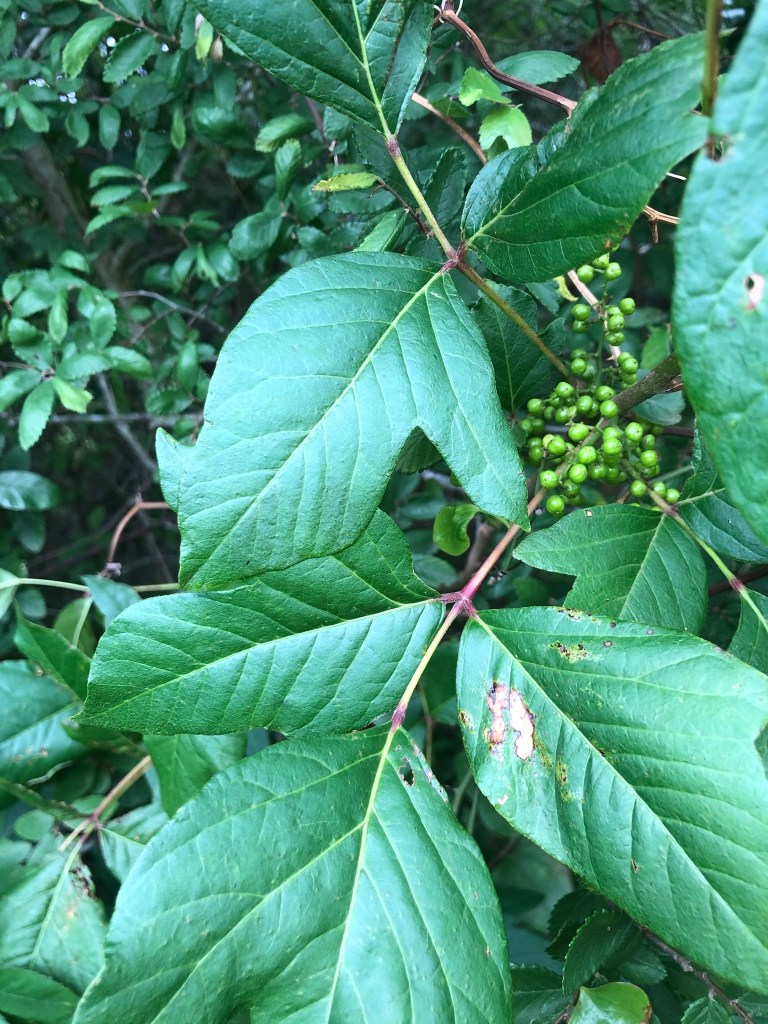
Poison ivy near Cameron, by Sue Ann Kendall from iNaturalist. Creative Commons copyright.
This vine is often mistaken for our favorite vine, Poison Ivy, but Poison Ivy has three leaves.
Right now you can find both vines just about everywhere in the country especially around wooded areas with part shade, so be careful to identify which one you just touched..
I have personally found that an over-the-counter product called “Tecnu” Poison Ivy Scrub. If used within 8 hours, it can really help get rid of the oil that causes the itching.
Most of us have these beautiful vines that come up on the ground, fences, and trellises. So besides being magnificent, who else appreciates them? Butterflies and birds, that’s who.
Passionflowers
The vines only show up when it’s hot. Pretty lucky for us, because it’s hot here.
The Latin name for the passion vine is Passiflora incarnata. What you may not know is that many of the vines we have here are actually naturalized, not native. You can tell by the number of leaves on them which one they are.
Another view.
If they have five leaves, they originally came from Asia and naturalized here. If vines have only three leaves, they are true natives. Both work well here and are host plants for the Gulf Coast and Variegated Fritillary butterfly. The vine also provides cover for other insects.
Fritillaries
The Gulf Coast species is orange and black with silver under parts.
Gulf Coast Frittilary
They use the passion vine as a host plant. They love hot weather, so only appear when the vine emerges. Pretty smart of them.
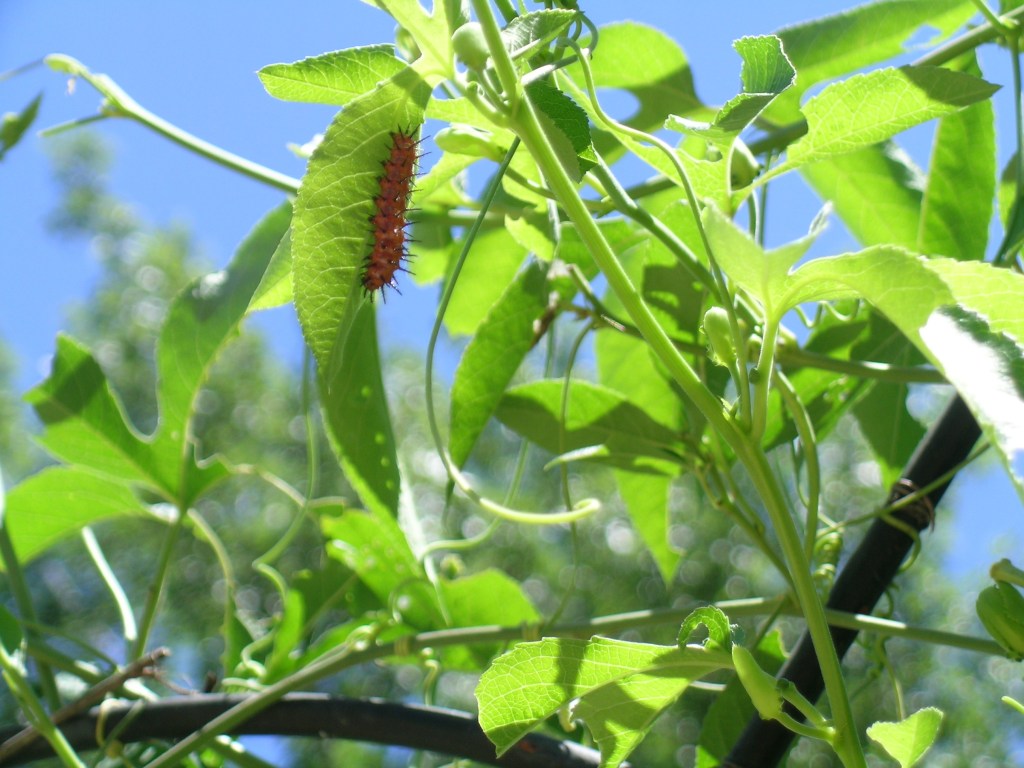
Gulf Coast Fritillary caterpillar
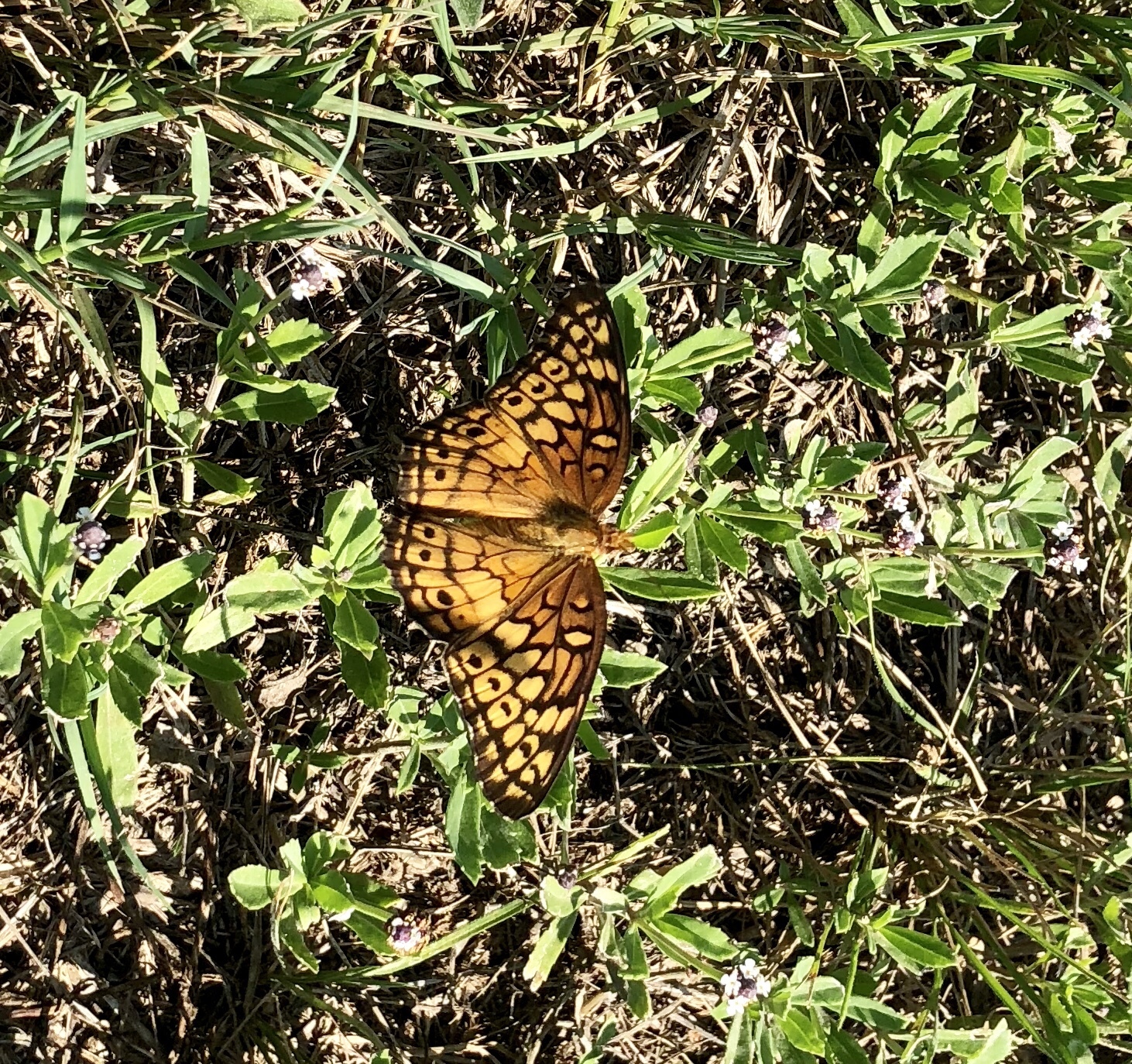
The second species of Fritillary is the Variegated variety.
Variegated Frittilary. Photo by Sue Ann Kendall.
Variegated Frittilary caterpillar. Photo by @susanmco on iNaturalist.
They also use the passion vine as a host plant to deposit their eggs on.
The Vairegated Frittilary does not have the silvery underwings of the Gulg Coast. It looks more like a dried leaf when it has its wings up. Both Fritillaries appear in the summertime, and will leave when the weather turns cooler.
The passion vine is a great way to cover a large area in your garden. [Suna points out that the fruit is also edible and makes a lovely jelly.]
This vine has five-leaf clusters, so it’s naturalized.
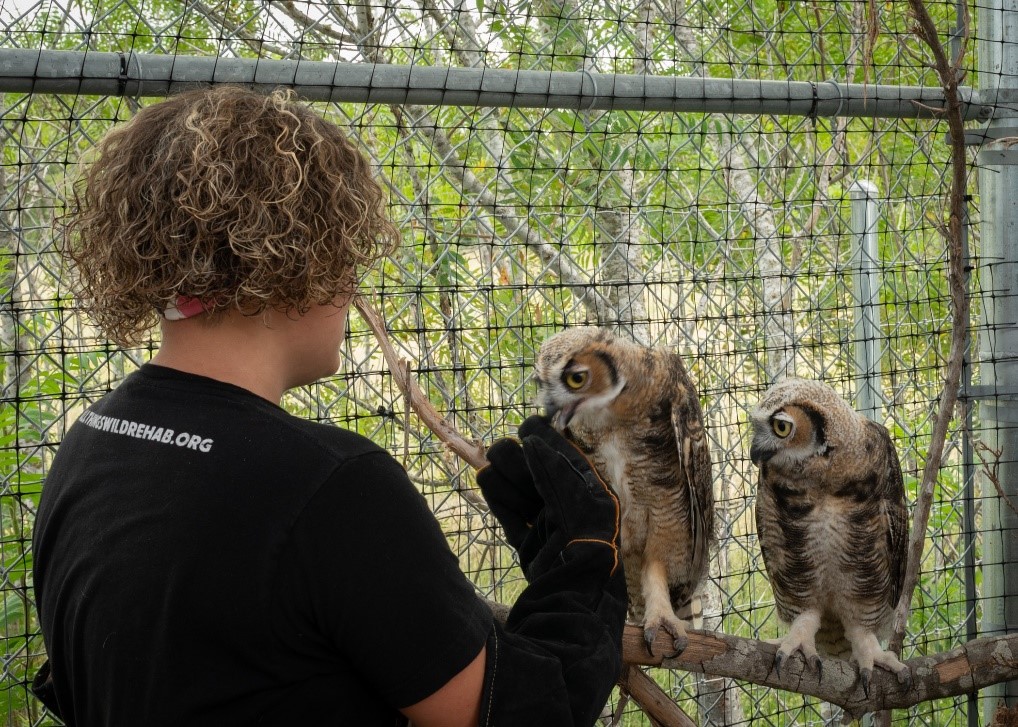
In the afternoon of June 2, 2020, three young Great Horned Owls were gathered and placed in a large dog carrier.
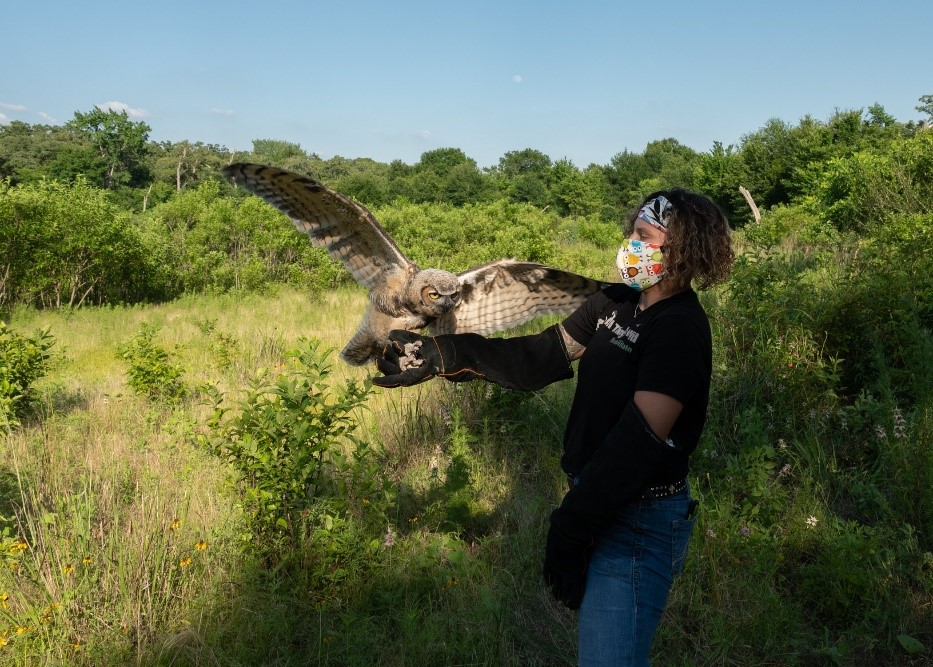
1: Sara Prepares the Owls for Their Journey
Their destination was Cedar Hill Ranch, Gause, Texas, for release into the wild after being saved and rehabilitated by All Things Wild Rehabilitation.
Later that evening they and their human volunteers arrived at Cedar Hill Ranch.
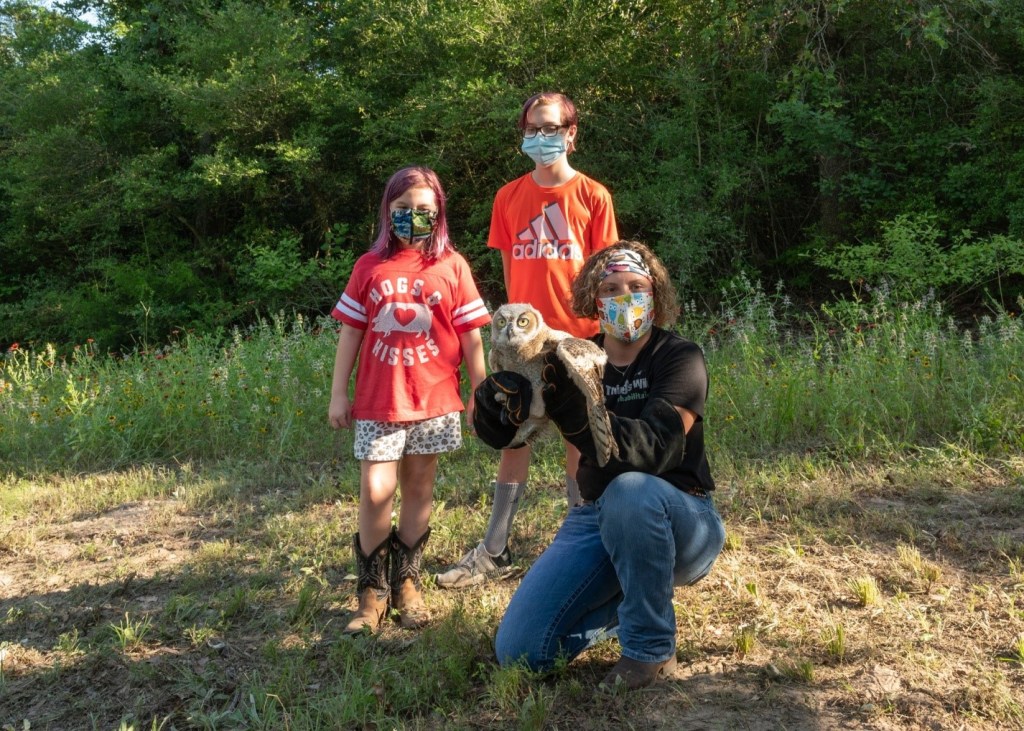
2. Owls in Carrier3: Conners and Sara Ready for a Release
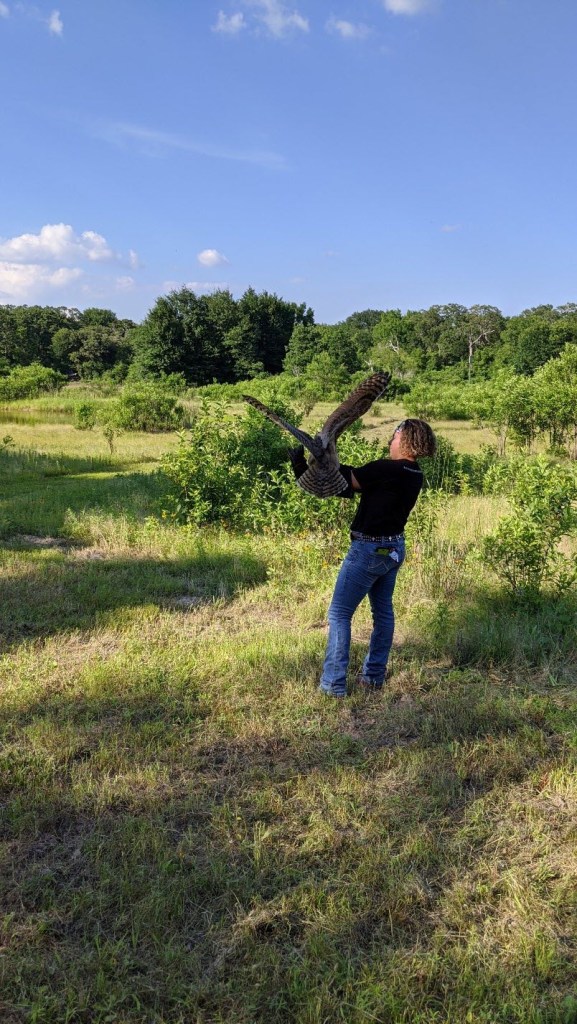
After a short drive to a meadow with ponds surrounded by mixed forest, the birds were released one by one. Conner grandchildren were visiting the ranch that day and were able to participate in the release.
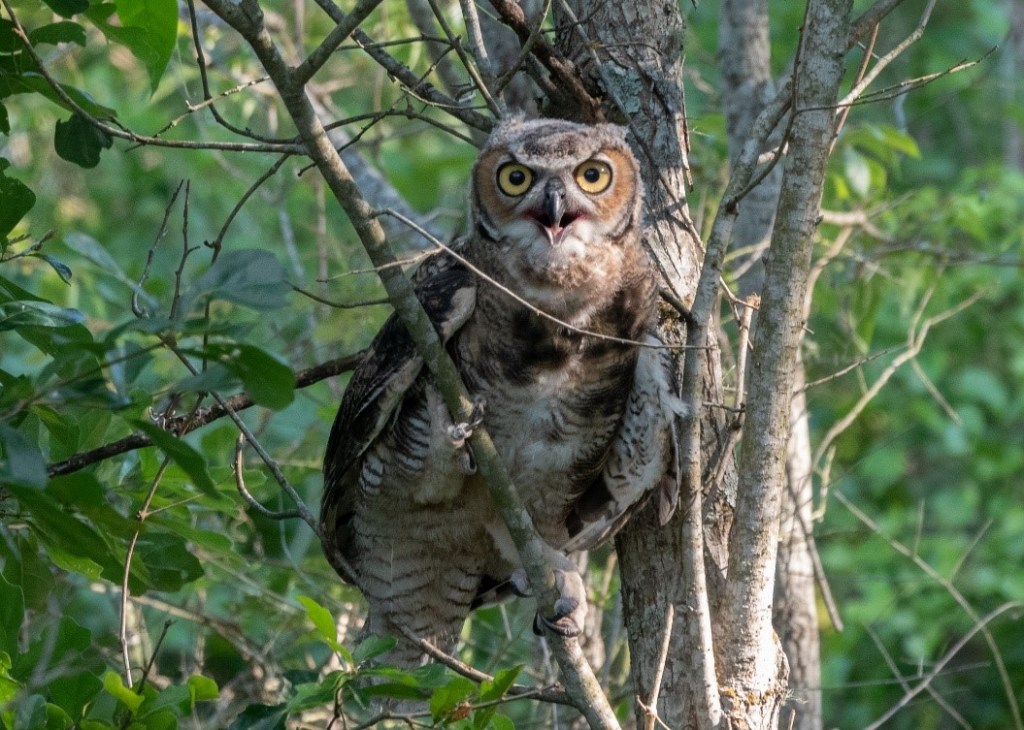
5: Sara Releases Another Owl4: Sara Releases an Owl6: One of the Released Owls
One owl posed for photos high up in a nearby tree before heading farther out into his new home environment.
Little Foot, 6/2/2020
Another owl, four weeks younger than the other two, stopped in a nearby cedar tree, and posed for a long time. We later learned that his human caretaker had named him “Little Foot”.
After about an hour, the humans returned to the ranch house and left the owls to live out their days wild in the area.
Update
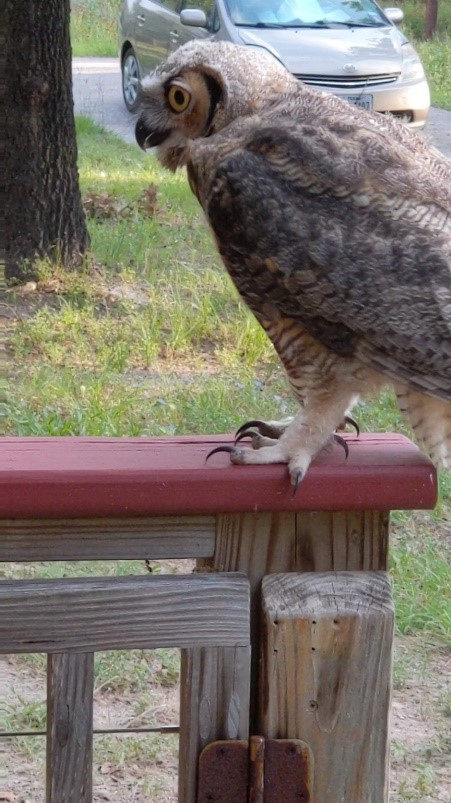
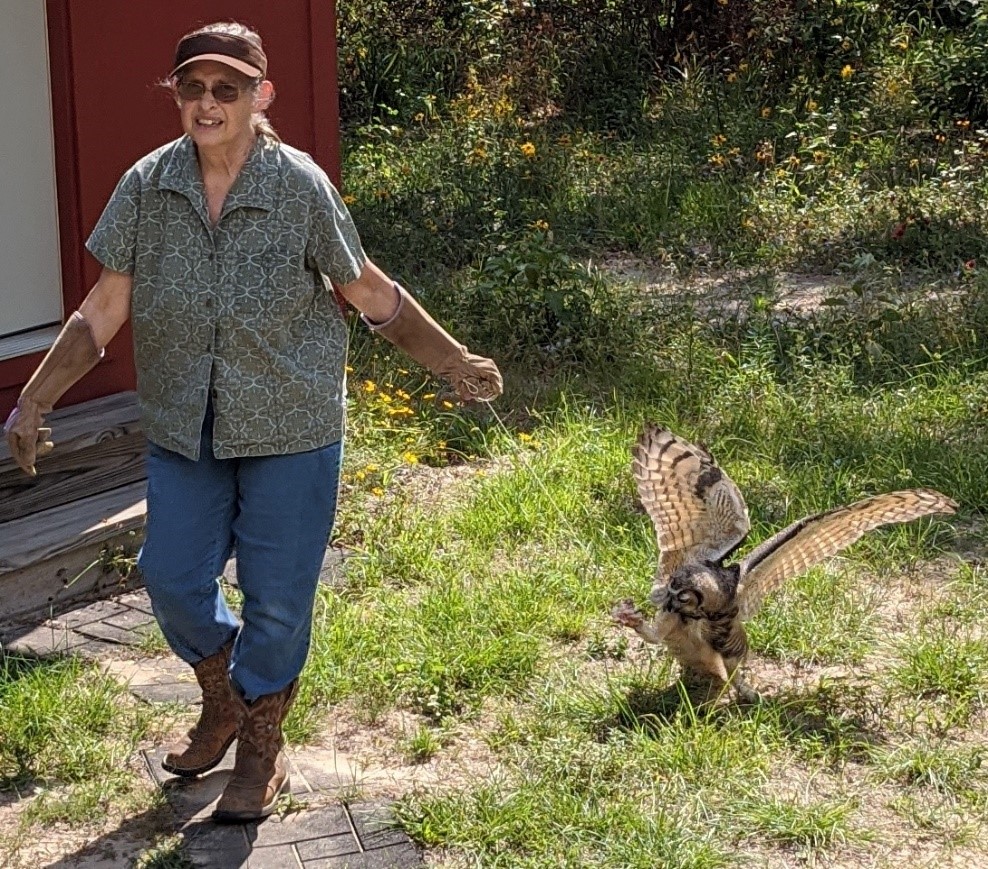
Six days later Little Foot appeared at the Cedar Hill ranch house begging for food by clicking his beak and screeching.
Watch Little Foot asking for food.
8: Little Foot Returns, 6/8/2020
We were advised by the All Things Wild staff to make noise with pots and pans so that he would not be comfortable near the house and would return to the woods. Although he flew away that evening, he reappeared the next morning. This time he flew directly up to us and pecked at our legs. This behavior indicated to everyone that he was not ready for release in the wild, as he was still relying on humans to provide food to him.
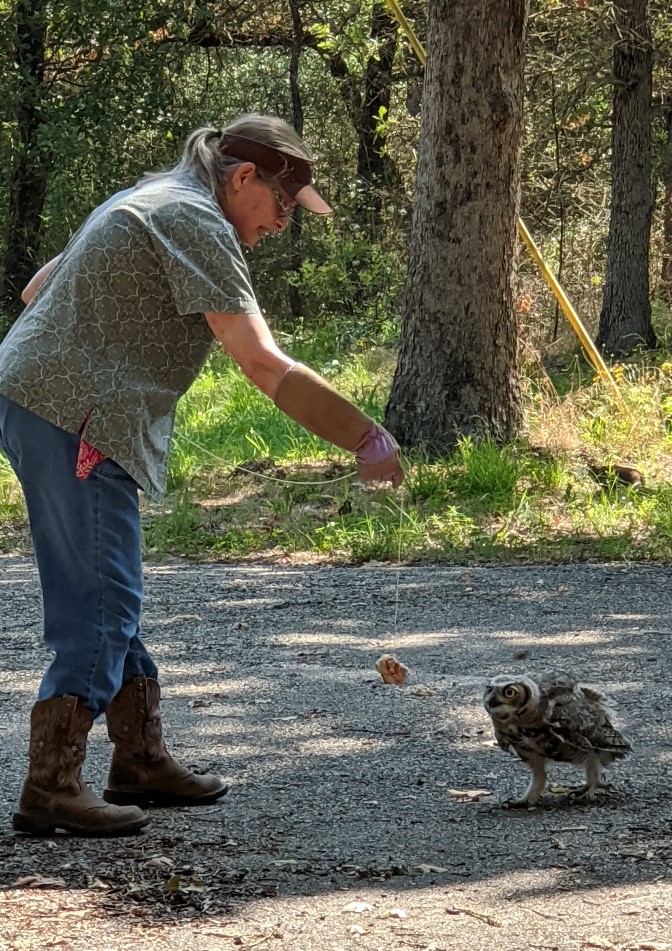
We were then told to lure Little Foot into an enclosure to hold him until Sara was able to get him that evening. Joyce tied a piece of raw chicken to a string and led him slowly several hundred feet into one of our chicken coop enclosures.
9: Luring Little Foot
At one point Little Foot grabbed the chicken and tried to get it away from Joyce. Although hungry, he was surprisingly strong.
10: Little Foot Grabs the Chicken Piece
11: Little Foot Waits in a Chicken Coop Enclosure
Sara and friends arrived that evening. They took Little Foot back to the All Things Wild Rehabilitation Center where he will live in their “flight” cage. They will feed him only live food for about a month to get him ready for a second release attempt.
12: Sara and Friends Recapture Little Foot, 6/9/2020
Can You Help?
All Things Wild Rehabilitation (ATW) is looking for places to release animals to the wild. Usually, they like a site to have a source of water and for landowners to be willing to put out food for the young animals for about 2 weeks until the animals learn how to forage on their own. However, we have been a release site five times and have never been asked to put out food.
If you find a wild animal that you think needs help, visit the ATW website at and review “Found An Animal?” information. If after reviewing that information, you decide you need to contact the center about the animal, call 512-897-0806.
If you are interested in becoming a release site, the following information is from their website.
How to Become a Release Site
The goal of wildlife rehabilitation is to return the bird or the animal to the wild. We release the rehabilitated animals on private property with permission from the owner. All Things Wild is always looking for good release sites. Here are our dream criteria for releasing most small mammals and raptors:
Acreage, preferably 10 acres or more, with woods,
No high fences,
Water year-round,
Away from busy highways, communities, houses, and lots of people,
Accessible by vehicle or hiking,
Willingness to do a soft release* if necessary, and
An appreciation of wild animals.
If you would like to offer your land as a release site for ATW, please email allthingswildrehab@gmail.com.Thank you!
*A soft release is when food is left out for released animals until they become accustomed to foraging in the wild.
More about Great Horned Owls
If you’d like to learn more about these amazing birds, please download this PDF fact sheet that Joyce made to help educate her grandchildren, based on information she found on the web.












 Nature Along the El Camino Real