Cedar Park in Milam County

by Linda Jo Conn

Driving past the roadside park on Hwy 79 between Milano and Gause on my way to Sugarloaf Mountain Bridge, I told myself that one of these days I was going to stop and investigate the place. So, on the way home, I stopped and looked around. 

It is a typical roadside park. Surrounded on three sides by a chain link fence supporting several species of vines, it has a circular drive, the usual brick and cement tables and benches, and some large cedar trees.

Later, when using Google Maps to enter the GPS location for my observations into the iNaturalist.org website, I discovered that this small roadside park actually has a name:  Cedar Park. Not surprising. Cedar trees are the dominant trees.

Bird’s-eye speedwell.

Although the area is closely mown, there were a few flowers to observe. I saw my first Bird’s-eye Speedwell (Veronica persica) and Field Madder (Sherardia arvensis) blossoms of the season. There were the usual roadside park plants of Straggler Daisies (Calyptocarpus vialis), Crow Poison (Nothoscordum bivalve) and Green Poinsettia (Euphorbia dentata).  

Climbing the chain link fence were common vining plants:  Mustang Grapes (Vitis mustangensis), Carolina Snailseed (Cocculus carolinus), and Poison Ivy (Toxicodendron radicans). 

The most memorable plant of the visit stayed with me a while. The park must have been covered with grass burrs (Cenchrus sp.).  You may call them sandburs or stickers. Not noticeable in the short vegetation while I was walking about, they showed up as I was about to get into my truck. There must have been hundreds of them stuck to my jeans and to the tops and soles of my tennis shoes! It took a while to remove them.

Grass burs. Not fun.

Cedar Park is a shady, convenient place to stop on the highway and was visited by several travelers while I was there. Fortunately none had children or pets wanting to romp on the grounds. That would have been a memorable stop for them also. Ouch!

Invasion of American Robins

by Donna Lewis

I have had an invasion of American robins this week. They came by the hundreds and have not left.

Usually they land, eat bugs, then move on, but this time they looked around and decided they would hang out. Life is good here.

So, every day they have been drinking and pooping in my bird baths. I’m not sure in which order; we’ll leave that alone. Because of that, twice a day I put fresh water in all of them and replace the dried mealworms.

A robin guarding my feeders.

My resident birds, the cardinals, woodpeckers, chickadees, and others have to fight to get their share.

But one robin has taken it to a new level. He or she has decided to chase my bluebirds off the mealworm feeders. None of the other robins are doing this, just the one.

For four days the bird has sat on the platforms and chased the little bluebirds away.

I love all the birds, but this is pushing my patience, so I tried to run him off so he could join his flock in the pasture.

He’s not budging! I almost touched him once.

I could not get a photo of all the action, but here he is in all his glory. I call him the Bluebird Bully.

Stay away from my mealworms!

Bon appetit.

My Keyhole Garden Experience

by Debra Sorenson

After years of putting in a garden and many hours of chopping, watering, preventing hogs from getting in the garden, droughts and then too much rain, we decided it wasn’t worth it.  Some years we had an abundance of green beans, black eyed peas, squash, and okra, but not enough to outweigh all the work. 

Then on September 12, 2019, I attended the Master Naturalist meeting and the presentation was on Keyhole Gardening.  “WA LA!”  This may be our solution, I thought. I purchased the book, Spoiled Rotten ,by Deb Tolman, Ph.D., and began gathering materials for our garden.  NOTE – my husband thought I was nuts! 

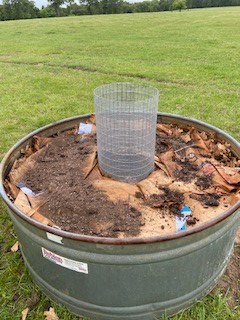
Here are my steps (photos of the stages are below):

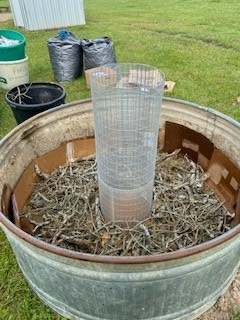
  1. We used an old water trough, cut the bottom out and put galvanized small wire in the bottom to keep gophers out. 
  2. We made the keyhole for composting scraps out of wire and wrapped it with old window screens. The purpose of the window screen is to keep the roots from going into the keyhole while allowing the nutrients from the compost to feed the plants.
  3. Added a layer of rocks over the wire for drainage.
  4. Then alternated layers of sticks, wet paper feed sacks, dried cow manure, wet cardboard boxes, blue jean (cotton) scraps, and paper. It took more materials than you would think!
  5. The top 8 – 10” is bagged garden soil. TA DA! You could use your own soil but ours isn’t the best – clay and sand…

Our spring garden was not as productive as we hoped, as there was not enough time for the compost to supply the nutrients for the plants. 

This fall, I worked in bags of Miracle Grow (shhh…it’s all supposed to be organic) to help give the plants a boost. Next spring, we will work in some chicken manure and compost from the Bird and Bee Farm or the mushroom compost from the Madisonville area! 

Finished fall garden

We’ve got lettuce, broccoli, cauliflower, carrots (just coming up), brussels sprout, mint, one pepper plant, and a rogue cantaloupe from the spring! Delicious! And it’s so much easier than the traditional garden. 

My husband thinks we should do another one  in the spring, as he’s got another water trough with a rusted holey bottom. He realized that I’m not as nuts as he first thought!

Monarch Butterflies (Danus plexippus)

by Donna Lewis

So you thought we didn’t have many monarchs here in Milam County…

These little beauties were in my pollinator garden just a few weeks ago (the last week in October).

They were nectaring on blue mist flowers, which are very easy to grow.

Yes, we can make a difference for our monarch friends. This is what we do as Texas Master Naturalists. We protect the natural world so that those who come after us will get to enjoy them like we do. What an honor for us.

Make sure you plant what the butterflies need to survive. And keep on learning!

Observing Milam County: Nashville Historical Marker 11-03-20

by Linda Jo Conn

Driving east on Hwy 79 toward the Brazos River Bridge at the Milam/Robertson county line, a convenient paved pull-off invites travelers to stop, stretch their legs, and perhaps read the inscribed granite markers telling the history of this area.   The curious will learn that this was the site of the town of Nashville, founded by early Texas empresario, soldier and statesman Sterling Robertson and named after his former home in Tennessee.  Nashville was also the first Texas home of George C. Childress, chairman of the committee that drafted the Texas Declaration of Independence. 

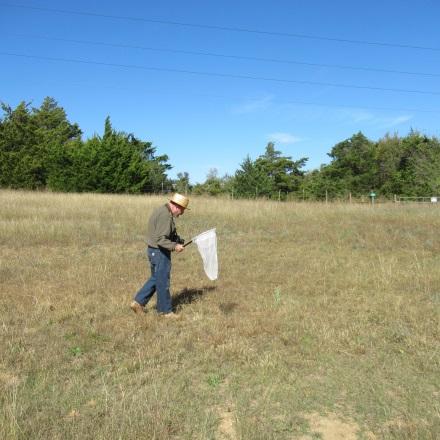
Fellow TMN and iNaturalist Eric Neubauer and I met at the pull-off for a ‘socially-distanced’ investigation of the flora and fauna of the area.  A grasshopper expert, Eric took his bug net up the slope of the right of way see what was willing to be netted.  

Eric nabbed several species of grasshoppers with his net, including a ‘new for him’ species.

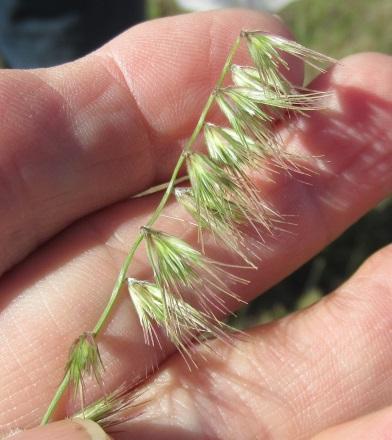
Being more of a plant person, I focused my attention on things with roots that tend to remain stationary (until the wind blows).  I was pleased to find Texas grama (Bouteloua rigidiseta) in abundance as well as patches of other native grasses:  silver bluestem (Bothriochloa laguroides, little bluestem (Schizachyrium scoparium), and white tridens (Tridens albescent). 

C:\Users\Owner\Pictures\2020-11-03 001\IMG_6906.JPG

Texas grama lost out on the designation as the state grass of Texas to the larger species sideoats grama.  

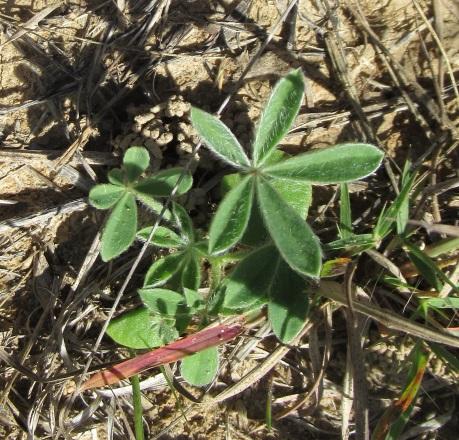
When the spring of 2021 arrives, this roadside area should be a go-to place to enjoy a solid blue slope of Texas bluebonnets (Lupinus texensis) in bloom on the ROW.  Literally hundreds of bluebonnet rosettes dot the ground.  Other plant species I was pleased to observe were Zizotes milkweeds (Asclepias oenotheroides),  ‘new to me’ species Barrens silky aster (Symphyotrichum pretense), winecup mallows (Callirhoe involucrata), and turkey tangle frogfruit (Phyla nodiflora). 

C:\Users\Owner\Pictures\2020-11-03 001\IMG_7237.JPG

Lupinus texensis, one of the five bluebonnet species recognized as the state flower of Texas.

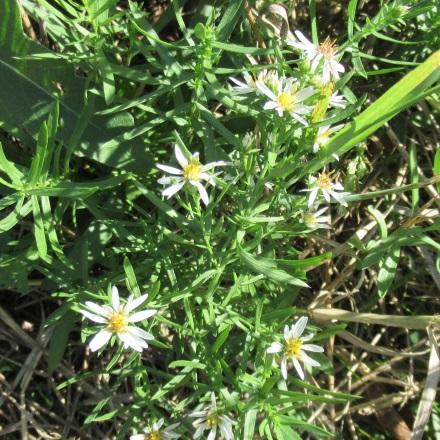
I was elated to observe another ‘new for me’ species blooming at the location:  Willowleaf aster (Symphyotrichum praealtum).  It is one of several species of aster-like flowers blooming along the roadsides during this time of year that can be challenging to ID without photos of diagnostic plant parts. 

C:\Users\Owner\Pictures\2020-11-03 001\IMG_7263.JPG

True to its common name, willowleaf aster sports leaves resembling a willow tree. 

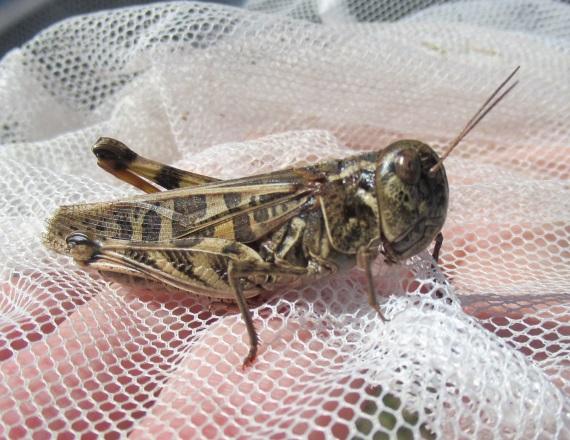
Eric shared his grasshopper finds with me, including a wrinkled grasshopper (Hippiscus ocelote).  Eric also shared the scientific names of each species, which I, not surprisingly, promptly forgot.  Another reason I appreciate the resources and users of the iNaturalist.org website.

C:\Users\Owner\Pictures\2020-11-03 001\IMG_6947.JPG

A monochrome of brown, this wrinkled grasshopper (Hippiscus ocelote) is actually an intricately marked individual. 

Eric and I traveled back down the highway to Milano to join Catherine Johnson at the Milano Wildscape for further observation and investigation.  Next week, interested chapter members will participate in a ‘socially distanced’ stroll down CR 364 at the Sugarloaf Mountain bridge near Gause.