Things Flying Over My Head

by Sue Ann Kendall

This summer hasn’t been as bad in the heat and rain department as last summer, so I’m not complaining one bit. But there sure have been some interesting developments in the sky, many directly over my head.

hawk
Some overhead things are cool, like this Red-tailed Hawk I got to listen to yesterday.

I’ll start with the most interesting one. For the past week or two I’d been noticing a lot of honeybees around my legs. It seemed like the earth was buzzing. Upon closer examination, I saw dozens of bees crawling on the tiny blossoms of the grass (I think it’s Dallis grass) that is blooming now. The bees were all very busy, zipping from flower to flower (not leisurely sipping as they usually do), and they were loaded with pollen.

This went on for a few days. Yesterday, there was no buzzing as I walked along the field in my daily bird-watching patrol. Then, late in the afternoon I was over by the trees listening to a Yellow-billed Cuckoo when I heard something that sounded like one of those annoying drones people fly these days. I looked up and didn’t see a drone. I saw a large mass of tiny things moving along at a rapid clip. It was hundreds and hundreds of bees swarming. I guess they were moving on to better pastures. I’m not sure where their hive was before, because I hadn’t heard one in a couple of years. I hope they find a nice new dead tree!

FAKE NEWS! The blog software generated this image when I asked for “swarm of flying bees.” I don’t think they actually swarm in a giant ball.

Moving along, I’ve also been dealing with birds overhead, specifically the beautiful but omnipresent Barn Swallows. Now, normally they hang out on our porches, building mud nests, raising babies and pooping. They also eat numerous insects, so they get to stay (also it’s ILLEGAL to mess with a nest of wild birds; you can ask Mike Mitchell about it if you don’t believe me). We coexist just fine, looking into or out of the windows at each other, and enjoying the swimming pool area.

Swallows on the pond.

However, lately, the little darlings have not been at all happy with me. They aren’t nesting anymore, just flying around the ponds and in the air catching food. They are always there, and for some reason they resent my presence. When I go for my morning or afternoon walks, I often hear a very loud CHIRP, with a Doppler effect as the chirper moves away. The swallows ambush me from behind, for the most part, but occasionally they fly right at me and veer off just before they make contact with my head.

There are so many!

I have absolutely no clue as to why they are dive-bombing me. I’ve had Mockingbirds and Red-winged Blackbirds do this when they are nesting nearby. But, hey, do they think I want to home in on their mosquitos?

Creepy? Why, yes, it is. Never trust AI to draw an insect. Or a horse. They always have five legs.

Other things in the sky have been more benign. I was a bit surprised to see both Black and Turkey Vultures in the air and in my trees until I realized the Mighty Hunter (Goldie the Great Dane) had eliminated yet another armadillo that had wandered into the fenced-in area. I wish they’d read my signs that say “Armadillos and Possums: Keep out! Killer Dog! This means YOU!”

Other flying friends include the usual Green Herons, Great Blue Herons, and Great Egrets, along with some hardy butterflies and a smaller-than-usual number of dragonflies. I’m going to pretend the flying Differential grasshoppers don’t exist.

Yep, the skies around here are busy. Always look up in case bees or swallows are coming for you!

It looks so peaceful out there…but it’s NOT!

Falls County Canoe Trip

by Alan E Rudd

It was a day when, like it or not, we got up hours before sunrise. Trying to paddle down a reach of the Brazos River on the last day of June, any boating crew is well advised to start early and finish early. Unlike most of the days in the rainy first half of 2024 this one promised to have few clouds, and therefore the full intensity of the midsummer sun.

Bluffs. Photo by Peggy Connor

We looked at weather apps as we rode along that describe the expected true air temperatures and the now ever so popular “FEELS LIKE” index. We noted that the “Feels Like” index was exactly the same for Houston, Waco, Terlingua, and Las Vegas, Nevada. All of these places have different levels of humidity due to their locations on the North American continent. But for the most part they all receive the same amount of solar radiation (sunlight) on any given day. The locations where the humidity was higher Houston and Waco were blessed with lower temperatures but they “felt” to be the same temperature as the two chosen desert localities. This is no new discovery: IN SUMMERTIME IT IS HOT. Therefore it “FEELS HOT.” Always has!

Fishing Spider. Photo by Victoria St. Everett

As it was, we got into the river and launched boats at 7:33 AM. Angie and Adam dropped us off under the Highway 7 bridge with Victoria, Alan, and Peggy in three boats. The river level was gently dropping into the 2400 cfs range after being higher during the wee hours of the morning. This was pretty-clear, cool water from Lakes Whitney and Aquilla that was being released upstream of Waco. The flow rate pushed us downstream and even in this wide, placid stretch of the Brazos you did not have to work hard to move rapidly. We saw Great Blue Herons, heard woodpeckers, and watched Bluff Swallows entering and leaving their nest holes in the colonies burrowed into the red soil riverbanks. Cliff Swallows mobbed the bridges where they had huge colonies of mud nests glued to the underside of the concrete structures.

The wide Brazos River. Photo by AE Rudd.

Victoria was in the lead when she passed an antlerless white-tailed deer swimming across the river. You could see why the cattle drovers from the Texas coastal plains always pushed their herds upstream of Waco before trying to cross the Brazos on the northward cattle drives. This deer was stuck below a high, steep, red alluvial soil embankment. Its thrashing hooves could not gain traction to climb the bluff and it repeatedly fell back into the river and was washed downstream where it would try again to clamber up the slick red clay. Finally, it arrived at a point where a small creek entered from the eastern shore, and it rapidly disappeared up the slope of this creek-bed.

I was reading about mammals’ swimming abilities recently, and the author pointed out that swimming motions are directly derived from walking motions. Humans (and probably other hominids) are a rare exception to this rule, and we must learn to swim with motions other than our walking strides. Even goofy arboreal species of mammals like tree sloths are surprisingly talented swimmers. I would like to travel back in time 16,000 years and watch a giant ground sloth swim across the Brazos River.

The trip was fast. We traveled 4.9 miles by kayak and canoe in 1 hour 35 minutes. We had a perfect pull-out point at the concrete boat ramp at Falls on the Brazos Park. A big thank you goes to the Falls County Commissioners court for keeping this old park open access. The recent two months of flood stage water levels have rebuilt sand and gravel bars and scoured clean the riverbed. Every river benefits from a good flushing to renew the system. I had to risk exposure to the heat to get a quick look at the cleaned-up face of the Brazos.

Antique Rose Emporium

by Catherine Johnson

On the way home from Washington-on-the Brazos, a group of Master Naturalists stopped by to visit the Antique Rose Emporium garden, which was stunning.  The new owners are continuing to add structures, add educational programs, and partner with NPSOT to stock many native plants.

One of the caretakers told of how they created a continuous flowing “creek” around the Cypress trees.  Available outdoor seating and refreshments help provide a peaceful experience in a Shire-like setting.

Happy May Day! Celebrate with flowers!

El Camino Real Texas Master Naturalist Take Historic Tour

by Carolyn Henderson

The El Camino Real Texas Master Naturalist took a trip Saturday to a major Texas historical site and got a side of beautiful nature along with it. The tour of Washington on the Brazos was both informative and beautiful. 

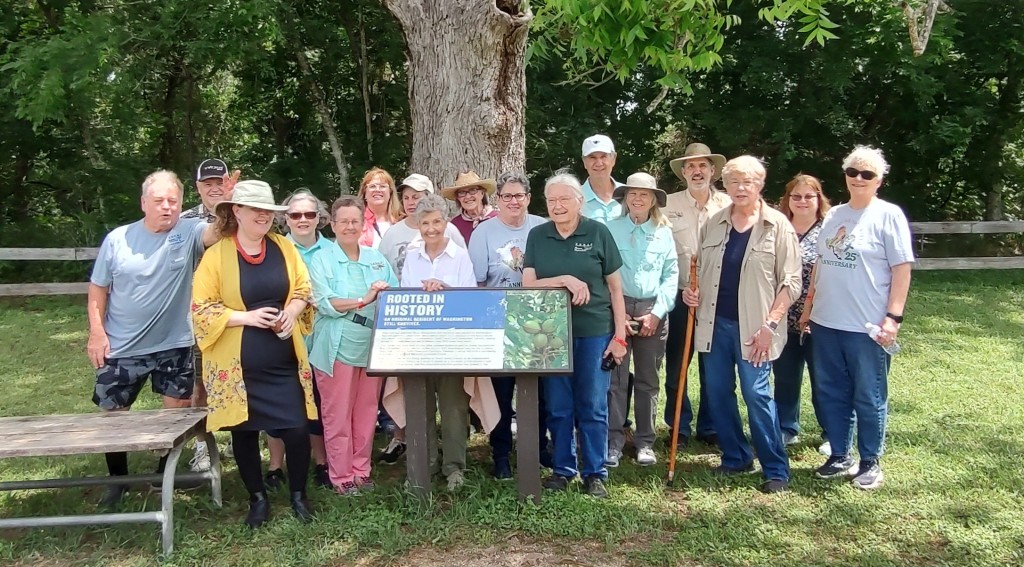
Master Naturalists under pecan tree
Group photo in front of famous pecan tree, including Master Naturalists and friends

The Texas Historical Commission has taken over management of the state park and is doing some major renovation on the facilities. The museum manager led the group through a lesson in the most major event in Texas history, and added information on how nature played a role in the events at the site. Sam Houston and delegates from every major city in Texas at the time met there to sign the Texas Declaration of Independence on March 2, 1836. The site was the capitol of Texas for several years, too. Lack of a railroad did it in in favor of Austin. 

There is currently an archeological dig that will be made visible to visitors once it’s complete. Several buildings have been reconstructed based on descriptions by visitors there to sign the declaration. The only original structure left from the 1830s is a water well. It was built with stone. The park sits on the Brazos River, which is why it was chosen to be the meeting site. At the time there was a ferry running to the site. There are also some paving bricks left from the original town. Nature took its toll on the main path to the river, and washed it out and away eventually. Another original, and somewhat old structure is still there, too. It is the pillars that marked the entrance to the original park. They are going to serve as the entryway into the archeological dig for visitors. 

The grounds, which have grown over the years, have been given over to nature. They are covered in native grasses, wildflowers and trees. The commission has to replant only the  state flower – Texas Bluebonnets – because people trample them while taking their pictures in them which disrupts the  natural reseeding. All the others manage to come back on their own. 

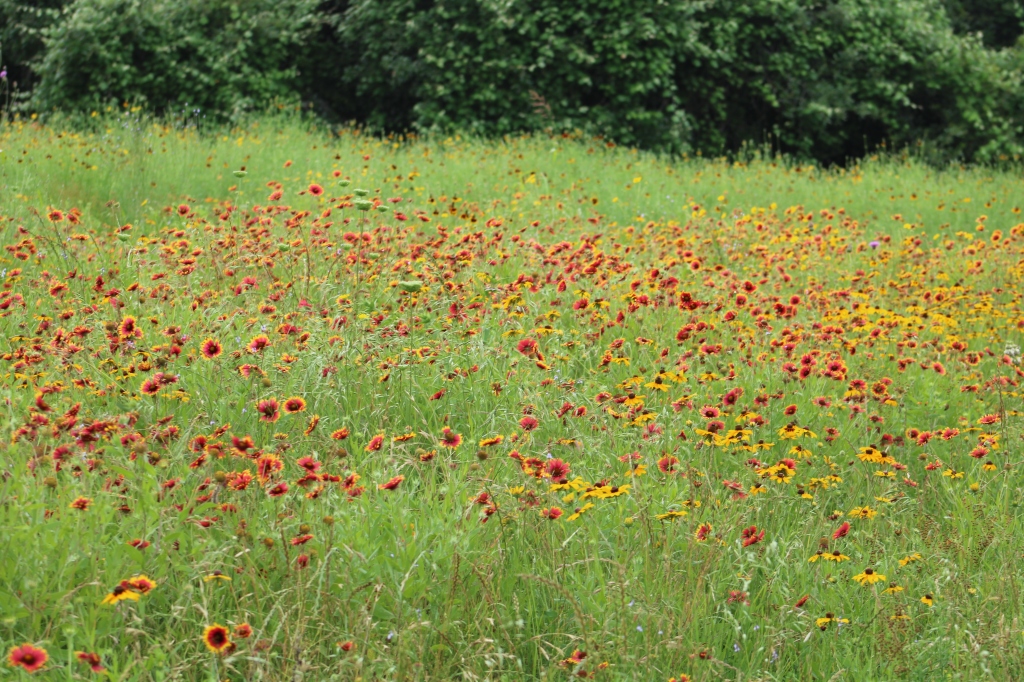
wildflowers
Wildflowers, mostly Indian blanket and black-eyed Susans.

There is a particularly notable Pecan tree on the grounds near the river (see photo above). It is the oldest documented pecan tree in the state of Texas. The delegates met under it during the 17 days it took to get the declaration written and signed. Ironically, it was discovered recently that it is not a native Texas pecan tree. Scientist ran DNA tests on it and discovered it originated in northern Mexico. It is assumed it came with early settlers from Mexico or perhaps missionaries that came up from Mexico sometime well before 1836. It was a pretty good size by then. If you go to the web site for Washington on the Brazos, you can order saplings from the tree. Costs for it are used by the commission to renovate the facilities. 

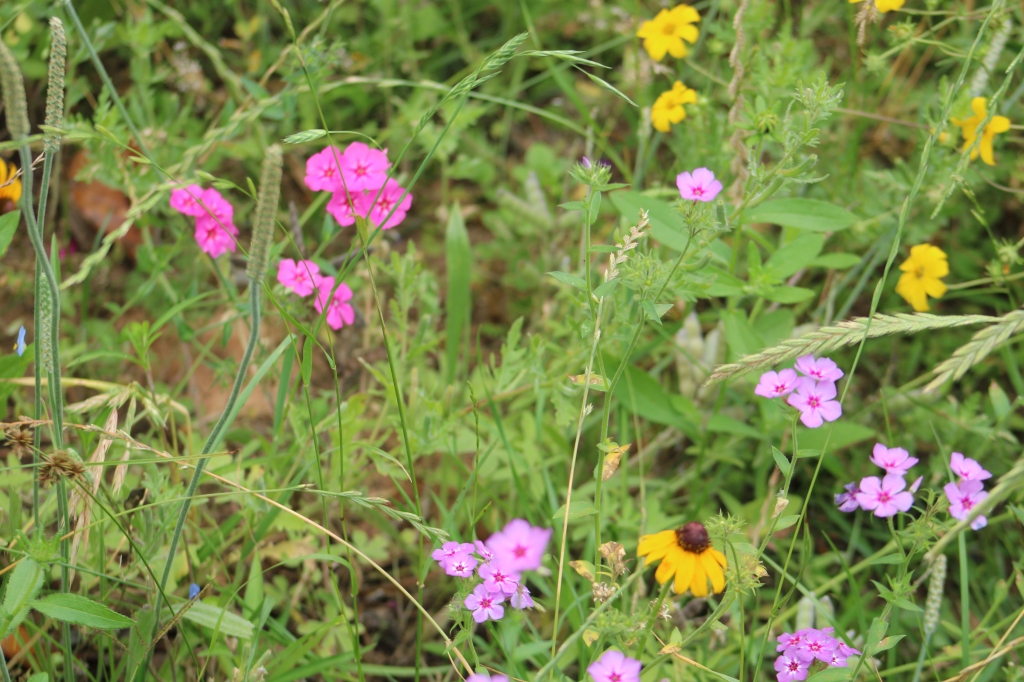
wildflowers
Drummond’s phlox, clasping coneflower, and Engelmann daisies.

Catherine Johnson, organizer of the trip, organized a picnic under the pavilions to round out the trip. It is a trip worth taking, especially if you take a side trip to Independence, Texas nearby. 

Take Care for Snakes

by Joyce Conner and Donna Lewis

If you have been paying attention lately in your garden or yard, you probably will have noticed that our friends, the snakes are back.

They are out grocery shopping for lizards, frogs, birds, eggs, and other small mammals. Humans are NOT on the list, but they will bite us if we scare them or step on them. Can you blame them?

So, when you move leaves around or pull weeds, you need to be observant.

Sticking your hand down into the brush might not be so smart. (Wasps might not like us to disturb them either, so beware of their bites and stings too!)

Texas Rat Snakes, Broad-Banded Copperheads, and Western Cottonmouths are the main ones out on our properties, so you probably have them too.

There are many more Texas Snakes in Central Texas, but these are the recently observed species.

Most people are really afraid of snakes. But, they serve a purpose in nature as all wild things do. As they go about their business of finding food, reproducing, protecting themselves from their enemies, and maintaining a comfortable body temperature, they are no different from any of the other wild animals on this planet. And, as a member contributing to the cycle of life on earth, they play an important role in maintaining balance. Without snakes, we would have an overabundance of insects, rodents, amphibians, etc.

Almost all snakes are docile and will not bite unless provoked. We just have to remember that “provoking” them may be no more than walking/reaching too near where they are lying in wait for a lizard to come by.

Yes, the snakes are definitely out of their dens and enjoying the change in weather!

On Wednesday, April 24, Joyce and Mike dealt with two snakes that same day. First, a rat snake was found in the chicken coop.

Here Joyce is taking the Texas Rat Snake out of a nesting box. Notice the black blotchy purplish pattern on its back in the second picture. Rat snakes are not venomous but can bite. Use caution when handling them.

According to Texas Snakes: A Field Guide by James R. Dixon and John E. Werler, the Texas Rat Snake is one of Texas’ longest snakes. Most adults measure between 42 and 72 inches. It is found in brushy and wooden areas and can easily climb trees. After checking out its length, Joyce put it in a bucket and released it at one of the ponds away from the house.

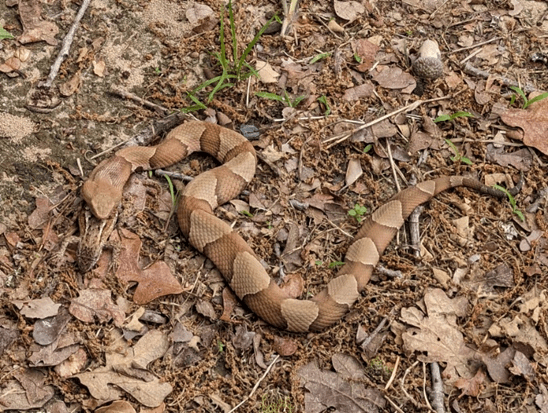
Later that same day, Mike nearly stepped on a copperhead just off the porch. According to Texas Snakes, the Broad-Banded Copperhead “is marked with wide, reddish brown crossbands that alternate with narrower tan to pale brown interspaces.” The adult grows to usually 30 inches long.

This one appeared to be young (they can live up to 18 years) and short (we estimated around 2 feet). It blended in nicely with the dead leaves and dirt. While Joyce photographed, it stayed completely still. Until she reviewed her first photos, she didn’t notice that it had stunned a lizard.

Each time the copperhead was checked, the lizard was a little less visible, as it was being swallowed whole.

After a while, the lizard had completely disappeared inside the snake.

Mike and Joyce do not handle venomous snakes and do not recommend anyone doing so unless well trained and outfitted with special snake-catching equipment.

When checked later, the copperhead was no longer found around the porch.

However, the next day, Mike and grandson Bryce saw a long rat snake in another area of the yard. Joyce wonders whether it could be the same snake she took away from the house the day before. Snakes can find their way back to an area by smell. Since Joyce is the snake wrangler at the preserve and she wasn’t around, the boys were unable to catch and release it that day. But no worry – if it goes into the chicken coop, Joyce will catch and release it elsewhere!