Creating Little Nature Lovers

by Sue Ann Kendall

I had a wonderful opportunity to introduce young people (and some adults) to observing nature and learning from it. On March 9, I was invited to help a Cameron Cub Scout pack learn how to behave in parks and what to look for when you’re out in nature. We went to Chalk Ridge Falls Park, which is in Belton, on the Lampassas River, next to the Stillhouse Hollow Lake dam.

River View

The park is a great place to take young people, because the trails are wide, there are safe stairs, and there are many different ecosystems represented (riparian, woodlands, and prairie). One caution would be that children have to be supervised, because the river has carved a pretty steep canyon that is NOT fenced off. Also note that while there are stairs down to the river, they are steep and would be difficult for anyone with physical challenges to handle.

There were twelve children in attendance, including a couple of siblings of Cub Scouts. There were plenty of helpful adults, as well, so I could concentrate on finding items of interest to show them. We talked about littering and damaging park property, since this public park has a litter issue. The Scouts hope to come back to do public service by picking up trash – it was their idea!

Checking out the bridge

We also talked about trail etiquette, such as not taking things from parks and staying on the path, which about 50% of the children were able to do. One thing I need to remember in doing this kind of thing is that nowadays many children will have attention-deficit disorders or may be on the autism spectrum, so it’s a good idea to present things that they all can benefit from. I did much better than I did last time I tried this, which led to a good time for all.

Since this is a city park, they probably expect kids to climb the trees.

Once the Den Mother and I showed the Scouts a few interesting flowers, bird nests, and pollen on tree catkins, the questions began. Some of the youngsters asked great questions about what they were observing or hearing (we heard a loud canyon wren, so I could explain that the park is the perfect habitat for them). I was asked about leaves, the berries on the cedar trees, how the seeds get in raccoon poop, and so much more. I was positively impressed at how much they got into the nature thing once they got started.

Exploring the woodland and future wildflowers

Parents and grandparents also were paying attention and asking questions, and the Den Mother and I were surprised at how far we ended up going down the trail. They didn’t complain about being tired until we’d been out more than an hour. Speaking of going down the trail, the grandmother who came along was using a cane to help walk the trails. She initially said she’d just sit and wait when we went down some stairs to go over a bridge, but she got so interested in what her grandchildren were seeing that she made her way down and went the rest of the way with us. When we were finished, she said she was now ready to do squats. We got a good laugh out of that. But, that’s what being out in nature can do for you!

These stairs were in pretty good shape, though, and the grandparent made it.

Here’s what made the nature walk worth it to this Master Naturalist. One of the Cub Scouts had asked me many questions and was fascinated by flowering trees and berries. As we walked off from looking at some new thing, he turned around and ran up to me, with his little face aglow and shining black eyes. He exclaimed, “I love nature now!” He also wanted a photo with me when we left.

Here I’m showing them an oak gall

One of the young girls was also having a lot of fun. We got to the place where we were going to turn around, and some of the families had snacks. Her family had left theirs in the car, so they were going to go on back. She looked stricken and said to her mom, “But I want to stay here and continue this adventure!” I have to say I agreed with her. There was lots more to see, since there are many trails in the park.

Nice trails and plenty of resting spots

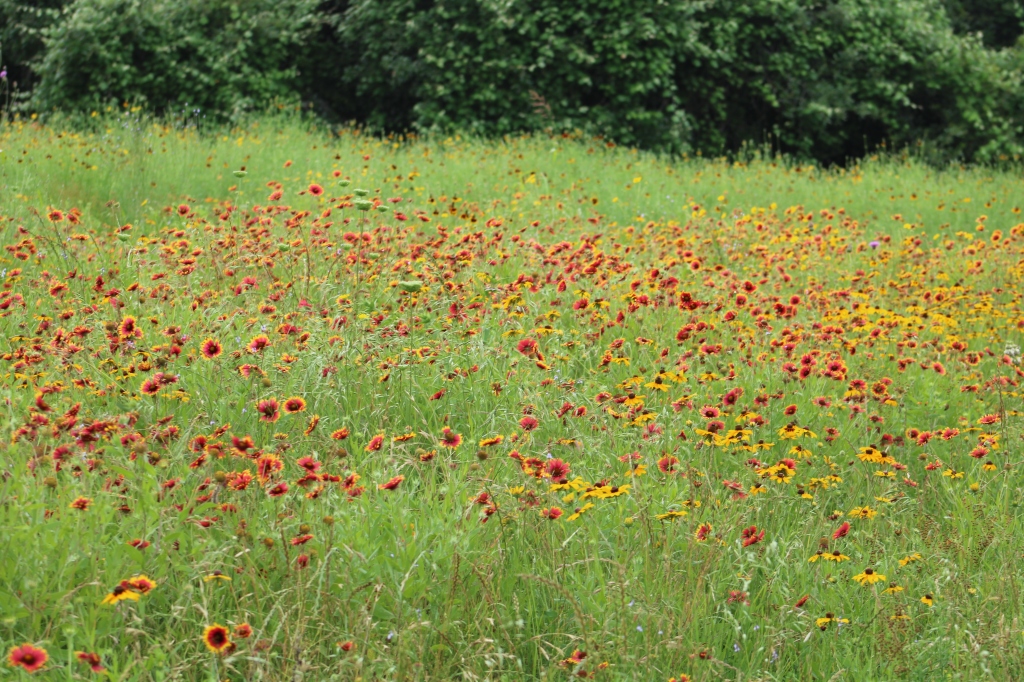
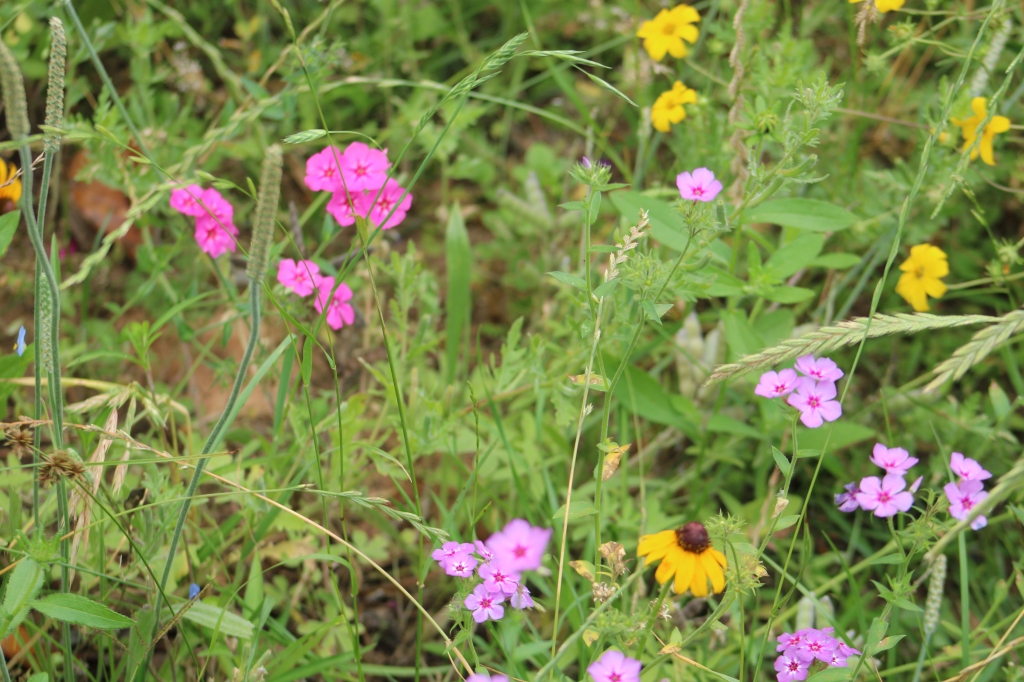
More than one parent mentioned wanting to come back and go further, without children. I think a field trip to do a BioBlitz here would be very worthwhile. I heard four types of wrens (before the children arrived) as well as other interesting birds, so it would be a good birding spot, too. Here are some of the things we saw.

I sure hope I can find more opportunities to lead nature walks. I think interpretation is my favorite part about being a Master Naturalist. I was so happy to see how much learning took place!

Alien Abductions in Milam County!

by Eric Neubauer

The rash of alien abductions in a certain sector of the Alligator Creek community has finally come to an end although they don’t know it yet. They have suffered being scooped up and moved through a series of examination rooms, often with bright lights, and being occasionally prodded for over two months now.

My earlier photos of Schizocosa perplexa weren’t good enough to do the species justice, so fixing that was on my project list for this winter. I started looking sooner, discovered the mid-juveniles in December and found they were easy to identify. Then I checked back whenever the weather was warm as the mating season approached. First the males became adults, and then finally the females just this week. Photos of a female are included here.

Whether they deserve a conservation status or not is unknown. They appear to have very specific habitat requirements, specifically wooded flood plains with long lasting vernal ponds. Substrate is important as I could only find them in two places in the Blackland Prairie part of the county. I’ve looked carefully in the Post Oak Savanna part and couldn’t find any. My local colony appears to have had a good year. The other colony in Milam County was gone this year. It may have been active
earlier but by the time I checked it last week, the ponds were already dried up and the leaf litter well picked through by armadillos. The original specimen came from Garland, Texas, and iNaturalist observations suggest robust populations in the Dallas-Ft. Worth area. These observations lack underside views so the species can’t be confirmed. S. perplexa is also known to be in Ohio.

No spiders were harmed during this project and all are alive, free, and well at home unless they got eaten by a frog, armadillo or suffered some other misadventure.

Bivalve Bayou

by Alan E. Rudd

The original plan for February 16, 2024 was to conduct a long downriver trip on the Brazos to examine spots suitable for an overnight canoe trip in spring. However, lots of rain upstream inundated the very sand and gravel bars that serve as the best camping spots. An alternate plan was in order, so the team of intrepid explorers chose a feeder stream known to be shallow, gravelly, and home to mollusks. Call the stream Clam Creek, Mollusca Millrace, or Bivalve Bayou. Mussel Run turned out to be a special place on a special day.

The warm February air on a Friday morning we knew would soon turn cold, with a blue norther due to arrive the next day. Victoria and Rosie were eager to put some paddling time in as a tonic for spring fever, so we did a reconnaissance canoe trip down this creek that is usually too shallow to allow boat travel of any kind. Dragging two kayaks and a canoe down into the creek-bed was easy as the rainy winter had grown a deep carpet of winter grass along Mussel Run Creek in Falls County.

The three of us claimed “First Descent” along this small tributary of the Brazos River, since it was an unknown path to any and all in our group of “river runners.” In the grand scheme of things, others have surely traversed and crossed this old watercourse. Having a name on the map so appropriate to what we would find along this creek is a sure indicator that other people have visited here often. It has likely been known to many people, and probably over thousands of years.

Paddling the first 200 yards of this 7-mile run we found sand bars littered with the shells of bivalve mollusks. Many were freshly opened and probably eaten the night before. Racoon tracks were everywhere in the freshly washed sand. River Otter tracks were less abundant but also found along with beaver slides and feral hog sign. Mussel shells numbered in the many hundreds on the sandbars. Rosie wondered out loud if any of the species we were seeing were edible. “Sure they are! Particularly if you’re a racoon”. Wise guy…….

We found Giant Floater clams (Pyganodon grandis), Yellow Sandshell (Lampsillis teres), Threeridge (Amblema picata), and Mapleleaf (Quadrula quadrula). These mollusks were new to me, but Justin Grimm at Brazos River Authority quickly identified them from my amateur photos.

Justin is environmental programs coordinator at Brazos River Authority in Waco. Part of his duties are to survey and document the health of a wide assortment of aquatic plants and animals in one of the largest watersheds in Texas. This creek originates in upland areas east and north of Marlin, Texas. Streams which contribute flow in this watershed are Wild Horse Slough, Big Creek, Cedar Creek, and Brushy Creek among others. It is not until this stream reaches that flat red soil of the Brazos River flood plain that it obtains the name Mussel Run on the USGS topo maps.

We noted that the farm fields above us were located on fine red “Brazos bottom” alluvial silt that appeared to be 20-25 feet thick when looking up from the watercourse. Below it at water level there was a stark change in the geology, with a layer of bright white limestone conglomerated-gravel, with the aggregates being about the size and smoothness of ping-pong balls. This gravelly rock layer contributed most of the material that made up the hard bottom of the creek-bed we could feel with our paddles. I wondered if this high-calcium gravel accounted for the habitat that provided such a top-quality home for all these bivalve mollusks.

One thing for is for sure, and it is that this creek has been a major access barrier for river bottom farmers for most of the last two centuries. The creek channel is uniformly steep and has actively eroding sections of alluvial soil at almost every turn. Crossing it with mules and plows in the 19th century or with tractors in the 20th and 21st century has had to require extraordinary effort. The bridge we launched at is a brand-new concrete “highway-quality” structure at the end of a Falls County road. As we traveled down-stream we paddled over a concrete low water crossing probably 3-4 decades old clearly built by the landowners and not Falls County engineers.

We also passed under a high bridge structure that had steel I-beam upright pilings and a rickety wooden deck. This structure was a proper place to eat lunch but had signs on both ends stating WEAK BRIDGE CROSS AT OWN RISK. River bottom farm families have likely been using this structure since the 1920s, but heavy modern agricultural equipment crossing this structure is out of the question these days. A large disc plow was permanently embedded in the bottom of the creek where it apparently slid down an embankment during a severe erosion-causing flood event. It was a stark warning about the power of rainwater visible from the lunch-time observation spot.

Because this creek had flooded only 4 days prior to our trip we were able to float over almost every rocky riffle and fallen tree. Once we reached the confluence with the Brazos River, we got the opportunity to deal with the remains of that flood, to the tune of 6130 cubic feet per second (cfs) water flow. Riding on top of this dense flowing mass one can quickly cover miles with only moderate exertion with the paddle. The power of flowing water to excavate and move soil, push trees, and shove large objects is widely renowned. The reason is that water itself is so very heavy (62.4 pounds per cubic foot). The water flowing past us as we entered the river amounted to a 382,573-lb. object shoving us down-slope every second. Being whisked along was a joy after the hours of hard paddling in the slow water of the creek. What is most dangerous when the river is high are obstacles. If you get lodged against a tree or other immovable object in the stream, the force of the flow will quickly bend you and your boat into a very abnormal shape, and then hold you there like an angry 382,000-pound sumo wrestler. It is not an exaggeration to say “Death can come quickly.” Fortunately, we skimmed along the surface in mid-channel and arrived to have our pick-up crew (Adam and Angie) throw us ropes and pull the boats up the muddy shoreline. Now we know what is up along Mussel Run Creek and have the luxury of staying next to the wood stove on a Saturday morning.

Outreach to Rockdale Rotary

by Catherine Johnson

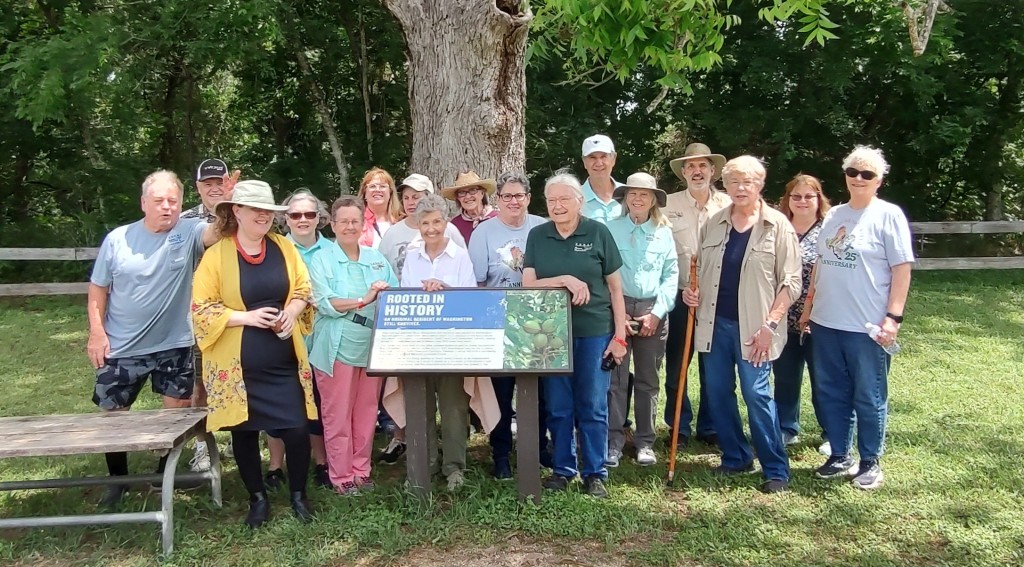
We had a good time at the Rockdale Rotary meeting this week, where we had lunch and shared information about our chapter.

They are a nice bunch of people working for the community. We appreciate the opportunity to tell the community a bit more about the Texas Master Naturalist program.

Need a Grass Expert?

by Michelle Lopez

It’s an exaggeration to say that the members of the El Camino Real chapter that have been taking a weekly class with Dale Kruse are grass “experts,” but we’ve been learning from one! It’s hard learning technical terms and yet it’s fun at the same time. Dale is so patient with all of us! 

Here are some photos from their most recent class.