Those of us in and around Milam County, Texas know there are more native mammals out in our area besides deer, cottontails, raccoons, opossums, and armadillos. But many aren’t easy to spot. I’ve never seen a porcupine, for example, but I know they’re out there. Occasionally we will spot coyotes, bobcats, or (very rarely) mountain lions. The most fun mammals we look for, though, are beavers and river otters.
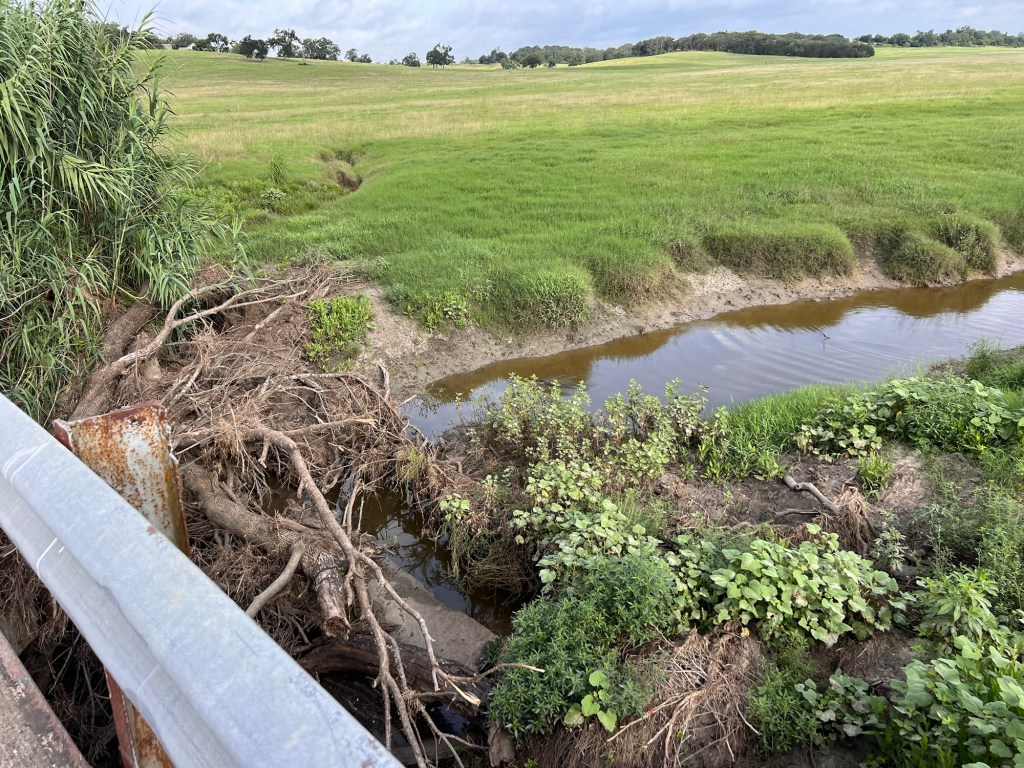
A likely sighting site, Walker’s Creek bridge on County Road 140, featuring: flood debris.
This morning I was doing my daily walk to the bridge and back, dreading the inevitable scattering of annoyed vultures (today both Black and Turkey) who have been patiently working on what appeared to be a deceased Holstein steer, which must have come a long way, since we have no Holstein cattle nearby.
Cow mercifully not shown. Zoom in. There are many vultures.
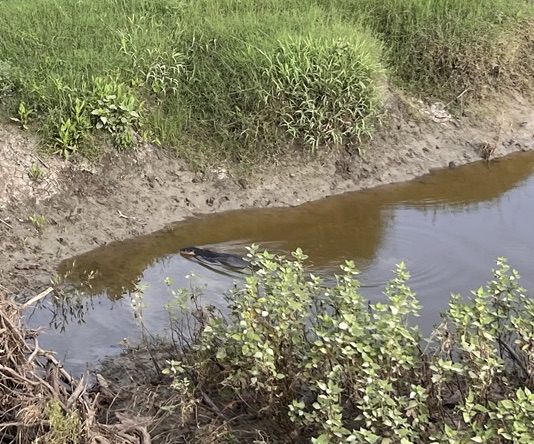
Sure enough, I scared the giant birds off. Then I noticed a head larger than that of a turtle or snake in the creek. Ooh! A mammal! I was instantly ready to snap a photo, figuring it would see me and exit.
Aha!
Sure enough, something brown and wet was exiting. Was it a beaver or an otter? I was ready to verify by checking its tail.
Looks skinny.
Yay! It was a river otter! How fortunate I was to see this water mammal! I’ve seen two swimming together here a few years ago, and one crossing our field after a big rain. That was very cute.
100% otter.
I didn’t take too many more photos, because I was enjoying the moment. But I was very happy to finally document one on iNaturalist!
Getting the heck away from me.
River otters are also called common otters (Lontra canadensis). As their scientific name suggests, they are found all over North America, except for a swath of territory in the center of the country.
Hmm.
They love to eat fish, crayfish, and turtles, but will also eat other small animals. They aren’t a danger unless you own a fish farm, which would lead to happy otters. River otters also love to play, which makes them very popular in zoos.
Not playing, getting away!
I’m glad we still have some otters here in Milam County, because they’re a sign of healthy waterways. I guess Walker’s Creek is pretty good other than pooping and dying cattle.
I’m still looking for a beaver, though I’ve seen evidence at a fellow Master Naturalist’s property nearby.
Bonus observations:
I saw a Northern Cardinal eating away at the berries of a nettle-leaf noseburn vine. more fell to the ground than went in.
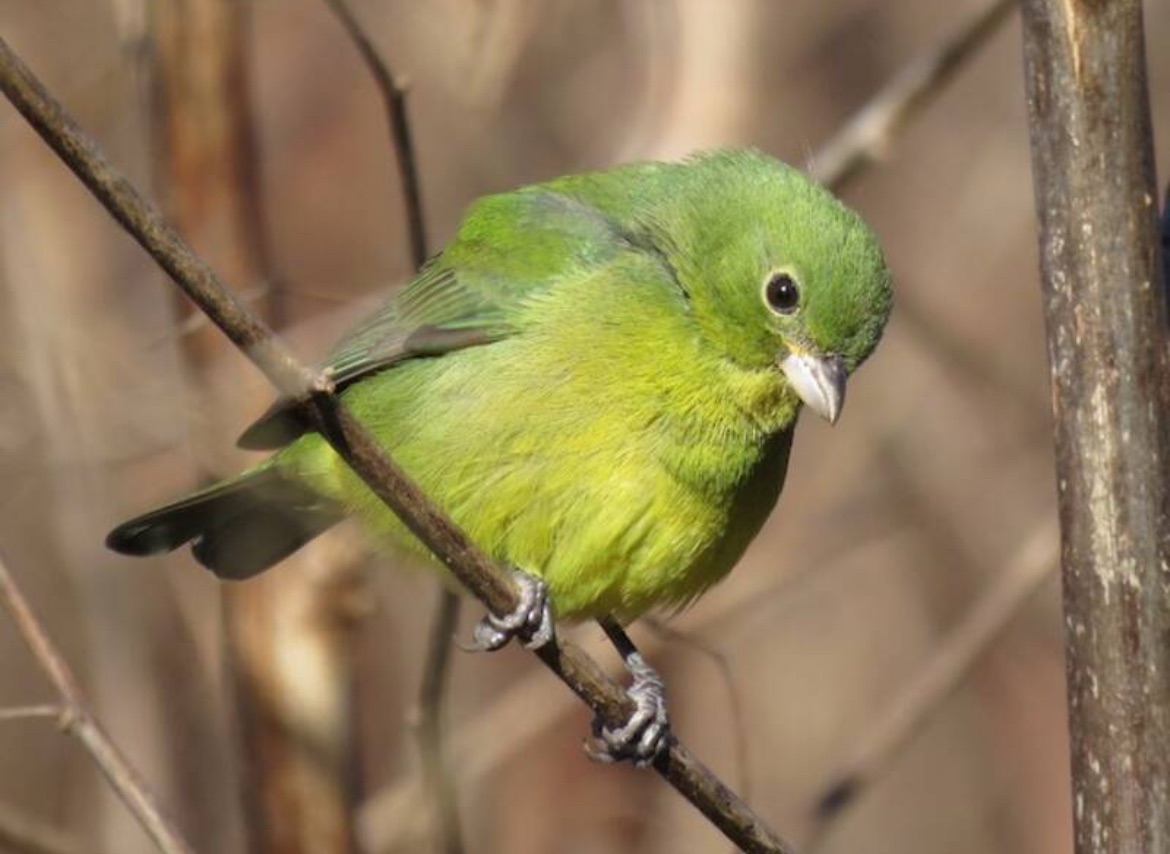
Yesterday I was swimming when I saw a small bird bathing in the shallow “beach” end of our pool. I figure it was a House Sparrow, but her breast was yellowish. Then she shook her wings. She was a Painted Bunting! I’d never seen one at the pool before!
Also yesterday I heard a Summer Tanager, and something chirped back. It was the female, for once not hiding. I’m always impressed with myself if I can ID a female bird of a species with drab females.
Nettleleaf noseburn Tragia urticifolia – photo by Sue Ann Kendall Female Painted Bunting Passerina ciris – photo by Lloyd DavisFemale Summer Tanager Piranga Rubra – photo by Don Danko
A week ago, two members of the El Camino Real Chapter, Texas Master Naturalist were invited to scope out the property of a third member to see if there were any interesting plants, birds, or other organisms there. Ann Collins and I made many discoveries at Carolyn Muller’s Burleson County property.
Ann and I experiencing species overload.
It’s always a privilege when private landowners allow you to catalog what’s on their land, so we’re very grateful to AD and Carolyn for their hospitality. We enjoyed finding out what thrives in this sandy soil with a nice mix of hardwood forest and untouched prairie-like fields.
A stand of Lemon Beebalm leads to the woods.
While Ann and Carolyn worked on bird observations from a guest cabin porch, I ran off and checked out the woods and open area under electric lines. There are often great flowers in those areas.
I then found a nice wide path through the woods with many Halloween decorations on it. While they weren’t great for iNaturalist, I’m sure little kids love it. And I found my first interesting milkweed, Tayalote (Cynanchum unifarium).
Too bad it wasn’t in bloom.
After I got back and we practiced entering sightings into iNaturalist, Carolyn took us on a ride around all the impressive paths that wind around to various outbuildings and such. There we found interesting mosses and fungi.
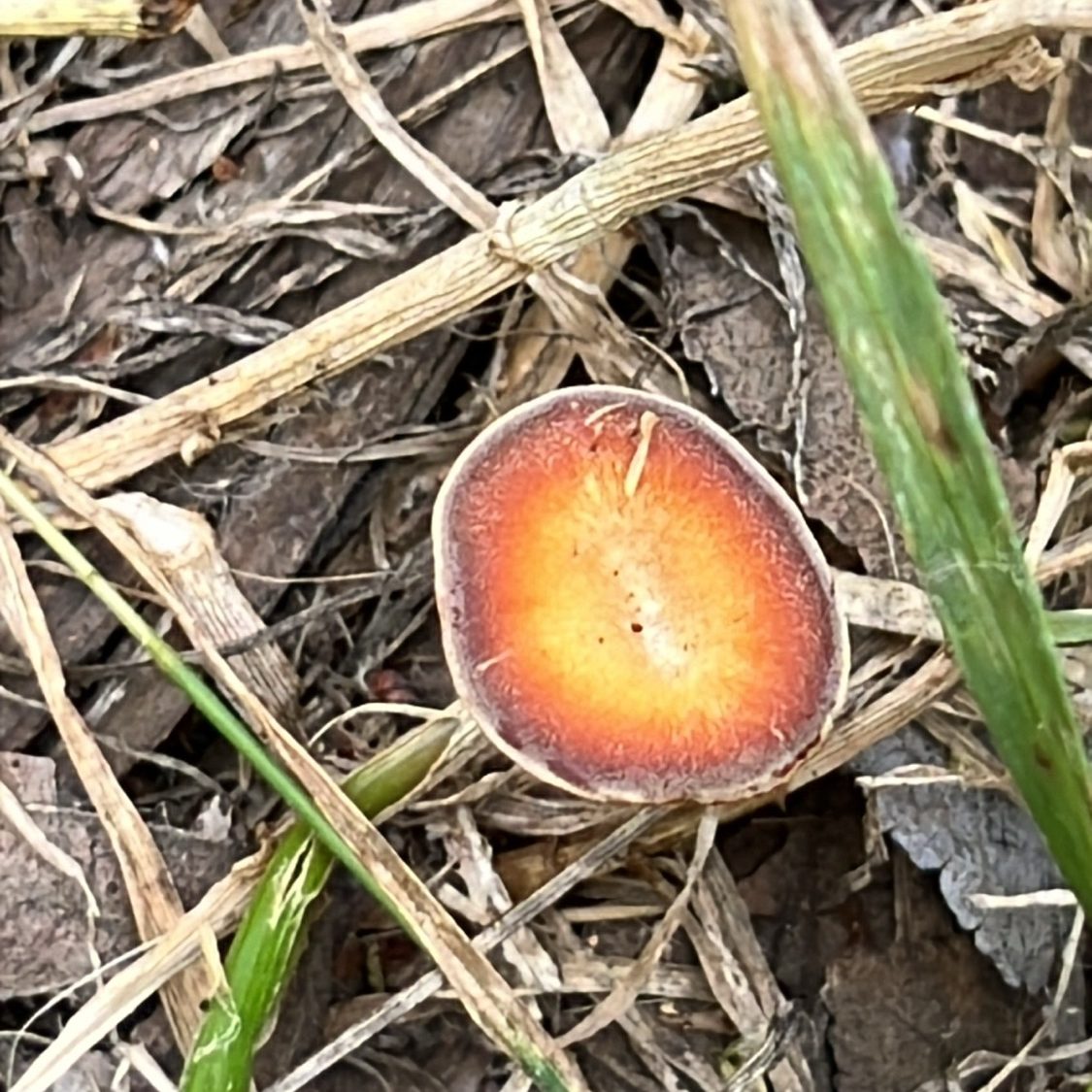
Pale Cow-hair Moss (Ditrichum pallidum) was interesting Coral-pink Merulius (Phlebia incarnata)Meadow pink (Sabatia campestris)Not sure Ringless Honey Mushroom (Desarmillaria caespitosa)
The highlight of the visit was the magical wildflower patch. It grows in a strip where a neighbor had erected a tall wildlife fence about ten feet behind regular cattle fencing. This strip doesn’t get mowed or grazed. It was spectacular.
Wildflowers galore!
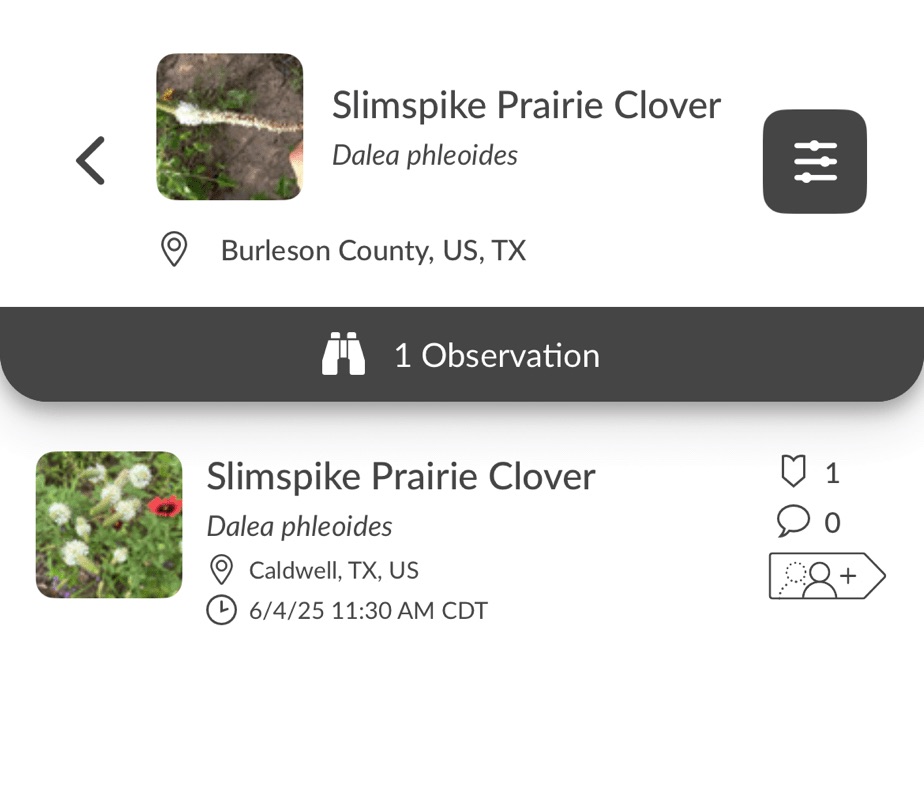
This area also contained plants neither Ann nor I were familiar with. Upon investigating, I found some of these natives have very few sightings in Milam or Burleson Counties. In fact, this Slimspike Prairie clover was the first observation in Burleson County. There are only 4 observations in Milam, all but one by a chapter member!
They are so prettyJust one observation in Burleson CountySlimspike Prairie Clover (Dalea phleoides)
Other interesting rare plants were these. Maybe they’re not spectacular, but they’re not observed often.
Ann and I were pretty hyped up about all these new plants, and Carolyn was thrilled to find out her property had plants we got excited about. As we looked around the property more, we also found yellow passionflower and the beautiful propeller flower, purple pleatleaf or Alophia drummondii. I stuck in some scenery so you can see the big picture!
Yellow passionflower, a favorite of mine (Passiflora lutea)Alophia
After another fun ride through the paths, we headed out, but I had my brain full of new-to-me plants, and Ann enjoyed hearing and seeing Swainson’s Warblers, Summer Tanagers, and two vireos (white-eyed and yellow-throated).
What a varied place to investigate.
We’d all love to return, and we plan to arrange friend trips. The presence of air conditioned rest facilities with refrigerators and water will make this a great place for our chapter’s naturalists to explore and learn about the amazing variety of ecosystems in this part of Texas.
I went out to Wild Wings Bird Sanctuary yesterday to see what birds were out there and to take some new resources for visitors.
Oops! Lost a tree.
I joined Ann Collins, who was as happy as I was to see new bluebird houses have been put up, one in the sanctuary and two others along the property driveway.
Next year’s Bluebirds will love this!
We appreciated the newly planted native plants and red lantana in the raised beds, and no doubt the hummingbirds will, too.
New plants.
That’s good, because curious heifers have been having too much fun with the official hummingbird feeders. You can’t help but be amused by them, though. Gene Rek found one of them had drunk all the water in the bird bath and was licking the water dripping down the drip chains. That’s just too cute.
Yum!
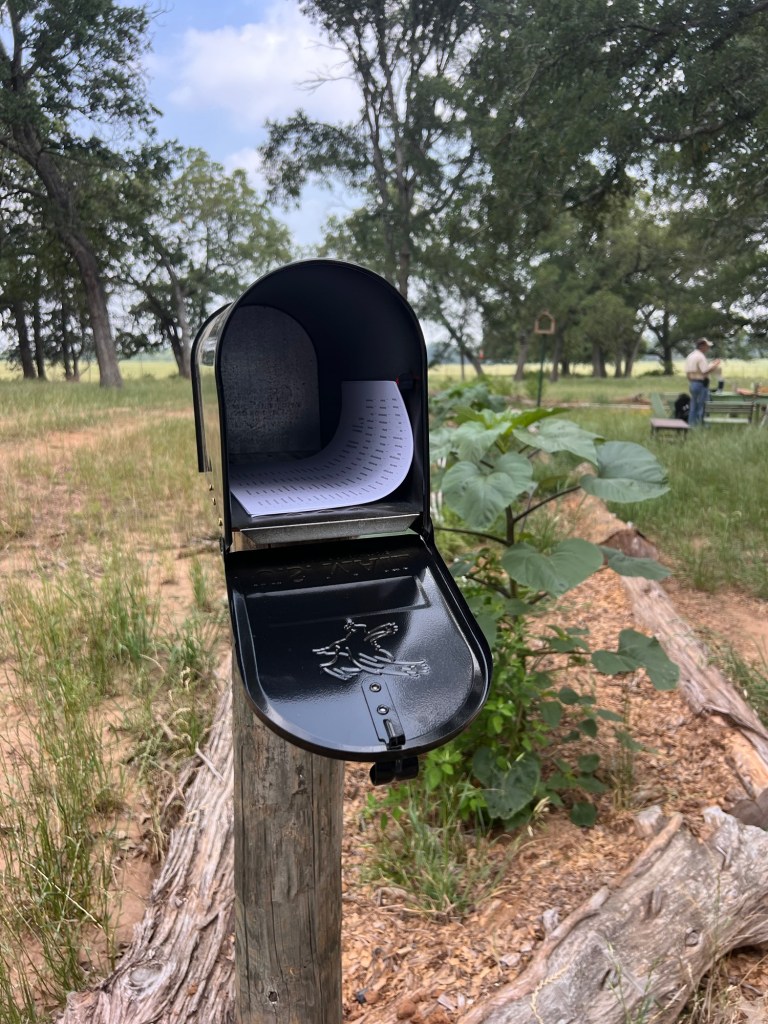
As we listened and watched for birds, I put two of our new bird sheets in the mailbox for visitors to take. One’s an alphabetical list of birds found in Milam County (an updated version is linked on the Wild Wings web page), and the other is our beautiful color bird sheet to help visitors identify what they may see at Wild Wings. You can also download your own copy on the web page. By the way, there’s also a bird list in taxonomic order in the collection as well. As soon as I can get these printed, you’ll find them in the mailbox as well.
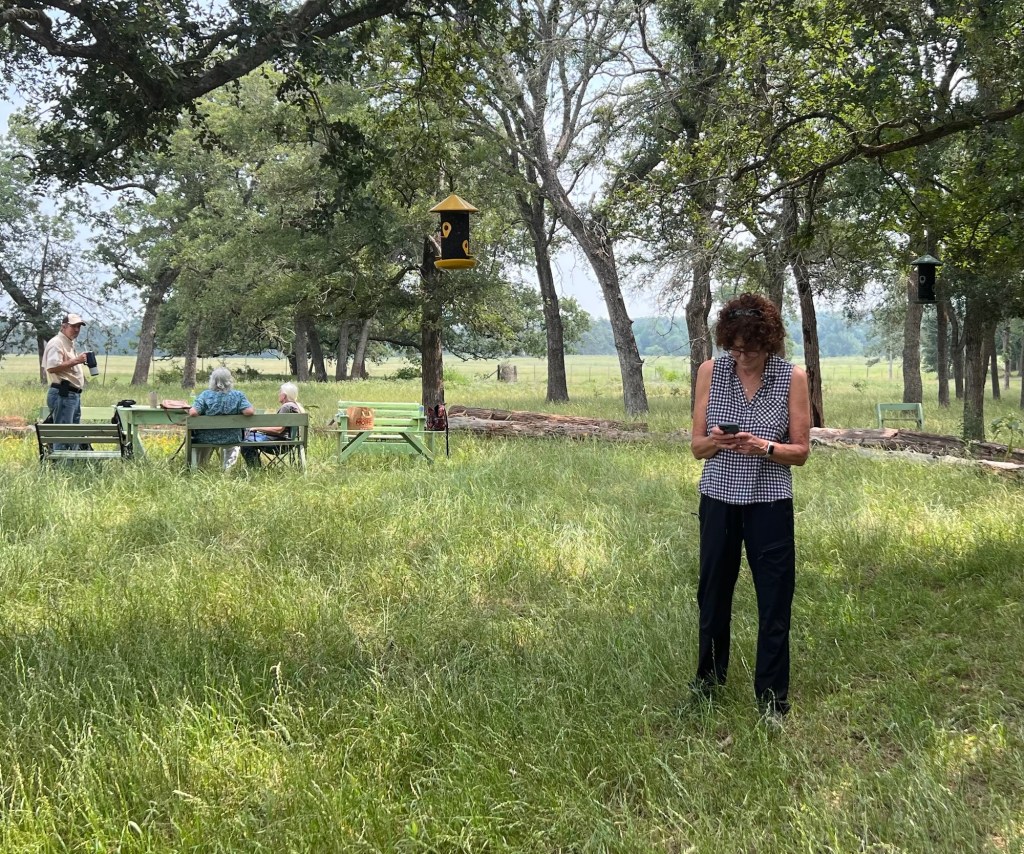
Shady meeting area.
We are still waiting for our signs to arrive, but I did put a few magnets in the mailbox, so visitors will know they’re at the right place.
I forgot to take a picture of the mailbox!
Mornings are a wonderful time to hang out with the birds and squirrels, so check out our growing sanctuary! Enjoy some of the sights we found during our visit.
Very cool grasshopper exoskeleton Bold jumping spiderArmy workCicada exoskeleton Brittlestem?Hard to ID. Pretty cluster. Lots of insects in this spotted horsemintInsect on pokeweedWhite example of usually blue white mouth day flower.
There I was yesterday, sitting in my back yard, listening to birds and trying to read a book, when I heard a noise in the adjacent pasture, a few feet away from me. Usually when I hear something it’s one of the cottontails coming out of their den to munch on grass, or the cotton rat family traversing their tunnels along the fence line. Y’all, cotton rats are very cute (and no doubt delicious to hawks).
Hispid cotton rat (Sigmodon hispidus) on my porch
When I turned to look, I saw a massive moving blob. I took a photo of it, in case whatever it was moved away before I could get closer.
Can you see it?
I shouldn’t have worried, because the blob turned out to be two Texas Rat Snakes (Pantherophis obsoletuslindheimeri) (our subspecies of Western Rat Snakes) engaged in their mating rituals. This is one of the most interesting things I ever saw in my life, and I’m no spring chicken and have seen many things!
Texas rat snakes are more colorful than other Western rat snake subspecies.
I took many photos and even a two-minute video, that I hope will upload to this blog so you can watch all the undulations and pulses they go through. You can even see the female’s cloaca.
Yay! It uploaded!
I was spellbound. What a privilege to see this behavior out in the wild, right next to my birding chair (eek).
So pretty.
Being the semi-scientific type that I am, I looked up what I could find out about the mating practices of Texas Rat Snakes. It wasn’t easy, because there was little literature specific to these snakes, and nothing mentioned the bit about putting one’s head in the other one’s mouth that I think I saw.
What’s going on here?
However, I did learn that rat snakes mate in May and early June, making this prime time to enjoy the spectacle. Male rat snakes have a two-pronged penis (hemipenis) that is inserted into the female’s cloaca to deposit sperm. They spend a lot of time coiled together (up to an hour), though not all of the time is actually mating. I guess it’s a good time for all.
I was glad to see both heads looking fine.
Texas Rat Snakes lay 10-12 eggs 5 weeks after mating, and they hatch in early fall, which is, not coincidentally, when I tend to see many baby rat snakes.
This one just ate one of my eggs.
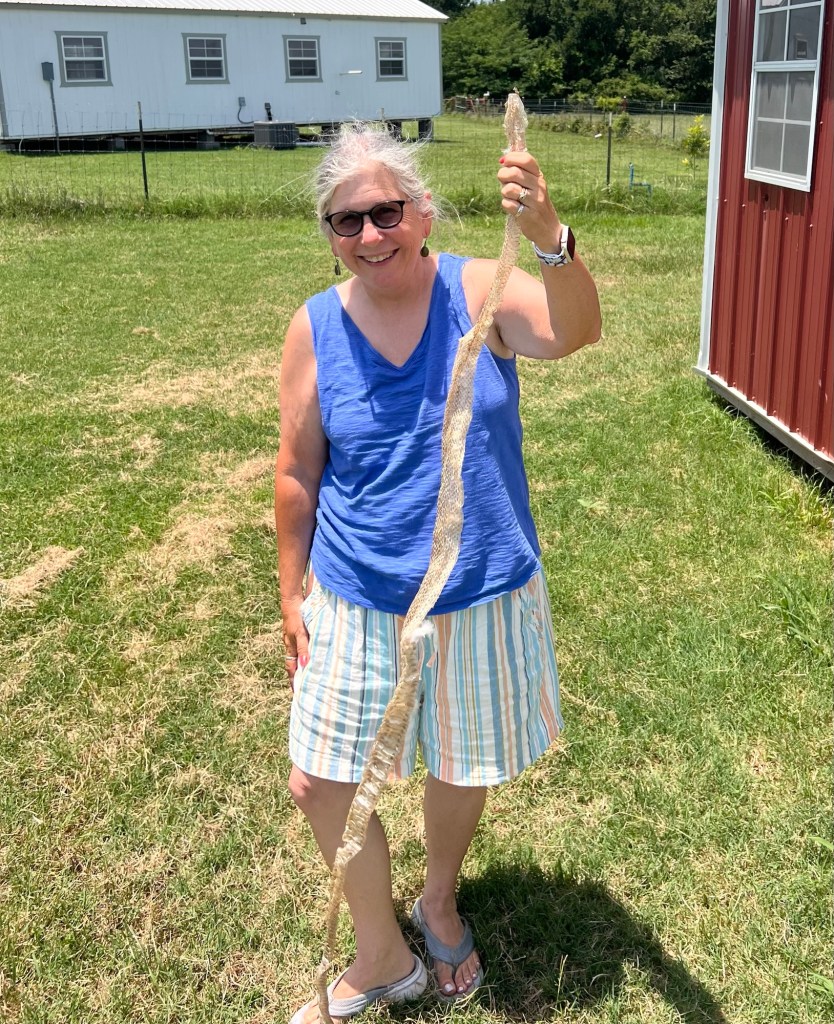
On my property we have quite a few of these snakes, which eat many of our pesky rodents, and many of my chicken eggs. I found a shed skin in my chicken house that was taller than me (I’m 5’2”) which makes sense, because rat snakes are the longest snake found in North America (up to eight feet, though Texas rat snakes usually top out a bit smaller).
Ignore my hair and look at the snakeskin! Photo by Asphalt.
They are constrictors, so that’s how they subdue small mammals before eating them. They will eat pretty much whatever animal they find. Their predators are hawks, especially Red-tailed Hawks, and where they have them, minks. I don’t think we have minks in Milam County, so that’s one less thing for the snakes to look out for.
Checking the hen house.
I really enjoy observing these snakes and consider any eggs they eat to be payment for mouse patrol. Note that they are great at climbing, and it’s fun to watch them climb walls. In fact, when we kept one as a pet for a few years, its name was Climber.
Climbing
By the way, this is prime snake season. I saw two plain-bellied water snakes today, on the Walker’s Creek bridge and in Walker’s Creek, north of Cameron, Texas. My friend Pamela found one at her house in a bucket of water, too. They are non-venomous snakes, like the rat snakes, so I just watch them and let them do their thing.
It was crawling off the bridge.I love the patterns they make in the water. Heading for shore.Photo by P. Neeley.
Today we had one of our first educational sessions at the Wild Wings Bird Sanctuary, sponsored by the El Camino Real Texas Master Naturalist chapter. Although there’s no denying the weather was toasty and humid, the attendees all learned about Merlin Bird ID and iNaturalist.
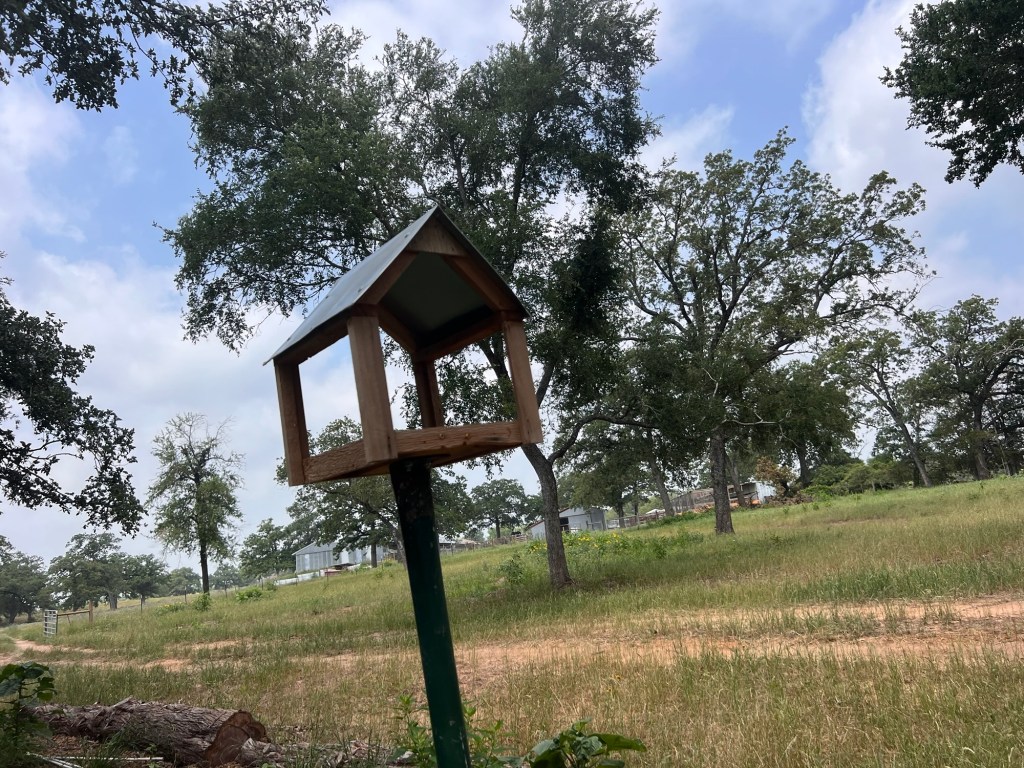
Practicing with MerlinMany wildflowers surround the Wild Wings Bird SanctuaryNew platform feederMailbox for things to shareThere’s a birds of Milam County checklist and some tools you can borrow in hereBonus: a Wheel Bug Arilus cristatus
I enjoyed leading the discussion, since I just retired as an adult educator and miss teaching people. I’m grateful for the opportunity to give back to the chapter.
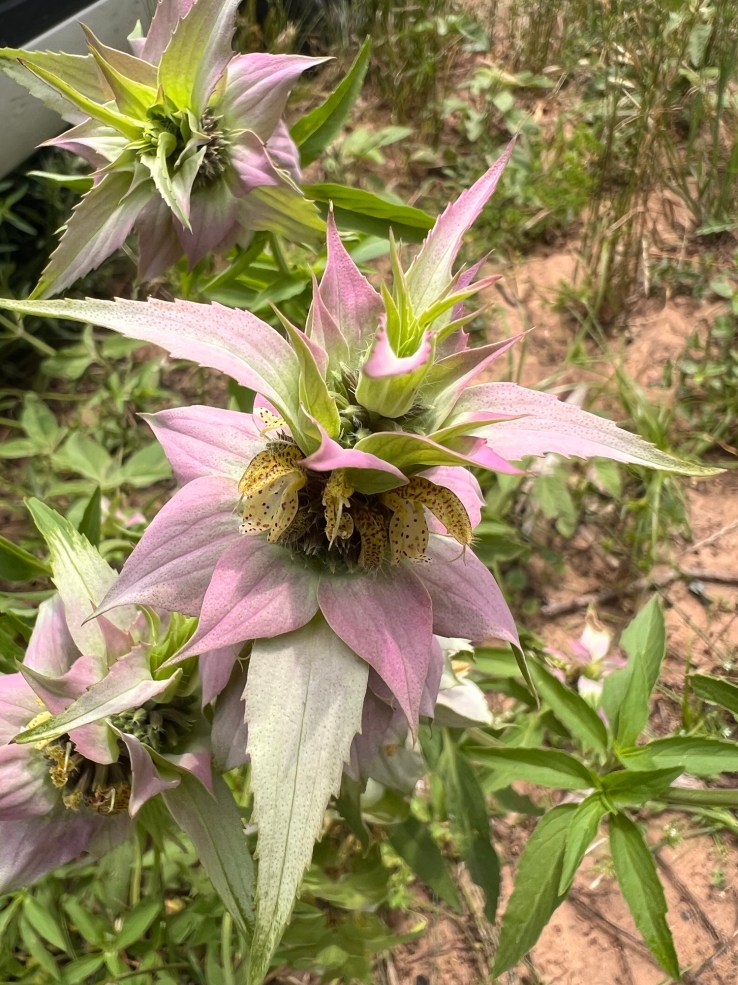
When I parked, I went next to this Spotted Horsemint (Monarda punctata). You sure could smell it!
Anyway, before we started, one of our members brought a baby bird she has been caring for to try to identify it. We enjoyed watching it eat and peep. No doubt it will soon be in the hands of All Things Wild or another rehab organization, but for now, the little Blue-gray Gnatcatcher or Mockingbird seemed in good shape. Interestingly, more than one of us tried to use Merlin Bird ID to identify it, but depending on the angle of the photograph (or something), different birds came up. On iNaturalist, my photo came up unambiguously Blue-gray Gnatcatcher, however. And looking at the bird, it seems more likely to be a Gnatcatcher than a Mockingbird or Phoebe. It will be interesting to find out how it turns out.
Getting a photo with the tail feathers seemed to help.
The class had a mix of learners, from people who were unable to access the App store to get either app on their phone to very quick learners to experienced helpers. I did my best to help everyone but always got stumped when I can’t remember their passwords for them (I can’t remember mine either, but have finally found ways to find them when I need them). I can help people later! Oh, and those with Android phones weren’t able to acquire the new iNaturalist, because it’s only out for iPhones, to the great consternation of some of our power users!
Merlin
The good news is that even some of the experienced people learned new features of Merlin Bird ID. Some of the most helpful information is kind of buried among menus and options with cryptic symbols. We had a lot of fun seeing what the most likely birds in the area around Wild Wings would be, and people practiced the step-by-step and photo ID features. I enjoyed showing learners how to get to additional information about birds they identify, such as migration patterns, songs and more.
Most important from a “citizen science” viewpoint, is that everyone learned how to save an observation to their life list. There were some very gleeful folks who started to build out their lists. Who doesn’t enjoy seeing a bunch of stars appear and the words “New Lifer!”? I sure enjoy it, even with 333 birds on my list (I travel a lot, so there are lots of East Coast, Colorado and Arizona birds). These observations go on eBird, where biologists and others use it to track patterns of movement, migration, and numbers. The more people record observations, the more information they will have.
My most recent birds. Can you tell it was migration time?
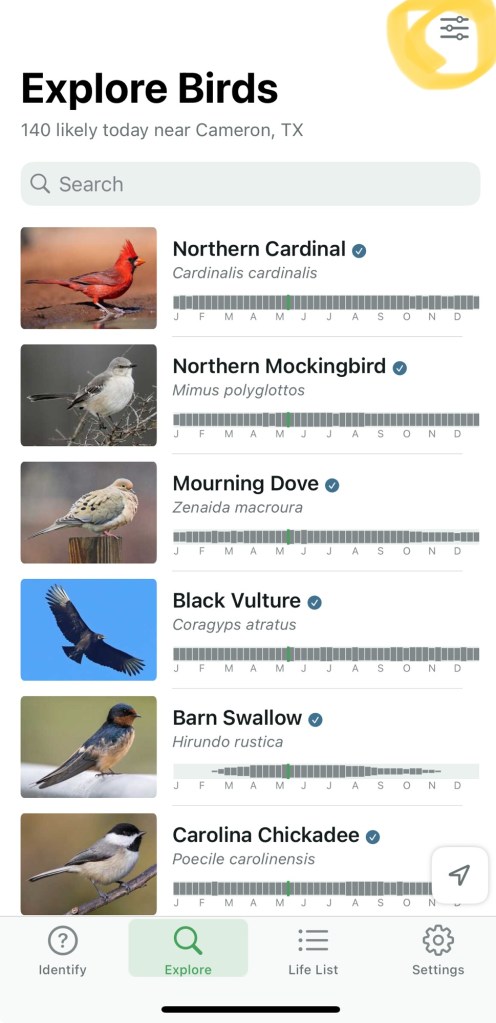
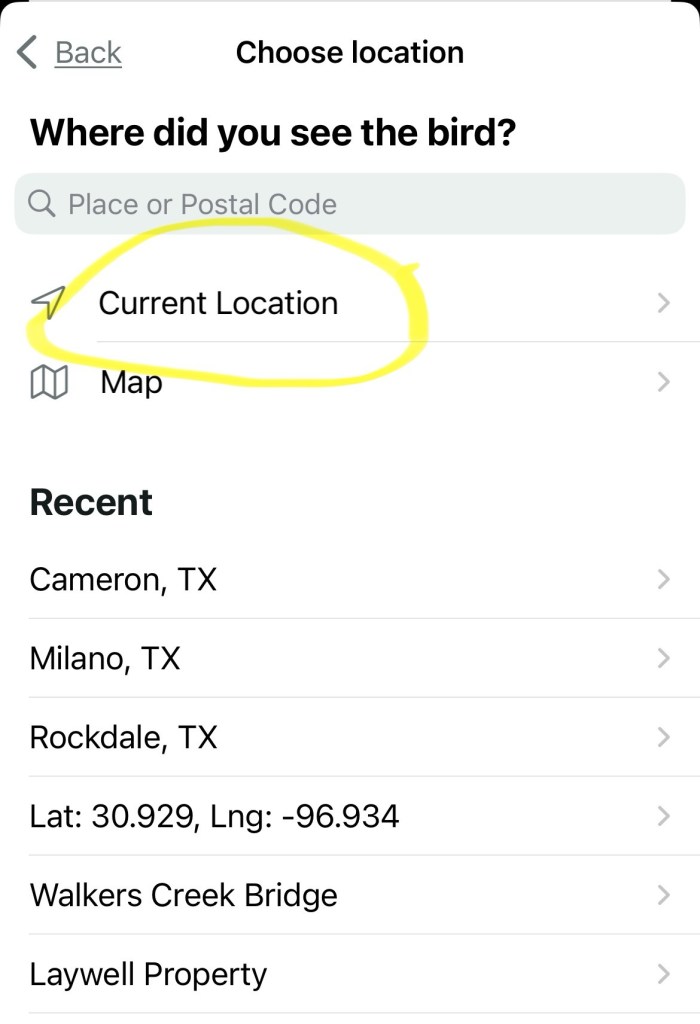
It’s important to remember that the birds identified by the AI software used by Merlin are not always accurate, as I’ve written about before. For example It’s less accurate if you don’t have it set to listen for birds where you are, too (I forgot to tell mine to stop listening for South Carolina birds recently, and only realized when a Texas bird I heard was missed). [I forgot to teach this part, so here are some instructions.] The setting to change locations (if you travel or something) is accessed by clicking the menu on the Explore (search) screen and clicking where it says “Cameron TX” on my version of the Refine Bird List screen (yours may differ). Then click Current Location (I usually leave mine on my house, which works fine for all our area). It will be stuck on your last location until you select “current location”
How to change your location in Merlin Bird ID
It helps to visually confirm the birds heard unless you’re familiar with it (I think most of us can confirm an American Crow) and to ensure that there isn’t another source for the call (Mockingbirds in my area do a great job with Eastern Phoebes, Eastern Bluebirds, and Belted Kingfishers, for example). Still, using Merlin is a great help for learning to do your own identification of bird calls and impress non-birders.
iNaturalist
Most of our group knows how to use iNaturalist on the computer and/or phone, but not many were familiar with the new iPhone app. So, I showed those who needed the app how to find it and helped get them started. The new app is quite different and has some interesting new capabilities, like using AI to identify what you’re looking at without taking a photo, identifying batches of observations and uploading them later (handy if you have limited bandwidth in the field), and grouping your photos before uploading (a little tricky but helpful).
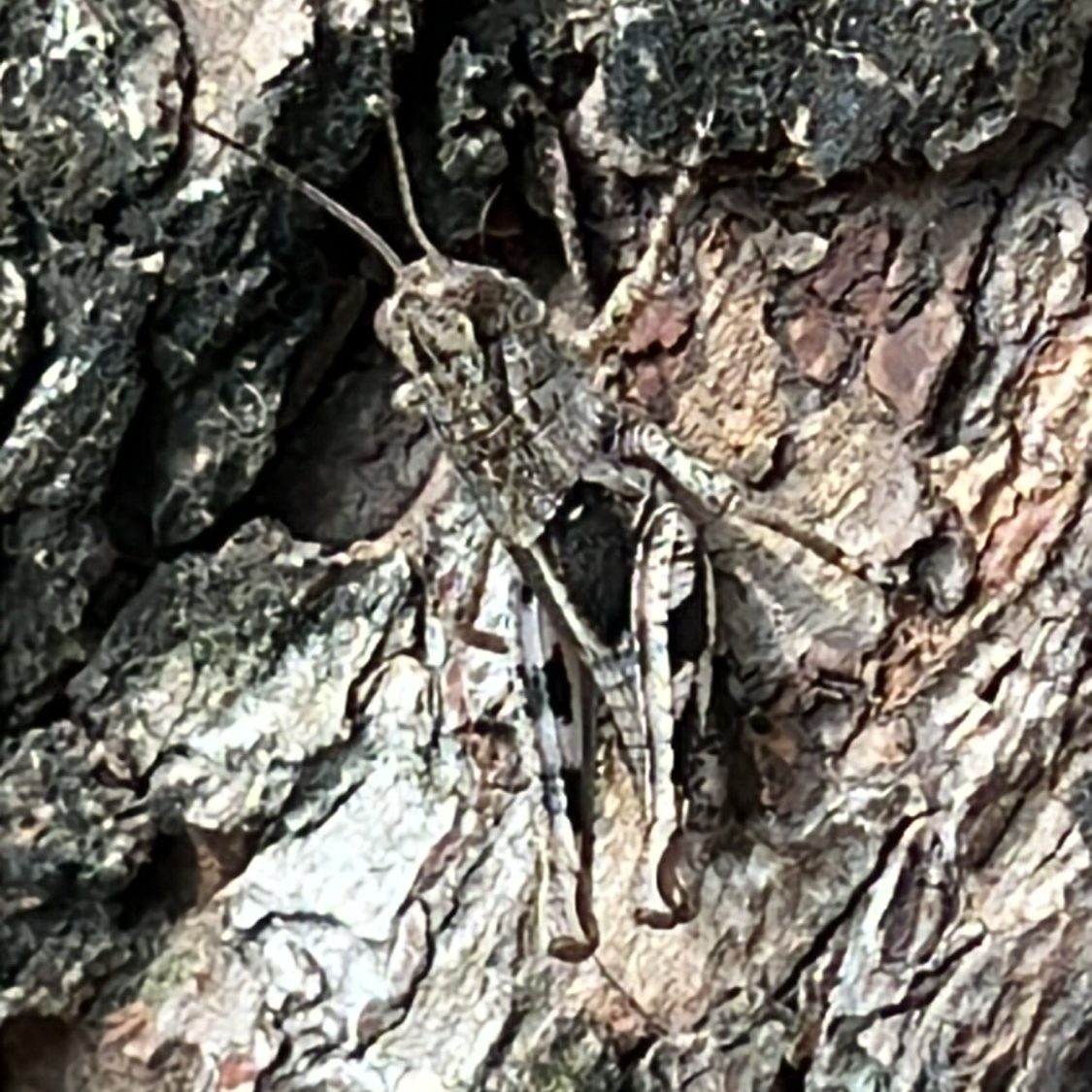
This Ponderous Spur-throated grasshopper sure blended in with the tree, but iNat got it!
I’d like to do another session on the updated iNaturalist when more Chapter members get set up and try it out a bit. But at one of us said to me, the best thing to do it just get it and make yourself use it until you figure it out. That’s what I did (it helps that I learned and taught applications for a living until just recently, so I’m a good software learner).
iNat has no clue what this fungus is. I should have gotten a photo from the side – rookie error!
I’m here as a resource for anyone with questions on this one. Send me an email or comment on this blog. Our usual source of vital iNaturalist information, Linda Jo Conn, is hampered by having an Android phone, but she’s your go-to on the computer app and the “classic” iNaturalist. Of course, iNat is working on that Android version, so it should be out soon, we hope.
Thanks as always to Ann Collins and Gene Rek for their hard work on Wild Wings, as well as to our bird sanctuary committee. They have kept the project on track and enabled us to start our educational programs.
Resources
New iNaturalist App for iPhone! This article provides more information about the new iNat app, and has a handy video on configuring it to behave a bit more like the earlier version, which is more like how people who do a lot of identification will want to use it. I highly recommend this if you can learn from text or video (some people prefer to be shown).
















 Nature Along the El Camino Real