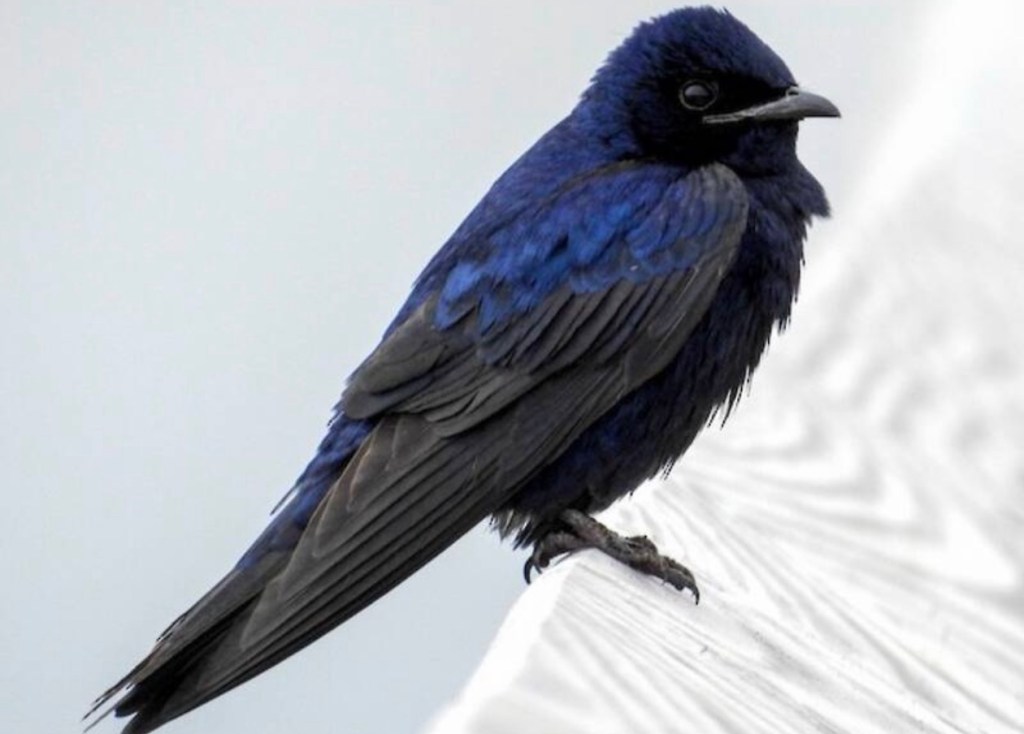
On a quest to take more photos for another iNaturalist on a possible Viper’s Bugloss plant, I discover baby Purple Martins and something else. There is always something new to discover in nature.
Purple Martin nests
There are photos of parents feeding the recently hatched Purple Martins. Plenty of the houses at Mike McCormick’s considerable housing for the birds are occupied with hatchlings and eggs.
McCormick says the majority of them will take flight in mid-June. He also noted that the late male arrivals are fighting the older males for housing. This is apparently common. The debate is over whether they are drawn to their nest they were hatched in the year before or they are trying to establish territory.
While standing out among the martins, I noticed a ball on the ground. It was between cow patties, but it was too perfectly round to be that.
The bi-annual trip of the El Camino Real chapter – Texas Master Naturalist to the Purple Martin conservation project of Mike McCormick was both awe inspiring and amusing. McCormick had hundreds of Purple Martins making his place home for the nesting season while a notable number of dumped roosters were fighting it out on the ground.
Purple Martins in the sky.
McCormick, who started the Purple Martin conservation project at his place south of Buckholts at least 40 years ago, estimated somewhere between 800 to 1,000 Martins in residence this year. It is nearly triple what has come around for the last two years. He attributes it to milder weather so far this year.
McCormick talks about the birds.
He has a few hundred Purple Martin houses set up. They are particular about their “homes.” They like them to be a certain level above the ground away from trees and buildings. They need a pond or stream in the near vicinity. They also do their hunting of insects at a high altitude, although they have been known to hunt over ponds and even on the ground if the weather is bad.
Chapter Members enjoying the talk.
McCormick will walk around under the many houses to get them to come out then the sky looks like it’s covered in Martins. Many are pairing off. Once the babies are hatched, they take about a month before they leave the nest. By early fall, these Martins have flown to Austin, where thousands meet up to then fly to Brazil or other points south for the winter.
Purple Martins’ primary natural competitors are European Starlings, which are invasive to the USA, and sparrows, many of them also invasive. They take over their houses. McCormick has styled a large cage to catch those competitors in and remove them. Human expansion is also a problem for martins wanting to nest in natural spots.
The resident Barn Swallows build their own nests. These are hungry babies!
McCormick and his sister have added a nature trail on the site to let visitors see the natural habitat there. They also have created a sort of refuge for other native bids and those ever-invasive non-natives. They use a small corral that used to be used for training horses. They have a birdbath, several feeding sites, and a few bird houses.
Repurposed trah-bin lid makes a great birdbath.
He puts birdseed on the tops of all the fence posts, which brings Cardinals, Red-bellied Woodpeckers, Brown-headed Cowbirds, and and few other species to the little refuge.
Male eats while female Cardinal darts away.
The piece de resistance is new bathroom facilities with running water and full plumbing.
Visits are more pleasant with these available!
To top it all off, they had at least 15 (my sort-of count) roosters dumped on their place. I’m used to dogs and cats being dumped – but not roosters. They were in a fighting mood while we were there.
Innocent rooster just hanging outFighting stancePreparing to go at itFight time – who would dump 15 roosters, knowing they do this?
It’s worth a trip to see all the sites and have McCormick impart much knowledge about Purple Martins.
As you are aware if you live in Central Texas, the weather has been cold and very windy as of late.
My Purple Martin Colony has had to deal with a number of very difficult weather events. Windy conditions mean that flying insects are not flying. Many are grounded until the winds die down. No insects mean no food for Martins.
Last night, I watched my Gourd Houses as my Martins returned to their homes just as dusk appeared. The little bit of the sun setting was enough for me to see them.
As I turned to go back in my house, I heard them chirping very softly to each other. That was not normal as they are generally quiet when they come in for the night.
An hour later it was completely dark and I went out on my porch again to check on them. They were still softly singing. Every gourd had music for all to hear. What a heartwarming moment. It made me sad and glad at the same time.
All living things are important to this world. They may even care for each other more than we are aware of. We must remember to protect this earth, not just for them, but for us too.
A sweet event I was fortunate to witness. Remember our fellow earthly creatures…
Yes, it is already that time when our Purple Martin friends will start their migration from Brazil back to North America. Yes, the early ones will still face freezing and other harsh weather events.
I wish I could ask them to wait a little longer, but instinct is urging them onward. The scouts (who are not the youngest birds) hope to find the best housing first…
As of today, 1/30/2025, sightings have been called in for San Antonio, Austin, Houston, and a few more Texas sites. Central Texas does not have a certified sighting as yet. I hope that myself or our Landlord in Buckholtz will win that honor. We’ll know soon. I am watching for them all day..
First of all, your houses (gourds, or apartments) should be cleaned, and with added pine-needles if you do that. I also added pine-needles to my Blue-bird houses. The openings should be blocked off so no sparrows, other birds, or insects can get in them. You need to check yourself. Do not open the housing until the first scouts land on the houses. If you are looking for the Martins you will see or hear them. Then open a few of the cavities, not all of them. I usually will pick four to open.
You do not want the non-native birds (House Sparrows or Starlings) to get in the houses. These birds will kill the Martins for the nests. Trust me, it is not a pretty thing to see. I think keeping predators and non-native birds out is the hardest thing landlords have to deal with.
Right now my gourd rack is lowered and ready to open. This coming week I will get the apartment house ready to raise up.
I have had back issues this past year, so I will have to have some help caring for my friends this year.. But I will help them out as long as I can. Their song is so addictive that most Landlords that love and care for these native birds will do it until the end of their life. A gift from Mother Earth. Their songs are like no other.
Here are some photos showing me stuffing the gourds with fresh pine-needles that will help keep the birds warm and give them a start on nest building that will come later.
We can expect to have Martins here with us for about six months, until they leave for their winter home in Brazil. again.
Birds can lift a sad spirit. No matter what the world is going through, every day they go about their business with joy and sing to us. How lovely.
Remember who you want to call to your home, and furnish what they need. They will come.
Now let’s look at readying the apartment house for the Martins.
It has been cleaned, emptied of all nesting materials and covered last August when the Martins left this area. Then the house was lowered down and secured till the next season which usually starts in Central Texas in late January and on.
At my site, February 14th is the normal time for my friends to return.
Once again, the first scouts are normally males looking to get a nest they like. They will then start singing trying to attract females to the site. It is a beautiful song..
Right now I uncovered the house. I inspected it to make sure no wasps, spiders or anything else had taken up residence since I last closed the house.
I then slide in the nest box that I have put fresh dry pine needles in all of the 26 compartments. I also have an early arrival door that goes over the openings. It has only the door for the birds to enter. When the summer heat has arrived and there are babies in the house, I switch the doors to ones that are made with more ventilation.
It can be extremely hot inside the houses. That is why I have aluminum houses painted white to reflect the heat as much as possible. So now, I recover the house and keep it as low as it will go.
When I hear the Martins arriving, I remove the cover and roll it up. Then I only open a few holes at a time. That will keep some of the House Sparrows from taking over. It is absolutely a requirement to keep them out. They can ruin an entire colony by killing the Martins.
So right now is the time to get new or existing ready to open at a moment’s notice. It’s kinda like a fire drill. So naturally, the weather is going to be cold, windy and rainy. That is why you want to do what you can while your hands are warm.
So my timeshare is OPEN, come on in! I just love the Martins and all birds.