Lots of Bird Action at Wild Wings

By Sue Ann Kendall

I’ve been making up for lost time at our Chapter’s little bird sanctuary, Wild Wings. Fall and winter are the best times to visit, anyway, since winter visitors may appear. I brought all my birding equipment for the past few weeks, so I could see all the little guys flitting around with my better-quality binoculars.

I also brought my real camera and telephoto lens, so here come the bird photos!

I got to watch a Red-shouldered Hawk and multiple Red-bellied Woodpeckers last week, but didn’t get many photos. I also enjoyed checking out the plants Gene has put in the beds, too.
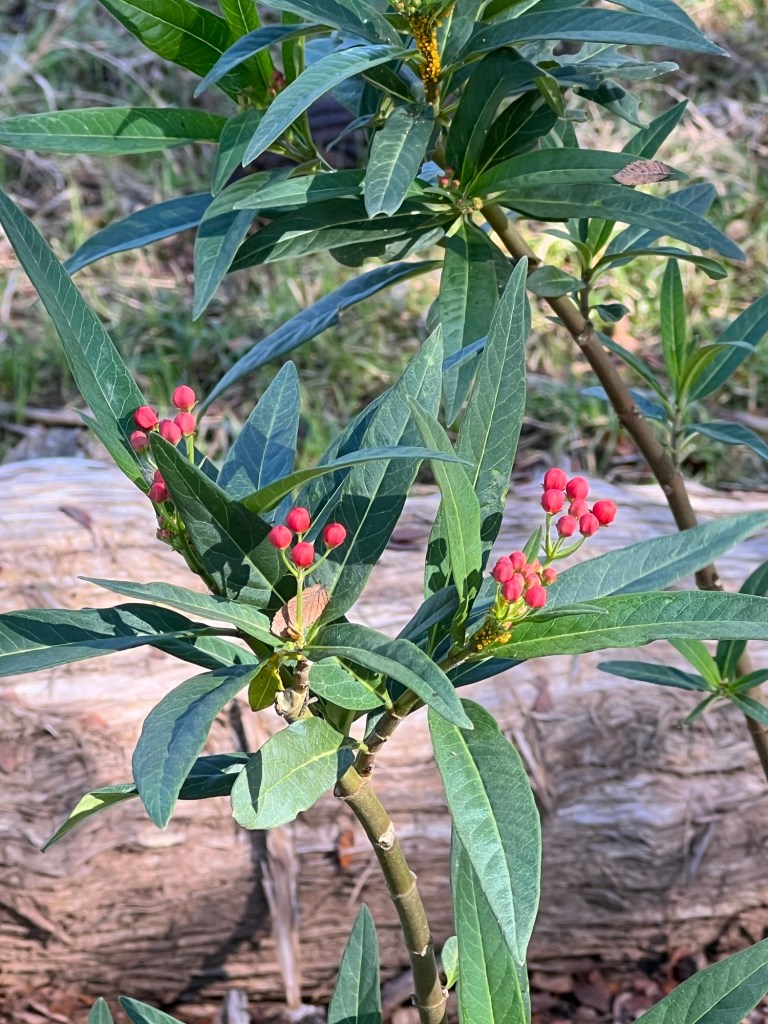
Non-native tropical milkweed will be beautiful next spring and summer.

This week, Kit and I spent time at the sanctuary listening to the birds—we have heard 17 species via Merlin Bird ID this week, plus additional ones last week, so this will be a good month for our totals, which have been missing for a while due to our volunteers and their issues/schedules (I mean me).
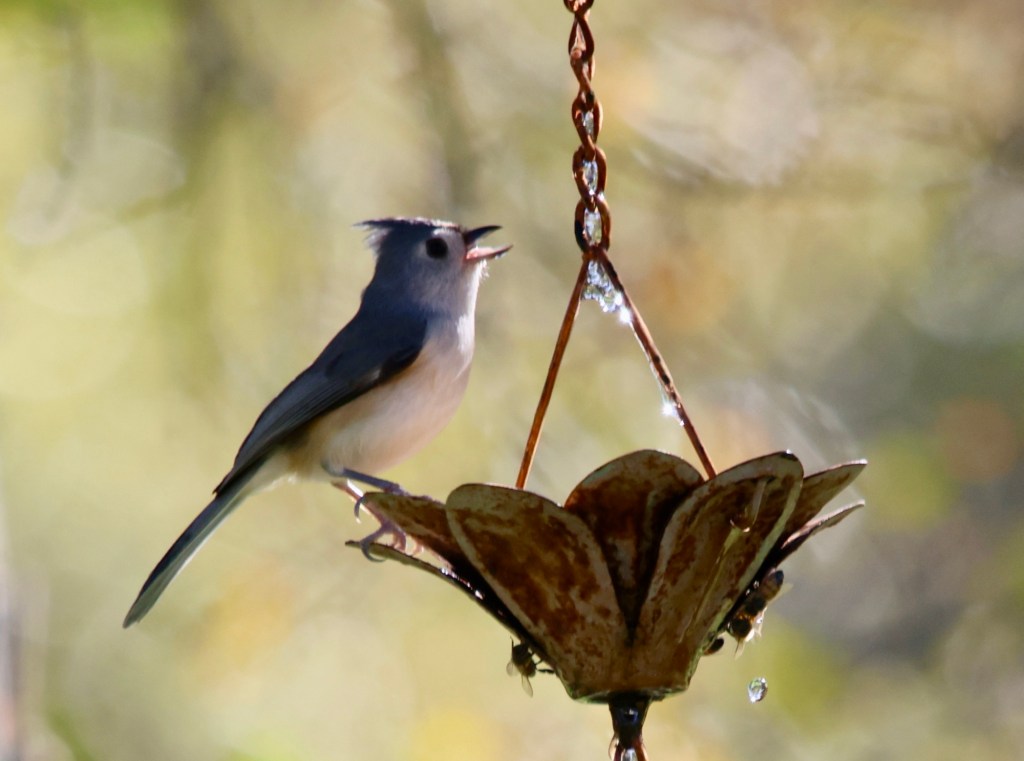
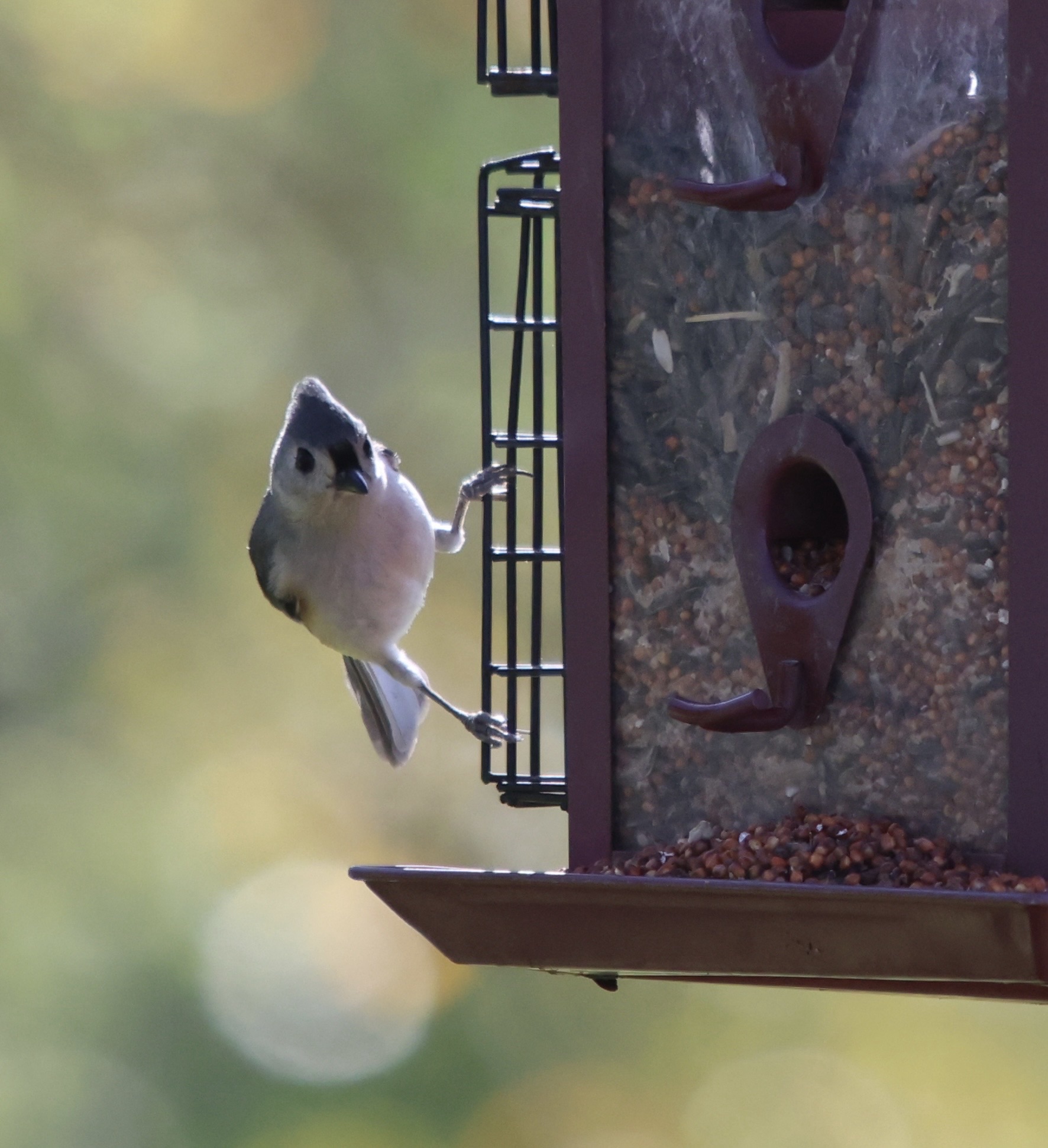
This Tufted Titmouse on the rain chain did not judge me.

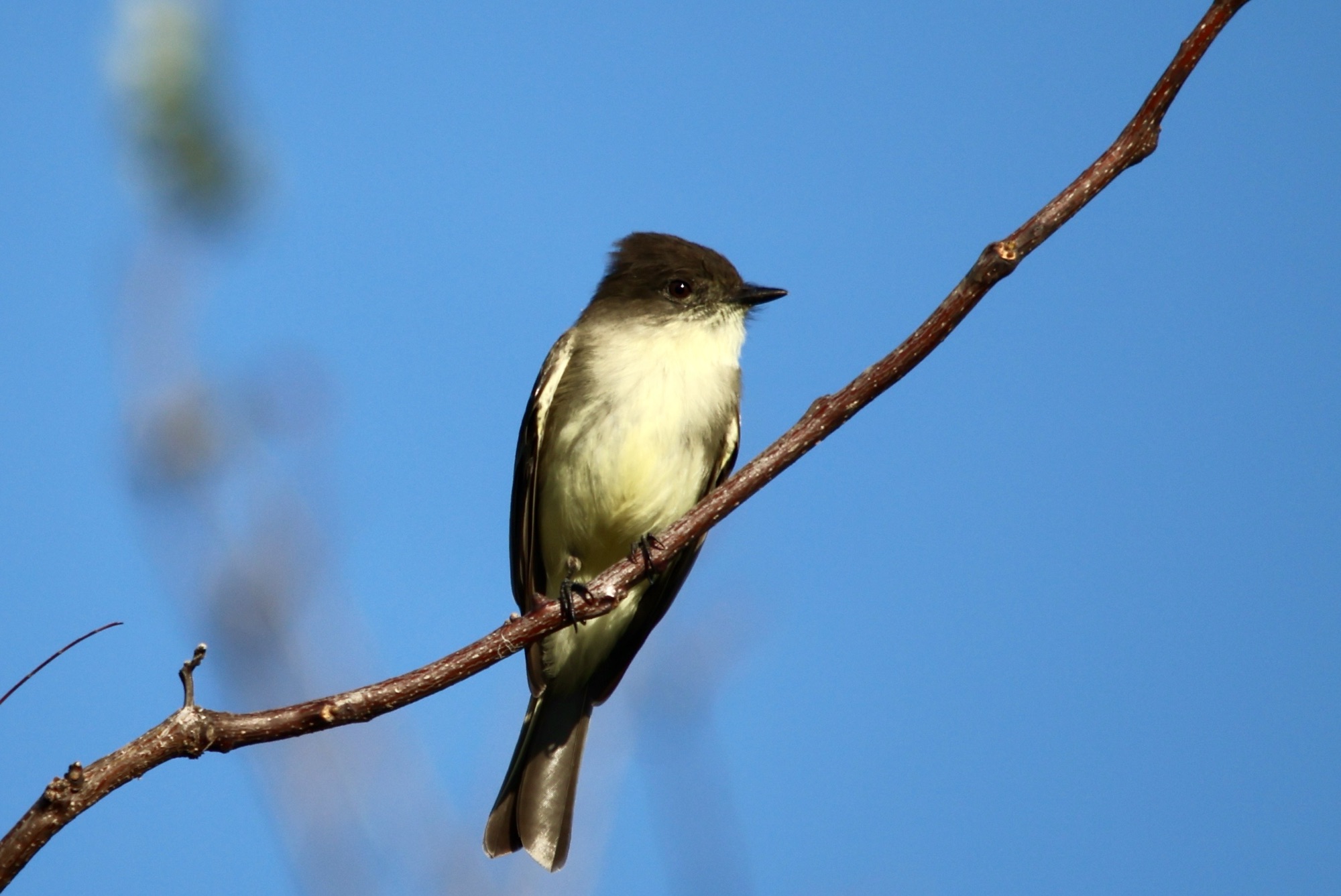
Sitting quietly in the sanctuary with all the feeders filled to the brim by our caretaker, Gene, lets you get some fine photos of whatever birds come to feeders, which means Carolina Chickadees and Tufted Titmice, and one Eastern Phoebe.

The sanctuary also is home to many bees, as it’s near an apiary. The bees love the rain chain that drips into the bird bath. Look at all the bees!

They’re on the right.

We encourage visitors to the Wildscape to come on down for some peace, quiet, and birdsong.

Forest Walk and Monthly Bird Count

by Sue Ann Kendall

This month’s bird count at the Wild Wings Bird Sanctuary took place on September 14. Ann Collins, Sue Ann Kendall, and Phyllis Shuffield not only looked for birds with their eyes, binoculars, and ears, but they practiced their Merlin Bird ID skills. We identified 25 different birds in the two hours we spent at the sanctuary. Highlights were a juvenile and adult male Eastern Bluebird and a chatty Downy Woodpecker. Merlin identified other new birds, Alder Flycatcher, Blue Grosbeak, Lark Sparrow, Upland Sandpiper, and White-breasted Nuthatch. These are all plausible birds to have around this time of year in Milam County.

Eastern Bluebird. Photo by Skyler Ewing on Pexels.com

The group decided to take an informal forest walk in the wooded part of the sanctuary (not an official Shinrin-yoku walk, since we were identifying plants and birds. It’s quite pretty back there, where a creek often flows when it’s wet outside. We found some late wildflowers, such as Marsh Fleabane (Pluchea odorata) and Late Boneset (Eupatorium serotinum). We observed lots of berries for the birds, including many coralberry plants (Symphoricarpos orbiculatus). There was evidence of animals who hang out in the sanctuary, especially deer who had been there very recently judging from the fresh scat and urine.

Ann and Phyllis refilled some of the hummingbird feeders, which were primarily being used by the local honeybees of Bird and Bee Farm and a few butterflies. There are now many feeders, and it appears that the birds (primarily Carolina Chickadees and Tufted Titmice) are eating out of them all. There were dozens of Northern Cardinals flying around, but they were not coming to the feeders.

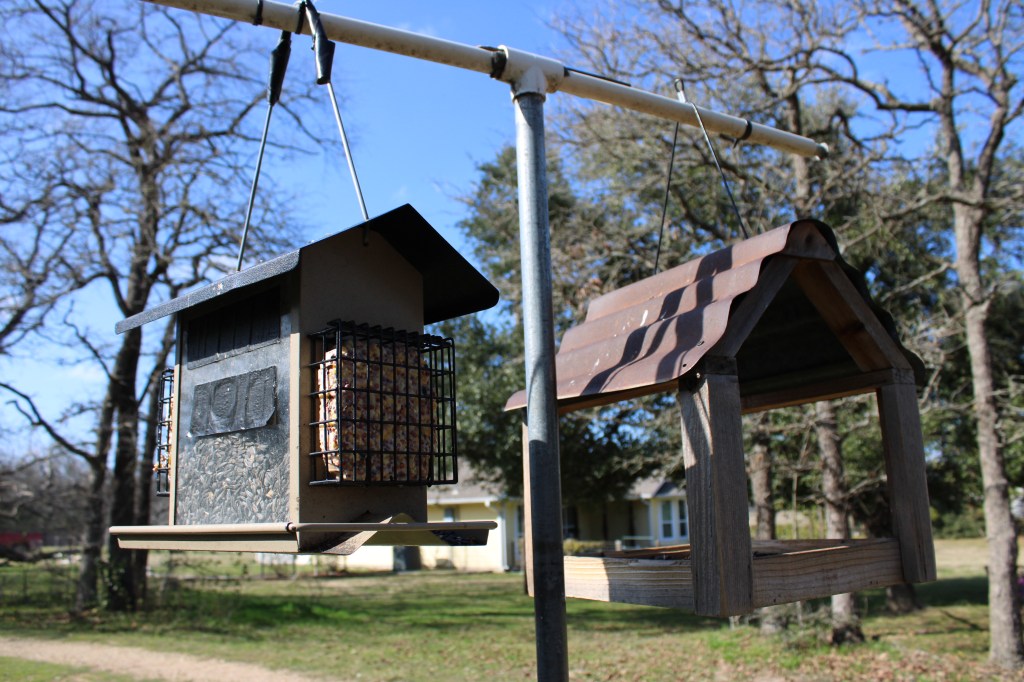
Bird feeders and the seating area

Since our last visit to the bird sanctuary, the intrepid Gene Rek has put in more raised beds and planted some new shade-loving plants in them, including beautyberry and Turk’s cap. They have drip irrigation to help get them established. The new bird bath is still working great, too. There’s lots of progress being made.

And as a bonus, Sue Ann left with two new Cochin hens! It was a good morning at the Wild Wings sanctuary!

Cathy the hen is much happier now that she’s in a hen house.

We made a page that lists all the birds we’ve seen since we started observing here. Please let one of us know if you come out and see a new bird!

Extra Help for Birds in Winter

by Donna Lewis

So, we have some very cold weather upon us.

Some of you who are originally from the North may think it’s not cold. But those of us born in Central Texas think even barely freezing is terrible. I am one of those people.

I can hardly bear it to go below 50 degrees. I hate it. It makes me crazy to worry about our wildlife friends.

But, they are adapted more than we think.

The birds have a harder time finding food when it’s cold. That is because the insects they like are not moving around.

One way we can help during this time is to put out suet for them. You can make your own or purchase it. I found that making it is messy. So, I bought some. Now is the time to put it out.

It needs to go in suet holders and placed near feeders. You can make your own holders and make them suit your location. A suet holder can be as simple as a small cage made from hardware cloth.  Anything that a bird can cling to. Many species will come to a suet feeder. Even woodpeckers like them.

The suet provides needed energy to help the birds keep warm.

Right now, I am waiting for a new product to arrive that keeps hummingbird feeders from freezing. As soon as I receive it, I will put that info out for everyone.

So don’t forget our feathered friends…

“I cannot do all the good that the world needs, but the world needs all the good that I can do.

Jana Stanfield

A Winter Mealworm Feeder for the Bluebirds

by Donna Lewis

I love the Bluebirds.  In the winter I try to help them out by feeding them dried mealworms.  They probably like live worms more, but they are more expensive and harder to get. But a little help during harsh weather is still a good thing.

Every year I hate to see the dried worms ruined by rain or ice. However, the Bluebirds will not use any feeder that is closed in. They want an open platform with a perch on it. They do not like anything that they have to go inside.

I have tried many types of feeders marketed for them. They have not worked.

I have been watching the birds for years, so I know what they do. I thought maybe a clear container with a small cover might do. I placed it on a square plywood board, put a back board on the North side to block some of the rain and wind, then watched to see if that would even take a chance and go for the worms.

Success!!  They did. Boy, was I excited.  Now, I will see what happens when the severe weather arrives.  That will be the real test.

They do not like rope or bungee cords attached to the feeder. They might think they are snakes?  I don’t know.  I hope the wind does not blow the feeder off.

Anyway, we will see soon if the feeder keeps some of the worms dry.

You have to observe our wild friends to see how they feel about something we have made for them.  Think like a bird. Keep learning by observing.

Who are you gardening for?

Hummingbirds: Feeders Aren’t Necessary to Attract Them

by Carolyn Henderson

The only time that I find being outside tolerable during this long heat wave/drought is early morning or late evening. I think Hummingbirds agree with me. And I don’t feed them intentionally. 

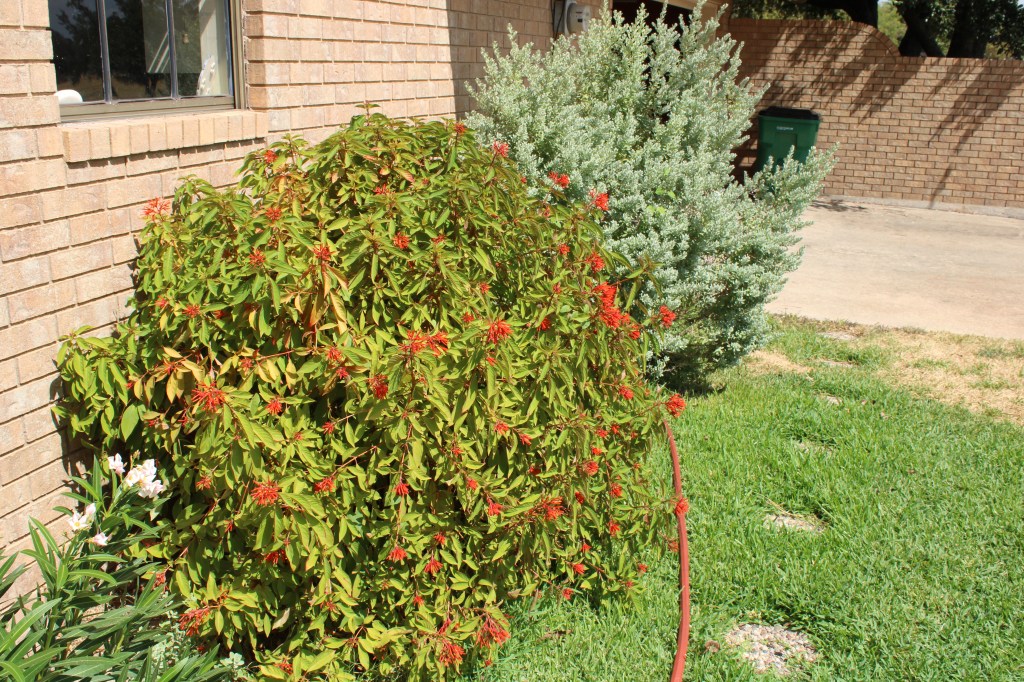
I stopped putting out bird food of any sort several years ago after I saw my sometimes-outside cat, with a Hummingbird then a Yellow Rumped Warbler in his mouth. I decided to limit his pickings as much as possible. However, I did plant a Mexican Honeysuckle bush from the El Camino Real Texas Master Naturalist Wildscape, and I also have a Fiery Hummingbird Bush (also called a Fire Bush) that was here when I bought the house. They both are in full bloom now, and Hummingbirds and several types of butterflies are very fond of feeding on them. The multitude of wasps that I have nesting at my house like them, too. 

These two bushes, my Crape Myrtle and a couple of Mexican Hats are all in bloom now. These plants are heat wave tolerant, feeding birds, butterflies, Western Honeybees, and three types of wasps. I only see the Hummingbirds in the very early morning and evening. They come in groups of three to four. I believe they are the Ruby Throated version. Three of them have white undersides and one, that I finally got a photo of this morning, looks to be Ruby Throated (according to iNaturalist). I’ve been trying to get photos of them for a few weeks, but I never have my camera ready at the right time. It seems that if they see that I have seen them, they head for the tallest trees. 

Hummingbird zooming in on Fiery Hummingbird Bush

The Crape Myrtle, which bloomed late this year, attracts mostly wasps and honeybees. I normally have a Texas Purple Sage in bloom that the bees really like, but it has not put out more than 5 or 6 blooms a few times. The Mexican Hats are just about done for the year. Luckily for the feeders, the Mexican Honeysuckle Bush and Fiery Hummingbird Bush bloom until it freezes – which may not occur this year. 

I must say, being able to watch the birds and butterflies eat without having to frequently clean out the feeder is nice. They really like my new bird bath, too. They, along with Robins, Blue Jays, Doves, Cardinals, and Mockingbirds have become very fond of it. They drink it and cool themselves off in it.