Fight of the Invasives to Continue at City Wildscape

By Carolyn Henderson

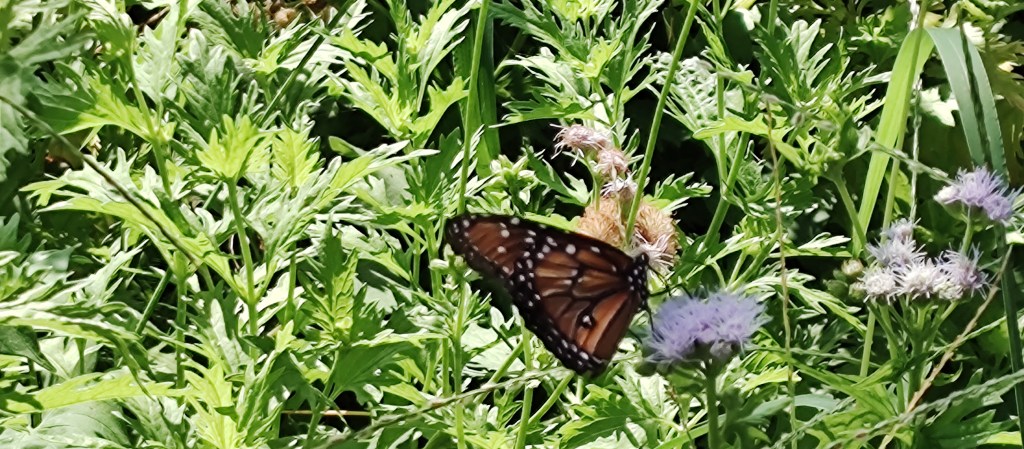
On Saturday morning I took a side trip to the El Camino Real Texas Master Naturalist City Wildscape to find a pleasant surprise in the overgrown mess. Queen butterflies had found the place. I counted about 20 that morning – all on the Gregg’s Mist. That is by far and away the Queens’ favorite nectar producer. 

Not only had the Queens landed, American Bumblebees had also located nectar sources for themselves – mainly the Common Sunflower that planted itself in the city wildscape and reproduced many more this year. 

I also saw Ligated Furrow Bees and Jagged Ambush Bugs. Those are pending identification verifications in iNaturalist. I also saw Oblique Longorn Bees – a second time for a new to me bee. They are very tiny and in near constant motion. All of these were on the Sunflowers.

Other things we planted were in bloom, but they are mostly overwhelmed by the terrible invasive “Tree of Heaven” and the Persimmons. Persimmons have taken over the right half of the wildscape (if you’re looking at it from the street) and the Tree of Heaven, an invasive from China, has the left side. 

I met with the church directors Sunday morning, and they agreed to let us make a last ditch effort to eliminate both of those. Crape Myrtles also are spreading, which are not native to this area either. They have lots of pretty blooms, though. More Queens had arrived.
Alan Rudd has devised a plan to kill these invasives. We believe that we can do it without harming the Pecan tree in the wildscape, but there is no guarantee of that, so we needed approval from the All Saint’s Episcopal Church to do it. They were in agreement, since they also were dealing with the Tree of Heaven in most other parts of their landscape. 

Liz Lewis is having the source of the Tree of Heaven, three trees nearby, removed, too. Otherwise, they’ll just come back. No one knows where the Persimmons came from, but we hope we can get them out, too. 

Once that is done, the wildscape needs weeding. Good for volunteer hours, everyone. 

A Summer’s Day in Late October

by Donna Lewis

Yesterday ( 10-23-2024) , I went outside to be with nature and take a few photos. It’s so hot I thought it was a summer’s day.

I took photos of some Goldenrod, a favorite of some butterflies, including the Monarch.

Next was an Armadillo, which should have been laid up somewhere in the shade.

Then there was a Black Water Snake near a bird feeder. They are non-venomous.

And last one of my bird baths with lots of native honey bees getting water for their family.

I also saw, but was not fast enough to take photos of, an American Kestrel, A Ruby-throated Hummingbird, and a single Monarch butterfly.

All in a one hour period in the morning here in Central Texas. We are so lucky to see these things.

Let us hope that all of us humans keep them safe for the next generation to enjoy.

They Aren’t Supposed to Be Blooming!

by Gene Rek

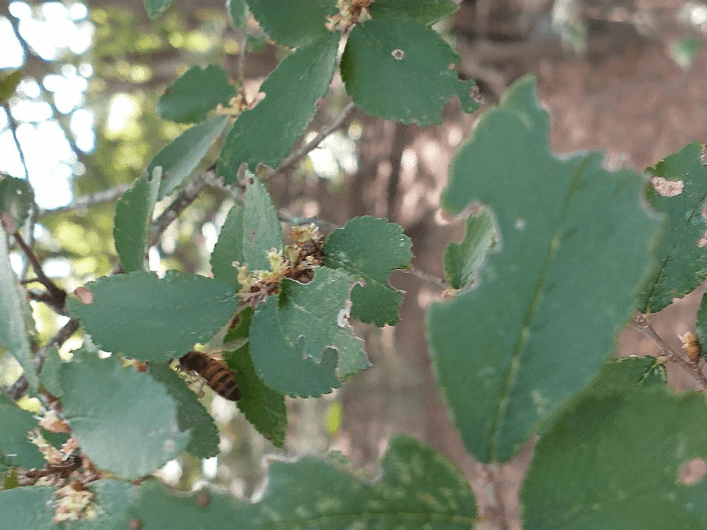
Late January is the beginning of spring for the honeybees. That is when the cedar elm trees begin to blossom, and the bees start bringing in sacks of yellow pollen. Pollen is protein for bees, thus particularly important for a healthy hive.

Bees coming into their hive packed with yellow pollen from the elm trees

Today when I was in the woods the trees were buzzing. It’s not unusual to find bees busy in trees in late summer or fall when they might find galls on oak trees or dewy sap on pecan leaves. I was curious as to what was causing all this activity. I was not surprised to find them on the elm trees, but the reason they were there did surprise me.  The elms are in bloom! Some of the trees are in full bloom while others are fading.

A bee gathering pollen from elm trees

We received almost 2.5 inches of rain last week. After a brutal summer did this cooling off to ninety degrees fool the trees?

More bee action around the cedar elm blossoms

I’ve never observed this before. Maybe being a Master Naturalist is making me more observant of such things. 

[Editor’s note: I noticed that mesquite trees were blooming at my ranch this week. iNaturalist wasn’t able to ID my photo, perhaps because they were blooming at an unusual time.]

Training Class Studies Bee Farming

by Kathy Lester

The El Camino Real Texas Master Naturalist training class met at Walker Honey Farm, where owner Clint Walker discussed all the wonderful things about bees. Attendees were able to handle the hive frames, see the queen bees, and observe at least three different colors of pollen carried by the bees. They were dressed appropriately for visiting hives. 

Bee handler Blake explained the manufacturing process.

Then they had some great “retail therapy” at the Walker Honey Farm store.

As Linda Jo Says, Let’s Get Outside

by Donna Lewis

Yes, it is winter here, crazy Texas winter.

But it is nice today and there are some really neat things out there.  Just look for them.

I do have the little native bees out foraging.  It’s hard to catch a photo of them since they are quick.

I have some neat-looking mushrooms and moss also. In the sun they are very pretty and nice to touch.  Close your eyes as you gently touch and listen to Mother Earth.

Also, there are still too many fritillary chrysalis hanging everywhere, even on “Babe.”

So, before it gets down to sub-freezing weather again, go outside. Take your dogs with you and enjoy the weather.

By the way, if you happened to be outside late last night, the stars and dark blue sky can be wondrous. You can look up and imagine the millions of other beings looking up at us.

Our Texas song we have heard most of our lives, if we were born here, kept playing in my head.

Go ahead and sing it…

The stars at night are big and bright, boom boom boom, deep in the heart of Texas!!

Now get outside, like Linda Jo Conn tells us every week.