It was a day when, like it or not, we got up hours before sunrise. Trying to paddle down a reach of the Brazos River on the last day of June, any boating crew is well advised to start early and finish early. Unlike most of the days in the rainy first half of 2024 this one promised to have few clouds, and therefore the full intensity of the midsummer sun.
Bluffs. Photo by Peggy Connor
We looked at weather apps as we rode along that describe the expected true air temperatures and the now ever so popular “FEELS LIKE” index. We noted that the “Feels Like” index was exactly the same for Houston, Waco, Terlingua, and Las Vegas, Nevada. All of these places have different levels of humidity due to their locations on the North American continent. But for the most part they all receive the same amount of solar radiation (sunlight) on any given day. The locations where the humidity was higher Houston and Waco were blessed with lower temperatures but they “felt” to be the same temperature as the two chosen desert localities. This is no new discovery: IN SUMMERTIME IT IS HOT. Therefore it “FEELS HOT.” Always has!
Fishing Spider. Photo by Victoria St. Everett
As it was, we got into the river and launched boats at 7:33 AM. Angie and Adam dropped us off under the Highway 7 bridge with Victoria, Alan, and Peggy in three boats. The river level was gently dropping into the 2400 cfs range after being higher during the wee hours of the morning. This was pretty-clear, cool water from Lakes Whitney and Aquilla that was being released upstream of Waco. The flow rate pushed us downstream and even in this wide, placid stretch of the Brazos you did not have to work hard to move rapidly. We saw Great Blue Herons, heard woodpeckers, and watched Bluff Swallows entering and leaving their nest holes in the colonies burrowed into the red soil riverbanks. Cliff Swallows mobbed the bridges where they had huge colonies of mud nests glued to the underside of the concrete structures.
The wide Brazos River. Photo by AE Rudd.
Victoria was in the lead when she passed an antlerless white-tailed deer swimming across the river. You could see why the cattle drovers from the Texas coastal plains always pushed their herds upstream of Waco before trying to cross the Brazos on the northward cattle drives. This deer was stuck below a high, steep, red alluvial soil embankment. Its thrashing hooves could not gain traction to climb the bluff and it repeatedly fell back into the river and was washed downstream where it would try again to clamber up the slick red clay. Finally, it arrived at a point where a small creek entered from the eastern shore, and it rapidly disappeared up the slope of this creek-bed.
I was reading about mammals’ swimming abilities recently, and the author pointed out that swimming motions are directly derived from walking motions. Humans (and probably other hominids) are a rare exception to this rule, and we must learn to swim with motions other than our walking strides. Even goofy arboreal species of mammals like tree sloths are surprisingly talented swimmers. I would like to travel back in time 16,000 years and watch a giant ground sloth swim across the Brazos River.
The trip was fast. We traveled 4.9 miles by kayak and canoe in 1 hour 35 minutes. We had a perfect pull-out point at the concrete boat ramp at Falls on the Brazos Park. A big thank you goes to the Falls County Commissioners court for keeping this old park open access. The recent two months of flood stage water levels have rebuilt sand and gravel bars and scoured clean the riverbed. Every river benefits from a good flushing to renew the system. I had to risk exposure to the heat to get a quick look at the cleaned-up face of the Brazos.
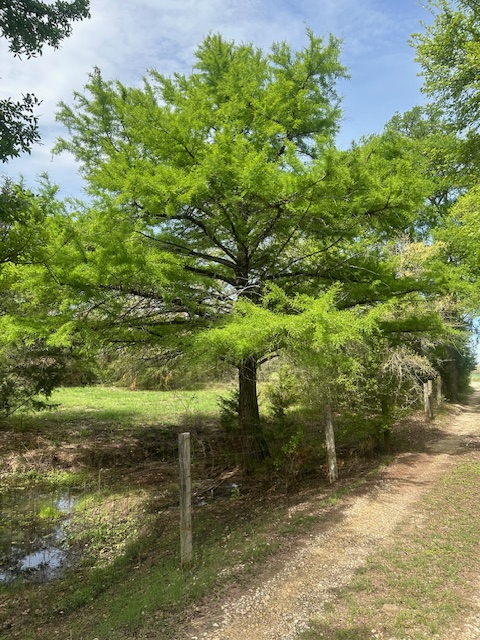
The oldest individual bald cypress tree (Taxodium distichum) in North America is likely to be one in North Carolina that has been aged by drilling a core to the center of its trunk to expose the number of annual rings. This specimen growing along the Black River is over 2600 years old and apparently still looking mighty healthy.
The conifer family Cupressaceae, showed up in the fossil record over 200 million years ago. Bald cypress are modern North American members of this family that has over 130 species occurring across the northern hemisphere They traveled along as blocks of continental plates broke up and moved apart. Cypress trees in the Mediterranean look a good bit different than the bald cypress growing in our southern swamps and along riverside habitats in North America, but they are all related to those that lived on the super-continent Pangea.
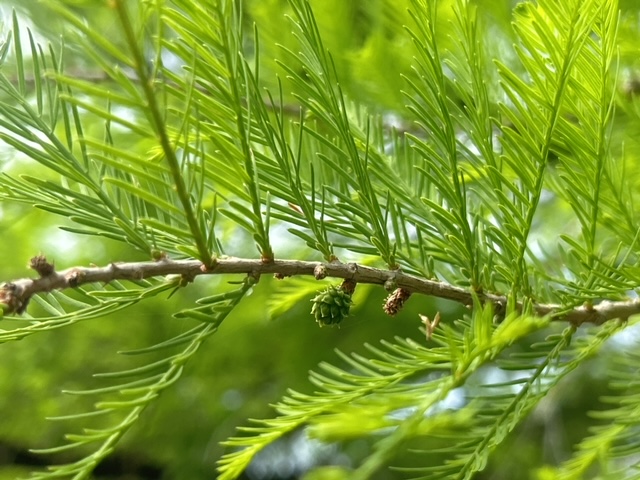
Bald cypress
In North America tree scientists agree that we have two distinct species, bald cypress and Montezuma cypress (Taxodium mucronatum). As with all taxonomists there is skepticism and disagreement. This involves yet another variety dubbed “pond cypress.” We will leave the bickering about pond cypress to the paid professionals.
Montezuma Cypress
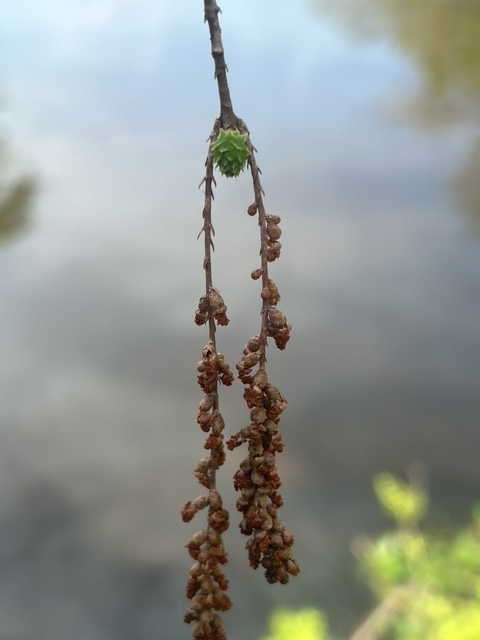
I have both Montezuma and bald cypress around my pond and have watched them develop differently for years. I observed my bald cypress in Burleson County to be flowering in late January. These trees have male catkins that are about 2 inches long which emerge from the end of last years twigs. Just below those pollen-emitting catkins are small female flower parts that resemble tiny pine cones. The amazing thing to me is that these delicate flowers bloom when it is almost a dead certainty that several hard freezes will arrive before spring. Across North America and as far north as Delaware bald cypress are shown to flower in January. Here in Texas the flowers are exposed for as much as 7 weeks before any new leaves begin to erupt in March.
Flower
Contrast that with a Montezuma cypress located on the same pond 70 feet away. It sprouted leaves in early February and is in full-green glory on the same day that my bald cypress trees are still leafless. Montezuma cypress is the National Tree of the Republic of Mexico. In central Mexico and further south these trees never lose their leaves. The one in my yard holds it leaves much later in fall than the bald cypress, but eventually does drop them after hard freezes around Christmas each year. Burleson County, Texas isn’t Mexico City, but these trees have the ability to be either evergreen or deciduous.
Montezuma cypress flower
It has always fascinated me that bald cypress are present in abundance along swampy acidic streams in East Texas and yet also along calcareous, alkaline streams in the Texas Hill Country. It is an adaptable plant that can thrive in both pH 4.5 or pH 9.5. I wonder if at one time in the past they extended completely across the south, through Texas and down into Mexico as a solid band? Maybe while we let the tree taxonomists argue we can imagine a scene in deep time when things looked very different on the continent now known as North America. This ancient lineage of trees has survived a roller coaster of changes and thrived during “ice-box earth” and in times when tropical warmth dominated the across the Arctic Circle.
We have had the typical bumper crop of red berries in the yaupon (Ilex vomitoria) thickets of Burleson County again this year. Last year during the February 2023 cold spell these berries that contain hard seeds were consumed by legions of robins (Turdus migratorius). A mockingbird (Mimus polyglottos) that owns our front-yard and half the farm, fought thousands of these rest-breasted raiders trying to protect his winter food supply. He lost the battle, but survived to eat grasshoppers as the spring season warmed toward the heat of summer.
Today is the “Ides of March” 2024 and so far very few robins have ganged-up in the oak thickets of Edwards Ranch. I saw them in the woods along Sandy Creek in February, but they never touched the yaupon berries near the house. A sizable flock of cedar waxwings (Bombycilla cedrorum), however, have been staying about and gorging themselves on yaupon fruit for the last three days. These calm, gregarious birds allowed me stand at a distance of six feet and watch them pluck red berries from a 12-foot tall female yaupon. It required me to be completely still and lean into a tree trunk, while doing my best to impersonate shaggy bark. I watched predator eat prey. After eating berries for less than a minute the birds flew up into the height of a nearby bald cypress (Taxodium distichum), only to repeatedly return to the yaupon to continue the feast. The winged berry-predators were dropping seeds processed through their digestive tract to the fertile ground below.
Those waxwings were smiling. The yaupons, too, were smiling. As in every true symbiotic relationship, who is the master and who is the servant?
The original plan for February 16, 2024 was to conduct a long downriver trip on the Brazos to examine spots suitable for an overnight canoe trip in spring. However, lots of rain upstream inundated the very sand and gravel bars that serve as the best camping spots. An alternate plan was in order, so the team of intrepid explorers chose a feeder stream known to be shallow, gravelly, and home to mollusks. Call the stream Clam Creek, Mollusca Millrace, or Bivalve Bayou. Mussel Run turned out to be a special place on a special day.
The warm February air on a Friday morning we knew would soon turn cold, with a blue norther due to arrive the next day. Victoria and Rosie were eager to put some paddling time in as a tonic for spring fever, so we did a reconnaissance canoe trip down this creek that is usually too shallow to allow boat travel of any kind. Dragging two kayaks and a canoe down into the creek-bed was easy as the rainy winter had grown a deep carpet of winter grass along Mussel Run Creek in Falls County.
The three of us claimed “First Descent” along this small tributary of the Brazos River, since it was an unknown path to any and all in our group of “river runners.” In the grand scheme of things, others have surely traversed and crossed this old watercourse. Having a name on the map so appropriate to what we would find along this creek is a sure indicator that other people have visited here often. It has likely been known to many people, and probably over thousands of years.
Paddling the first 200 yards of this 7-mile run we found sand bars littered with the shells of bivalve mollusks. Many were freshly opened and probably eaten the night before. Racoon tracks were everywhere in the freshly washed sand. River Otter tracks were less abundant but also found along with beaver slides and feral hog sign. Mussel shells numbered in the many hundreds on the sandbars. Rosie wondered out loud if any of the species we were seeing were edible. “Sure they are! Particularly if you’re a racoon”. Wise guy…….
We found Giant Floater clams (Pyganodon grandis), Yellow Sandshell (Lampsillis teres), Threeridge (Amblema picata), and Mapleleaf (Quadrula quadrula). These mollusks were new to me, but Justin Grimm at Brazos River Authority quickly identified them from my amateur photos.
Justin is environmental programs coordinator at Brazos River Authority in Waco. Part of his duties are to survey and document the health of a wide assortment of aquatic plants and animals in one of the largest watersheds in Texas. This creek originates in upland areas east and north of Marlin, Texas. Streams which contribute flow in this watershed are Wild Horse Slough, Big Creek, Cedar Creek, and Brushy Creek among others. It is not until this stream reaches that flat red soil of the Brazos River flood plain that it obtains the name Mussel Run on the USGS topo maps.
We noted that the farm fields above us were located on fine red “Brazos bottom” alluvial silt that appeared to be 20-25 feet thick when looking up from the watercourse. Below it at water level there was a stark change in the geology, with a layer of bright white limestone conglomerated-gravel, with the aggregates being about the size and smoothness of ping-pong balls. This gravelly rock layer contributed most of the material that made up the hard bottom of the creek-bed we could feel with our paddles. I wondered if this high-calcium gravel accounted for the habitat that provided such a top-quality home for all these bivalve mollusks.
One thing for is for sure, and it is that this creek has been a major access barrier for river bottom farmers for most of the last two centuries. The creek channel is uniformly steep and has actively eroding sections of alluvial soil at almost every turn. Crossing it with mules and plows in the 19th century or with tractors in the 20th and 21st century has had to require extraordinary effort. The bridge we launched at is a brand-new concrete “highway-quality” structure at the end of a Falls County road. As we traveled down-stream we paddled over a concrete low water crossing probably 3-4 decades old clearly built by the landowners and not Falls County engineers.
We also passed under a high bridge structure that had steel I-beam upright pilings and a rickety wooden deck. This structure was a proper place to eat lunch but had signs on both ends stating WEAK BRIDGE CROSS AT OWN RISK. River bottom farm families have likely been using this structure since the 1920s, but heavy modern agricultural equipment crossing this structure is out of the question these days. A large disc plow was permanently embedded in the bottom of the creek where it apparently slid down an embankment during a severe erosion-causing flood event. It was a stark warning about the power of rainwater visible from the lunch-time observation spot.
Because this creek had flooded only 4 days prior to our trip we were able to float over almost every rocky riffle and fallen tree. Once we reached the confluence with the Brazos River, we got the opportunity to deal with the remains of that flood, to the tune of 6130 cubic feet per second (cfs) water flow. Riding on top of this dense flowing mass one can quickly cover miles with only moderate exertion with the paddle. The power of flowing water to excavate and move soil, push trees, and shove large objects is widely renowned. The reason is that water itself is so very heavy (62.4 pounds per cubic foot). The water flowing past us as we entered the river amounted to a 382,573-lb. object shoving us down-slope every second. Being whisked along was a joy after the hours of hard paddling in the slow water of the creek. What is most dangerous when the river is high are obstacles. If you get lodged against a tree or other immovable object in the stream, the force of the flow will quickly bend you and your boat into a very abnormal shape, and then hold you there like an angry 382,000-pound sumo wrestler. It is not an exaggeration to say “Death can come quickly.” Fortunately, we skimmed along the surface in mid-channel and arrived to have our pick-up crew (Adam and Angie) throw us ropes and pull the boats up the muddy shoreline. Now we know what is up along Mussel Run Creek and have the luxury of staying next to the wood stove on a Saturday morning.
Labor Day weekend this year cried out for a river trip, and the only “river” that was running hard on September 3 was a portion of the stream that the Spanish explorers dubbed the Rio San Francisco. Stephen F. Austin drew a map of the expanding land grants between the Brazos and Colorado Rivers in 1829 and labeled this same stream Yegua. It stands to reason that those people occupying the land at that time had identified this watercourse as a place populated with horses. Yegua in Spanish are female horses. A valley to the west of the Brazos River with a significant abundance of horses deserves such a distinctive name. St. Francis of Assisi was already known as “the patron saint of animals” when the Spanish priests were spreading their culture north into Texas circa 1690. His name would be attached to many other places and a few streams. The Texas stream that is named after the horse populations attracted to its bottomland habitat is a special kind of place. It was my time to explore it.
Adam and I put boats into the water of Yegua Creek below the Hwy 36 bridge in Somerville. It was before dawn, and I was hoping to paddle the first portion of a 13-mile run in moonlight. As luck would have it, we were running a bit too late, and the moon was slightly obscured by thin clouds anyway. Angie was our driver and her photographs taken as we shoved off show an orange dawn sky looking downstream. Turns out it was a darn good thing we could see well because the first three miles of this trip seemed like a combination of paddling through a Venezuelan jungle and the log-ride at Six Flags. We needed full visual acuity. Short-statured elm trees reached far out from each shore, and you had to weave around them. Open shorelines were densely populated with sedges, rattle bean, millet, and smartweed. Somerville Dam was just a mile upstream and was releasing 366 cubic feet per second to supply users down near the Texas coast. In this 40-60-foot-wide channel the water was pushing hard toward the Brazos and shoving our boats with it.
The narrow channel was alive with insect life on the water surface and in the air above it. There were clouds of small insects buzzing about us but not biting or landing upon us. I suspect they were midges (I inadvertently swallowed several but could not identify species from the taste), and they were being attacked and fed upon by an astounding number of dragonflies. In the dawn’s early light thousands of dragonflies of many sizes and colors were passing through the dense haze of Chironomids and eating them in mid-air. Looking upward was like watching tuna feeding on schools of sardines. Dragonflies were to be over and around us all day.
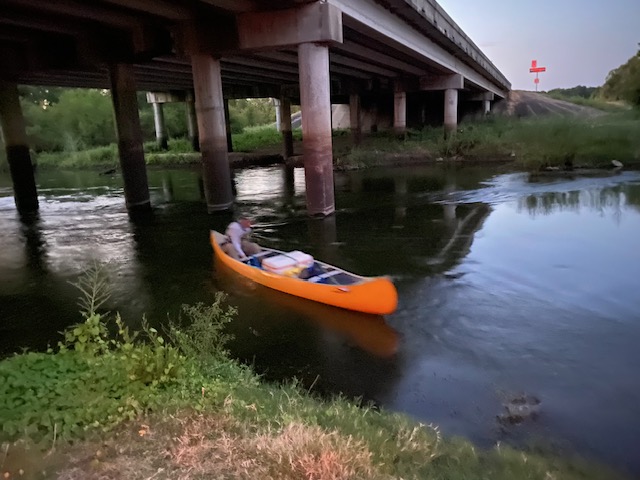
Lots of supplies in Alan’s canoe
One of my worries about running a narrow creek was about how many large trees would be lying completely across the channel. Very rapidly Adam scraped over the top half of a semi-submerged log in his kayak but my cargo canoe loaded with water and food could not pass. We pulled to shore, carried the cargo around and then portaged the canoe 60 feet to reload and relaunch. This turned out to be the only portage of the day and I pointed out to Adam that many famous “canoe trails” in Maine and Minnesota have ¼ mile portages between upland ponds that have no water flowing between them. This kind of portage was a cinch unless there turned out to be one tree every half-mile.
Very rapidly we were off, and then came the rapids. The first was a washed-out concrete vehicle crossing that had collapsed in the middle. Both boats sailed through the gap and the Yegua carried us soon to a second loud crashing of water half a mile downstream. This spot was a concentration of large rock rip-rap strewn across the channel and below a powerline that supplies Somerville and Caldwell. Construction crews likely used this material when stringing wires 50 years ago. The heavy water flow got us over the rocks and into the big eddy four feet below. No problem! However, this day was far from over.
The next rapids could be heard but were hidden around a hard right turn. It ended up being a steep drop of 5-6 feet. This spot is a natural rock formation. The 366 cfs filled my boat when I went over the drop and was pushed sideways into a rock wall. This, dear hearts, is why we tie all our gear securely into the canoe.
The entire boat was full of creek water in under three seconds and was being pushed rudely downstream. The water jugs, canteens, Pelican box holding my I-phone, ice chest (strapped tightly closed), first aid kit were all attached. Adam, who had shot through the rapids ahead one minute ahead of me in the kayak, had spun around to watch as I inelegantly exited my boat and was floating along beside it in my ugly brown PFD (personal floatation device). Don’t ever let anybody tell you it is too hot to wear a PFD (even an ugly brown one), especially on a reach of river that you have never traveled before. We were shoved downstream 300 yards along straightaways and around corners before an adequate sandbar was located to pull up the water-filled canoe.
The PFD was absolutely essential to keeping me from snagging a pant-leg or belt on a submerged tree-limb while being dragged along. The water temperature felt good in late summer, but in winter getting “tumped” over would have been a problem that required quickly building a fire to heat up a shivering paddler (me). Yet another reason you never paddle alone. It is hard to start a fire when you are shaking like a coon-dog trying to pass a peach pit.
Adam in kayak ready for adventure on Yegua Creek near Lake Somerville
The fourth rapid was halfway through the trip and had a large rock in the middle of the river. A lunchtime spot! The rest of the trip was delightful. Magnificent pecan and willow trees over-hung the river. We paddled in the shade almost the entire day. Without question the largest black willow trees I have ever seen stand like mythical giants along the Yegua. I wondered what it takes to be the state record Salix nigra? Two of these we saw had to be contenders.
Beautiful live oaks grew on both the Washington County bank and the Burleson County shore. Big antlered deer and feral hogs were sleeping and feeding in the lush green growing on the shoreline sandbanks. There were two old, abandoned county road bridges. Cattle swam and waded back and forth across the county line (who needs bridges?). We noted two minimalist fish camps but not a single drop line was seen. This apparently is rod and reel territory.
Adam and Alan on Yegua Creek near Lake Somerville just past HWY 36 bridge
Having unceremoniously plopped over my trusty OUACHITA, I was glad I did not bring my binoculars. Many small birds flying across in front of me consequently went unidentified. I did note eastern phoebes, pileated woodpeckers, a lone anhinga, wood ducks, a Louisiana heron, green herons galore, and great blue herons. At least my vision is still good enough to see the big ones!
The surprised behavior of a lone coyote suggested he had never seen a boat before. Deer antlers seem big this year based upon the whitetail bucks we flushed. That cool rainy spring must have provided protein at the right time for a lot of grazing animals. Francis of Assisi would be pleased.
The nice thing about this canoe trail is that it has easy access to put in on Hwy 36 and easy access to take out at Hwy 50 near Clay, Texas. Driving home through Independence and eating Mexican food at Las Fuentes in Somerville after a 6-hour paddle was a sweet finish to a Labor Day Sunday trip. Always bring dry clothes or lunch must be eaten in the outdoor heat.
Nowadays the Yegua is considered a “creek.” After experiencing the intensity of the flow and taking a thorough dunking at a natural waterfall I can see why those well-educated Padres and Spanish Expedition commanders wrote down in their diaries that the San Francisco was a river.
Yegua Creek, which is actually a river. Photo by Alexey Sergeev, 2020. Public domain. (as you read on you’ll see why Alan shared no personal photos)






 Nature Along the El Camino Real