A Visiting Snapper

 by Sue Ann Kendall

I went out Friday morning to see if I could get a photo of the feral cat that’s showed up at our ranch (brave thing, considering our predator density). Thus, I had my camera out and ready when I detected movement over by my tack room. It wasn’t a cat, though. At first, I thought it might be an armadillo, but as I got closer, I recognized a common snapping turtle (Chelydra serpentina) was lumbering along across the property, heading from one body of water to another.

snapping turtle
I’m busy. Leave me alone.

We’ve always had snapping turtles at our ranch. For a long time there was one much bigger than this (those tend to be males), with a head as big as a pro football player’s fist. We’d usually run across it in April or May, heading somewhere across a pasture. The dogs bark at them, but horses don’t seem to mind them. I’ve never seen one snap, though my mother used to tell a story of how she narrowly avoided losing a finger once.

snapping turtle
Obviously, it came out of a body of water next to the blooming black willow trees.

These turtles tend to live in shallow water, especially streams and creeks. That’s where at least one of the snapping turtles on our property was for much of this spring. I don’t know if it’s the same one. This one looks less ancient somehow.

This is in the creek in front of our house and is smaller than the other one. Notice the hole in its shell. I wonder if someone tried to eat it or shot it.

These turtles are really cool, and I’m glad they are still around. They seem like relics of a long-ago age, to me. Here’s a fact I found that you might like:

In shallow waters, common snapping turtles may lie beneath a muddy bottom with only their heads exposed, stretching their long necks to the surface for an occasional breath. Their nostrils are positioned on the very tip of the snout, effectively functioning as snorkels.

iNaturalist

I’ve seen them doing just that in Austin in the limestone creeks, which was fun. Whenever I saw people and their dogs frolicking along Barton Creek, I remembered how many snapping turtles I had seen there, in Lake Creek, and in Brushy Creek. They are quite common, as their name hints. Still, it’s always fun to see them out of the water, since they spend most of their time submerged and snorkeling along with those handy nostrils out, unless there’s a mating mission or something.

The tail looks pretty scary, too!

What Else Is New?

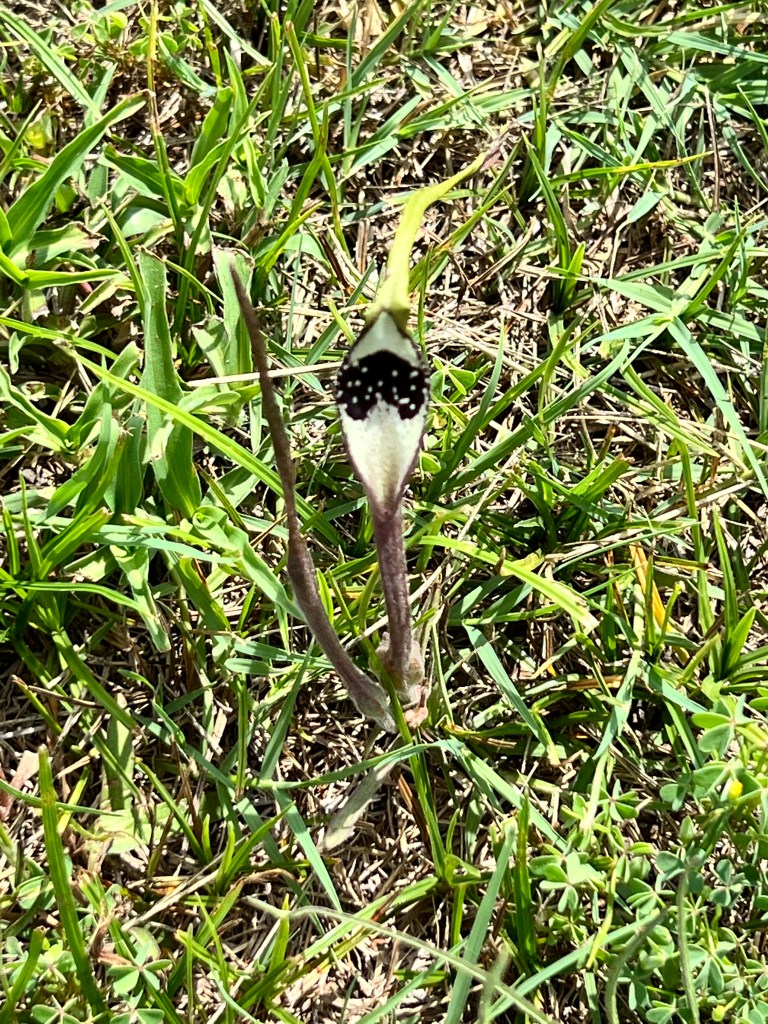
I’m always on the lookout for new flowers and such, and sure enough, every day seems to bring something fun and/or pretty. Who needs all those bluebonnets and paintbrushes when the other guys are just getting started? My Engelmann daisies are taking over, as usual, but I’ve been seeing some other favorites popping up, as well. Take a look!

I’ve tried my luck at posting sound files on iNaturalist, too. So far, I have a confirmed (and VERY loud) Chuck-will’s widow and dickcissels. You’d think I could get a red-winged blackbird, but there are always bunches of other birds around when they are calling. I could get other birds, but I don’t know what a lot of them are, and there’s no help identifying the sounds if you can’t see the bird.

Pipevine Swallowtail

by Donna Lewis

There has been lots of activity in the pipevine area of my garden.

The first baby pipevine swallowtails (Battus philenor) of the year. These are the black form of the larva. There is also a red form. I will probably have both later on in the month.

This is a species of butterfly that is common around Milam County, so, I am sure there is a native pipevine that it uses as its host plant. My goal this year is to find it, and take some photos.

You will know this butterfly by the blue-metallic hind wings.

Photo taken April 20 at Canyon Lake by dnvarga on iNaturalist. Used with permission.

The pipevine plant I have in my garden is a naturalized version from Brazil. It is apparently safe (not invasive).  It is hard to come by, because the caterpillars will eat it to the ground in 24 hours. Thankfully, it has grown back 4 to 5 times each year. This plant has a toxic ingredient like milkweed to protect the adult butterfly.

 I really like these little guys.  They do not sting you and are interesting to watch.

Who are you gardening for?

In Memory of Sam Jolly

Sam Jolly – 1969-2022

Our chapter was sad to learn that one of our long-time friends and member of our most recent 2020 graduating class, Sam Jolly, passed away on April 13.

Sam attended our meetings for many years before joining a class. He was always there to help his friends and neighbors with lifting objects, driving at night, or getting up and down the stairs when we met at the old church basement.

While he had many challenges from brain tumors that affected his memory for the past few years, he was always cheerful about them and didn’t let them stop him from learning, participating in activities, and helping out in any way he could.

As recently as last year, he built bee houses for our chapter that we gave away last year at an event we held at the Wildscape. He was always busy creating, teaching others, or photographing the world around him. You can see some of his photos on iNaturalist, and it’s worth taking a look. Some are just amazing.

Long-time friend Cindy Travis said:

Pipevine swallowtail near the end of its life, but still beautiful. Photo by Sam Jolly.

He had a good heart and we feel blessed to have had him close to us and our friends for most of his last years.

Cindy Travis, friend and former landlord

After moving from Milam County to be near his family for his last few months, Sam passed away. He has left his body to science. He was always generous that way.

Learn more about Sam and his life and family in his obituary. Please share your own thoughts, photos, and memories of Sam with Sue Ann at ecrmnsecretaryATgmail (figure it out) or in the comments, and she will add them to this post.

Here are some great pictures of Sam, most of which were sent to us by his son (as was the photo at top). We are grateful for more memories of our friend to enjoy.

A Long Overdue Chapter Event

by Sue Ann Kendall

Our Texas Master Naturalist chapter is finally getting back into the swing of things since the pandemic has given our county a bit of a break. We have held a class with in-person meetings and have enjoyed hybrid Chapter Meetings all this year as well.

One thing we’ve really missed for the past few years is celebrating our milestones. At our Chapter Meeting on April 14, however, we remedied that, and it sure felt good. Those of us who persevered for the past year got a second pin like we got last year for sticking with our volunteer duties and getting things done, in spite of COVID. Those in attendance all got to stand near each other and pose. It was good.

Chapter members grateful to be together and to have contributed our time and effort in service to the nature of Milam County.

We also celebrated milestones in our work. Eric Neubauer reached 500 volunteer hours (that’s a lot of spider observations!) and our current President, Carolyn Henderson, reached 250 hours. In addition, a number of us have re-certified as Texas Master Naturalists for the year 2022 by completing ten hours of advanced training and 40 hours of volunteer time. All we applauded and lauded, as well they should have been.

It’s been nice hearing speakers like Dr. Frank Summers speak to us in person, but it’s also great that those of us unable to attend for whatever reason can attend via Zoom as well. What great things technology has brought us!

We’ve also been able to have visitors again and getting to meet new people has been a highlight for this year, too. At our meeting we got to visit with Patricia Coombs, sister to one of our meeting hosts, Catherine Johnson. We also got to hang around with a fellow Master Naturalist, Mary Ann Melton, of the Goodwater Chapter in Williamson County. Many of us have seen or spoken with her before at conferences. Ah, conferences. Master Naturalists around the state and country are hoping to be able to attend our annual meetings this year.

Greetings to all of you out there enjoying your own volunteering, meeting, Zooming, and interacting with each other. It’s wonderful how nature and our love of learning brings us all together.

Spotting a Kinglet

by Pamela Neeley

I spotted a Ruby-Crowned Kinglet in the window feeder this morning around 10:00 am.  With the metal screen in the window, I can get within two feet of birds if I am extremely quiet.

A photo of a website image of the crown

This is the second time I have identified this bird. The first time he was flashing his psychedelic ruby crown, a few years ago. 

Female, photo of a web page

Today, this male was enjoying the sunflower seeds. They winter in Texas but do not nest here.  Unfortunately, I didn’t get a photo. Here are a couple from the web.

More about the Ruby Crowned Kinglet