Sporty Sports and Dandy Lions

by Sue Ann Kendall

Here are two sets of thoughts in one post.

Sporty Sports

As I continue to monitor the new flowers that are blooming in northern Milam County, I’ve found a few interesting ones. You probably know that occasionally a plant will produce a flower that’s different from its usual form or color. These sports are how new cultivars can come about, especially if humans show up and start breeding them intentionally. Out here, though, they just show up and we enjoy them.

This is a Texas paintbrush Castilleja indivisa found on County Road 140 near Walker’s Creek.

Here’s my mandatory Wikipedia quote about sports in botany, in which I left the links in case you want to learn more:

In botany, a sport or bud sport, traditionally called lusus, is a part of a plant that shows morphological differences from the rest of the plant. Sports may differ by foliage shape or color, flowers, fruit, or branch structure. The cause is generally thought to be a chance genetic mutation.

Wikipedia

The beautiful flower you see above was a pleasant surprise on my morning walk down the road in front of our property, where I was looking for new things and admiring the bluebonnets. What the heck is that yellow plant, I wondered? It looks like popcorn. When I got close, I was taken aback by how beautiful this sport of the normally orange-red flower was. I guess if I was a nursery owner, I’d have collected some seeds in a few weeks. Instead, I looked up more information and found that pale orange and yellow variations do occasionally occur.

Here’s now 99% of the native annual Texas paintbrushes, which are a parasitic plant, by the way, look where I live:

That looks more familiar!

The more I have been looking closely at my roadside wildflower friends, the more variations I’ve seen. Have you seen any of these? I know that the pink ladies/evening primroses Oenothera speciosa vary widely in their pinkness. We always have a patch of the whiter ones here. I’ve also run across a light purple bluebonnet Lupinus texensis that I found quite charming (more so than the burgundy ones), as well as a white Texas vervain Verbena halei, which I had never seen before.

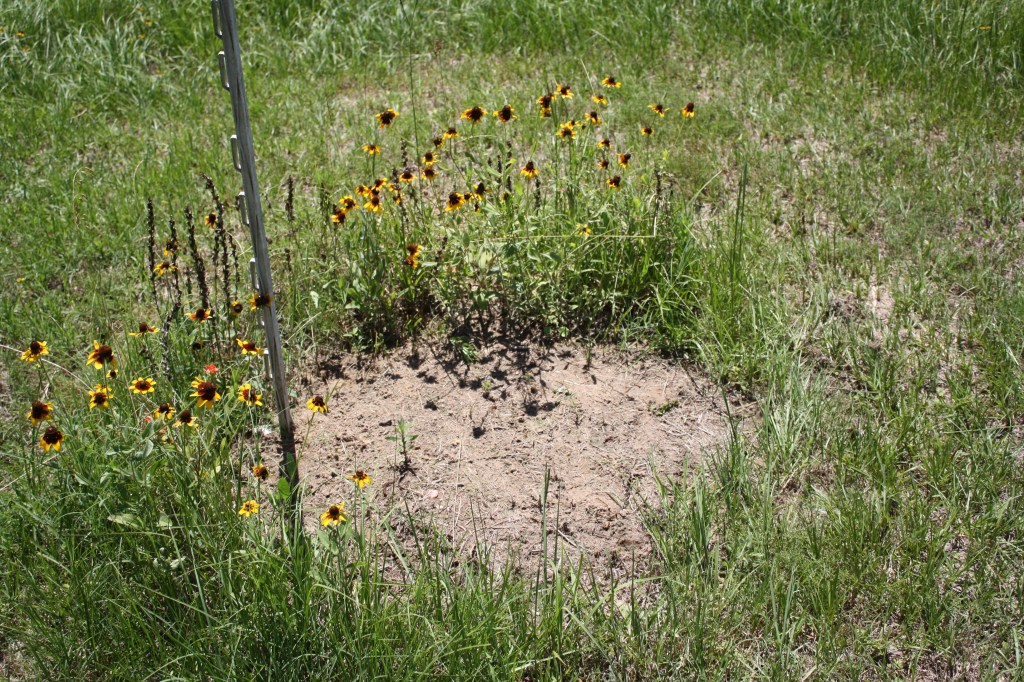
You might call me paranoid, but I wonder if the reason there are so many variations in the colors of the flowers on that stretch of road is because of the chemicals sprayed every year on the field across the road (which is the only field in miles in any direction that’s managed using fertilizers and herbicides sprayed by an inaccurate plane). I’ll never know, but I have my suspicions, especially since tomatoes and peppers always die after the spraying. I’m pleased that this year they have winter rye or some silage thing that they don’t spray.

This is the field to which I refer. Apparently the chemicals do not bother the verbena.

Speaking of herbicides that I don’t use…

Dandy Lions

Someone on Facebook recently was complaining about how chemical companies always use the common dandelion as their generic image of an ugly weed that must be eradicated. We all know that you can eat the young leaves, make wine from the flowers, and dye using the roots, of course. They have many health benefits, from what I read. They are friendly lions!

They are also vitally important to our pollinators in the early spring. Last month, they were among the few blooming plants out there for the bees, tiny wasps, and butterflies to feed on. Until the rest of the flowers showed up, later than usual, they kept the beneficial insect population going. I was very glad to see so many healthy common dandelions out in my pastures.

This gal was also happy to see a dandelion.

But, have you noticed how many members of the dandelion family are actually out there in our fields, pastures, and yards? I have been greatly enjoying some of them, including the tiny weedy dwarf dandelion Krigia cespitosa, the shy smooth cat’s ear Hypochaeris glabra that spends most of its time tightly closed up, and the extra prickly one, prickly sowthistle Sonchus asper.

One more interesting thing about dandelions. I just discovered today, when I was researching which flowers I’ve been seeing were in the dandelion family, that what I called dandelions my whole life, and the only ones I saw as a child, were in fact false dandelions Pyrrhopappus pauciflorus, which is a member of the aster family. Now I know.

They are beautiful, anyway.

Miscellaneous

And while I’m here, I may as well share what else is popping up around here. I saw my first winecup and fleabane this week, and my first Englemann daisy, sikly evolvulus, and tie vines today (forgot to take a picture of the latter). My heart leapt for joy when I discovered I DO still have baby blue eyes on my property (someone “cleared brush”). For added pleasure to those with allergies, the black willows are blooming, too.

All I can say is keep looking down. You’ll see plenty to keep you entertained for hours. We live in a beautiful place, and have so much we can learn if we are observant!

There’s always something to see on a Texas country road in spring.

First Monarch Caterpillar

by Donna Lewis

The first tiny monarch caterpillar in my garden for this year! It is a first instar and very little. Of course, the only milkweed I have right now is pretty tiny also.

The photo is not the best, because the wind was really blowing the camera around.

Still, it’s pretty exciting to see the little thing that will grow up to be a magnificent monarch butterfly.

Reach for the stars, little one.

Look Who Dropped In!

by Donna Lewis

My favorite little frog was sitting in one of the frog tubes that I made and installed in the garden.

Spot the frog!

Mike Conner put the instructions on our website Easy to make.

(editor’s note: I looked for the instructions on the website but couldn’t find them. I did find this link to Texas Parks and Wildlife’s YouTube instructions and am sharing the video below! Fun.

It is a Green Tree Frog (Hyla cinerea). I just love them. They look so sweet.  This baby did not move an inch when I walked right up to it.

I actually didn’t see it until I was close because I was cleaning up part of my garden where the little froggy house is. I didn’t want to get too close and scare it.

These frogs like to be near area’s where it is moist and protected. I have it attached to a trellis with vines on it. So, it’s shady and moist and the frog can hide out under the trellis.

What a nice surprise.

The Rise and Fall of the Giant Earth Ball

by Sue Ann Kendall

Sometimes it’s fun to observe a natural object over time. I tried this with a mushroom I found on my property, the Hermits’ Rest Ranch in northern Milam County. On March 29, I saw what appeared to be an egg in the field in front of our house. When I looked more closely, I realized it was a large mushroom. Of course, I photographed it. My whole family laughs at how I photograph everything.

The first day I saw it.

I dutifully went to iNaturalist and recorded my observation. I thought it might be a puffball, but it appeared to be a Common Earthball, Scleroderma citrinum. Sadly, no one has confirmed it.

Wikipedia tells us that it’s the most common of its ilk in both the US and the UK. I’d never seen one before, however. It sure was large. Here are some facts about the earthball:

Earthballs are superficially similar to, and considered look-alikes of, the edible puffball (particularly Apioperdon pyriforme), but whereas the puffball has a single opening on top through which the spores are dispersed, the earthball just breaks up to release the spores. Moreover, Scleroderma citrinum has much firmer flesh and a dark gleba (interior) much earlier in development than puffballs. Scleroderma citrinum has no stem but is attached to the soil by mycelial cords. The peridium, or outer wall, is thick and firm, usually ochre yellow externally with irregular warts.

Scleroderma citrinum can be mistaken with truffles by inexperienced mushroom hunters. Ingestion of Scleroderma citrinum can cause gastrointestinal distress in humans and animals, and some individuals may experience lacrimationrhinitis and rhinorrhea, and conjunctivitis from exposure to its spores.

Wikipedia https://en.wikipedia.org/wiki/Scleroderma_citrinum

The next day, when I came back, the earthball had grown a lot. I used my ear bud as a comparison (I didn’t have a coin, which is traditional).

Next time, it had grown even more. Luckily I’d just been gathering eggs, so I got some nice shots. That’s the biggest mushroom I ever saw.

After that, I got curious about its lifecycle, so I decided to photograph it every day. Since it’s poisonous, I didn’t lick it. And, before you ask, the dogs are on the other side of a fence from it.

I was afraid I’d miss yesterday, since I was scheduled to go to a conference yesterday and today. “Luckily” the conference was canceled. Unluckily, I didn’t find out until I had already spent a night in Kerrville. (The TXPWD were kind and repaid my hotel bill, since it was their error that some attendees weren’t notified.) Anyway, I got home to find it had finally burst open.

This was in the late afternoon, so not great light, but look at all that spore material in there!

There sure were a LOT of spores in there. Since yesterday was so windy that there was a Red Flag warning in the county, I figure there may be future earthballs all over the place!

Sad earthball. You’ve been fun to watch!

This morning, my buddy looks pretty sad. But I’m impressed the mushroom hung around for over 11 days! I’ve learned something about the Common Earthball, and so have you!

Learn More

Pulling Weeds at the Wildscape

by Carolyn Henderson

Aren’t all weeds native? Ha!

Scott inspects all those weeds

Weeds were the call of the day when a dedicated group of El Camino Real Texas Master Naturalist members showed up at the Birds and Bees Wildscape Saturday. There were plenty of them calling.

Eric gets the malabar spinach area under control

Members Gene and Cindy Rek own the Bird and Bee Farm, and they have allotted space to ECRTMN to grow a wildscape for use in educating people and spreading native plants to interested citizens. They are converting the acreage they have to native plants and grasses. These efforts have brought about an award from the Texas Environmental Quality Commission.

Catherine, Debra, and Cindy talk weeds

The TEQC is going to come out and video interviews with the Reks and a couple other members of ECRTMN. Catherine Johnson, manager of the ECR part, called for a clean-up day to make the wildscape more presentable for its “two minutes” of fame. More information on the award will be discussed when more is known about it.

Donna weeds, prunes, and imparts plant information

Catherine, Donna Lewis, Scott Berger, Linda Burgess, Eric Neubauer, Debra Sorenson, Alan Rudd and his son, Adam, Cindy Rek, Jackie Thornton, and I knocked out a good portion of the clean-up but had to avoid some for ant treatments. Bees, unusual flies, spiders, and a few butterflies were already there, too. There are not yet many flowers. Everything is slow coming back this year, and I believe that is statewide, according to Texas Nature Trackers – TMN. In another week or so, I believe it will be in full growth mode.

Linda volunteered for weed dumping. She took many trips.

Alan and Adam finished a storage building they had started at the wildscape. It is a great building for the site, and now all the planting pots that we save to share with others will not blow all over the place.

There was also a good amount of fellowship – especially around the table where all the goodies were that Catherine baked and brought for us. We went home having eaten a lot of chocolate and honey tea from Cindy.

Food and fun!

There’s more to be done in a short period of time, so if any members have time and an urge to pull weeds (Catherine treated the two spaces that had ant problems), the gate is usually open.