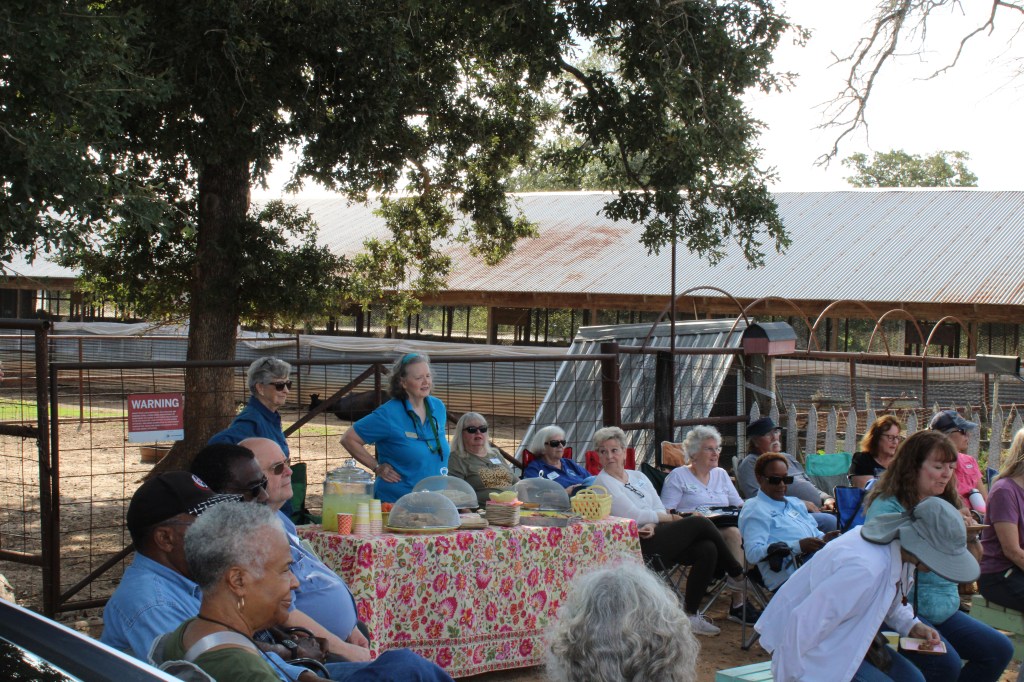
Little River Master Gardeners gathered at the El Camino Real Master Naturalist Wildscape last Wednesday to learn about native plant gardening. The Master Naturalists have a wildscape out on FM 334 to learn, teach, and share with each other about keeping it native.
Worker bees getting ready for presentation to the Little River Master Gardeners
Connie Anderle, a member of both chapters, introduced everyone then turned it over to Catherine Johnson, manager of the wildscape for ECRMN, to explain the layout and where the plants come from to be planted. Linda Jo Conn then talked to the group about why growing native plants is better for everyone and all native species of insects, birds and animals. Jackie Thornton spoke about the beauty of native species and read excerpts from a children’s book titled A Prairie Garden. Gene and Cindy Rek also spoke about their contribution, which is a lot, to the project.
Jackie Thornton reads pocket garden book to the group
Ann Collins made refreshments for the attendees and Ellen Luckey helped serve. There was a great deal of debate over which of Ann’s multiple types of cookies was the best.
Ann Collins and Ellen Luckey serving refreshments
After the speeches, all the guests toured the wildscape with members guiding and explaining what each section is about. There were 32 Master Gardeners in attendance.
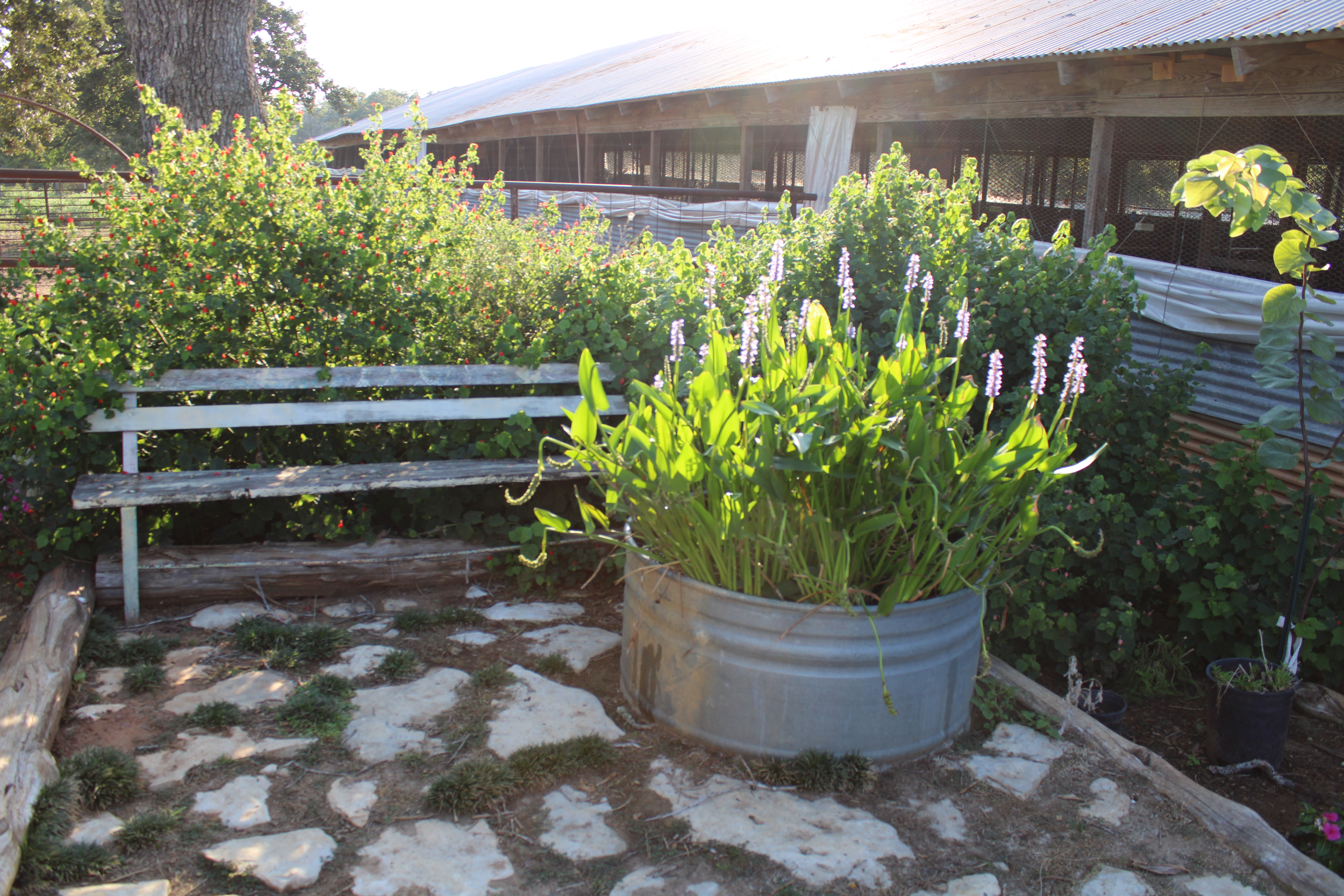
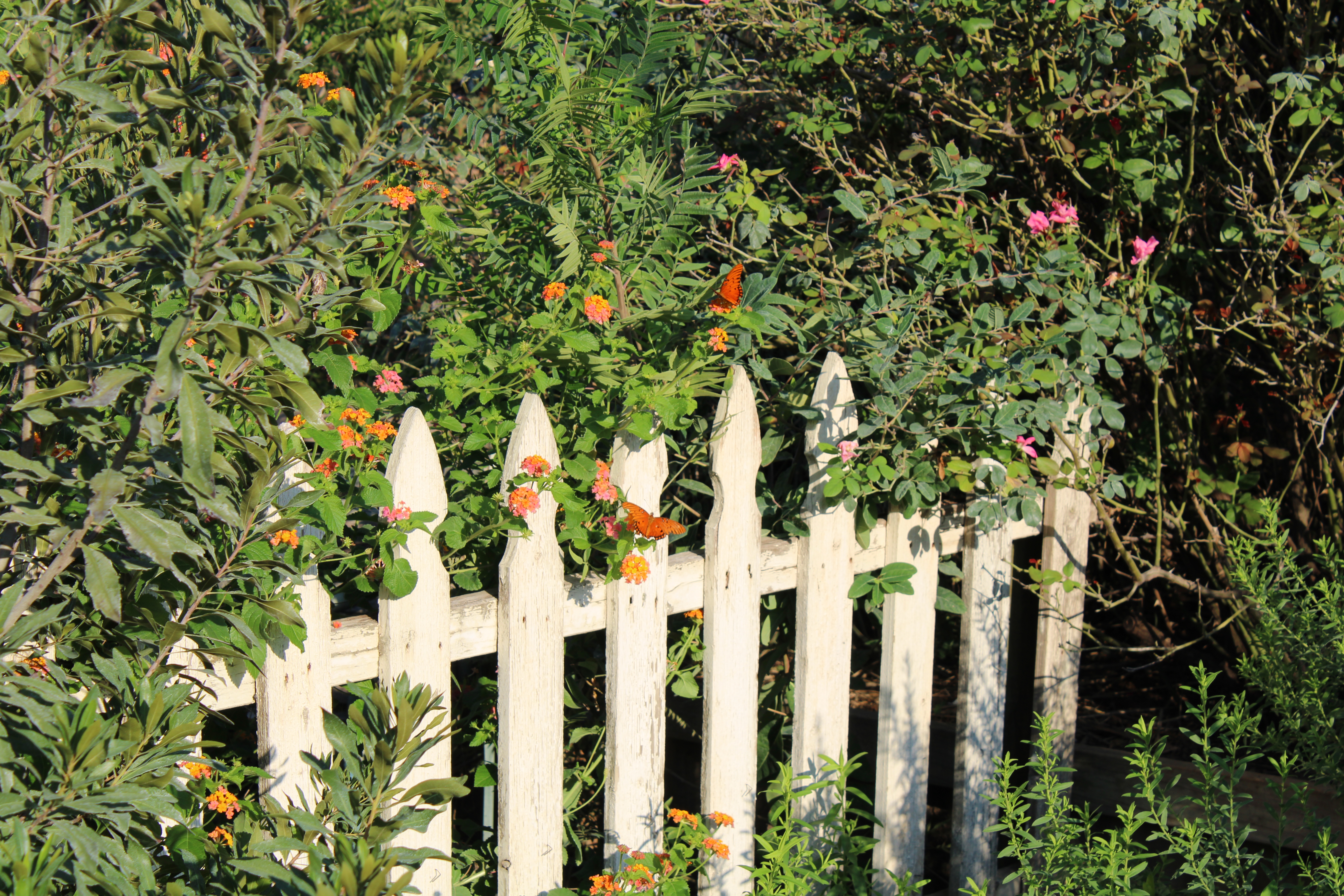
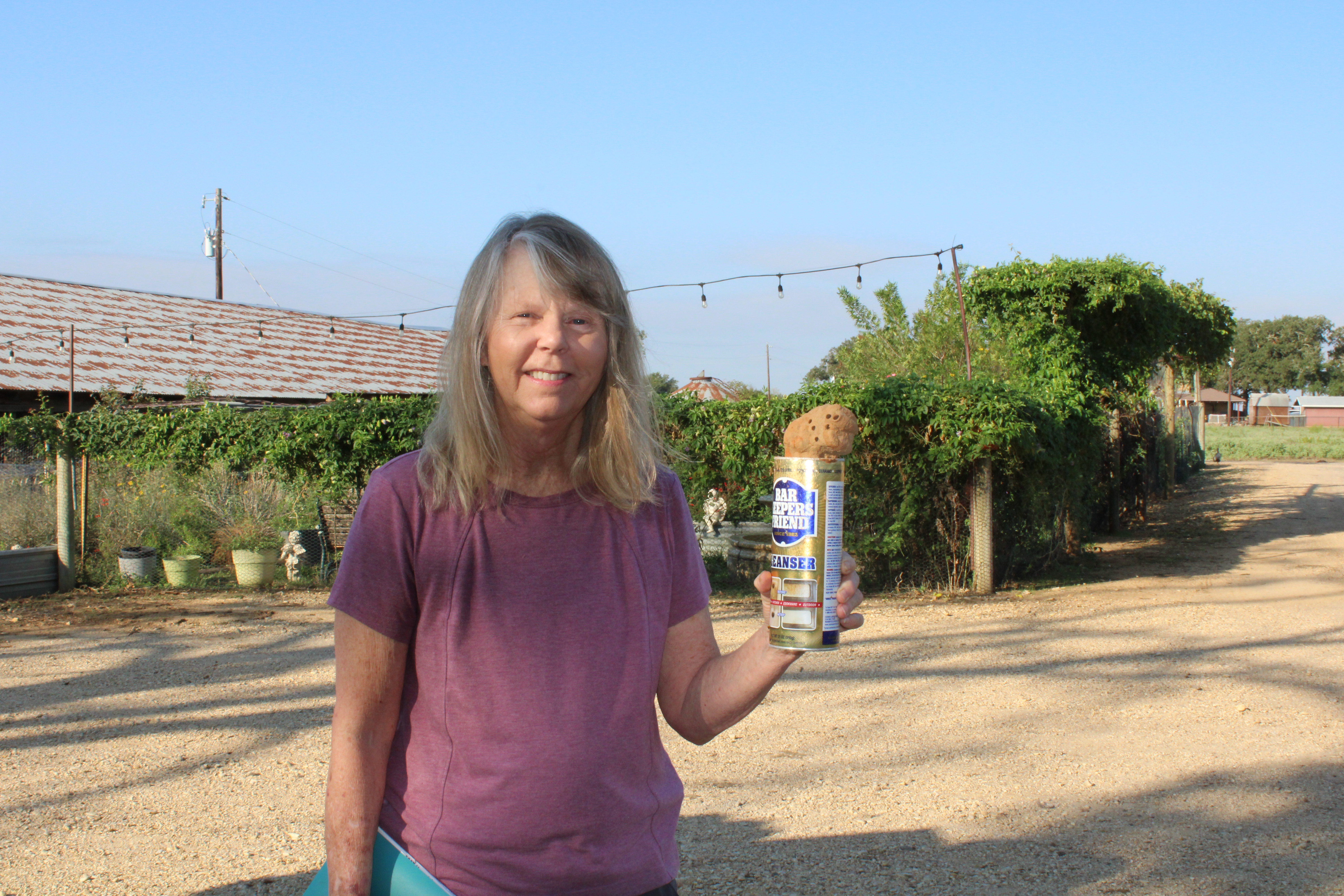
Entrane to the wildscapeA few of the many Gulf Fritillaries flying all over the placeCindy Rek shares her very large dirt dbauber nest made on top of a cleaning agent can.Linda Jo Conn explains why native is better
My yard has been visited by a few birds I’ve never seen live and in person before, and one I’ve seen before, but not at my house this summer. The addition of a bird bath seems to have been the big draw.
I don’t normally put out feeders or water because I have a cat that will kill and eat birds. I’ve had many birds despite that because I have blooming plants and big trees. Due to the long hot, dry summer, I felt compelled to at least get them some water. And they came to use it.
Daily it attracted a family of American Robins. It was common to see four to five of them together in the bath. They’ve been around a while though. They like to play in the sprinkler when I run it. Blue Jays, Cardinals and Mockingbirds used it too. Those are all common here. Doves – both White-winged and Inca – also used it.
Before I got the bird bath, I found a pretty good size fledgling trying to fly from the ground. I’d never seen one like it before. After putting the cat in the house until I knew it could fly, I put it on iNaturalist. It was not a good photo because the baby was in constant flapping motion. I identified it as a juvenile Yellow-billed Cuckoo. I thought I had to be wrong, but it was verified. Then I found an adult sitting in the tree. It was a first for me and my yard.
Blog editor notes that these are most easily identified by sound. It sounds like the jungle noise in a Tarzan movie.
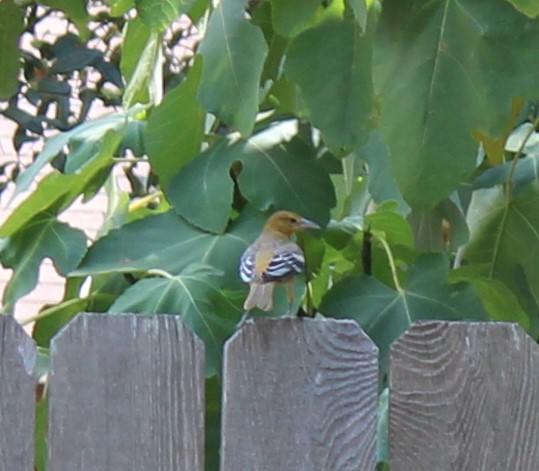
Once the bird bath went in, a Baltimore Oriole showed up. It’s a female with a lot of bright yellow feathers. I had never seen one of those before either. I had it verified on iNaturalist, also. There is another Oriole that looks somewhat like it, but not exactly, so I was glad to get it verified. Based on a poll at our monthly Master Naturalist meeting this week, quite a few people saw these Orioles for the first time this year. Bird Lady of Milam County Ann Collins gets them regularly, though.
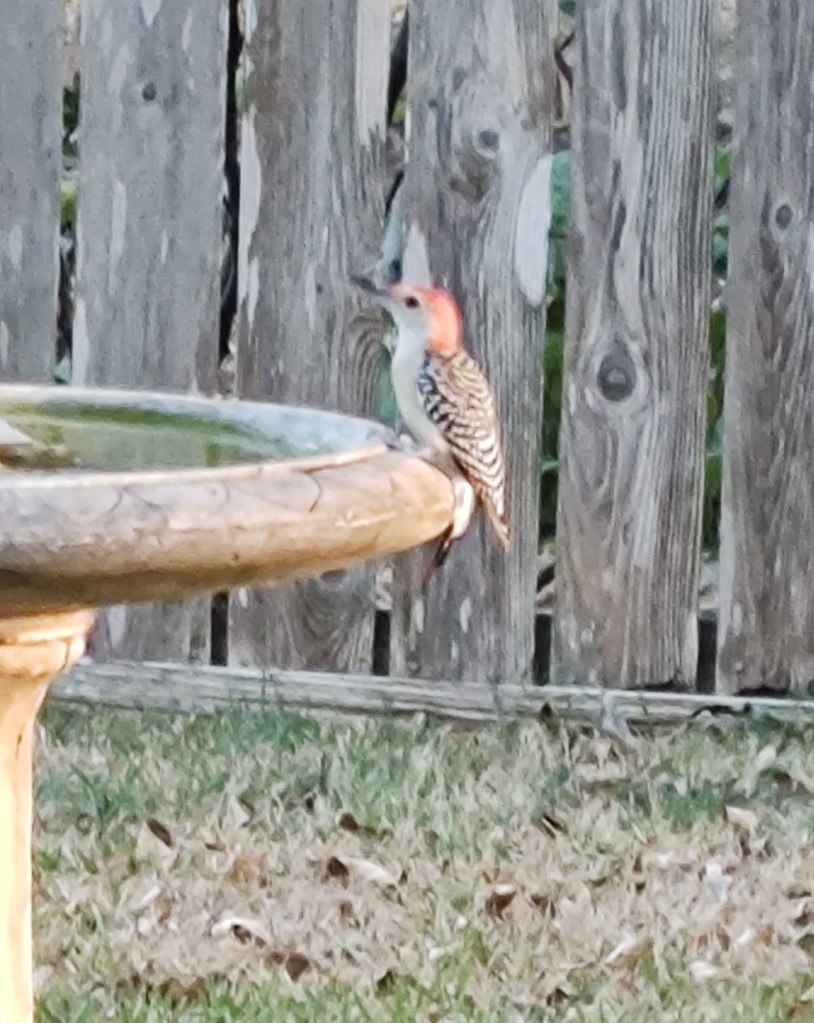
I also had a Red-bellied Woodpecker come to the bird bath and Ash tree. I’ve seen those before, but never in my yard. They have been here before because the holes are in my tree.
All the photos are taken through a window in my house, so they aren’t great. But the birds sit still when I’m on the other side of it.
Oriole from the back
Finally, I’ve included a photo of a mystery bird. It was in a large vacant lot near my house. I took the photo with my phone. It was too far away to get a good shot. But I’m wondering if anyone can identify it. It hasn’t been identified on iNaturalist yet.
Since the rain started two days ago, the birds have not needed the bird bath.
According to The Cornell Lab, All About Birds, many birds, especially Blue Jays and Cardinals, molt in late summer and fall. It grows and replaces feathers gradually but occasionally a bird may lose all the feathers on its head at once, particularly Blue Jays, in which molt of the feathers of the head “capital tract” in synchrony. This usually occurs in juveniles undergoing their first prebasic molt.
My apologies for somewhat blurry photos since they were taken through the window to not scare off the bird.
The last one is filling in a bit, but don’t worry! They will all be beautiful again eventually.
As I have mentioned and you certainly know, this year has been a hard year for every living thing. Water and food are not as plentiful for our wild friends.
So, while I have lots of extra water stations, I also have put out extra bird food.
Black oil sunflower seeds are my favorite for most of the feeder birds, along with dried mealworms for the bluebirds and phoebes. Live mealworms are the best, but even more expensive than the dried ones.
I have spent way over my budget this year, so I need to win the lottery soon. Like me, the birds will have to be careful with our funds.
I took these photos this morning of first-year bluebirds sitting on one of my platform feeders eating mealworms I had just set out. They must fight the cardinals for them. The eastern phoebes also like the mealworms.
The bluebirds were born this spring, so they look a bit rough. They will look better in their second year.
It’s nice to do something for the birds. It’s nice to do something nice for anyone.
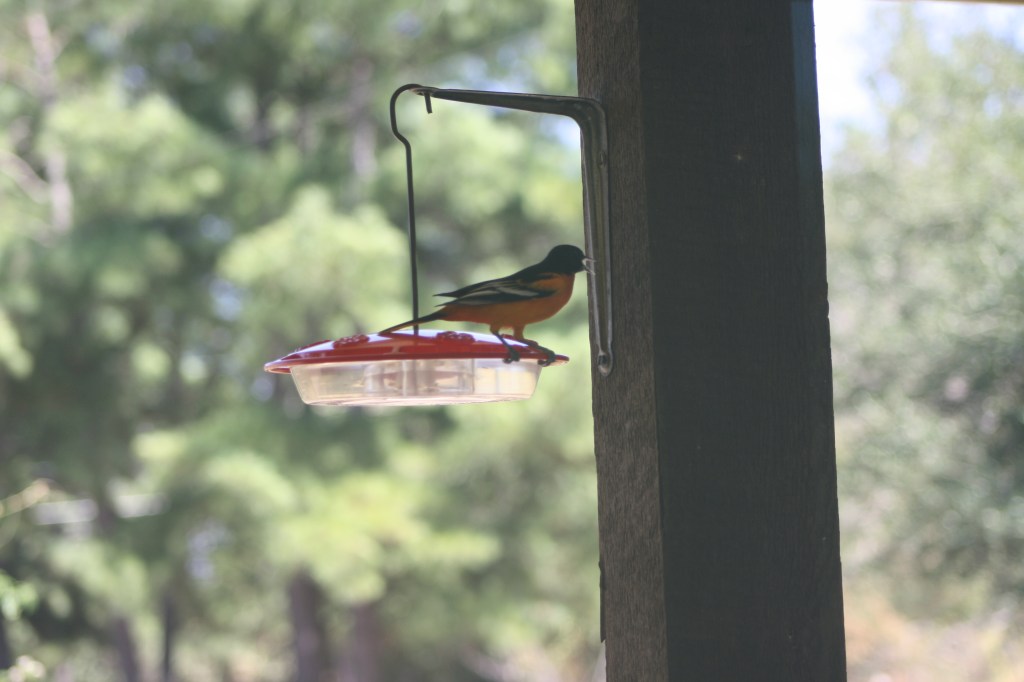
This morning I looked out our front window to check on one of my hummingbird feeders. I went oh, what is that big orange thing! It was a male Baltimore Oriole!!
It was trying to drink the sugar water from the hummer’s stash. I rushed to see if I could take a photo through the window. I got a few that were good enough to clearly identify the bird. He was not there long because a couple of attacks to his head by one of my male ruby-throated hummers ran him off.
I had the bottom of an old feeder, so I got it out. I placed some grape jelly, pineapple chunks, and some Mandarin oranges in it and mixed a little sugar water in it also. An orange cut in half would have been better, but I had to use what I had on hand.
I took the feeder out to my garden and hung it on a shepherd’s hook.
In about an hour the Oriole found it. But so did the other hummers. Not so fast they cried.
Those little rascals simply think they own the garden. I have seen them run the butterflies off too. I love them all, so they will have to work it out amongst themselves.
I have noticed that for the past three years, I have had just one of these beautiful birds show up here at our place.
So why is it alone? No one will ever know, he’s not talking.
The world is full of beautiful little nature events like this; you just have to pay attention.








 Nature Along the El Camino Real