I wrote up a version of this for my personal blog, but thought I’d share it here, in case it inspired any of you to do something similar while you are sheltering in place (or any other time).
This fun project I did yesterday didn’t require any human contact nor leaving the property where our office is. I decided to see how many different yellow flowers I could find in the weed/wildflower collection known as our empty lot.
I simply ambled outside with my phone and tried to get good pictures. Yellows are difficult in bright sunlight, so it was good practice for me to try to get photos with a lot of detail and not just glare. As you can see, I managed to fill a whole screen in iNaturalist!
Most of the field actually LOOKS purple, because there is so much common storks-bill (Erodium cicutarium) growing in it, but when you look closer and closer, the yellows dominate (purple is in second place, with field madder and a little patch of grape hyacinth that must be left over from when there was a house here – I plan to replant them in the “flower bed” I’m making).
What have we got? Let’s take a look. Many of these flowers look really similar, but are different sizes or have other subtle differences. Note that I may have gotten something wrong in my identification, so if anyone corrects me on iNaturalist, I’ll correct it here, too.
Common Dandelion. Taraxacum officinale. Delicious and nutritious. Bees love them.
False Dandelion.Pyrrhopappus pauciflorus. Plus a tiny wasp and tinier beetle.
Prickly Sowthistle Sonchus asper. It’s everywhere. And very prickly. Note that there are aphids or something on it.
Smooth Cat’s Ear. Hypochaeris glabra. Looks like a teeny dandelion on a very long stem. Compare to the first dandelion and you’ll see how small it is.
Cutleaf Evening Primrose. Oenothera laciniata. Smaller than most evening primrose, but a beautiful buttery yellow.
Crete Weed. Hedypnois cretica. I thought it was a dandelion, but look at the leaf and the cool petal shape.
Woodsorrels. Genus Oxalis. I’m not sure which one it is, but it’s certainly oxalis. Sour tasty leaves!
Bur Clover. Medicago polymorpha. It’s about finished blooming and starting to make burs. Yellow is a hard color for my camera, and I couldn’t get a good shot of these.
Straggler Daisy. Calyptocarpus vialis. Lots of leaves, tiny flowers. They are pretty up close, though.
I got a lot of bugs and other things, but I’m just going to leave this parade of yellow-ness alone, in all their glory. I’ll see what other themes I can come up with over the next few weeks as all the flowers bloom away.
Do you have any suggestions? Share with the group!
These images are some Ann clipped from her reading.
I’ve been seeing that some areas of pollution have cleared up somewhat since people have been restricted in travel. Can this be true? The canals of Venice are clear, and dolphins have returned. Satellite images of northern Italy show a huge reduction in fouled air.
Small bits of good news.
Is this Mother Nature’s way of saying, “Hey people! Stop destroying this wonderful world I’ve provided for you?” If we can’t be responsible caretakers, we get a wake-up call in the guise of a pandemic and mandatory quarantines, huh?
Factories have shut down, travel is curtained, people are socked up at home (not so much running up and down the road at any and every impulse).
Just a reprieve
Sadly, the reports indicate that all will return to normal. Factories will belch poison into the air again, cars will spew brown smoke again, planes will dart about like flies in the sky. Here we go again! Didn’t we learn anything? Probably not. We have become so self centered that we won’t make even the smallest sactifice, even to save ourselves.
Mother nature has sent us to our rooms.
Sigh.
PS from the webmaster: We have learned that dolphins really were not swimming in the canals of Venice, though it’s certainly a lovely image. Let us know if anything else we share is not verified!
This past spring on a cool, clear day, my daughter Rosie and I picked up Master Naturalist Donna Lewis and Danielle Ramos in Milano at dawn. We traveled to Washington-on-the-Brazos State Historic Site for an enjoyable edible plant walk. Master Naturalist Patrick Still and his wife also attended.
The group of travelers (this was before social distancing).
Along the way we saw chickens, longhorns, and wildflowers. We then toured the “Birthplace of Texas” where in 1836 Texas declared independence from Mexico to become the Republic of Texas.
A new friend!
After lunch and Jet Fuel coffee to keep us going, we headed to the Antique Rose Emporium in Independence. Donna kept us laughing with her tales. Once she was visiting a nearby farm and a “nice” miniature horse bit her. The children on the tour got scared and ran away!
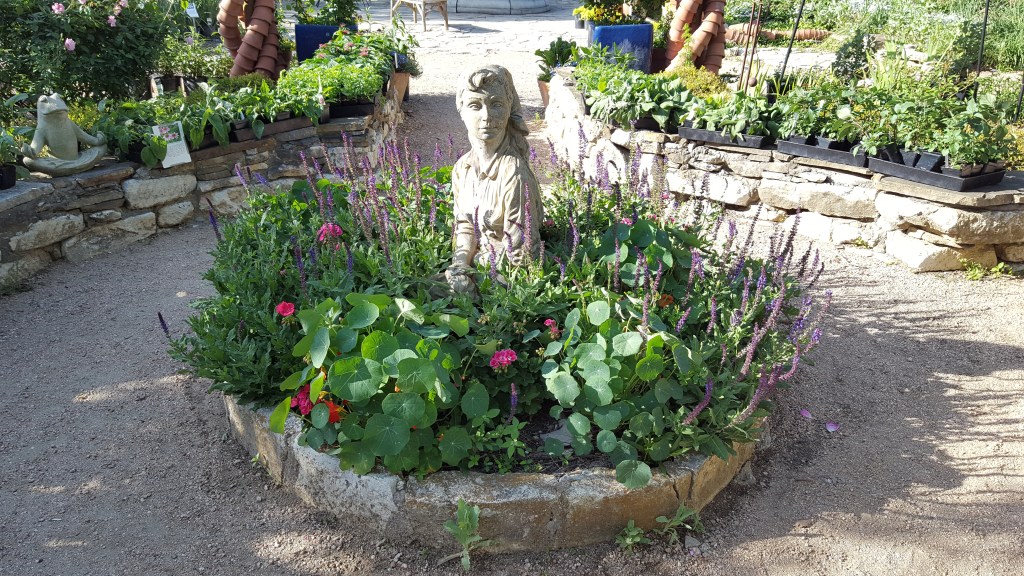
Beautiful gardens.
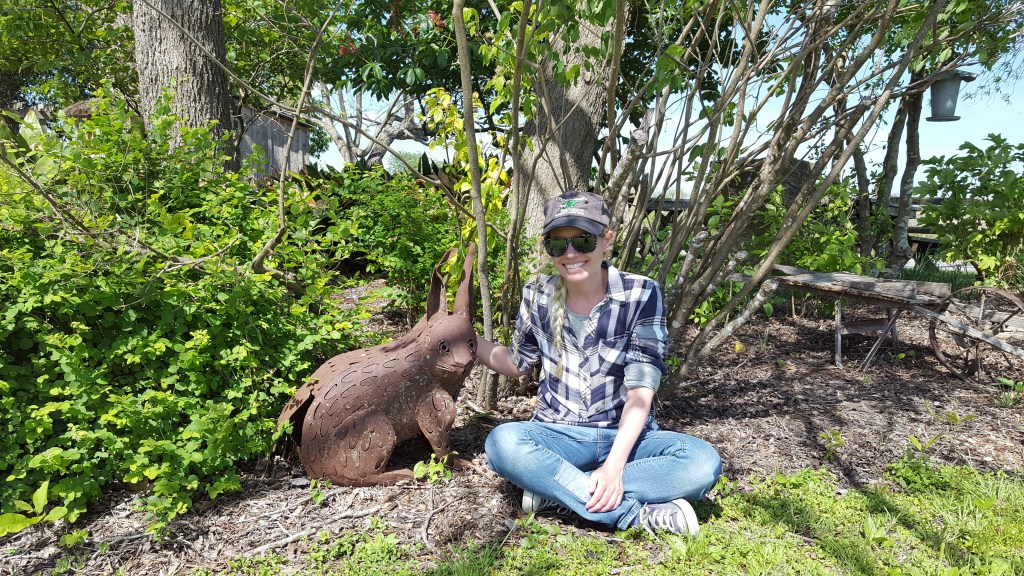
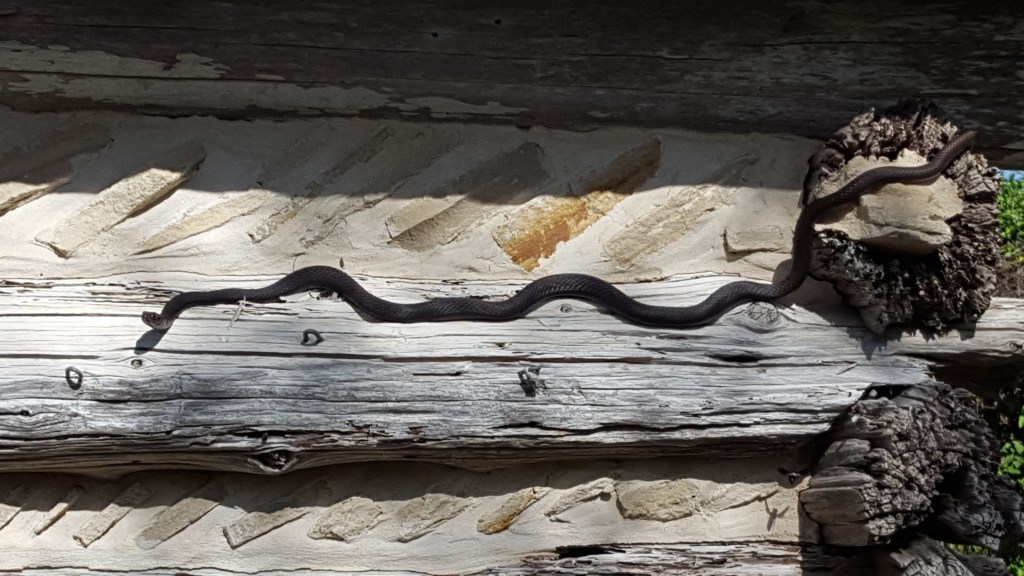
The Emporium was stunning, and we found our favorite blooming sweet peas. We also found artisan beer, wine and snacks at the new bistro there. While relaxing on a porch surrounded by flowers and wind chimes, we noticed a long black crack on a building which turned out to be a snake! We said nothing so as not to “scare the children”.
Yeah, kids, that’s just a crack in the wood.
As we left, we saw a bride having her picture taken among the roses. We were too tired to stop for dinner, so Donna got home by dark—–a perfect spring day in Texas.
I love this place! 5 stars! Photo by Pamela, through a window.
While we aren’t having meetings for a while, we are able to have our own adventures out in nature, or if we’re lucky, nature comes into our homes.
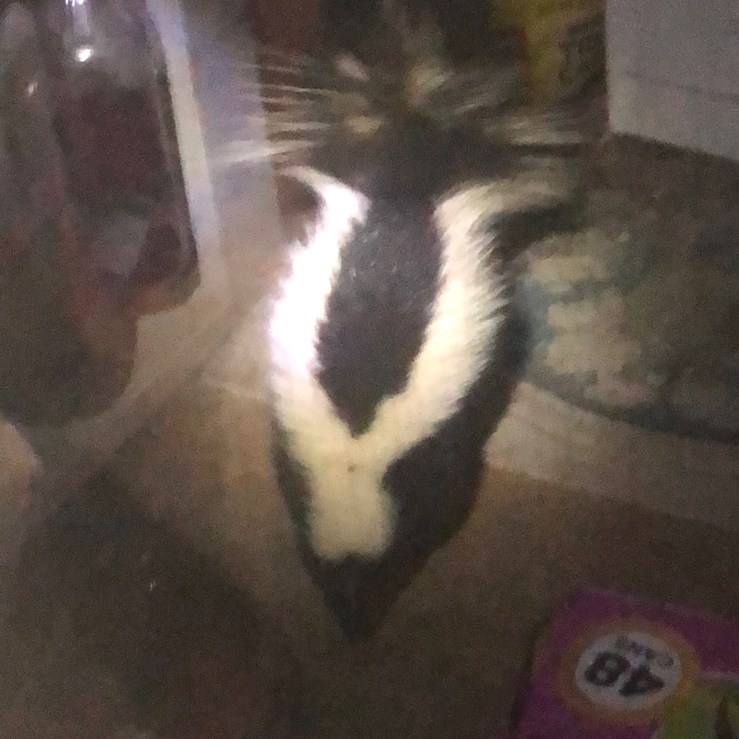
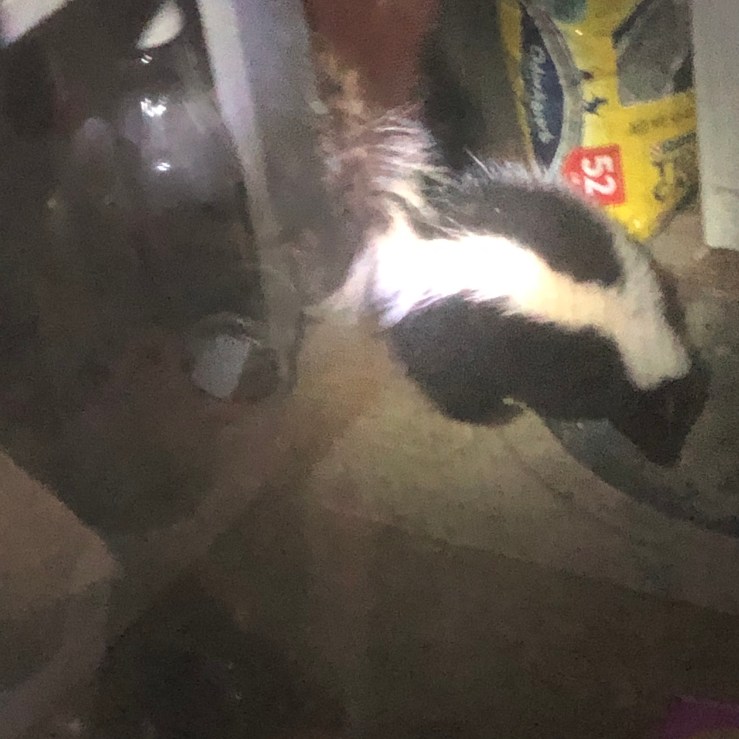
Chapter member Pamela Neeley is well known for having a home that’s welcoming to creatures of nature. People who have been to our meetings may recall that she recently had a skunk that liked to come in and check out her cat food.
It would come in through the pet door and make itself at home. It never sprayed or anything, but was quite clever.
They have the best restaurants here at Chez Pamela.
When Pamela tried to block the door, the patient skunk slowly but surely worked out how to remove the barriers, so he or she could search for snacks. Cat food is really delicious, apparently.
I guess the skunk got along well enough with Ruby the dog, though Ruby did alert Pamela to the skunk’s presence.
Skunks CAN make good pets, but that’s not something we Master Naturalists would suggest as an option. Besides, this is a wild one, and fully operational.
About that Snake
Pamela also has cats. They go in and out that same door the skunk used. Sometimes cats bring presents, as cats are known to do. Earlier in the week, the present Apollo brought was long, thin, and not dead.
The snake was first spotted heading into what Pamela calls the “scary room filled with boxes,” from where she had no chance or removing it. Since she’s so used to critters, she went about her business, until yesterday, when she noticed Apollo the cat was stalking the bathroom. Aha!
Well, hello!
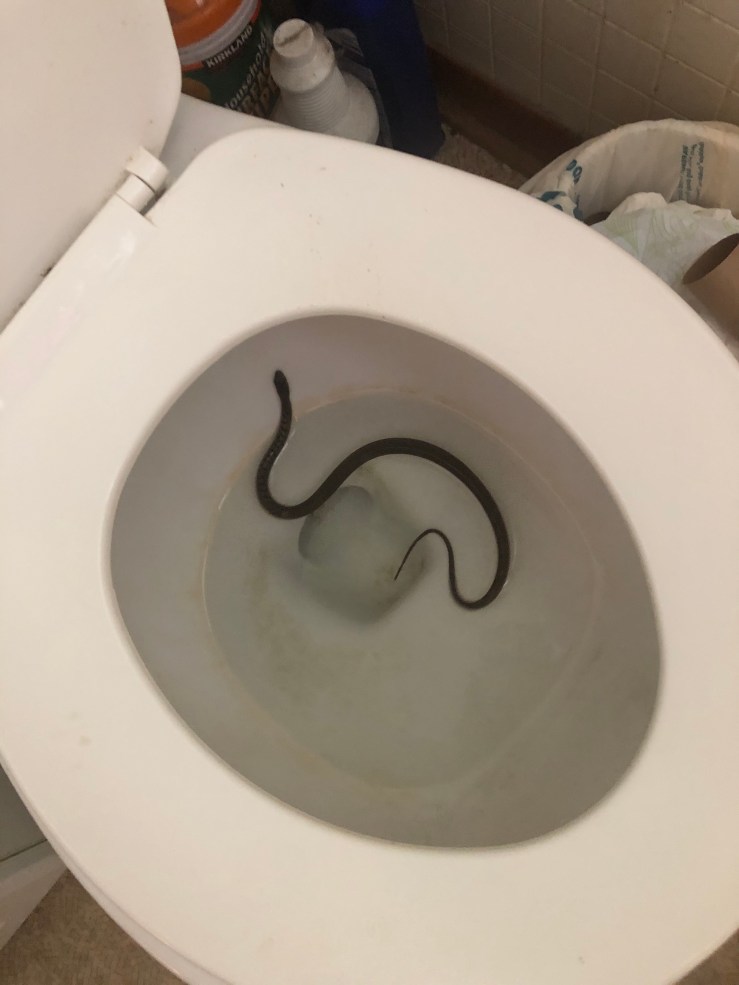
The snake was taking refuge in a nice, damp place. That can scare the pee out of you!
After taking a bunch of pictures, Pamela contacted her team of friends on a group text for suggestions. And she got dressed. That’s important.
Ideas came quickly from her amazed friends. One idea was flushing, which was immediately rejected. That’s not being kind to our reptile friends!
Other ideas were use a mop, use one of those pick-up sticks that help the elderly, kitchen tongs, a net, and so forth.
Pamela chose the large towel method. She was ready to fling it into the bathtub if it got too wiggly, but it turned out the snake just curled up and she could easily get it in the towel. It was probably relieved.
Pamela took it to the woods a good ways from the house, and everyone was relieved.
What Was It?
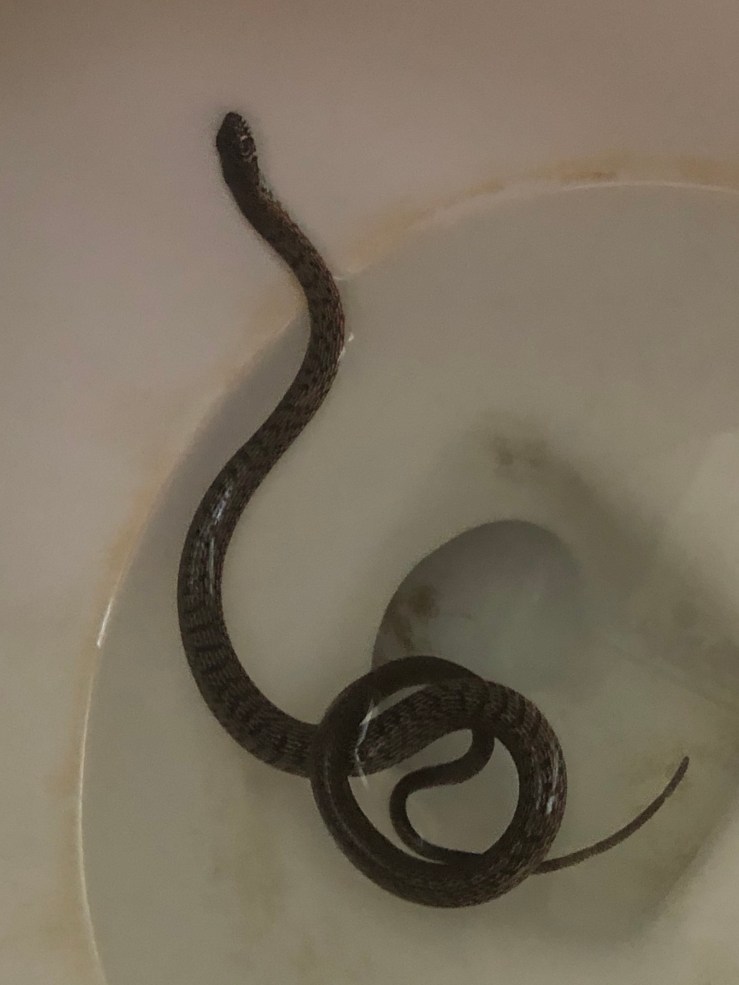
Closer image of the scared snake.
Naturally, everyone in the Cameron ladies’ text group wanted to know what kind of snake it was, especially those of us who are Texas Master Naturalists. Pamela knew what to do, and uploaded it to iNaturalist, suggesting it might be a brown snake, judging from the markings she noted.
Soon she got feedback that the snake was a coach-whip snake. Now she’s glad it didn’t do its characteristic whipping action on her. Since the snake may have been in her house as long as a week, she also hopes it ate some scorpions or other annoying creatures while it was a guest in her home.
Share Your Stories!
Now that we are mostly sitting around looking at the nature around our homes, please share what’s going on with you! Maybe it will make up for all the meetings and classes that have been canceled. I already have one to share tomorrow, so stay tuned.
Shortly after purchasing Cedar Hill Ranch in 2013, we started learning about how much a controlled burn would help to reduce the thick Yaupon understory from much of our forested area (mainly from Billy Lambert, Tim Siegmund, and Bobby Allcorn – TPWD). A reduced brush understory would allow surface plants to take hold, leading to much more productive land for feeding and sheltering the native wildlife, and improving the soils. As managers of our wildlife land, we looked forward to the time when a controlled burn could be conducted safely and productively. But the land was too dense in the first years and we had difficulty getting the surface clear for grasses – there was too much forested land and we could not manage to get enough of it ready for a controlled “grass” burn. So, Mike and family members spent years reducing Yaupon and Eastern Red Juniper by chemical and mechanical means. In more recent years, we started hearing about a “forest” burn solution.
Texas Parks and Wildlife staff
The day finally arrived for our first forest burn on Thursday, February 27, 2020. But it did not come without many hours of preparation, both on the part of Texas Parks and Wildlife personnel and us landowners. Texas Parks and Wildlife personnel must be trained as fire specialists – to understand and monitor winds and humidity, understory leaf and grass litter, snags and overhanging branches, safety zones, water and fire supply equipment, clothing and on-ground equipment, team management, safety of all people involved – the list is lengthy but necessary to ensure safety of participants and neighboring households, animals, land, and structures. Finally, they had to notify EMS and Fire Station personnel about the burn. The landowners worked with TPWD biologists to identify the acreage to be burned, called the burn unit. Bobby Alcorn then developed a detailed and comprehensive burn plan. This plan described the area to be burned, the type of burn to be conducted, and the weather conditions necessary, and it gave a comprehensive analysis of the safety issues surrounding this particular burn unit. In late 2019 Mike Conner cleared a 10-foot bare sand firebreak and also cut down dead trees from the edge of the burn unit and moved them 30 feet into the interior of the unit. Toni Aguilar, TPWD Regional Controlled Burn Coordinator, and Bobby Allcorn, local TPWD Biologist, visited the site several times to monitor and approve Mike’s progress. Mike then notified and invited all the surrounding neighbors and also members of El Camino Real Chapter of the Texas Master Naturalists to attend.
Volunteers
On Thursday morning 7 Master Naturalists, one neighboring landowner, one Native Plants Society of Texas member, and 6 Texas Parks and Wildlife fire brigade personnel (a total of 15 individuals) arrived.
Everyone was given a map of the rectangular 50-acre tract that was to be burned so that everyone was familiar with the area. We volunteers were then given specific explanations and instructions about our activity and duties by Edwin Bowman, burn leader-in-training.
Drip torches
And then our wait began. A burn in a forested area with a mostly closed canopy or dense brushy understory needs a brisk wind, low humidity, and dry conditions. As the optimum weather circumstances neared, we moved to “Corner A” where we were given more instructions and then split into teams. Mason Conley’s team would work from Corner A and move south, Tim Siegmund’s team was to work from Corner A and move west. Since the team moving south was supposed to have less smoke, all of the women volunteers chose that team, leaving all of the men to face the worst smoke. (As it turned out, the smoke had a mind of its own and did just the opposite!) Each team had at least one walkie-talkie.
As each team started, Toni headed to the interior. We could see her occasionally and the fire that followed her path. (She was joined by different staff members at different times.) Bobby was in charge of watching the wind and humidity with his special equipment. He was in constant communication with all of the other leaders. A quick change in wind or sudden drop in humidity could cause unexpected movement of the fire, so this was a crucial task.
Learning how to torch
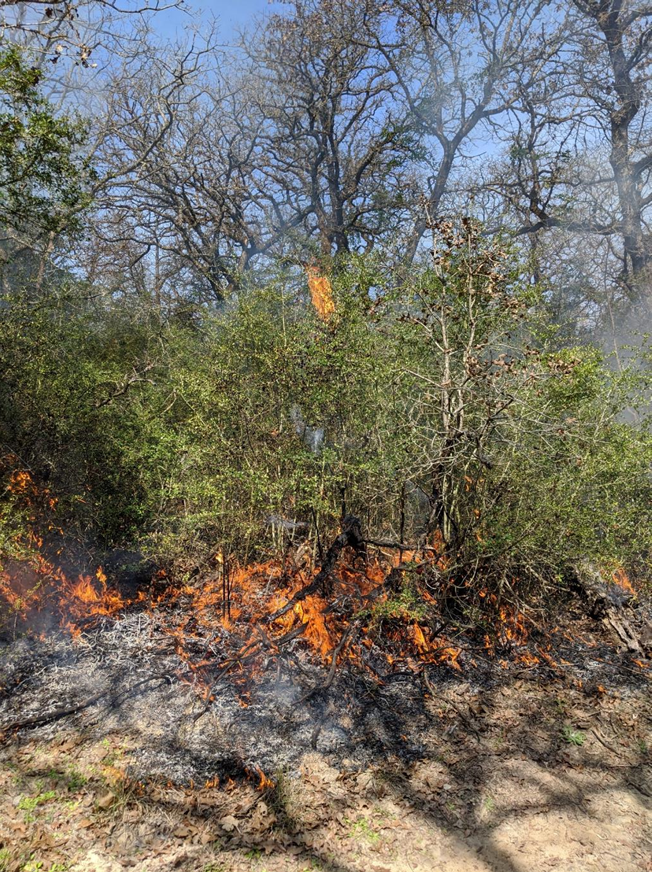
Surprisingly, the filled fire torches were heavy to carry in one hand (about 8 pounds). Once lit, the fire starter would “drag” the torch behind them, dripping the liquid flame in the leaf litter. This could be dangerous if you did not keep moving ahead of the flames now burning right behind your feet, or if you became distracted and turned, creating a circle around your feet of flame! Another danger could be created when you “tossed” the flames into the woods at various locations. As we volunteers waited for our turns to carry the torch, Bobby reminded us to also check across the safety zone for embers – a sign that the fire had jumped the barrier and could go rogue. This was difficult to do because the fire within the burn zone was mesmerizing! Luckily, we had Jay Whiteside (TPWD) driving one of the water trucks along the perimeter as he constantly watched for any potential problem.
Watching the torch
Pamela lucked out and was able to experience dripping her fire torch while simultaneously riding in a utv! (Disclaimer – This was done under the supervision of one of the fire specialists.)
Laying down the burn line
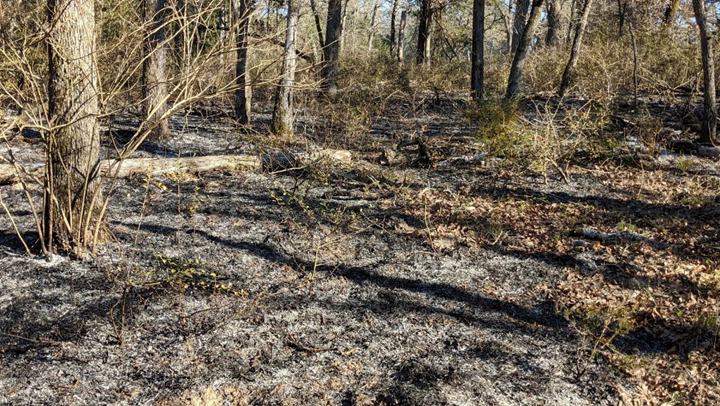
When the entire perimeter was torched, we regathered at the parking area for a review of the day. In the end, we learned that we had one more very important thing to do – check the entire perimeter for fire/glowing embers within 40 feet of the firebreak. Everyone decided to stay for this last job, so it was fairly quick work. When an ember or burning log was found, it was tossed farther into the interior. When Mike was told that there was one snag at the farthest corner of the burn unit that had to be taken down, he rushed back to the barn and got his bobcat. If left on its own, the snag could release embers that might travel across the firebreak and ignite a whole new part of the forest – creating a serious fire hazard! At the snag, we watched as Edwin and Mike took turns with the chain saw and the bobcat until the snag fell. Mike then moved the broken snag farther into the burn unit. After hosing down the snag’s embers, the day was now officially over (although Mike and I would need to re-visit the site over the next few days to confirm that all was still well).
Managing the burn line
We learned a lot about controlled burns that we had not previously learned from several workshops, seminars, and research. We also learned that this first burn was only the beginning. The forest would need to be burned several more times over the next years, as only some of the brushy understory was actually destroyed. Much of the yaupon and junipers will either regrow or will need another fire to finally kill it. Because the temperature, wind, and humidity must be fairly precise, it will always be difficult to plan the exact time and day for this activity. But, at least now, we feel more confident that we are able to perform it.
The burn line, burning
Below the credits are more of the many pictures taken during the day. Thanks to everyone who supervised and helped!
Credits:
El Camino Real Texas Master Naturalist Volunteers: Joyce and Mike Conner, Donna Lewis, Liz Lewis, Lisa Milewski, Pamela Neeley, and John Pruett.
Neighbor Volunteer: Fred Russell
NPSOT Volunteer: John Glos
TPWD Staff: Toni Aguilar, Bobby Allcorn, Edwin Bowman, Mason Conley, Tim Siegmund, and Jay Whiteside
The burn lineEnsuring the burn line stays to the interiorWhen fire jumps into the treesWe thought the day was over… …only to find there was one more crucial stepThe snag has to be removedPamela hoses down the snag stumpLisa helps to hose the embersThe next day’s evidence of the burn






 Nature Along the El Camino Real