So you thought we didn’t have many monarchs here in Milam County…
These little beauties were in my pollinator garden just a few weeks ago (the last week in October).
They were nectaring on blue mist flowers, which are very easy to grow.
Yes, we can make a difference for our monarch friends. This is what we do as Texas Master Naturalists. We protect the natural world so that those who come after us will get to enjoy them like we do. What an honor for us.
Make sure you plant what the butterflies need to survive. And keep on learning!
Linda Jo, Donna, Eric, Scott, and Catherine Bioblitzed the areas around Sugarloaf, Lone Mountain, and Little River.
We identified many plants, met some new neighbors and their dog, and had lunch on the historic bridge. It was soo beautiful outside, and we all learned a lot.
While others are away in the cool mountains,* a group of us decided to check on the condition of the El Camino Real Master Naturalist Butterfly Garden in Milano, which we started a number of years ago.
The Butterfly Garden
It is in complete disarray but still with butterflies and other insects trying to hold on to smothered natives. A memorial on the site is also in complete disarray. We are considering possible solutions to make the area respectful.
Sulphur butterfly.
Eric Neubauer and Linda Jo Conn did some BioBlitzing, and Eric was later given a tour of the Milam Wildscape, which he hadn’t visited before.
iNaturalist volunteers at work.
Unexpected Adventure
As we worked on the Butterfly Garden, I gained Master Naturalist volunteer hours for Nature Improvement in Public Areas, learned what false garlic and Carolina Snail vine look like, learned what a pipevine swallowtail butterfly looks like, and got to know new member Eric.
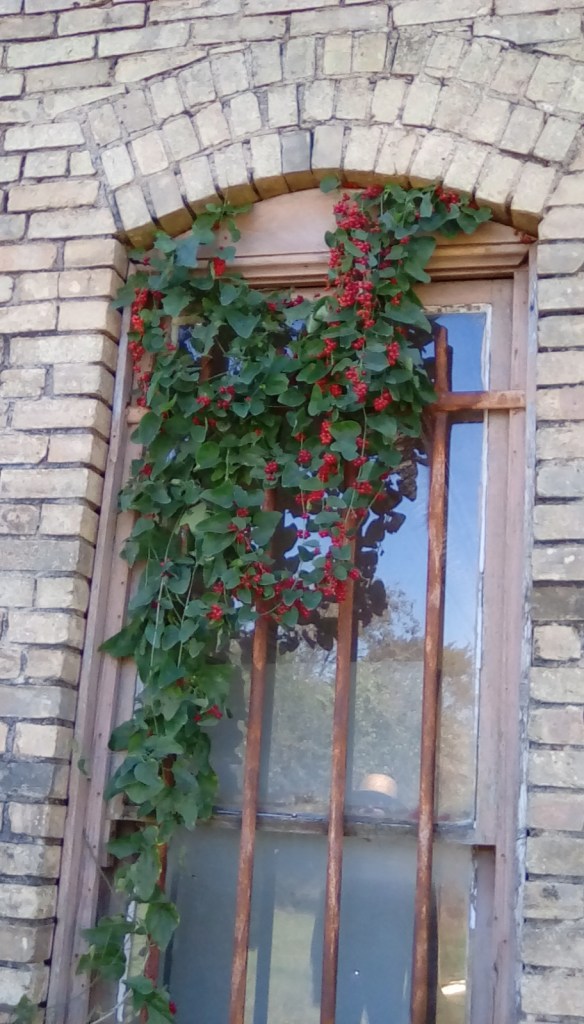
Carolina snail vine (the seeds look just like a snail!)
While in Milano I also got to hear lots of trains and watch the lowering of the flag at the post office. It was a balmy day balmy day and a good one for exercise!
Oh, and we found odd gourds near the train tracks. That was unexpected.
*She is referring to the Chapter President, Suna, who has escaped to Utah. She will post!
A sea of color is in bloom at the Milam Wildscape project at Bird and Bee Farm outside of Milano. Most of the blooms are courtesy of native Texas plants. On a follow-up trip on Saturday, October 24, to check on the Malabar Spinach vine I am trying to keep trimmed, I was met with a surprise of different colors and some catatonic bees.
There were many shades of purple, pink, orange, yellow, red and white from a variety of plants still thriving.
The most surprising was a Cypress Vine (below) that had sprung up, wrapped itself around the awning with the spinach, climbed about four feet and proceeded to bloom since I was last at the site.
Cypress Vine, growing like crazy
There were also Lavender Leaf Sage, American asters, Southwestern Cosmos and some pink flowering vines full of catatonic carpenter bees.
Lavender leaf sage (mealy blue sage in the background)
Cosmos
The carpenter bees had attached themselves to a few different flowers but mostly to this plentiful pink flowered vine (Suna says: coral bells Antighonon letopus). They seemed to be in a state of hibernation – probably temporary. They could be touched with almost indiscernible movement from them. (I thought they were bumble bees until I put them on iNaturalist.)
Also in bloom and growing were goldshower, cut-leaf crane’s-bill, Indian blanket, white and pink roses, and a frilly, white shrub-like flower. A pair of Gulf Fritillary were also weathering the cold front on a tropical sage.
If that’s not enough, a great group of volunteers were planting more including a couple of trees. (Pictured l to r : Carolyn Henderson, Pamela Neeley, Scott Berger, Liz Lewis, Catherine Johnson, and Donna Lewis (kneeling). Most of the foliage is putting out “babies”, and the “babies” are available for adoption to be planted at your place. For information on that, contact Catherine. You also can volunteer to help grow the wildscape by contacting her.
It was a great day last week for seeing new things in my garden. It’s a reminder that to see these beautiful living things, you must always be looking for them.
So after I saw the new Black Swallowtail caterpillar , I walked around in my garden and a fast moving butterfly landed right in front of me. I looked down to find something I had never seen!! It was a Julia male butterfly. They are a brush-footed butterfly (Nymphalidae).
Julia Heliconian (Dryas iulia)
This group of butterflies occur worldwide except at the polar ice caps. They are generally some shade of orange, which is why they are sometimes mistaken for a Gulf fritillary (my second photo), which was on a zinnia at the same time the Julia was. They were both just a foot apart. Lucky for me I was outside with a camera.
Gulf Fritillary (Agraulis vanillae)
Brushfoot butterflies all have reduced fore legs that are useless for walking, hence their name. Butterflies in this group include: Admirals, Fritillaries, Checkerspots, Crescentspots, Anglewings, Leafwings, Painted Ladies, Tortoisehells, and Longwings.
The Julia caterpillars feed on passion flower leaves.
I will look for their caterpillars, now that I have the adult butterfly here.
Keep your eyes peeled Master Naturalists, it’s all out there.