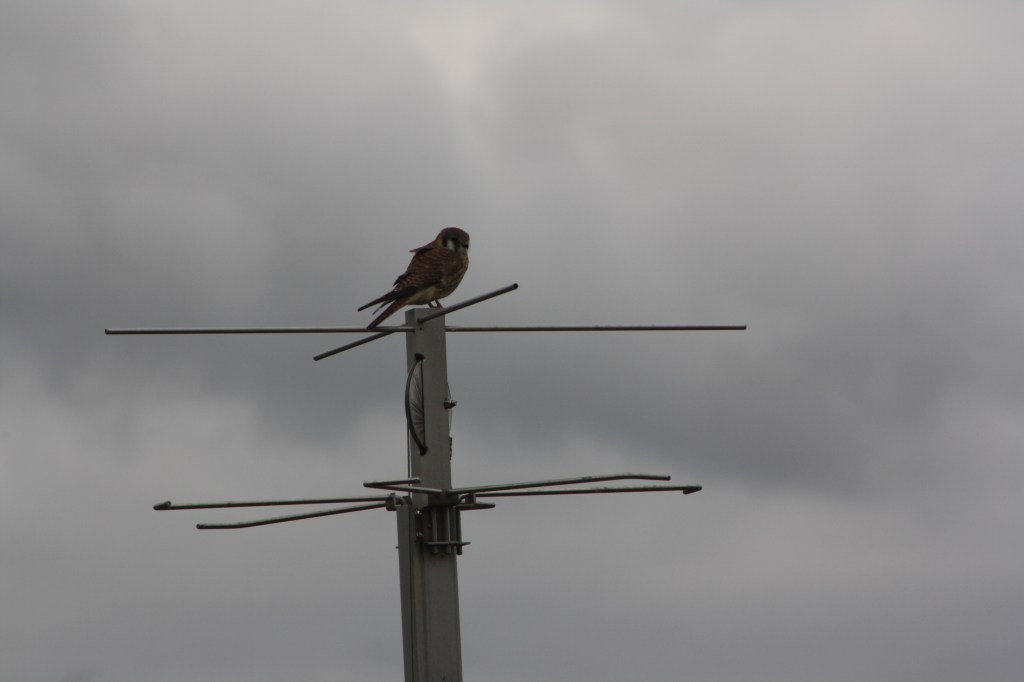
This beautiful falcon (American Kestrel, Falco sparverius) was sitting on top of my Martin House pole this past week. It was cold and windy. He hovered over the ground and came up with a small rodent and then perched on the fence to have lunch. When I went outside to get a better photo, he took off.
Vigilant sparrow hawk
American kestrel (sparrow hawk). (c) chrisvt used with permission
However, he has been back every day this week. Must like the mice here.
The nickname of Sparrow Hawk is a misnomer. He is not a hawk and rarely eats sparrows. The kestrel prefers rodents, reptiles, frogs, insects and the smaller bats like the Mexican Free Tailed Bat.
If you can get a closer look at him, he is beautiful!!! Some of the Egytian drawings on tombs show many hawks, cranes, ducks and falcons. One God was Re-Horakhty the lord of the sky; he looked like a Falcon.
This bird is common all over the US and likes open fields.
Right now you can see them perched on the overhead wires looking for a meal.
A couple of weeks ago, several ECR members visited three of the city parks in Rockdale.
Eric checks out the park up close
The first was Wolf Park, which is located on Main Street in town where the former American Legion Hall once stood. When we arrived, a crew was at work erecting the framework for a Christmas tree near the pavilion in the center of the lot.
Yard asters, still blooming
The closely trimmed city block has a border hedge of holly festooned with Carolina snailseed (Cocculus carolinus ). The lawn contains the usual scattering of straggler daisy (Calyptocarpus vialis), turkey tangle frogfruit (Phyla nodiflora), and yard asters (Symphyotrichum divaricatum). A couple of large lilac chaste trees (Vitex agnus-castus) and a bur oak (Quercus macrocarpa) are the landscape trees.
Carolina snailseed and holly
Leaving the busy scene at Wolf Park, we drove across the railroad tracks to visit Sumuel Park which was funded in part by a Texas Parks and Wildlife Department grant. It has a splash pad water feature (unused this summer due to COVID), a playscape, picnic area, walking trail, basketball half court, restrooms, and free WiFi.
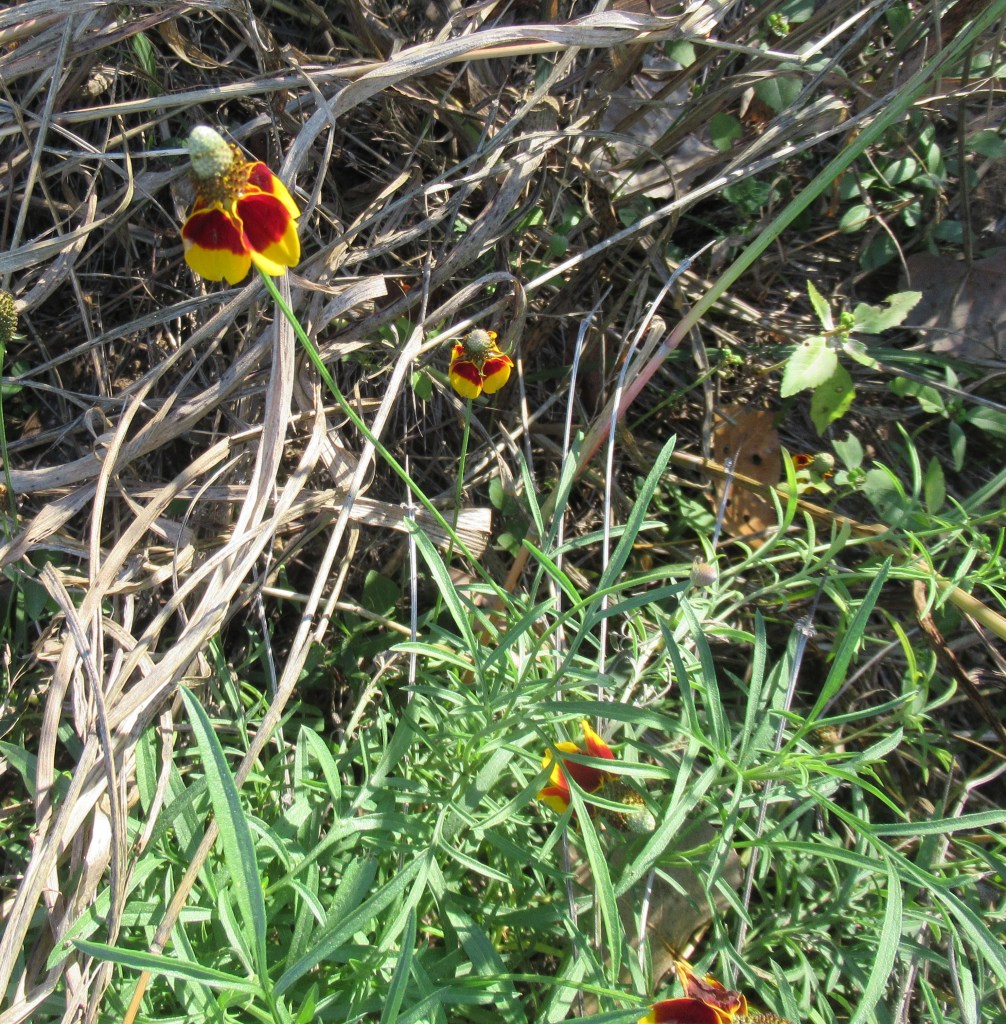
Upright Prairie Coneflower
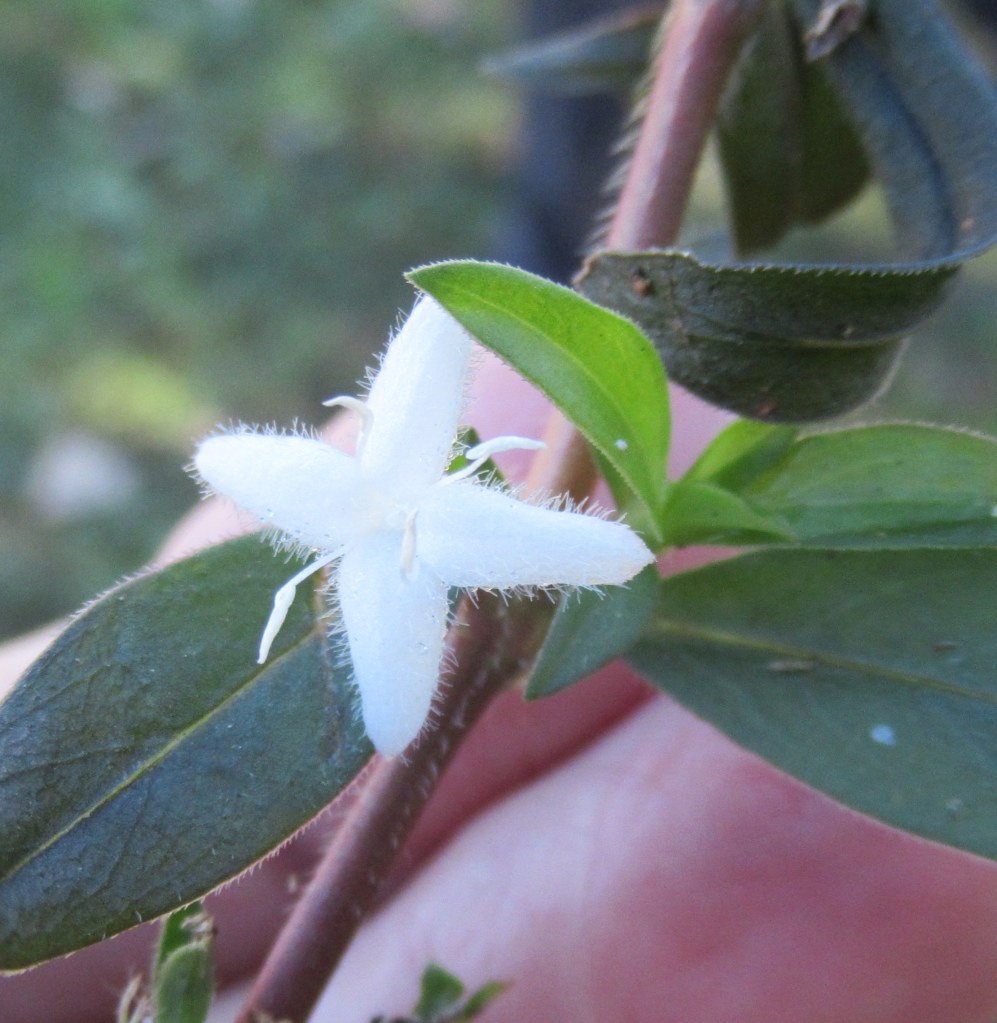
There was a bit more nature to observe at this park, including upright prairie coneflower (Ratibida columnifera) and buttonweed (Diodia virginiana) in bloom. A black vulture (Coragyps atratus) watched our activity from a nearby tree.
Black vulture keeps watch
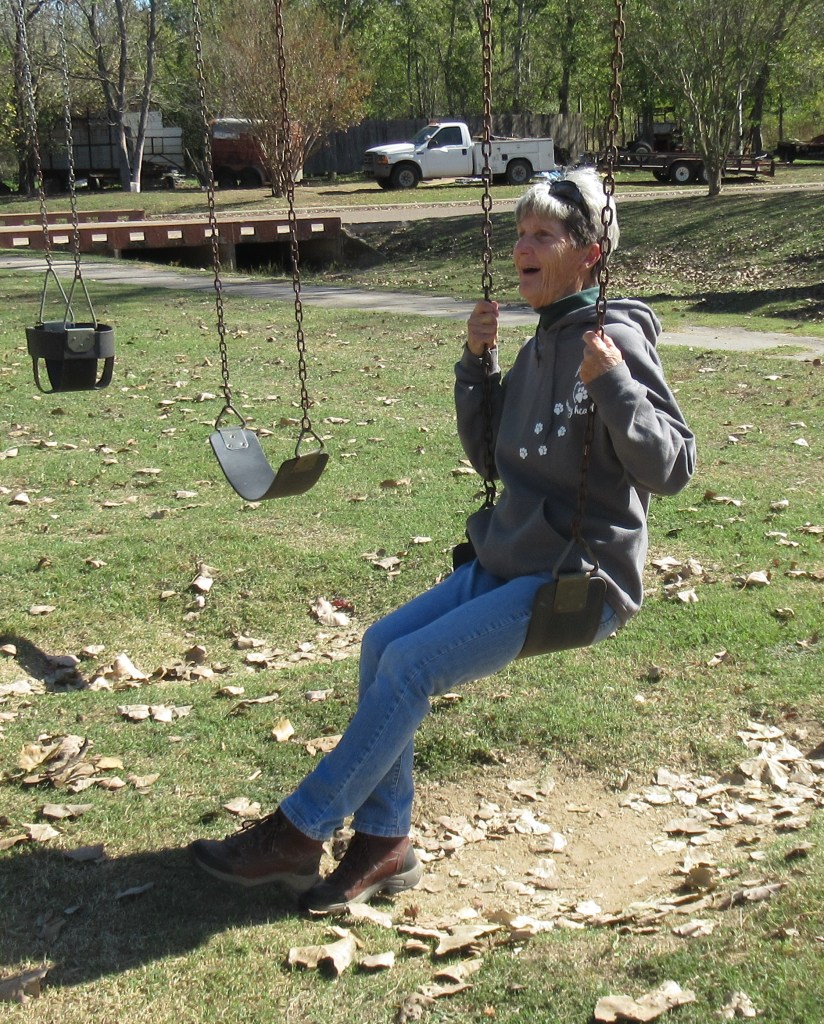
While Eric Neubauer captured another image of a grasshopper, Donna Lewis tried out the swing set.
Master Naturalists know how to have fun!
I suppose the high point of the visit to this park was our discovery of an enormous cottonweed tree. ECR nature explorers Debbi Sorenson, Donna, Scott Berger, and Eric physically distanced themselves around the tree for a photo to show its size. It turned out that this tree had already been noticed by our ECR chapter. You can read more about this towering cottonwood on our ECR website: https://txmn.org/elcamino/chapter-projects/special-projects/big-trees-of-milam-county/ .
That’s one amazing cottonwood!
We traveled on to Moultry Park, located behind the former Aycock School on Baxter Street. The park was being enjoyed by a mother with her young children when we arrived. A spacious area, it contains a basketball court, baseball field, and restrooms.
Buttonweed at Sumuel Park
This park visit was a sobering and disturbing personal experience for me. The adjacent brick building, used by various community organizations until a 1993 fire, remains in ruins. I could literally hear the echoes of children chattering in the hallways, chalk screeching on the blackboards, and bouncing balls in the gymnasium.
Orange Sulphur butterfly
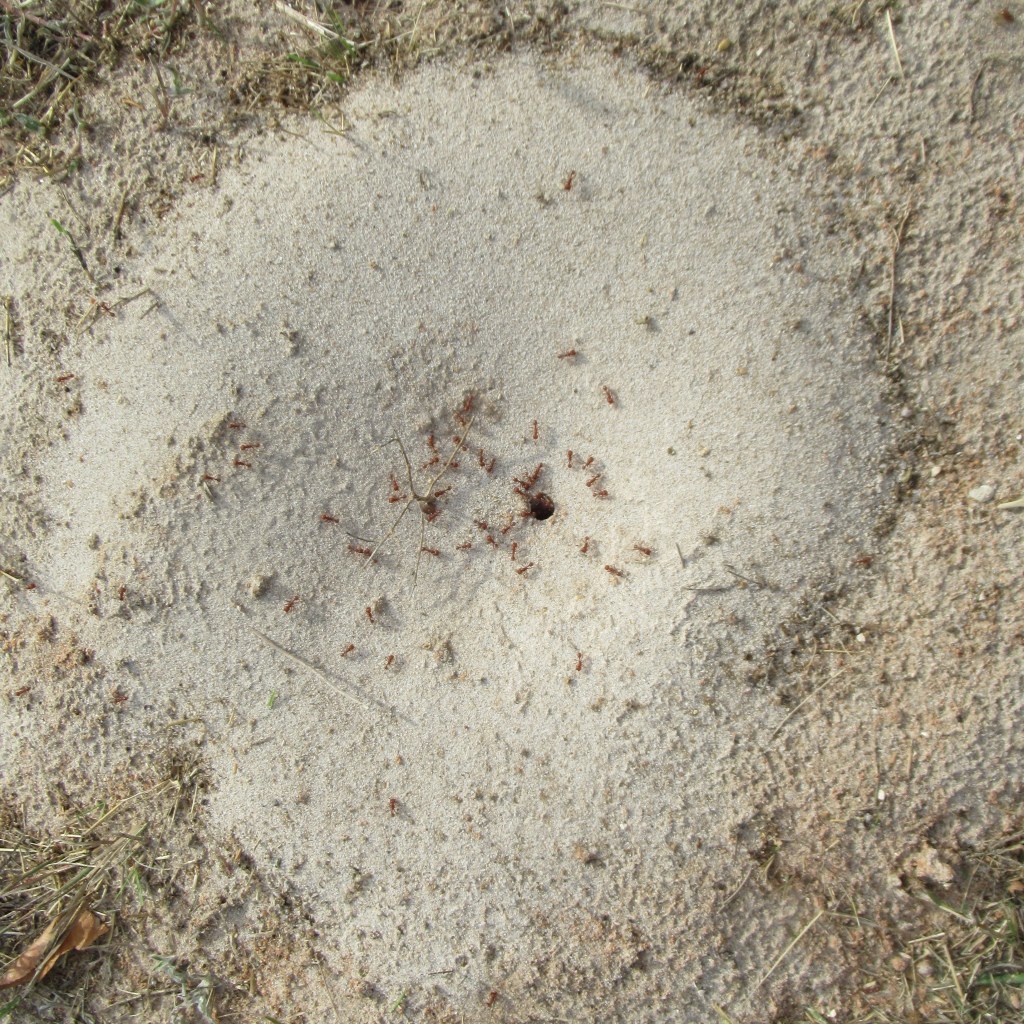
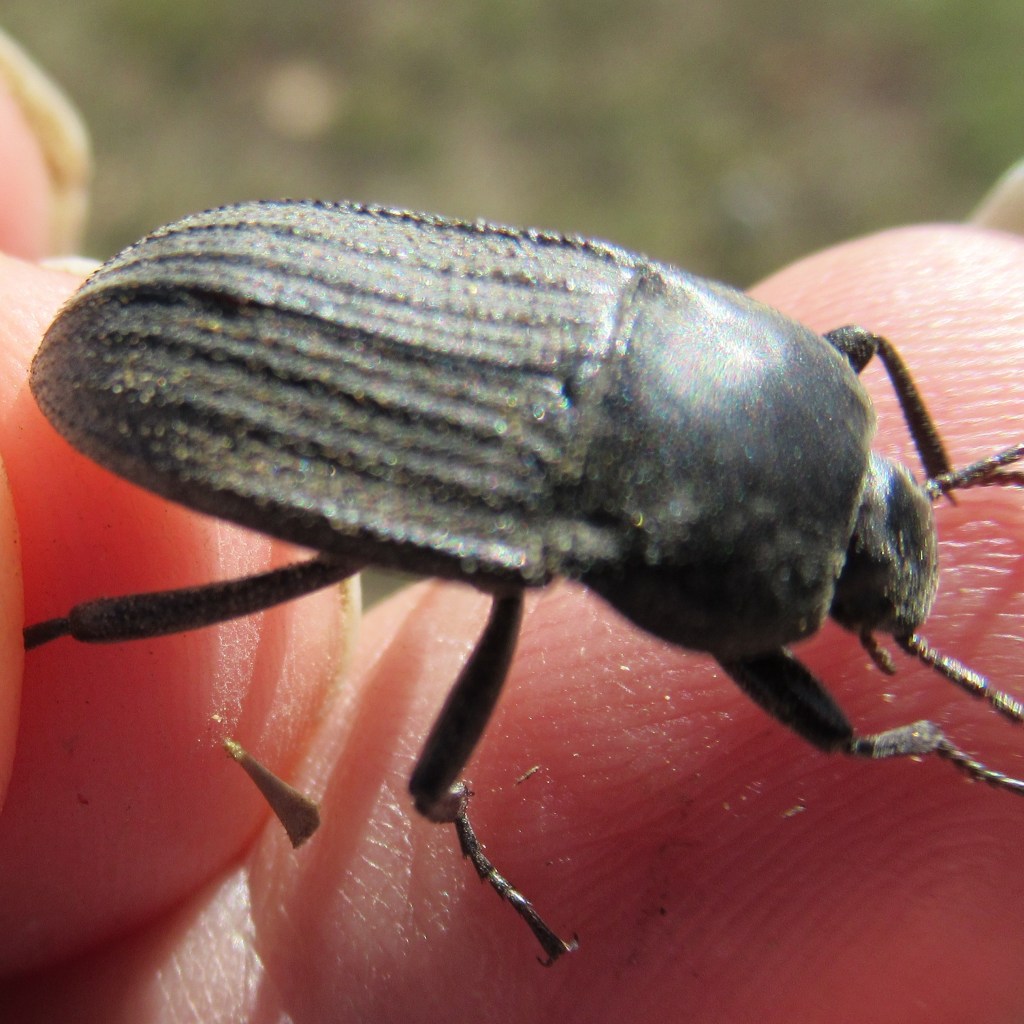
We did observe some interesting species in and around Moultry park: an appropriately named three-ribbed darkling beetle (Eleodes tricostata), a flighty orange sulphur butterfly (Colias eurytheme) visiting a camphorweed flower (Heterotheca subaxillaris) and several mounds of harvester ants (Pogonomyrmex sp.).
Hooray! Harvester ants!
The area is a perfect habitat for horned lizards.
The darkling beetle
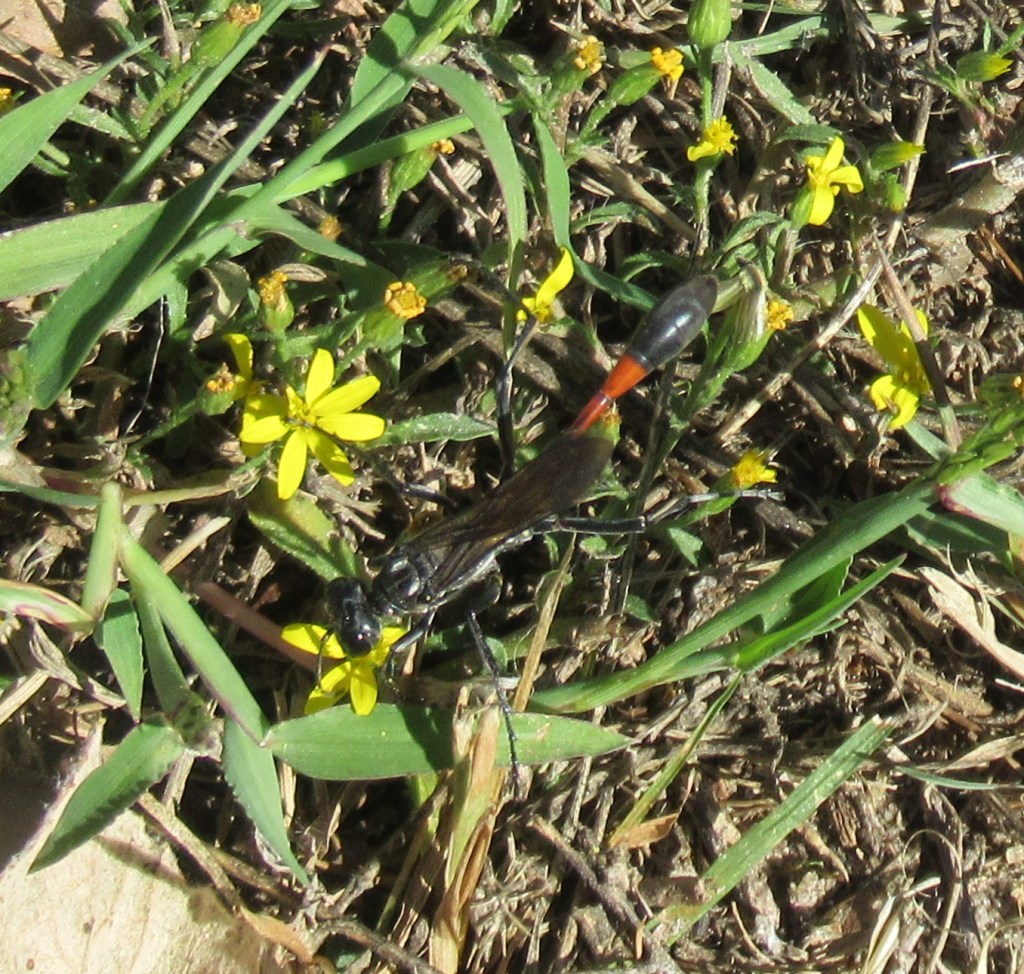
Eric stalked what he has identified as a common thread-waisted wasp (Ammophila procera) until we were both able to take photos of the large wasp.
The big wasp
He also graciously pointed out a couple of grasshoppers (Melanoplus sp).
One of the many grasshoppers Eric spotted.
After some unexpected and serendipitous happenings at the park we headed to our homes for the day. A good time was had by all. I think. You will have to ask Donna about that.
Have you ever taken a random photo and later discovered that the object or moment captured in time was priceless? Perhaps it was a photo of a child with a precious smile, that perfect shot of a hummingbird in flight, or an incriminating image of a pesky raccoon.
What frequently happens to me is that when I am cropping photos for observations on iNaturalist.org, I find previously unnoticed insects, caterpillars and spiders on the petals of a flower or the stem of a plant. I call these “bonus observations”.
Then sometimes, what I thought I was photographing turns out to be a complete blunder in identification. Such was recently the case.
Fellow El Camino Real member Scott Berger and I met for a scheduled physically-distanced nature walkabout survey at the Bridge Park in Rockdale. We inspected the iron bridge frames, the historic wood plank calaboose from Burlington, and a nearby oil well pump. We noted the usual ragweed, fall asters, grasses, spurges, and various emerging winter season plants as well as a few skittish grasshoppers, skippers and some gopher mounds.
While strolling about the area, I noticed a bird soaring above us in the sky. Snapping a quick photo of the presumed vulture, I figured that if the photo was at all usable, I would try to identify it by the silhouette.
At home, I cropped the blurry photo, entered it on iNat, and gave it my best shot at an ID: Black Vulture (Coragyps atratus). An expert bird identifier soon replied. “No, the wing span looks too long for a black vulture.”
My blurry, cropped photo. Look at the head and tail!
Back at my computer, I cropped the photo more severely and noticed what appeared to be a white head on the bird. Could this be a bald eagle (Haliaeetus leucocephalus)? I entered that ID. Soon, my supposed vulture in the sky over Rockdale was confirmed to be a bald eagle.
I am still doing a happy dance. My first sighting of an eagle outside of confinement!
Driving past the roadside park on Hwy 79 between Milano and Gause on my way to Sugarloaf Mountain Bridge, I told myself that one of these days I was going to stop and investigate the place. So, on the way home, I stopped and looked around.
It is a typical roadside park. Surrounded on three sides by a chain link fence supporting several species of vines, it has a circular drive, the usual brick and cement tables and benches, and some large cedar trees.
Later, when using Google Maps to enter the GPS location for my observations into the iNaturalist.org website, I discovered that this small roadside park actually has a name: Cedar Park. Not surprising. Cedar trees are the dominant trees.
Bird’s-eye speedwell.
Although the area is closely mown, there were a few flowers to observe. I saw my first Bird’s-eye Speedwell (Veronica persica) and Field Madder (Sherardia arvensis) blossoms of the season. There were the usual roadside park plants of Straggler Daisies (Calyptocarpus vialis), Crow Poison (Nothoscordum bivalve) and Green Poinsettia (Euphorbia dentata).
Straggler daisy
Crow poison
Field madder
Greem poinsettia
Flowers in the park
Climbing the chain link fence were common vining plants: Mustang Grapes (Vitis mustangensis), Carolina Snailseed (Cocculus carolinus), and Poison Ivy (Toxicodendron radicans).
The most memorable plant of the visit stayed with me a while. The park must have been covered with grass burrs (Cenchrus sp.). You may call them sandburs or stickers. Not noticeable in the short vegetation while I was walking about, they showed up as I was about to get into my truck. There must have been hundreds of them stuck to my jeans and to the tops and soles of my tennis shoes! It took a while to remove them.
Grass burs. Not fun.
Cedar Park is a shady, convenient place to stop on the highway and was visited by several travelers while I was there. Fortunately none had children or pets wanting to romp on the grounds. That would have been a memorable stop for them also. Ouch!
I have had an invasion of American robins this week. They came by the hundreds and have not left.
Usually they land, eat bugs, then move on, but this time they looked around and decided they would hang out. Life is good here.
So, every day they have been drinking and pooping in my bird baths. I’m not sure in which order; we’ll leave that alone. Because of that, twice a day I put fresh water in all of them and replace the dried mealworms.
A robin guarding my feeders.
My resident birds, the cardinals, woodpeckers, chickadees, and others have to fight to get their share.
But one robin has taken it to a new level. He or she has decided to chase my bluebirds off the mealworm feeders. None of the other robins are doing this, just the one.
For four days the bird has sat on the platforms and chased the little bluebirds away.
I love all the birds, but this is pushing my patience, so I tried to run him off so he could join his flock in the pasture.
He’s not budging! I almost touched him once.
I could not get a photo of all the action, but here he is in all his glory. I call him the Bluebird Bully.