Early Nectar for the Pollinators

by Donna Lewis

Here are a few bushes and trees that bloom early.  The bees and butterflies love them.

A Yellow Tiger Swallowtail on Henbit, Mexican Cherry Tree, Coral Honeysuckle vine, wild native Plum Trees, and a Peach tree.

There are many more that bloom early.  Fruit trees are always good for pollinators and then for us with fruit, nuts, or berries.

Put some of these in your yard and the wildlife will be happy.

Remember… who are you gardening for?

Purple Martins Are Still Arriving in Milam County

by Donna Lewis

This morning (March 20) I heard a lot more singing going on outside. I was delighted to count 14 Martins on my Gourd rack.  YEAH!!

Sadly, my Apartment Rack in the front of our house still has no Martins for three years now.

We had a very large Rat Snake climb over the baffle and get all the babies. I was very upset about it. Since then, I use the netting system to prevent any snake from getting to the birds. The bad thing is that it will kill the snake either on its own or you have to do it, so it does not suffer. I hate doing it, but it is the only thing that keeps the gourd rack safe from the snakes here. All life is important to me.  But it’s twenty babies or one snake.

I cannot understand why I still do not have Martins in the apartment now. I have cleaned it several times, added new bedding, everything I can think of. Prior to the snake, it was occupied every year. It has twenty-six apartments.  A mystery.

But we have 14 Martins to look at and listen to their beautiful songs. I am hoping more will arrive.

Come on in…free room and board.

The Rhythms of Nature

by Sue Ann Kendall

I have a project on iNaturalist where I record the flora and fauna on the ranch where I live. I started it right after I became a Master Naturalist in 2018 and am still contributing to it. My goal is to eventually analyze the data to see if flowers or birds are appearing around the same time or if there’s difference due to weather or climate, or what.

I especially love the tiny flowers, like this birds-eye speedwell.

I accumulated a lot of Master Naturalist hours while working on this project, since I go out on almost every nice day to see what’s new on the property. But, last year the program changed its policy, and now we don’t get credit for hours spent observing nature on our own property. I can see not wanting observations of the same twenty plants in a suburban yard, but we have 500 acres. I stopped for a while, but then I realized the project is still important to me, so I am still taking pictures and uploading, especially in the spring.

Last week I shared some of the earlier flowers in our fields and woods. This week some new ones have showed up, which always thrills me. I’ll share some photos of the new arrivals below.

We are also losing some birds and gaining others. The hawks are still here, red-tails and red-shouldered, along with the tiny merlins and peregrin falcons. And our resident harrier keeps hovering over the fields, hopefully eating a LOT of mice.

The amazing pair of great blue herons seems busy bonding, and the belted kingfisher who showed up over the winter is still flying around and making its unmistakable chirps. In addition to the crows and starlings, we have some visiting blackbirds that make a beautiful sound. I’m not sure what type they are but enjoy listening to them. And cardinals. Wow, do we have a LOT of cardinals, too. I never knew they flocked until I moved here.

Just one male cardinal
Action shot showing the beautiful tail of this barn swallow.

Yesterday, I looked into a willow tree behind my house with my binoculars and saw a loggerhead shrike, a dove, English sparrows, a pair of cardinals, and a festive group of tiny chickadees bopping around. That’s my kind of decorated tree. Oh, and some red-eared slider turtles were holding down the trunks (this was in a tank).

I was happy to see barn swallows already in their nests just a couple of days after they arrived. The tiny insects are here, so they are looking pretty happy.

Speaking of tiny insects, I am always seeing tiny flies and bees on the flowers. They are pretty hard to identify. For example, the fly or bee in this picture is much smaller than you’d think. That is a dwarf dandelion it’s on, not a regular one.

So, yes, it’s a fun time over where I live, and I’m glad I’m able to document the variety of life here in the northern part of Milam County. I look forward to seeing what others are observing. I’ve noticed lots of plum and redbud trees elsewhere, but I just have the buds on cedar elms and coral berry.

Besides all this, I’ve seen a lot of butterflies, such as sulphurs and red admirals, but no one will hold still for me. I even saw something big and black from a long way off. I look forward to more!

Thanks for visiting my part of the world. No matter what, the rhythms of nature keep on going, and that’s a comfort.

More Signs of Spring

by Carolyn Henderson

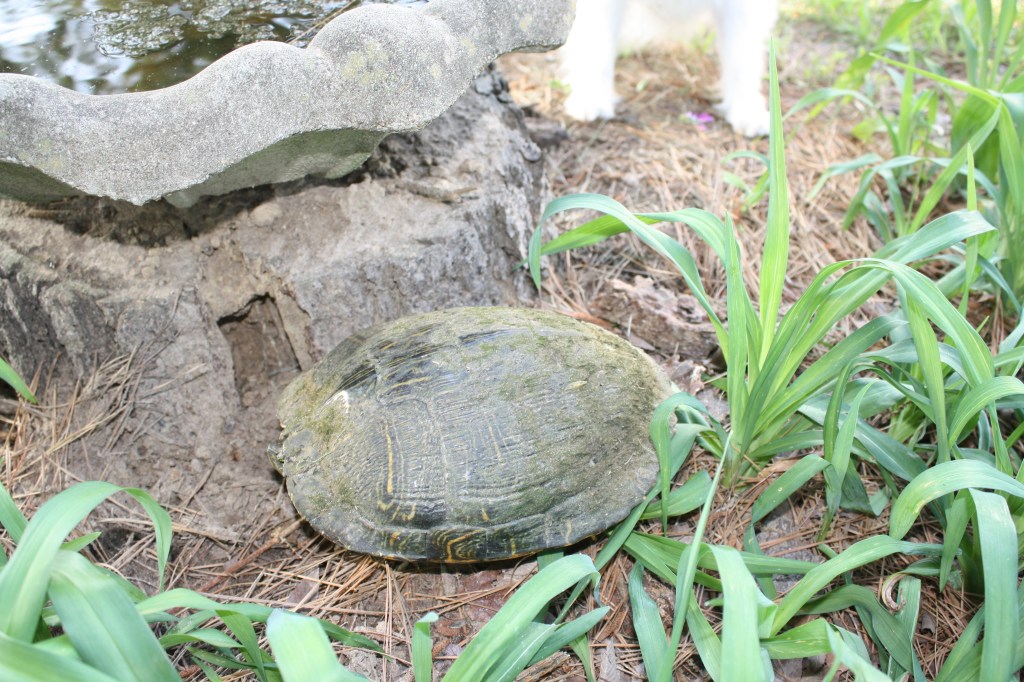
Flowers are not the only signals that spring is here. Today (March 12) a very cold front is moving in, but yesterday, Thursday, March 11, was sunny and warm, and that brought out some frolicking squirrels and some sun-bathing Red-eared Sliders. These two were observed at lunch time at Orchard Park in Cameron. There were ten or so squirrels playing chase all over the park while the turtles lifted their heads toward the sun. 

I also found an Eastern Redbud in full bloom in my neighbor’s yard. I also have Henbit Deadnettle growing in large blooming clumps in my yard, but so does everyone else, it seems. 

I hope spring is here to stay after this cold front.

Sandhill Cranes: Wonderful Sign of Spring

by Sue Ann Kendall

Last weekend I was at a horsemanship clinic when I heard a familiar sound. I pointed up and said, “Listen!” The ten-year-old girl who was in my group asked me what in the world that was. I said it was the sandhill cranes migrating north. It made my day to see how excited she was about it. She promised to keep her ears open this year and from now on.

Photo by @lburlew71 via Twenty20

The sandhill crane, Antigone canadensis, comes by twice a year, heading up north and heading back south. They aren’t endangered or anything, but they are endearing to me. I can remember when my children were small, I’d hear them from inside my car, pull over, and make my sons watch them flying over, clacking and honking as hard as they could. That was in Williamson County.

Nice quality, huh?

Of course, they fly over Milam County as well. Friends report that they touch down in some of our larger lakes, like over by the old Alcoa property, to rest as they go by. They’ve never stopped by our little ponds, but sometimes they are close enough to see the colors on their heads with binoculars.

Yep, it’s birds all right.

I ran outside today when I heard them from inside my house, and got a recording and took a few photos. They aren’t great, but that’s okay. I like to document when different birds migrate through each year to see how it differs. Last year they were a little later than this year. Hey, I’m a naturalist.

Well, it was pretty in person.

I’m glad I got the recording, so my iNat identification will be easier. Since I was on my property, I can’t get any credit for the observations, but so what? I got the thrill of listening to my favorite signs of spring as they head up to get some nice fresh food. Learning to observe the rhythms of nature is one of the best things about our training.

This took me forever to convert from one format to another, so truly, enjoy the sounds!