Clouds parted and the view was stunning of the Solar Eclipse. El Camino Real chapter members gathered at a member’s place to watch the event together as well as do a few projects – and of course eat.
There were 16 members and 7 guests who met at Jackie Thornton’s Party Barn near Minerva Monday. Jackie had everything ready to go including materials to make bee watering stations and Wren nests.
Working on projectsCarolyn sharing informationConnie sharing information
Debi Harris used gourds to make the Wren nests, and members put a little personalization on them. Jackie told everyone how to create the bee watering stations. Several creative pieces went home with members.
Training was then provided by Carolyn, Connie Anderle, and Linda Jo Conn on the eclipse. Carolyn provided facts, including the one that predicts another total solar eclipse will not occur in our area for 350 years. Connie provided safety information on viewing eclipses, and Linda Jo discussed how animals react to eclipses.
Linda Jo sharing information
After eating a large lunch, members set up outside in a wildflower-covered field and cheered when the clouds parted, making the eclipse visible. Everyone sat and watched for over an hour as the moon edged its way between the earth and sun.
Eclipse watchers
Everyone stopped all noise, to hear what nature would do as the totality came close. Before it was complete, but it was growing darker, birds, frogs and crickets began to make their noises that they normally do at dawn and dusk. At the darkest point, nearby coyotes howled for a minute or two. It was measurably cooler, too.
Getting toward total eclipse!
Several members were seeing colors – pink and blue – at the most covered point, too. I found out last night that it was solar flares making the colors.
Carolyn’s photo with a plane in itCarolyn’s photo with a streak that could be a meteor
I did not use the correct filter on my camera, so my photos show those colors, among other oddities. It was a once in a lifetime experience – unless you are willing to travel to see another one.
Of course, Linda Jo took some time for iNaturalist observations
[This article appeared in the Cameron Herald, Thursday, April 4, 2024]
A local member of the El Camino Real chapter of Texas Master Naturalist is putting Milam County on the scientific map in spider identification. Eric Neubauer, now considered a local Rabid Wolf Spider expert, discovered a kind of Wolf Spider that has never been identified anywhere.
Eric Neubauer
Neubauer discovered the new spider and named it Hogna Incognita while studying the biodiversity of his place out near Davilla in 2019. He had just moved to Texas from Pennsylvania and bought a few acres in that area. When he realized the place was covered in what are commonly called Wolf Spiders, he felt compelled to identify all of them.
The newspaper article
There are many kinds of Wolf Spiders, but after two years of trying to identify the Hogna Incognita without success, he believed that he had found a new, unidentified, as yet unnamed spider. “It’s amazing that a spider that big, that common had not been identified already,” said Neubauer.
He started using iNaturalist, an internet vehicle to identify all living things all over the world, in 2019. Only 4 people had an active interest in Wolf Spiders on the site. Neubauer went through 13,000 Wolf Spider observations on several different identification sites. None were his spider. The first identification of Wolf Spiders in Milam County goes back to 1904 when Texas was still a popular place for biologist to study all types of living things.
Hogna incognita– photo by Eric Neubauer
After extensive studying, he came to strongly believe that he had a new one that had never been mentioned in scientific literature. The Hogna Incognita has a relative that looks similar to it, but it doesn’t look exactly like it. The “cousin” is commonly called the Hogna Antalucana. He believes the incognita was thought to be the antalucana because they had one similar trait.
Neubauer began giving presentations on Wolf Spiders to fellow Master Naturalist. In 2021, convinced it was a new one, He put up a “note” on it on the Bug Guide web site. The curator of the site agreed that it was a new species.
After some statewide presentations by Neubauer in 2023, Tarleton Professor Russell Pfau read the presentations and offered to help Neubauer with definitive evidence of its uniqueness. Pfau did extensive DNA testing on both the incognita and antalucana. Neubauer and Pfau caught some of each type in several stages of development – including all the spiderlings on the mother’s back. Pfau has managed to raise them from infancy to adulthood. The raising of them showed difference between the two from birth to adulthood.
Just weeks ago, Pfau notified Neubauer that the two spiders did indeed have different DNA. He had found an unidentified Wolf Spider.
“Hearing that the DNA test verified what I was sure I’d found – I was more excited than I thought I would be,” said Neubauer, who is normally very stoic.
Neubauer would like to stress that Wolf Spiders are harmless. They may bite, but it’s not poisonous or painful. “I’d rather be bitten by a Wolf Spider than a mosquito,” he said. They offer some benefits out in the blacklands, too. The incognita is mostly in the blacklands and some surrounding areas, so if you’re in Milam County you probably have them.
If you’d like to read the original report, you can find it on the El Camino Real Texas Master Naturalist web site https://txmn.org/elcamino/ . You also can look up Wolf Spiders on www.inaturalist.org.
This solar eclipse of totality in Milam County is a rare event. They actually occur about every 18 months somewhere in the world, but it can take lifetimes before one occurs here again. There won’t be another total eclipse in the USA until August 23, 2044. The last time there was an eclipse of totality in this area (Austin to be specific) was 1397. That’s right, 1397, according to the Austin American Statesman.
Microsoft 365 stock photo
The total event will take up to 3 hours to complete. The actual total eclipse will last approximately 4 minutes, give or take 30 seconds. Where totality occurs, it will be completely dark for 4 ½ minutes. For those of us in the path of totality, which is 100 miles wide, we will see somewhere between 2 ½ minutes to 3 ½ minutes of total darkness. Our location is not at 100%, but we are only about 30 miles off, which gives us a full 3 minutes of chill bump-raising darkness.
According to NASA Astrophysicist Alex Young, the hype is true. He has seen 4 total solar eclipses. He says that every time he’s experienced one, he gets chills, like goosebumps, and all the hair on his arms stood up. He says he feels like a rush of adrenaline is washing over him. “Getting cold and getting dark happens so quickly that your mind is confused,” Young said.
So how long does the whole thing take? According to the National Solar Observatory, it will take about 2 hours and 45 minutes from start to finish. The moon moving in front of the sun will take more than an hour to complete. And then it’ll take more than an hour for the moon to completely move off the sun.
The best time to view this one in totality here will be 12:15 p.m. to 1:44 pm. Give or take a few minutes. It starts at 12:15 to12:30 and totality ends at 1:45ish.
So what’s the difference between the April 8, 2024 eclipse and the October 2023 eclipse that was best seen in South Texas? The October 2023 eclipse was an annular eclipse. An annular eclipse only partially covers the sun which creates the “ring of fire” effect. The eclipse today is a total eclipse. If you are in the “path of totality” (that’s the 100 mile wide path), you will see total darkness. As stated earlier, the time it stays totally dark depends on how far away from center you are.
According to NASA, a total eclipse needs the moon to be at just the right “eliptic” to the Sun. The eliptic is the apparent path of the Sun across the sky. The moon’s orbital tilt is why we don’t have solar eclipses during every new moon. The new moon is usually too high or too low to block out the sun. In an annular eclipse, the moon is too far from Earth to entirely block the Sun.
When a new moon passes between the Earth and Sun and the eliptic angle is right, a total eclipse occurs. During the eclipse, the moon’s shadow is cast upon the earth and travels across the surface at an estimated 1,950 mph, according to scientist in a Washington Post story. So if anyone is intending to try to keep up with it on the 195-mile stretch of Interstate 35 between Austin and Dallas, good luck with that. All of that is in the “Path of Totality”.
Nearly 32 million people live in the Path of Totality. This one will cross the homes of more people in Texas alone than the last cross-country eclipse of 2017. It is projected to last longer, too.
If you miss this one, it won’t happen again in our area until Feb. 25, 2343. That’s 340 years away.
Above all else, wear eye cover that meets the requirements for certification by the government. There should be the following on the eyewear: ISO 12312-2:2015 Certification. Looking directly at the sun too long at any time can harm your eyes. It is particularly harmful during eclipses.
The oldest individual bald cypress tree (Taxodium distichum) in North America is likely to be one in North Carolina that has been aged by drilling a core to the center of its trunk to expose the number of annual rings. This specimen growing along the Black River is over 2600 years old and apparently still looking mighty healthy.
The conifer family Cupressaceae, showed up in the fossil record over 200 million years ago. Bald cypress are modern North American members of this family that has over 130 species occurring across the northern hemisphere They traveled along as blocks of continental plates broke up and moved apart. Cypress trees in the Mediterranean look a good bit different than the bald cypress growing in our southern swamps and along riverside habitats in North America, but they are all related to those that lived on the super-continent Pangea.
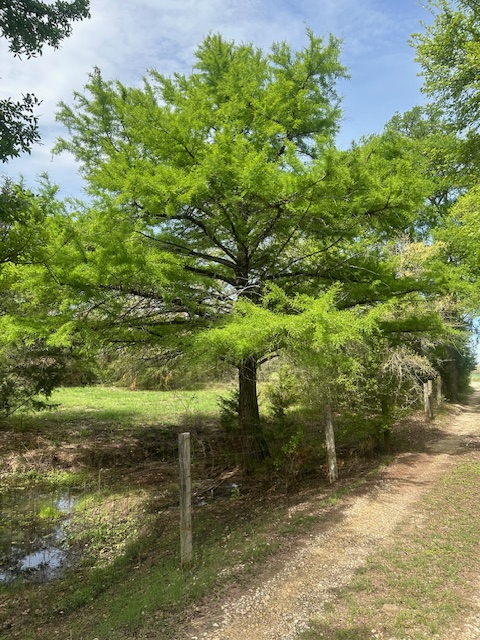
Bald cypress
In North America tree scientists agree that we have two distinct species, bald cypress and Montezuma cypress (Taxodium mucronatum). As with all taxonomists there is skepticism and disagreement. This involves yet another variety dubbed “pond cypress.” We will leave the bickering about pond cypress to the paid professionals.
Montezuma Cypress
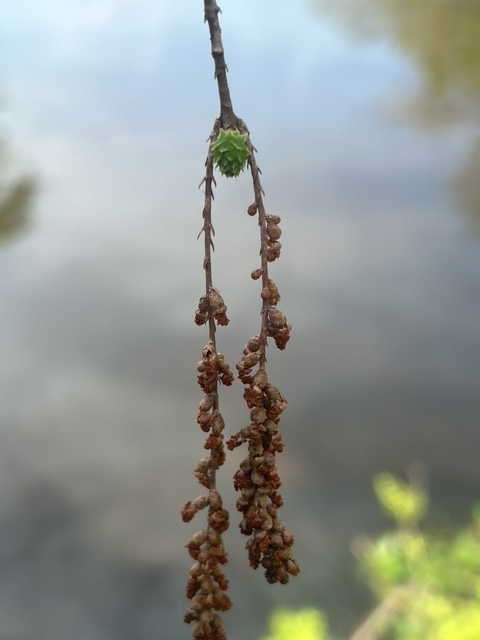
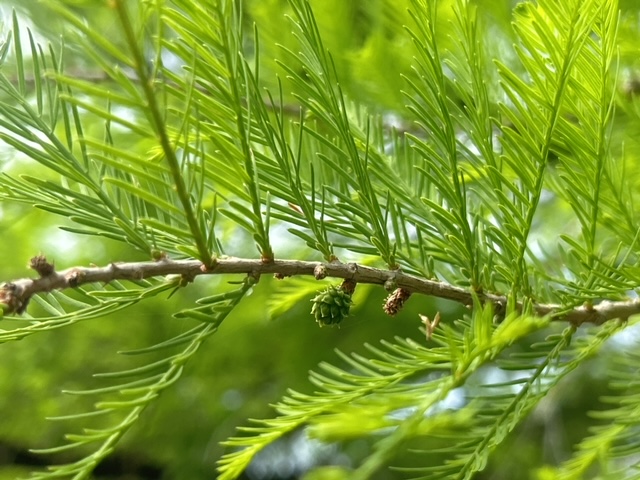
I have both Montezuma and bald cypress around my pond and have watched them develop differently for years. I observed my bald cypress in Burleson County to be flowering in late January. These trees have male catkins that are about 2 inches long which emerge from the end of last years twigs. Just below those pollen-emitting catkins are small female flower parts that resemble tiny pine cones. The amazing thing to me is that these delicate flowers bloom when it is almost a dead certainty that several hard freezes will arrive before spring. Across North America and as far north as Delaware bald cypress are shown to flower in January. Here in Texas the flowers are exposed for as much as 7 weeks before any new leaves begin to erupt in March.
Flower
Contrast that with a Montezuma cypress located on the same pond 70 feet away. It sprouted leaves in early February and is in full-green glory on the same day that my bald cypress trees are still leafless. Montezuma cypress is the National Tree of the Republic of Mexico. In central Mexico and further south these trees never lose their leaves. The one in my yard holds it leaves much later in fall than the bald cypress, but eventually does drop them after hard freezes around Christmas each year. Burleson County, Texas isn’t Mexico City, but these trees have the ability to be either evergreen or deciduous.
Montezuma cypress flower
It has always fascinated me that bald cypress are present in abundance along swampy acidic streams in East Texas and yet also along calcareous, alkaline streams in the Texas Hill Country. It is an adaptable plant that can thrive in both pH 4.5 or pH 9.5. I wonder if at one time in the past they extended completely across the south, through Texas and down into Mexico as a solid band? Maybe while we let the tree taxonomists argue we can imagine a scene in deep time when things looked very different on the continent now known as North America. This ancient lineage of trees has survived a roller coaster of changes and thrived during “ice-box earth” and in times when tropical warmth dominated the across the Arctic Circle.
I’ve been using Merlin Bird ID since last summer to identify birds I hear. I’d used it before to identify birds I saw, but once I started the listening exercise, I was hooked. It’s such fun knowing what I hear around me, and it’s great training for birding without the app. My ability to identify birds by song is hugely improved. Plus, knowing what’s out there helps you know what to look for if you want to see birds.
Merlin interface.
Cornell Labs has done an amazing job developing this app, which you can download from the App Store in whatever kind of phone you have. I can’t imagine how much work it has taken to train the listening app on the sounds of all the birds around the world (you can get Bird Packs for wherever you happen to be).
I got Europe because I keep getting those weird IDs and wanted to read about those birds. Mexico is because I go to South Texas sometimes.
I’ve learned a few interesting things about Merlin that those of you who use it or are interested in giving it a try may benefit from.
One of the most common birds I hear.
1. Merlin will not identify domestic birds. My chickens can walk right in front of the phone and nothing registers. It also completely ignores my horse trainer’s guinea fowl, and didn’t pick up the turkeys at Bird and Bee Farm. However, it has identified wild turkeys, so I think the turkey thing was a fluke.
I’m a bird!
2. The app has trouble with birds who make sounds that are low in pitch. For example, it needs most doves to be really close in order for it to register them. Collared doves make a higher sound that it identifies more easily. And you have to be on top of an owl for it to be picked up. In the past week, I’ve heard entire owl conversations that didn’t get “heard,” both of barred owls and great horned owls. That’s why it pays to also be able to identify birds with your own ears!
I’m so subtle.
3. Crazy things can happen after a recording is interrupted. Two things that happen to me often will interrupt a recording: the phone ringing or me accidentally starting a video rather than taking a photo while the app is running. You can usually save the recordings, though I have lost a couple.
However, I’ve found that if I start the listening function again after an interruption occurs, Merlin’s decides I am not only in North America, but I’m also in Eurasia. I will be informed that I hear a great tit or a European robin, which is highly unlikely!
So, if you suddenly get an identification of a bird you’ve never heard of, be sure to click on the map for that bird, to be sure it has actually been seen in your area. Sure, occasionally birds are blown off course when migrating or after a storm, but most European birds stay in Europe (other than our biddies the house sparrows and starlings, of course!).
My husband’s haiku: Porch sparrow drama – fussing, fighting – very loud What are they saying?
4. Moving around is hard on Merlin. The app works best if you are standing still (or the phone is sitting on something) and the environment is not noisy. It’s amazing how loud you are walking on a trail or around your property. I live in the country, yet I realize now that it’s loud here. Loud farm vehicles and trucks, single-engine planes practicing their takeoffs and landings at the nearby tiny airport, our six dogs, the pool pump and waterfall, and air conditioning units all contribute. When camping, screeching children on trails and boats are hazards. So are waves, believe it or not. But if you stay still, Merlin’s does a pretty good on anyway.
Savannah sparrows looking for bugs
When I’m out walking, I usually pause if I hear an interesting bird, so the app can pinpoint what it is. My exercise app on my watch hates that.
Merlin Hints
Save fairly often. I try to go no more than 20 minutes or so before saving a recording unless there’s some great bird action going on. That minimizes your losses if the app crashes, which does happen occasionally.
Remember to report interesting birds you hear or see to Cornell Labs. It goes to e-Bird and provides useful research data. I don’t report every sighting. I doubt they are interested in the fact that I see vultures and house sparrows every single day. You can also upload photos. Occasionally I get one good enough to share.
Have some fun with the app and do your own research. I’m tracking what birds I hear at my house each month. It’s letting me know which birds are winter birds, which migrate, which show up in summer, and of course, what’s here all the time (vultures, house sparrows, cardinals, chickadees). Be sure to report each new bird you hear, so your life list on Merlin can grow. I have 192 birds since last September. Majestic that 193. A marsh wren showed up today. That includes birds I’ve seen while traveling, too.
Yep, we are in their range.
Conserve your phone battery. To make my battery last longer when on long hikes, I don’t keep my camera open at the tame time Merlin is running unless I’m actively taking pictures (remember, I also obsessively record plants and other life for iNaturalist). If I were planning to go out for a long time, I’d take a spare battery. I tend to run out of juice after around three hours.
Don’t become annoying. I have developed the habit of shushing people who talk when I’m “listening” through Merlin. I’m sure it irritates my spouse. People are important! I also don’t even TRY to use the app when on a group hike unless I hear something really cool and go hide to try to capture it. I was hilarious at the National Butterfly Center last October, as I lagged behind the Master Naturalists trying to hear exotic Mexican birds. I also find myself trying to be extra quiet any time I’m outdoors,because it’s become a habit. I whisper answers to questions and such. I am working on fixing that before my family stope talking to me.
I hope you get something helpful out of these hints. If I’m wrong about anything, let me know. Also, if you have additional insights or hints, tell me and I can add them to this blog post. I’m still learning!
Flowers attract insects that attract birds.
By the way, I’m not claiming Master Naturalist VT hours for any of this, since it’s on my own property most of the time, and that doesn’t count. I did count my time during the Great Backyard Bird Count, since that’s approved. I don’t claim hours when I’m camping or traveling, since I’m also usually making iNaturalist observations at the same time and don’t want to “double dip.”
[this is a revised version of a personal blog post]







 Nature Along the El Camino Real