Happy Earth Day! Plant something native to our area in honor of it.
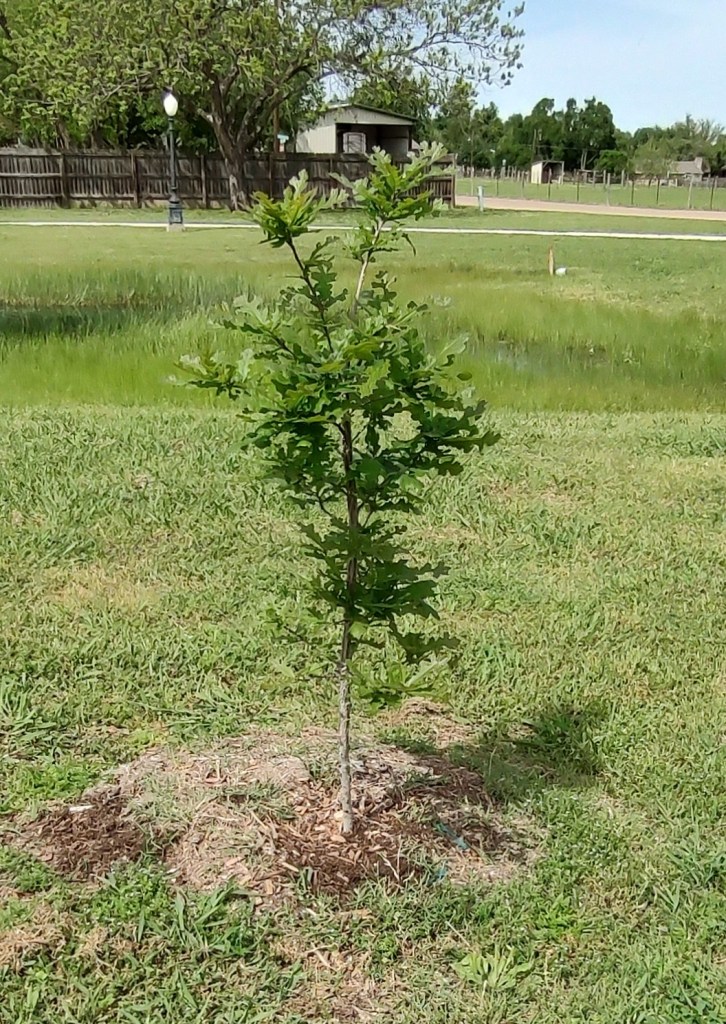
Last year a small group of us planted three Bur Oaks in Cameron parks in honor of the day. Two of them survived and are now thriving.
The photo is from the one at Orchard Park. We replaced a tree that went down in the freeze of 2023 there. The other surviving tree is at Wilson Ledbetter Park. It needs a little help being upright because of a major hit by that big storm we had right after we planted them, but it is already growing new ones to make up for it.
I watered the Orchard Park tree and Liz Lewis watered the Wilson Ledbetter Park tree. Liz went to see her tree at least three times a week, and she is still working on it. I have left mine to fend for itself. Watering a Bur Oak for its first year is enough for it to establish itself, it seems. Hint: they are both planted close to bodies of water.
[This article appeared in the Cameron Herald, Thursday, April 4, 2024]
A local member of the El Camino Real chapter of Texas Master Naturalist is putting Milam County on the scientific map in spider identification. Eric Neubauer, now considered a local Rabid Wolf Spider expert, discovered a kind of Wolf Spider that has never been identified anywhere.
Eric Neubauer
Neubauer discovered the new spider and named it Hogna Incognita while studying the biodiversity of his place out near Davilla in 2019. He had just moved to Texas from Pennsylvania and bought a few acres in that area. When he realized the place was covered in what are commonly called Wolf Spiders, he felt compelled to identify all of them.
The newspaper article
There are many kinds of Wolf Spiders, but after two years of trying to identify the Hogna Incognita without success, he believed that he had found a new, unidentified, as yet unnamed spider. “It’s amazing that a spider that big, that common had not been identified already,” said Neubauer.
He started using iNaturalist, an internet vehicle to identify all living things all over the world, in 2019. Only 4 people had an active interest in Wolf Spiders on the site. Neubauer went through 13,000 Wolf Spider observations on several different identification sites. None were his spider. The first identification of Wolf Spiders in Milam County goes back to 1904 when Texas was still a popular place for biologist to study all types of living things.
Hogna incognita– photo by Eric Neubauer
After extensive studying, he came to strongly believe that he had a new one that had never been mentioned in scientific literature. The Hogna Incognita has a relative that looks similar to it, but it doesn’t look exactly like it. The “cousin” is commonly called the Hogna Antalucana. He believes the incognita was thought to be the antalucana because they had one similar trait.
Neubauer began giving presentations on Wolf Spiders to fellow Master Naturalist. In 2021, convinced it was a new one, He put up a “note” on it on the Bug Guide web site. The curator of the site agreed that it was a new species.
After some statewide presentations by Neubauer in 2023, Tarleton Professor Russell Pfau read the presentations and offered to help Neubauer with definitive evidence of its uniqueness. Pfau did extensive DNA testing on both the incognita and antalucana. Neubauer and Pfau caught some of each type in several stages of development – including all the spiderlings on the mother’s back. Pfau has managed to raise them from infancy to adulthood. The raising of them showed difference between the two from birth to adulthood.
Just weeks ago, Pfau notified Neubauer that the two spiders did indeed have different DNA. He had found an unidentified Wolf Spider.
“Hearing that the DNA test verified what I was sure I’d found – I was more excited than I thought I would be,” said Neubauer, who is normally very stoic.
Neubauer would like to stress that Wolf Spiders are harmless. They may bite, but it’s not poisonous or painful. “I’d rather be bitten by a Wolf Spider than a mosquito,” he said. They offer some benefits out in the blacklands, too. The incognita is mostly in the blacklands and some surrounding areas, so if you’re in Milam County you probably have them.
If you’d like to read the original report, you can find it on the El Camino Real Texas Master Naturalist web site https://txmn.org/elcamino/ . You also can look up Wolf Spiders on www.inaturalist.org.
I had a wonderful opportunity to introduce young people (and some adults) to observing nature and learning from it. On March 9, I was invited to help a Cameron Cub Scout pack learn how to behave in parks and what to look for when you’re out in nature. We went to Chalk Ridge Falls Park, which is in Belton, on the Lampassas River, next to the Stillhouse Hollow Lake dam.
River View
The park is a great place to take young people, because the trails are wide, there are safe stairs, and there are many different ecosystems represented (riparian, woodlands, and prairie). One caution would be that children have to be supervised, because the river has carved a pretty steep canyon that is NOT fenced off. Also note that while there are stairs down to the river, they are steep and would be difficult for anyone with physical challenges to handle.
There were twelve children in attendance, including a couple of siblings of Cub Scouts. There were plenty of helpful adults, as well, so I could concentrate on finding items of interest to show them. We talked about littering and damaging park property, since this public park has a litter issue. The Scouts hope to come back to do public service by picking up trash – it was their idea!
Checking out the bridge
We also talked about trail etiquette, such as not taking things from parks and staying on the path, which about 50% of the children were able to do. One thing I need to remember in doing this kind of thing is that nowadays many children will have attention-deficit disorders or may be on the autism spectrum, so it’s a good idea to present things that they all can benefit from. I did much better than I did last time I tried this, which led to a good time for all.
Since this is a city park, they probably expect kids to climb the trees.
Once the Den Mother and I showed the Scouts a few interesting flowers, bird nests, and pollen on tree catkins, the questions began. Some of the youngsters asked great questions about what they were observing or hearing (we heard a loud canyon wren, so I could explain that the park is the perfect habitat for them). I was asked about leaves, the berries on the cedar trees, how the seeds get in raccoon poop, and so much more. I was positively impressed at how much they got into the nature thing once they got started.
Exploringthe woodland and future wildflowers
Parents and grandparents also were paying attention and asking questions, and the Den Mother and I were surprised at how far we ended up going down the trail. They didn’t complain about being tired until we’d been out more than an hour. Speaking of going down the trail, the grandmother who came along was using a cane to help walk the trails. She initially said she’d just sit and wait when we went down some stairs to go over a bridge, but she got so interested in what her grandchildren were seeing that she made her way down and went the rest of the way with us. When we were finished, she said she was now ready to do squats. We got a good laugh out of that. But, that’s what being out in nature can do for you!
These stairs were in pretty good shape, though, and the grandparent made it.
Here’s what made the nature walk worth it to this Master Naturalist. One of the Cub Scouts had asked me many questions and was fascinated by flowering trees and berries. As we walked off from looking at some new thing, he turned around and ran up to me, with his little face aglow and shining black eyes. He exclaimed, “I love nature now!” He also wanted a photo with me when we left.
Here I’m showing them an oak gall
One of the young girls was also having a lot of fun. We got to the place where we were going to turn around, and some of the families had snacks. Her family had left theirs in the car, so they were going to go on back. She looked stricken and said to her mom, “But I want to stay here and continue this adventure!” I have to say I agreed with her. There was lots more to see, since there are many trails in the park.
Nice trails and plenty of resting spots
More than one parent mentioned wanting to come back and go further, without children. I think a field trip to do a BioBlitz here would be very worthwhile. I heard four types of wrens (before the children arrived) as well as other interesting birds, so it would be a good birding spot, too. Here are some of the things we saw.
I sure hope I can find more opportunities to lead nature walks. I think interpretation is my favorite part about being a Master Naturalist. I was so happy to see how much learning took place!
We had a good time at the Rockdale Rotary meeting this week, where we had lunch and shared information about our chapter.
They are a nice bunch of people working for the community. We appreciate the opportunity to tell the community a bit more about the Texas Master Naturalist program.
Alan shows the attendees our impressive textbook.Catherine explains our many activities.Attendees
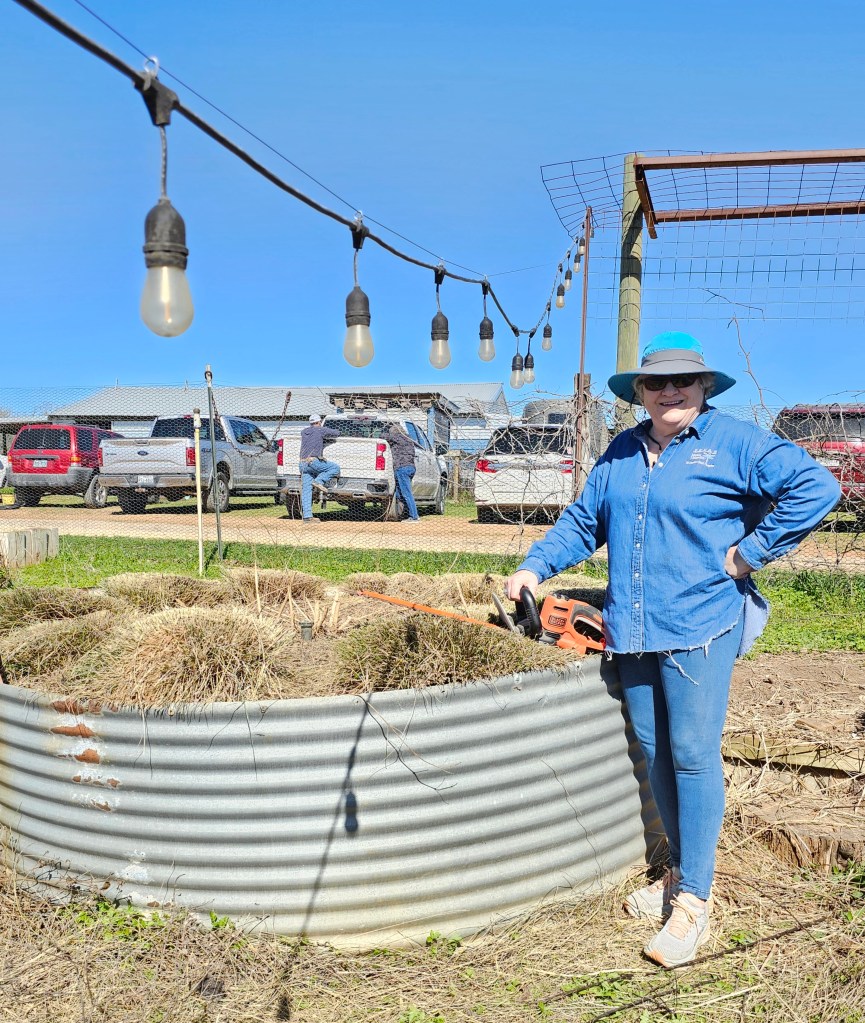
We accomplished a lot at the first Wildscape workday for the year.
Fantasy Garden
Neal worked on getting the children’s fantasy garden in shape. Debra sheared many large grasses, while Phyllis and Patricia hauled it away and weeded. Trees were pruned and ants killed.
NealDebraPhyllisPatriciaDebris!Good job all, says Catherine
The huge oak tree is gone having been destroyed by past ice storms. Now we have to work on getting more shade, as it will be a while until new trees grow. Everything is greening up, and the bluebonnets made it back!





 Nature Along the El Camino Real