Finding Hidden Treasures of the Plant Kind

By Sue Ann Kendall

A week ago, two members of the El Camino Real Chapter, Texas Master Naturalist were invited to scope out the property of a third member to see if there were any interesting plants, birds, or other organisms there. Ann Collins and I made many discoveries at Carolyn Muller’s Burleson County property.

Ann and I experiencing species overload.

It’s always a privilege when private landowners allow you to catalog what’s on their land, so we’re very grateful to AD and Carolyn for their hospitality. We enjoyed finding out what thrives in this sandy soil with a nice mix of hardwood forest and untouched prairie-like fields.

A stand of Lemon Beebalm leads to the woods.

While Ann and Carolyn worked on bird observations from a guest cabin porch, I ran off and checked out the woods and open area under electric lines. There are often great flowers in those areas.

I then found a nice wide path through the woods with many Halloween decorations on it. While they weren’t great for iNaturalist, I’m sure little kids love it. And I found my first interesting milkweed, Tayalote (Cynanchum unifarium).

Too bad it wasn’t in bloom.

After I got back and we practiced entering sightings into iNaturalist, Carolyn took us on a ride around all the impressive paths that wind around to various outbuildings and such. There we found interesting mosses and fungi.

The highlight of the visit was the magical wildflower patch. It grows in a strip where a neighbor had erected a tall wildlife fence about ten feet behind regular cattle fencing. This strip doesn’t get mowed or grazed. It was spectacular.

Wildflowers galore!

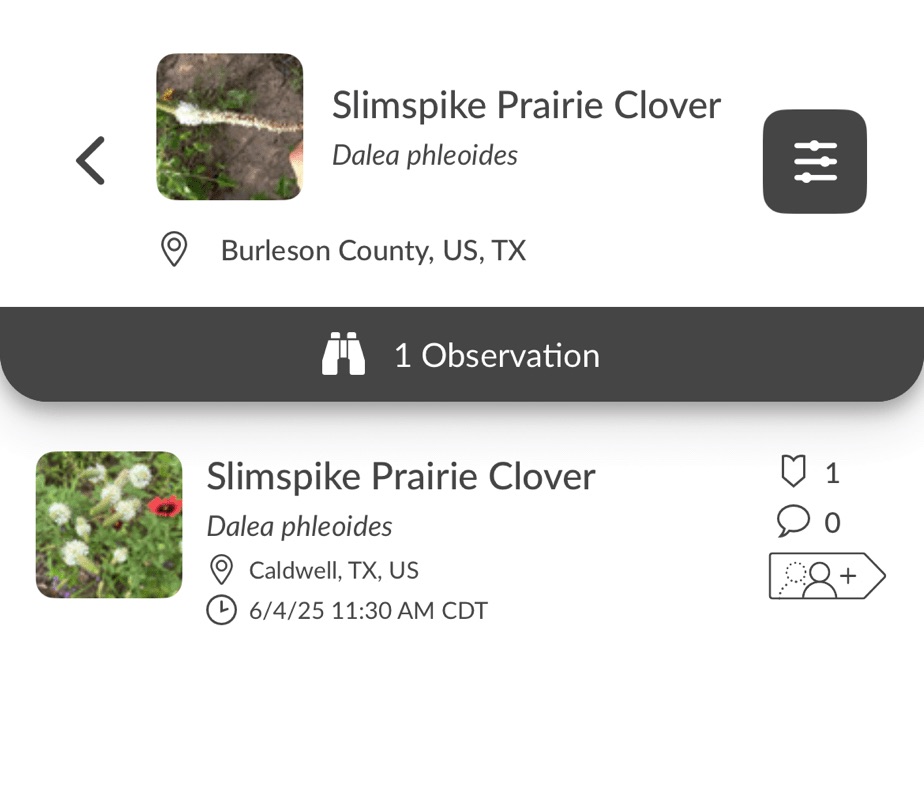
This area also contained plants neither Ann nor I were familiar with. Upon investigating, I found some of these natives have very few sightings in Milam or Burleson Counties. In fact, this Slimspike Prairie clover was the first observation in Burleson County. There are only 4 observations in Milam, all but one by a chapter member!

Other interesting rare plants were these. Maybe they’re not spectacular, but they’re not observed often.

Ann and I were pretty hyped up about all these new plants, and Carolyn was thrilled to find out her property had plants we got excited about. As we looked around the property more, we also found yellow passionflower and the beautiful propeller flower, purple pleatleaf or Alophia drummondii. I stuck in some scenery so you can see the big picture!

After another fun ride through the paths, we headed out, but I had my brain full of new-to-me plants, and Ann enjoyed hearing and seeing Swainson’s Warblers, Summer Tanagers, and two vireos (white-eyed and yellow-throated).

What a varied place to investigate.

We’d all love to return, and we plan to arrange friend trips. The presence of air conditioned rest facilities with refrigerators and water will make this a great place for our chapter’s naturalists to explore and learn about the amazing variety of ecosystems in this part of Texas.

Ann and Carolyn basking in wildflower glory.

Purple Martin Field Trip Fun

by Carolyn Henderson

The bi-annual trip of the El Camino Real chapter – Texas Master Naturalist to the Purple Martin conservation project of Mike McCormick was both awe inspiring and amusing. McCormick had hundreds of Purple Martins making his place home for the nesting season while a notable number of dumped roosters were fighting it out on the ground. 

Purple Martins in the sky.

McCormick, who started the Purple Martin conservation project at his place south of Buckholts at least 40 years ago, estimated somewhere between 800 to 1,000 Martins in residence this year. It is nearly triple what has come around for the last two years. He attributes it to milder weather so far this year. 

McCormick talks about the birds.

He has a few hundred Purple Martin houses set up. They are particular about their “homes.” They like them to be a certain level above the ground away from trees and buildings. They need a pond or stream in the near vicinity. They also do their hunting of insects at a high altitude, although they have been known to hunt over ponds and even on the ground if the weather is bad. 

Chapter Members enjoying the talk.

McCormick will walk around under the many houses to get them to come out then the sky looks like it’s covered in Martins. Many are pairing off. Once the babies are hatched, they take about a month before they leave the nest. By early fall, these Martins have flown to Austin, where thousands meet up to then fly to Brazil or other points south for the winter.

Purple Martins’ primary natural competitors are European Starlings, which are invasive to the USA, and sparrows, many of them also invasive. They take over their houses. McCormick has styled a large cage to catch those competitors in and remove them. Human expansion is also a problem for martins wanting to nest in natural spots.

The resident Barn Swallows build their own nests. These are hungry babies!

McCormick and his sister have added a nature trail on the site to let visitors see the natural habitat there. They also have created a sort of  refuge for other native bids and those ever-invasive non-natives. They use a small corral that used to be used for training horses. They have a birdbath, several feeding sites, and a few bird houses. 

Repurposed trah-bin lid makes a great birdbath.

He puts birdseed on the tops of all the fence posts, which brings Cardinals, Red-bellied Woodpeckers, Brown-headed Cowbirds, and and few other species to the little refuge. 

Male eats while female Cardinal darts away.

The piece de resistance is new bathroom facilities with running water and full plumbing.

Visits are more pleasant with these available!

To top it all off, they had at least 15 (my sort-of count) roosters dumped on their place. I’m used to dogs and cats being dumped – but not roosters. They were in a fighting mood while we were there. 

It’s worth a trip to see all the sites and have McCormick impart much knowledge about Purple Martins.

Killing Time Leads to a Wonderful Find

by Michelle Lopez

While killing time between doctor appointments in Temple, I found a store called Wild Birds Unlimited. I decided to check it out since I am an avid birder and struck up a conversation with the lady working in there. I found out that she is also a Texas Master Naturalist, and we had great conversations.

We talked about the different ways we get volunteer hours and different projects we are involved in. I really enjoyed meeting her. She told me about a nearby pond that had migrating Roseate Spoonbills and White Ibis, and that there is also a Bald Eagle that hangs out around there.

I got super excited and decided to check it out on my way home. She drew me a map on some scrap paper and I found the location easily. I was excited to immediately find the White Ibis. I keep binoculars in my car for such an occasion, and tried to get some good pictures to share. I didn’t see any Spoonbills or an Eagle but I thoroughly enjoyed this wonderful find.

I had another appointment today and decided to take the long way home so I could revisit the pond and hopefully see something new. Well, it was even better than the day before! I saw some White-Faced Ibis, American Avocet, and a Bald Eagle!  This really made my day. 

Killing Time Leads to a Wonderful Find

by Michelle Lopez

While killing time between doctor appointments in Temple, I found a store called Wild Birds Unlimited. I decided to check it out since I am an avid birder and struck up a conversation with the lady working in there. I found out that she is also a Texas Master Naturalist, and we had great conversations.

We talked about the different ways we get volunteer hours and different projects we are involved in. I really enjoyed meeting her. She told me about a nearby pond that had migrating Roseate Spoonbills and White Ibis, and that there is also a Bald Eagle that hangs out around there.

I got super excited and decided to check it out on my way home. She drew me a map on some scrap paper and I found the location easily. I was excited to immediately find the White Ibis. I keep binoculars in my car for such an occasion, and tried to get some good pictures to share. I didn’t see any Spoonbills or an Eagle but I thoroughly enjoyed this wonderful find.

I had another appointment today and decided to take the long way home so I could revisit the pond and hopefully see something new. Well, it was even better than the day before! I saw some White-Faced Ibis, American Avocet, and a Bald Eagle!  This really made my day. 

Toad Rescue

By Pamela Neeley

Thanks to the cautious behavior of my cat, Apollo, I interrupted the swallowing of the largest toad ever!

Apollo spots the problem.

The black snake was having trouble swallowing the toad because it was so large. I had to choose between my camera and using a stick to annoy the snake. I poked the snake with the handle of broom I had in my hand. It released toad.

There was a bad smell and it curled and headed my way. I maneuvered away! At last the black snake went the other way.

Thanks for saving me!

I placed the toad in a water dish while I settled my nerves. The photos are of the toad in the water feature and in the last, I imagine he’s smiling at me.  

I get to live to croak again.

Once I got back in the house (this had occurred at the back door) I looked up the snake, and I’m pretty sure it is a western cottonmouth.* I’m glad I didn’t know that earlier or the toad would be dead.

Cottonmouth photo by Railprof on iNaturalist — many are much darker than this.

The snake was large, black, thick, and with a skinny short ending to its tail. It also had a musky smell. It did want to escape. I only had an Asian broom but it worked.

The cat was no further help.


*Actually most of the observations in Milam County come up as northern cottonmouths, so who knows? (Inserted by curious editor)