Blog of the El Camino Real Chapter, Texas Master Naturalists, Milam County, Texas
Author: Sue Ann (Suna) Kendall
The person behind The Hermits' Rest blog and many others. I'm a certified Texas Master Naturalist and love the nature of Milam County. I manage technical writers in Austin, help with Hearts Homes and Hands, a personal assistance service, in Cameron, and serve on three nonprofit boards. You may know me from La Leche League, knitting, iNaturalist, or Facebook. I'm interested in ALL of you!
The garden is undergoing major alterations, so hosting programs will be easier and with more room.
Weston and his brother are new helpers who are eliminating massive overgrowth.
Some aggressive natives in the space are Passionflower vine and Climbing Cypress.
Most all plants are doing fine since the rains. However, as it dries out, it is always helpful for members or visitors to pick up a hose and water a plant in stress.
The native trees are tall, including Texas kidneywood, wax myrtle, elbow bush, and button bush.
Seeds are becoming available for the seed library, too. We will have seeds available at the Wildscape very soon.
If you would like to volunteer for chores, email me at cpc69earth@gmail.com. Or, just go see what is going on in June.
Here are some pictures from our trip to Red Mountain, where we prepped for the Tonkawa Powwow and did some trash pickup. What a spot!
Getting ready to climb
None of us had climbed the mountain before, but when we spotted some ribbons on trees, we figured that was our cue to start climbing.
Climbing
Let’s just say it was more of a challenge than we bargained for, but we all reached the summit. The kicker? Those ribbons were actually indicating where a trail was supposed to go. Who knew?
Anyway, our detour led to some neat discoveries, like some clay handles that could’ve been part of ancient clay pots. I took some photos and left the artifacts in place for the ongoing archaeological dig.
This may be a fossilized gourd in a rock!
Being a Texas Master Naturalist is a real treat, and our crew is fantastic. Love it!
Yes, it has been raining lately. And yes, it has been HOT! So let’s talk about our wild friends during the hot summer.
At Sue Ann’s house, they got 8.11′ of rain last night. Frogs are very happy.Photo by Sue Ann Kendall.
We love to put out bird seed, and other goodies for our friends, but the most important thing is water. Sometimes the closest water can be a great distance for the animals to travel. This means that providing a close water source is immelsely helpful. Keeping fresh water nearby could save the life of a baby bird, a baby bunny, and all of the wild things.
A good example of water with a place to perch. Photo by Janice Carriger on Pexels.com
Another thing to remember is that birds need a perch to light on. An especially important thing in wildscaping is to provide an arbor, a fence, or even a cattle panel propped up. I have been quite successful in bringing birds to our place, so I know what they like, which is water, a perch, food, and some shelter near all of these items. Shelter can be an evergreen bush or small tree. Safety from cats should also be considered.
Be creative, like we have at the Milam Wildscape! Photo by C. Johnson.
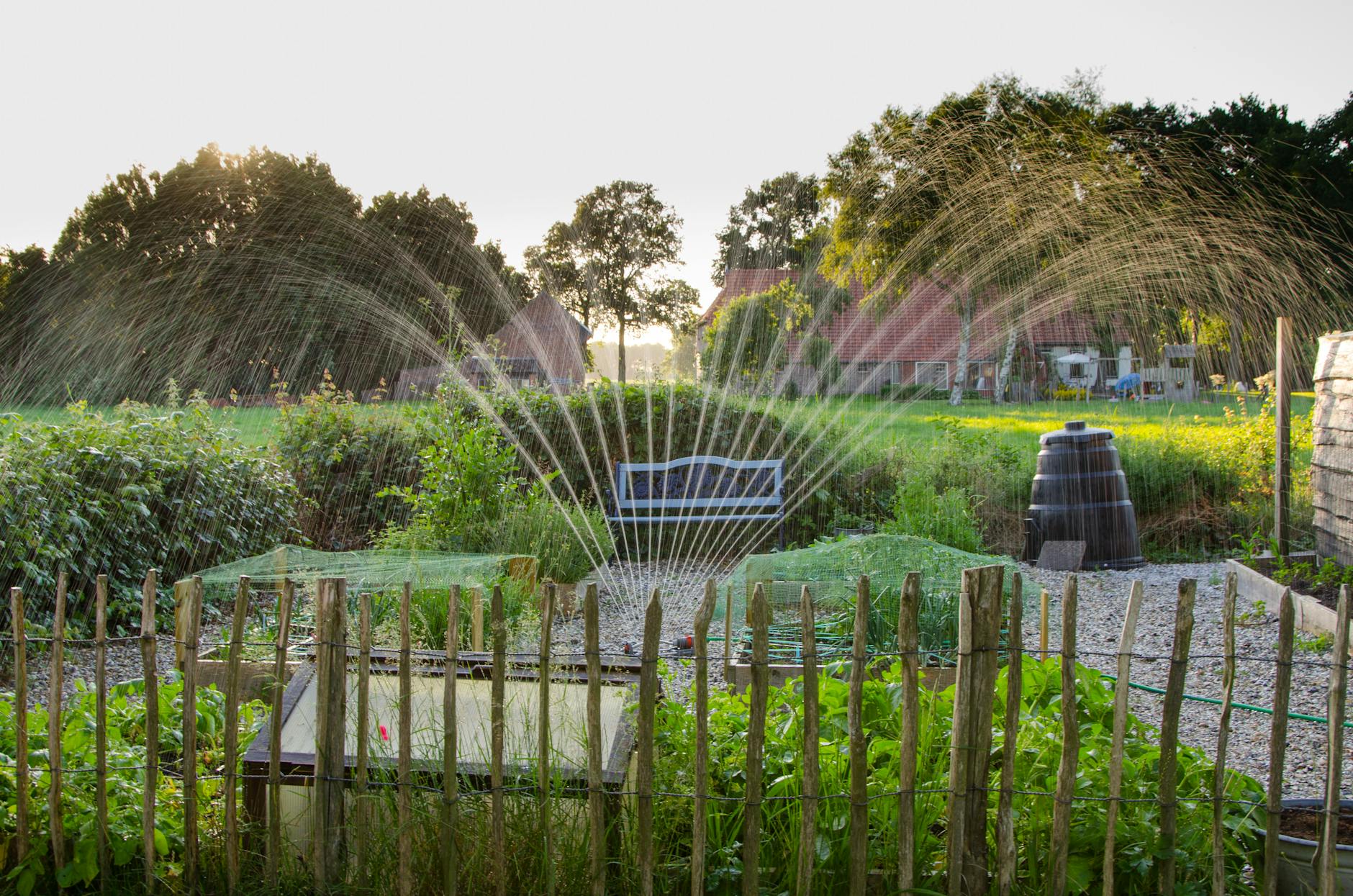
A sprinkler put out is heaven for my little hummers. I place the sprinkler near a fence lined with vines and they go crazy.
Maybe we don’t need as much rain as some of us got last night, but it is ALL appreciated. This is Walker’s Creek at County Road 140, now more like a river. Photo by Sue Ann Kendall.
A week ago, two members of the El Camino Real Chapter, Texas Master Naturalist were invited to scope out the property of a third member to see if there were any interesting plants, birds, or other organisms there. Ann Collins and I made many discoveries at Carolyn Muller’s Burleson County property.
Ann and I experiencing species overload.
It’s always a privilege when private landowners allow you to catalog what’s on their land, so we’re very grateful to AD and Carolyn for their hospitality. We enjoyed finding out what thrives in this sandy soil with a nice mix of hardwood forest and untouched prairie-like fields.
A stand of Lemon Beebalm leads to the woods.
While Ann and Carolyn worked on bird observations from a guest cabin porch, I ran off and checked out the woods and open area under electric lines. There are often great flowers in those areas.
I then found a nice wide path through the woods with many Halloween decorations on it. While they weren’t great for iNaturalist, I’m sure little kids love it. And I found my first interesting milkweed, Tayalote (Cynanchum unifarium).
Too bad it wasn’t in bloom.
After I got back and we practiced entering sightings into iNaturalist, Carolyn took us on a ride around all the impressive paths that wind around to various outbuildings and such. There we found interesting mosses and fungi.
Pale Cow-hair Moss (Ditrichum pallidum) was interesting Coral-pink Merulius (Phlebia incarnata)Meadow pink (Sabatia campestris)Not sure Ringless Honey Mushroom (Desarmillaria caespitosa)
The highlight of the visit was the magical wildflower patch. It grows in a strip where a neighbor had erected a tall wildlife fence about ten feet behind regular cattle fencing. This strip doesn’t get mowed or grazed. It was spectacular.
Wildflowers galore!
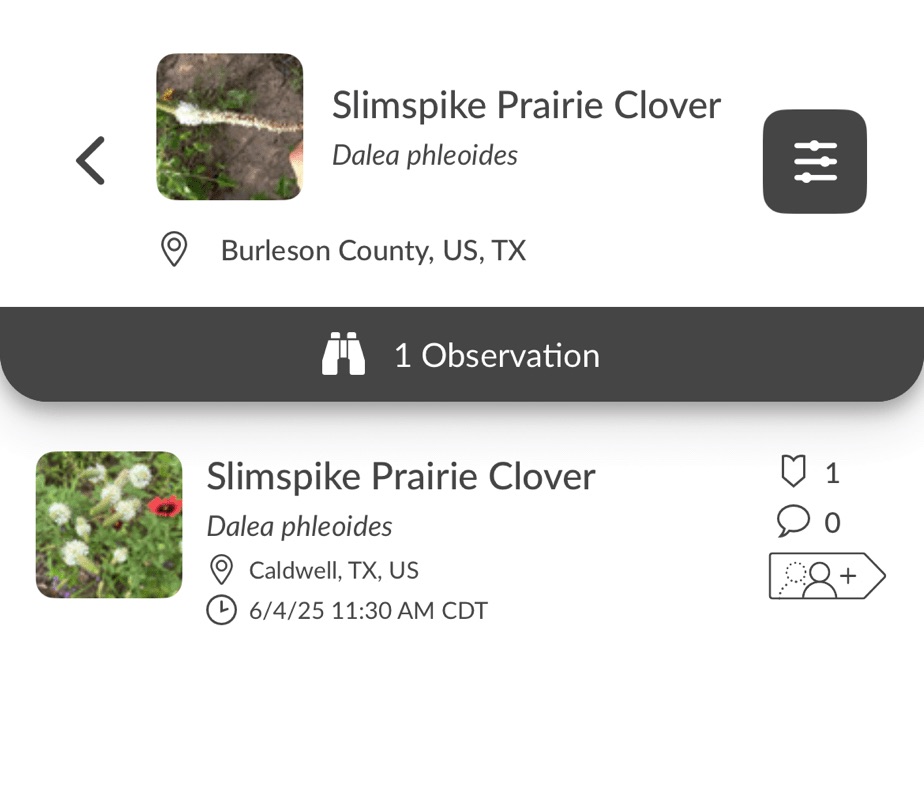
This area also contained plants neither Ann nor I were familiar with. Upon investigating, I found some of these natives have very few sightings in Milam or Burleson Counties. In fact, this Slimspike Prairie clover was the first observation in Burleson County. There are only 4 observations in Milam, all but one by a chapter member!
They are so prettyJust one observation in Burleson CountySlimspike Prairie Clover (Dalea phleoides)
Other interesting rare plants were these. Maybe they’re not spectacular, but they’re not observed often.
Ann and I were pretty hyped up about all these new plants, and Carolyn was thrilled to find out her property had plants we got excited about. As we looked around the property more, we also found yellow passionflower and the beautiful propeller flower, purple pleatleaf or Alophia drummondii. I stuck in some scenery so you can see the big picture!
Yellow passionflower, a favorite of mine (Passiflora lutea)Alophia
After another fun ride through the paths, we headed out, but I had my brain full of new-to-me plants, and Ann enjoyed hearing and seeing Swainson’s Warblers, Summer Tanagers, and two vireos (white-eyed and yellow-throated).
What a varied place to investigate.
We’d all love to return, and we plan to arrange friend trips. The presence of air conditioned rest facilities with refrigerators and water will make this a great place for our chapter’s naturalists to explore and learn about the amazing variety of ecosystems in this part of Texas.
I went out to Wild Wings Bird Sanctuary yesterday to see what birds were out there and to take some new resources for visitors.
Oops! Lost a tree.
I joined Ann Collins, who was as happy as I was to see new bluebird houses have been put up, one in the sanctuary and two others along the property driveway.
Next year’s Bluebirds will love this!
We appreciated the newly planted native plants and red lantana in the raised beds, and no doubt the hummingbirds will, too.
New plants.
That’s good, because curious heifers have been having too much fun with the official hummingbird feeders. You can’t help but be amused by them, though. Gene Rek found one of them had drunk all the water in the bird bath and was licking the water dripping down the drip chains. That’s just too cute.
Yum!
As we listened and watched for birds, I put two of our new bird sheets in the mailbox for visitors to take. One’s an alphabetical list of birds found in Milam County (an updated version is linked on the Wild Wings web page), and the other is our beautiful color bird sheet to help visitors identify what they may see at Wild Wings. You can also download your own copy on the web page. By the way, there’s also a bird list in taxonomic order in the collection as well. As soon as I can get these printed, you’ll find them in the mailbox as well.
Shady meeting area.
We are still waiting for our signs to arrive, but I did put a few magnets in the mailbox, so visitors will know they’re at the right place.
I forgot to take a picture of the mailbox!
Mornings are a wonderful time to hang out with the birds and squirrels, so check out our growing sanctuary! Enjoy some of the sights we found during our visit.
Very cool grasshopper exoskeleton Bold jumping spiderArmy workCicada exoskeleton Brittlestem?Hard to ID. Pretty cluster. Lots of insects in this spotted horsemintInsect on pokeweedWhite example of usually blue white mouth day flower.






 Nature Along the El Camino Real