Signs of Spring: Northern Milam Edition

by Sue Ann Kendall

Like many of our Chapter members, I always get excited when there are indications that maybe we’ll stop getting frozen participation, then heat, then cold, and over and over. Spring flowers give me hope. In the past couple of days, both Donna Lewis and Linda Jo Conn have shared flowers from different parts of Milam County. I’d already been thinking of writing a similar post, but they got there ahead of me. Or did they? We can all get into the search for spring!

It might be interesting to see what kinds of flowers are blooming just a bit north of where they observed (near Gause, and in Cameron). Plus, I needed to get outside for my nature fix.

I’ve always found henbit deadnettle (Lamium amplexicaule) pretty. Here it’s encouraging the other flowers, like the field madder, to get blooming.

I had intended to spend 20 minutes outside taking photos, but I ended up wandering around for an hour. It had been raining, so some of my specimens didn’t look too great. All the storksbills were bedraggled, the anemones were missing petals, and the crow poison had their blossoms firmly shut. So, a couple of these photos are actually from last week. But the plants ARE blooming now!

I’m fond of the showy blossoms that eventually show up each year, but my secret love are the little bitty flowers. Tiny bluets make me especially happy, and this is a great year for them out in my horse pasture.

Of course, everyone is out looking for their first bluebonnets, which are already up in Austin, from what I hear. In northern Milam County, they are usually a bit later than in many places, but that doesn’t mean we don’t have a bumper crop of them! This year will be no exception. I found beautiful leaf clusters holding raindrops in their centers, a few buds, and one just starting to bloom. I predict some great smells in the upcoming weeks!

It’s fun to see how the cold weather affects the new leaves on some of the plants, like this prickly sowthistle. I didn’t get any photos of it, but the dewberries have bright red leaves right now, too. Everything will get back to normal soon.

There are also some dandelions and field madder hiding in here with the prickly sowthistle (Sonchus asper). Notice the water droplets. I just noticed on iNat that this plant is even found in Hawaii. Those seeds stick to stuff!

I’d have a photo of my native plum tree, but it was too muddy to get to the reclusive shrubby tree. Maybe next week, if it’s still in bloom. I love those harbingers of spring, too. Some of the other plants I found were also shared by Linda Jo, but I love them so much that I can’t resist sharing.

So, fellow El Camino Real Master Naturalist Chapter members, what’s growing in your part of Milam County? No doubt that answer will be changing every day for the next few weeks. The weather will get nice one of these days, I know. Mother Nature has her own time clock.
Looking for Signs of Spring

by Linda Jo Conn

Is it just me or is spring behaving erratically this year?  I am so ready for some consistently warm days and swaths of colorful wildflowers brightening the roadsides!  

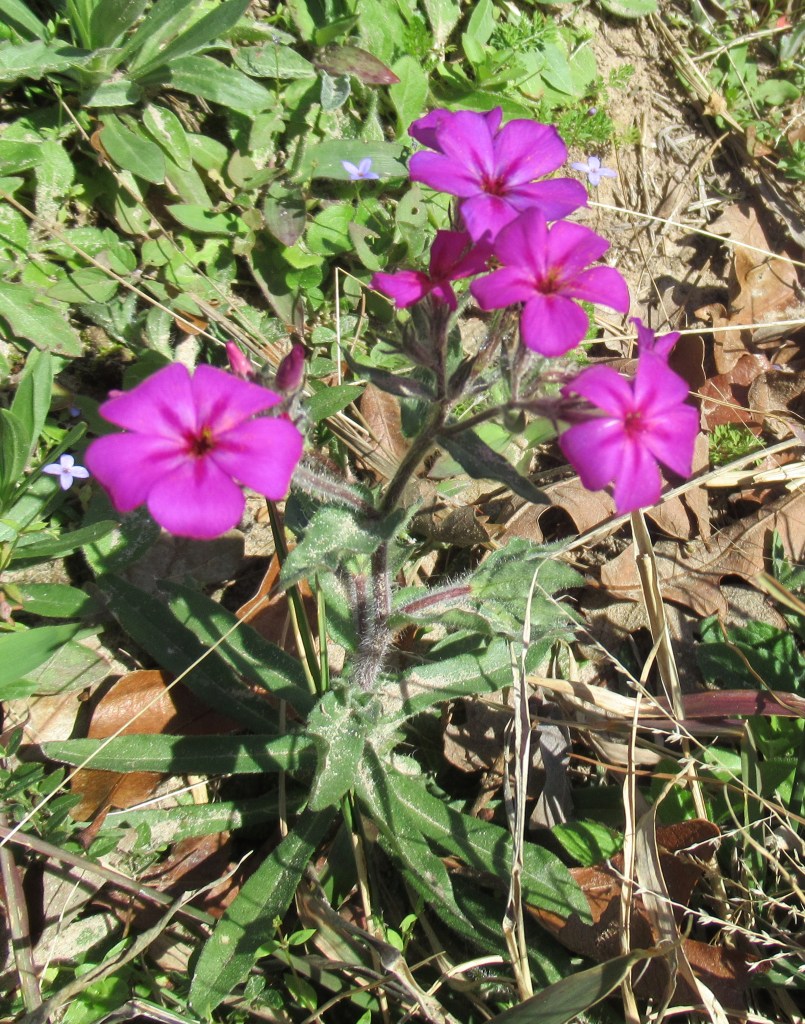
I did find some pleasant surprises during the past week.  On Monday, I had to go to Giddings, so I drove the back roads to check if the plum trees were in bloom.  No, but instead, I was delighted to find a couple of Drummond’s Phlox (Phlox drummondii).  

Drummond’s Phlox (Phlox drummondii)

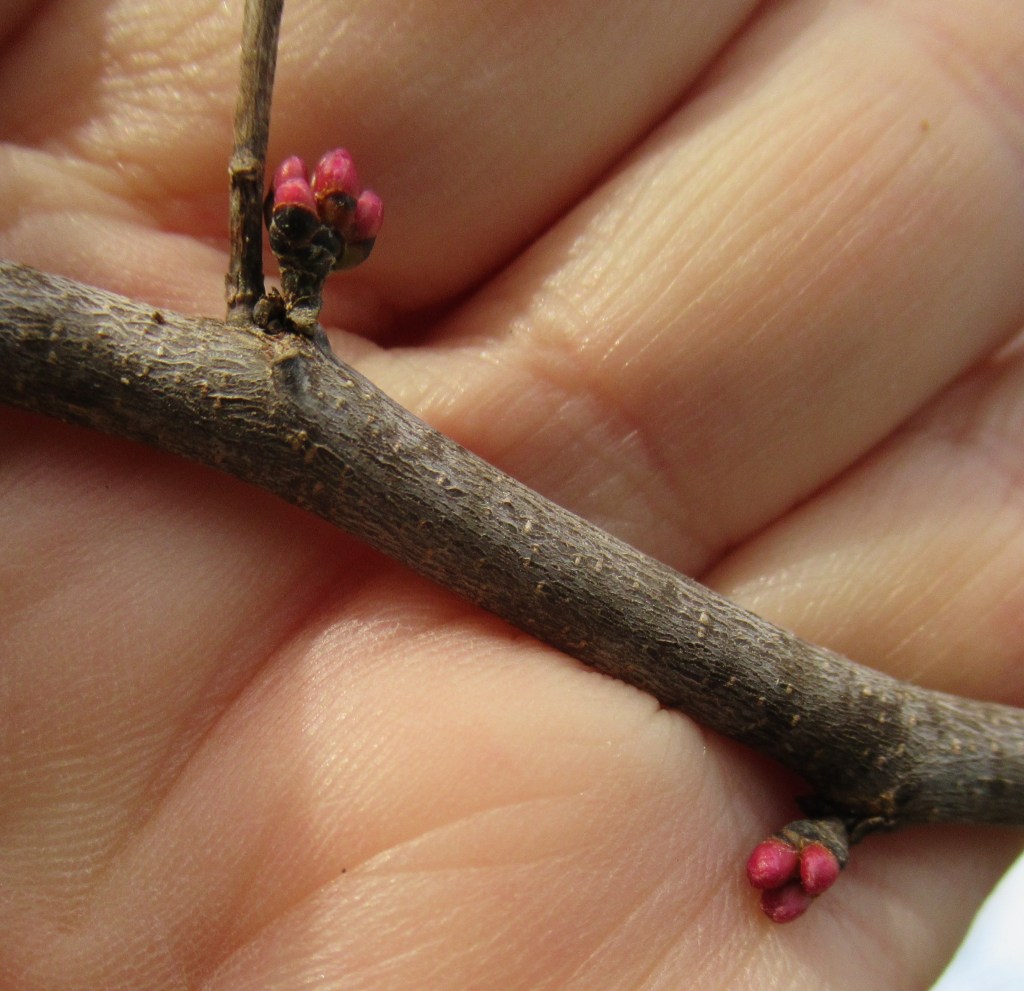
Tuesday, I observed the swelling flower buds of the volunteer Eastern Redbud trees (Cercis canadensis) near my house.  

Eastern Redbud trees (Cercis canadensis)

While leaving the herbarium at College Station on Wednesday, I finally spotted several specimens of Carolina Crane’s-Bill (Geranium carolinianum) I have been monitoring in the “lawn” area in bloom.   

Carolina Crane’s-Bill (Geranium carolinianum)

Thursday evening before the new student’s class at the Episcopal Church, I did a little “belly botany” and found a large patch of Bird’s-eye Speedwell (Veronica persica) nearby. 

Bird’s-eye Speedwell (Veronica persica)

While in Cameron on Friday helping fellow Texas Master Gardeners arrange and display the native plant offerings for the annual plant sale, I noticed non-native Redstem Stork’s-Bills (Erodium cicutarium) blooming in the cracks in the sidewalk. 

Redstem Stork’s-Bills (Erodium cicutarium)

When I arrived home from Cameron on Saturday afternoon after the plant sale, I was elated to see my first bloom of Texas Baby Blue Eyes (Nemophila phacelioides) for the year. 

Texas Baby Blue Eyes (Nemophila phacelioides)

Sunday afternoon, I again drove to Cameron watch my eldest grandson perform at the Milam County Community Theatre.  After the play, among other tiny blooms in the lawn, I found Field Madder (Sherardia arvensis).  

Field Madder (Sherardia arvensis)

My “Let’s Get Outside! Challenge” for last week was to enjoy the approaching spring.  Despite my misgivings, I did, and am looking forward to seeing more pops of color appearing in the countryside.

Signs of Spring

by Donna Lewis

Hi there,

I took a little stroll around the front five acres and saw all of these signs of Spring.

There are many wildflowers, a budding tree, and even some bluebonnets.

Of course, if you get too excited and start planting stuff…you know what is still lurking in the coming weeks, a freeze!!!!!

Budding tree

Happy trails to you. (Roy Rogers sang that).

When a Four-Year-Old Takes Hold of Your Camera

by Carolyn Henderson

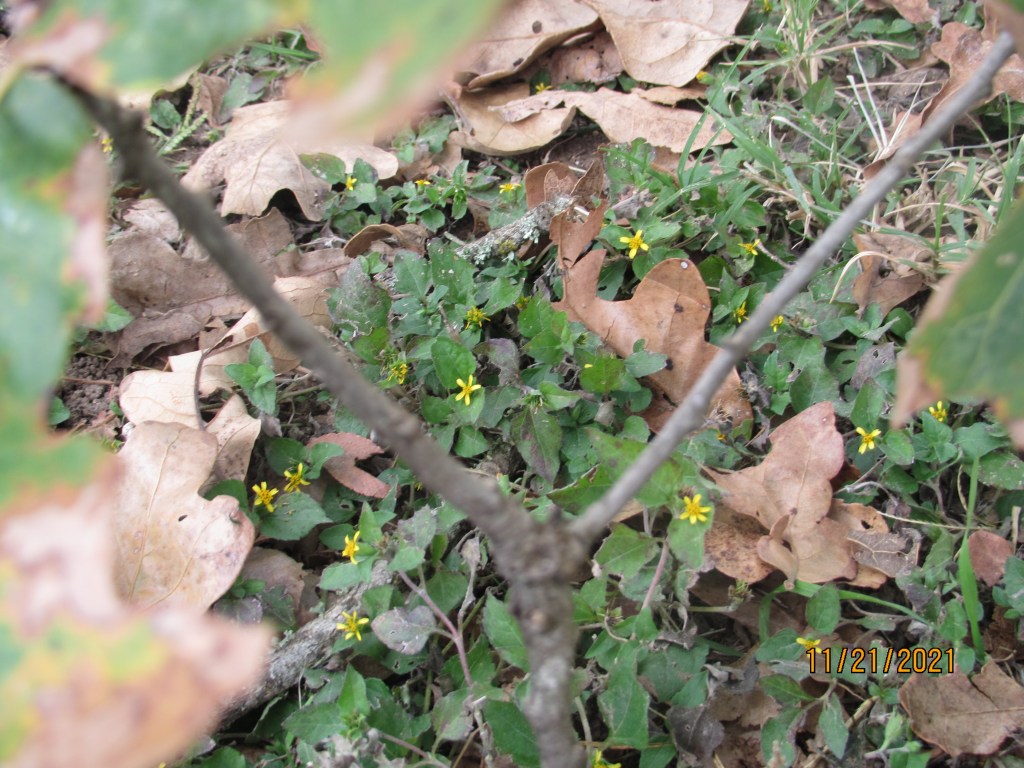
On Sunday, November 21, I discovered that four-year-olds have a natural eye for photographing nature. It started on the Saturday evening before when a friend asked me what I was going to do on Sunday, and I said I was going to go “iNating” at Wilson-Ledbetter Park in Cameron. And she said she and her daughter (the 4-year-old), would like to go with me. 

Vivi and the lady beetle.

Around noon on Sunday, we met at the park. Spring (the friend) had printed a nature scavenger hunt for Vivi (the 4-year-old). The idea was to keep Vivi occupied while learning about nature. It didn’t take Vivi long to find everything pictured except two with the help of Spring. A pinecone was not going to be found at Wilson-Ledbetter, because there is no pine tree there. We didn’t see a squirrel either. 

Wilson-Ledbetter Park bridge

She had been interested in me taking pictures of Birds-eye Speedwells, Straggler Daisies, Santa Maria Feverfew, Docks, and a Black Willow sporting yellow fall leaves. She asked me what each one was, and luckily I knew them – so far. This is when she decided to help me take pictures. Spring tried to divert her by offering her cell phone, but Vivi wanted the camera, and I was willing to share. It’s old and I need a new one, anyway. 

These seeds are not delicious.

After a few times reminding her to keep her fingers from in front of the lens, she had it down. She took a particular interest in holes in the ground, anything that had a “V” shape, because she knows that’s the first letter of her name (and the other letters, too), the blue seeds on an Eastern Cedar (which we had to dissuade her from tasting), Carolina Snailseed, Frostweed (which was still blooming), dandelions, and Lady Beetles, which she could also catch.  She had as difficult a time as I do trying to get some little yellow butterflies to be still for a minute. 

Carolina snailseed

All the pictures shown except for her holding the Seven-spotted Lady Beetle were taken by Vivi. She asked me to tell Santa Claus that she wants a camera for Christmas. I quickly sent the message to Santa. ; )

Donna’s November Garden

by Donna Lewis

Hello everyone,

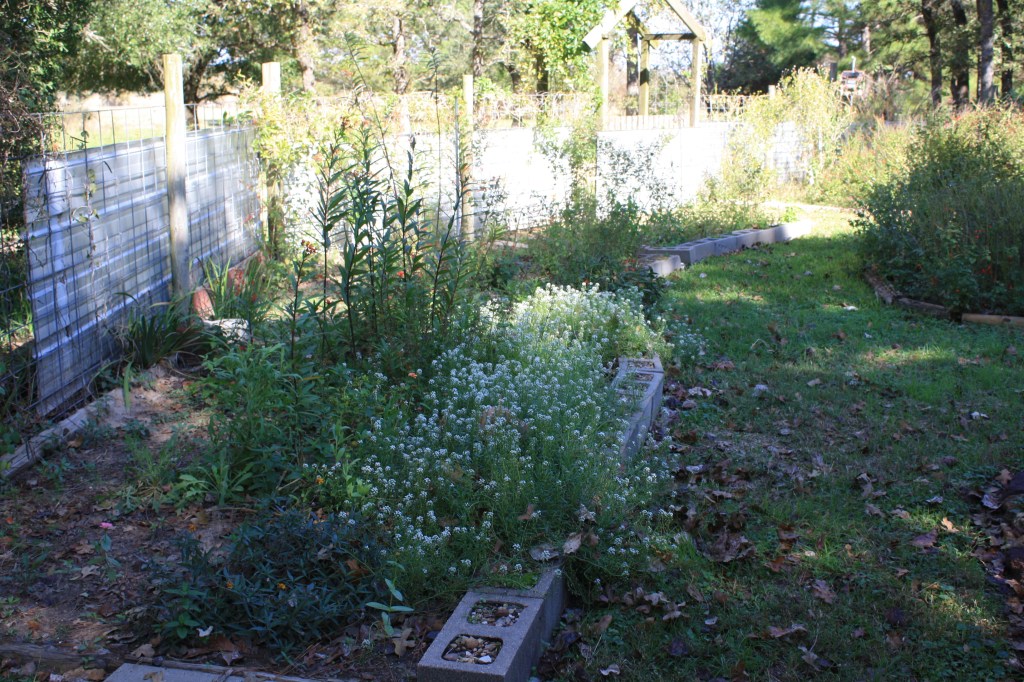
As promised, I am showing you photos of my pollinator garden through all 12 months of 2021. You can get an idea of what changes take place.   

My garden is 95% native plants and trees. That fact has made it more resilient to temperature and other factors making it easier to manage. Even now I have a few Monarchs, Fritillaries, Swallowtails, Sulphurs, and a host of other butterflies.

It is pretty warm in the garden so many plants like Salvia and Blue Mist Flower still have nectar to provide. Today it is cloudy and windy, not a good day for the butterflies to be out and about. The garden also has more shade now because of the location of the sun. Butterflies need sun to warm their bodies. They cannot regulate their own temperature.

The leaves are starting to cover the open areas and the plants. This provides the needed cover to protect living things from chilly weather. I have tree frogs moving around under the vines.  You can find chrysalis of several butterfly species under branches and along the fencing. Yes, it might look messy, but not for the wild things.

As I like to remind all of us who love nature… you must remember who you are gardening for? Look at the garden from the bird and butterflies’ point of view.

Soon it will be time for the winter nap.