Up Close Rat Snake Mating – Wow

By Sue Ann Kendall

There I was yesterday, sitting in my back yard, listening to birds and trying to read a book, when I heard a noise in the adjacent pasture, a few feet away from me. Usually when I hear something it’s one of the cottontails coming out of their den to munch on grass, or the cotton rat family traversing their tunnels along the fence line. Y’all, cotton rats are very cute (and no doubt delicious to hawks).

Hispid cotton rat (Sigmodon hispidus) on my porch

When I turned to look, I saw a massive moving blob. I took a photo of it, in case whatever it was moved away before I could get closer.

Can you see it?

I shouldn’t have worried, because the blob turned out to be two Texas Rat Snakes (Pantherophis obsoletus lindheimeri) (our subspecies of Western Rat Snakes) engaged in their mating rituals. This is one of the most interesting things I ever saw in my life, and I’m no spring chicken and have seen many things!

Texas rat snakes are more colorful than other Western rat snake subspecies.

I took many photos and even a two-minute video, that I hope will upload to this blog so you can watch all the undulations and pulses they go through. You can even see the female’s cloaca.

Yay! It uploaded!

I was spellbound. What a privilege to see this behavior out in the wild, right next to my birding chair (eek).

So pretty.

Being the semi-scientific type that I am, I looked up what I could find out about the mating practices of Texas Rat Snakes. It wasn’t easy, because there was little literature specific to these snakes, and nothing mentioned the bit about putting one’s head in the other one’s mouth that I think I saw.

rat snakes
What’s going on here?

However, I did learn that rat snakes mate in May and early June, making this prime time to enjoy the spectacle. Male rat snakes have a two-pronged penis (hemipenis) that is inserted into the female’s cloaca to deposit sperm. They spend a lot of time coiled together (up to an hour), though not all of the time is actually mating. I guess it’s a good time for all.

I was glad to see both heads looking fine.

Texas Rat Snakes lay 10-12 eggs 5 weeks after mating, and they hatch in early fall, which is, not coincidentally, when I tend to see many baby rat snakes.

This one just ate one of my eggs.

On my property we have quite a few of these snakes, which eat many of our pesky rodents, and many of my chicken eggs. I found a shed skin in my chicken house that was taller than me (I’m 5’2”) which makes sense, because rat snakes are the longest snake found in North America (up to eight feet, though Texas rat snakes usually top out a bit smaller).
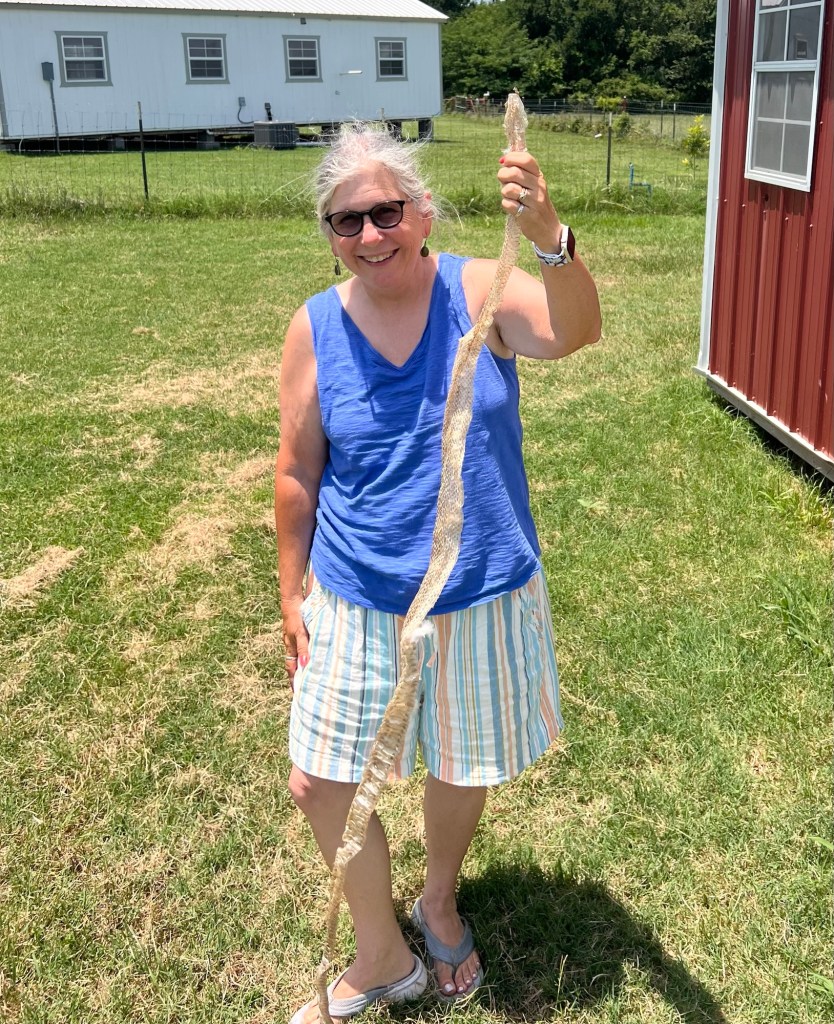
Ignore my hair and look at the snakeskin! Photo by Asphalt.

They are constrictors, so that’s how they subdue small mammals before eating them. They will eat pretty much whatever animal they find. Their predators are hawks, especially Red-tailed Hawks, and where they have them, minks. I don’t think we have minks in Milam County, so that’s one less thing for the snakes to look out for.

Checking the hen house.

I really enjoy observing these snakes and consider any eggs they eat to be payment for mouse patrol. Note that they are great at climbing, and it’s fun to watch them climb walls. In fact, when we kept one as a pet for a few years, its name was Climber.

Climbing

By the way, this is prime snake season. I saw two plain-bellied water snakes today, on the Walker’s Creek bridge and in Walker’s Creek, north of Cameron, Texas. My friend Pamela found one at her house in a bucket of water, too. They are non-venomous snakes, like the rat snakes, so I just watch them and let them do their thing.

Resources

Pantherophis obsoletus – Wikipedia

Texas Rat Snake – Wikipedia
My New Friend the Water Snake Returned

by Donna Lewis

Well since I wrote about the yellowbelly water snake eating my toad friend, it returned.

I thought it had left since it had eaten my little friend.  Sadly, it liked the hole the toad had wallered out and decided that it would take up residence there.

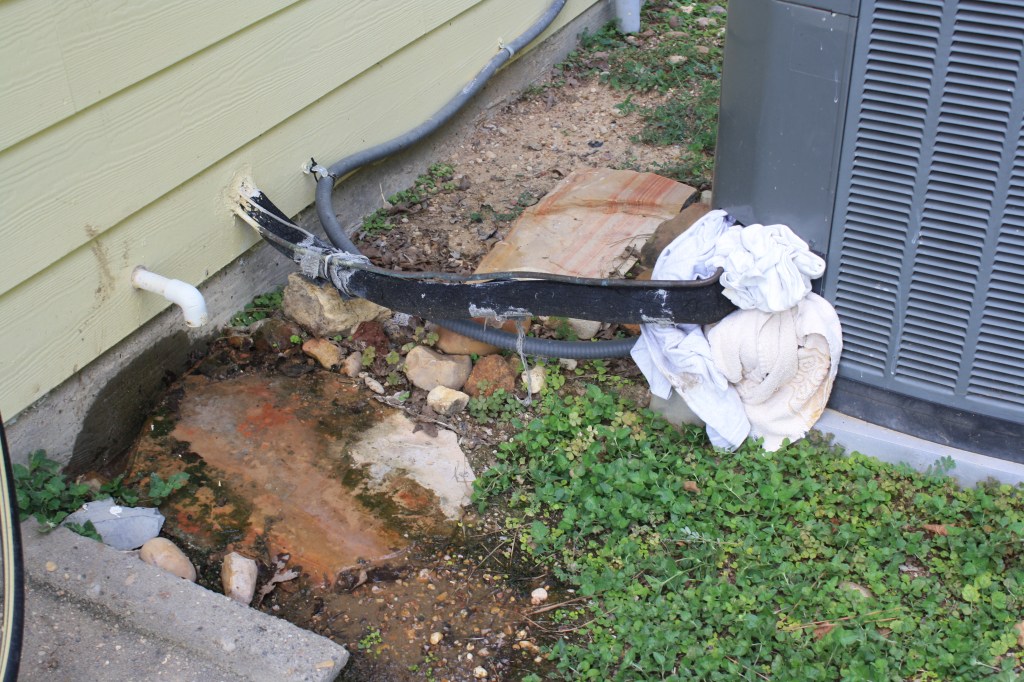
Hole, before filling in

So, now I could see its head poking out the hole under the water faucet every time I used the hose. All I could think about was it might be a girl and she would have her babies there. Not a good thing.   

I didn’t want to hurt it, but it needed to go back to our woods, where the pond is. My Linda also said it must go. She would have been happy to get the shotgun and blast away. I could not let that happen.

So, all I could think to do was to remove the little area under the faucet and fill it in. Of course, the snake was in the hole while I got started. How exciting.

Tools are ready!

I put on my snake leggings, just in case it wanted to bite me. Then I got everything I might need to do this task.  I got a hoe, shovel, dirt, and some rocks and put them close to the area.

Protection

Then, I lifted the flat rock that I placed there to keep the water from making a hole.  As soon as I lifted it, Mr. or Mrs. Snake came flying out and lunged at me. 

I had the shovel, so I flipped the snake away and started trying to scare it. I kept moving towards it and flipping it about five feet away. It actually was bucking in the air!  It was both terrifying and funny at the same time. 

At last, the snake finally decided I meant business and took off across the pasture.  Yes!

I quickly dug out the hole and then filled it in with all the stuff I had assembled. This was last week, and so far no snake.

All covered up

Who would believe this, but it’s true. No snake was hurt during this adventure.

What’s in the Hole?

by Donna Lewis

Early in the morning on Saturday, August 14, I was looking for my friend the Gulf Coast Toad that I say hi to on most mornings.  She is a big girl that lives under the faucet where I had put a flat rock for her to hollow out her house. It is always damp so she likes it there.

I like frogs and toads. They are gentle and sweet. I didn’t see her pop her head out to see me this morning. Instead another head with a yellow mouth outline looked up at me. Oh no, I think something got my friend, I thought. 

I could only see about an inch of its head. It looked like a lizard of some kind. Well, I am not afraid of lizards so I decided to take a photo of it.  You can see the first photo I took, before anyone poked their head out.

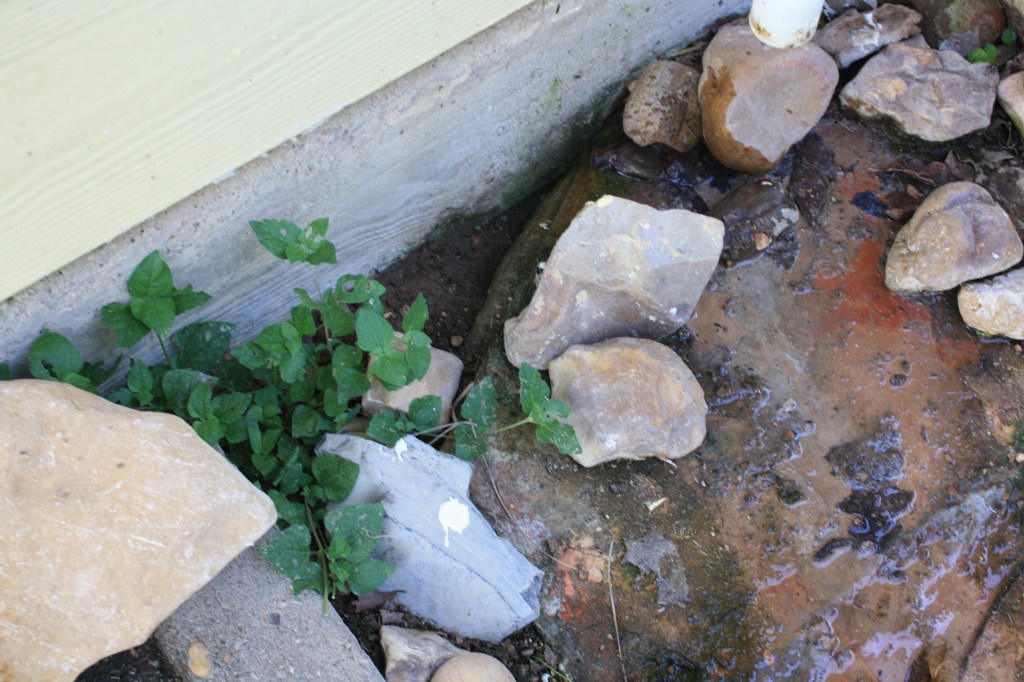
The hole under discussion

So I tossed a little rock in the hole to encourage it to come out for me so I could take a photo.  I leaned down pretty close to the hole. Woo boy!!! Something came out alright, but it wasn’t a lizard. 

You don’t see any second photo because I jumped back as fast as I could. It was a black snake with a yellow mouth and belly. It shot out that hole and came at me really fast!! 

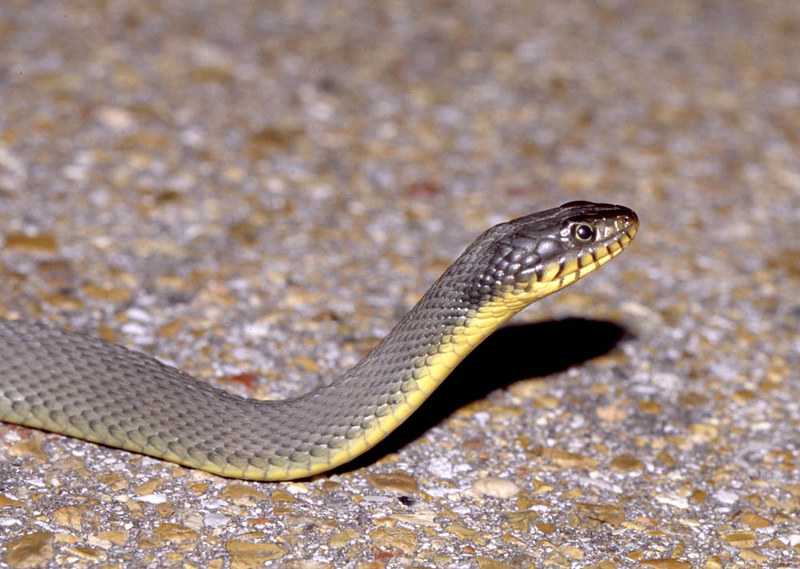
Donna asked Suna to find a picture for her, so here’s one from iNaturalist, © tom spinker, used with permission.

I must admit it scared me.  I am surprised I could move that fast. After looking through my snake guide I learned that it was a Yellowbelly (or plain belly), a non venomous water snake.  The guide also said it was a vigorous biter. I am glad I didn’t find out how vigorous.

So, I am sad about my toad friend…life outside.

Don’t Tread on Me

by Donna Lewis

I decided to go look at our pond to see if the water level had come up. I took my camera in case I saw something interesting. And lo and behold, there was a gorgeous Red Admiral butterfly nectaring on an elm tree just off the pond area. 

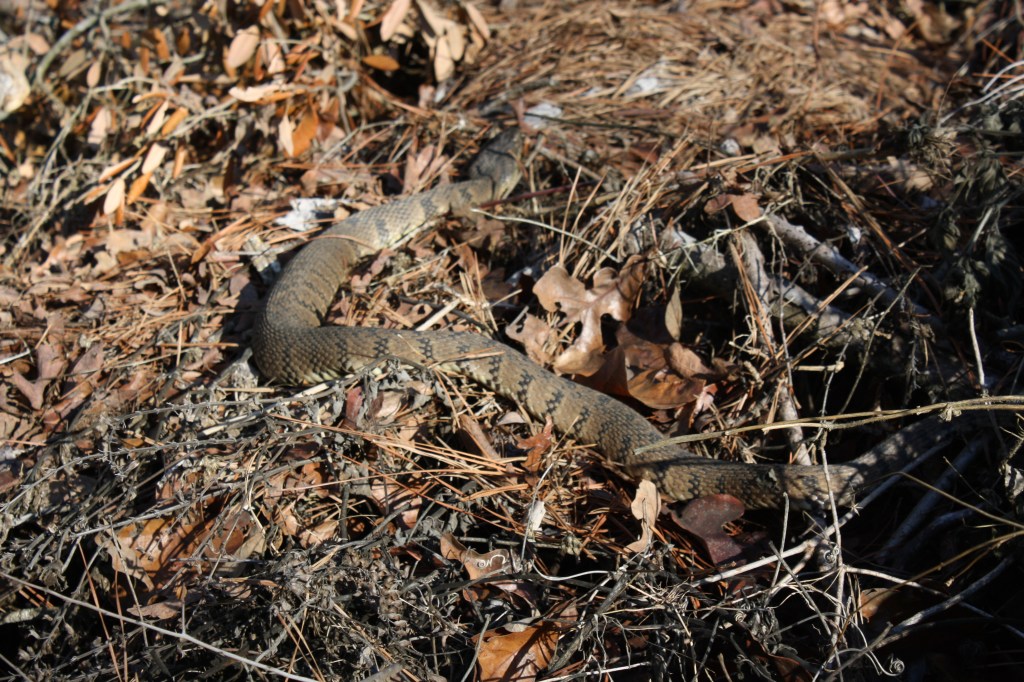
So I very slowly worked my way around the tree near a ravine and stopped in front of a pile of limbs.  Just as I looked down at my footing I just about had a stroke!!!  Probably 24 inches from my hands holding the camera was a large snake lying on top of the limbs. It was fat, oily, and waiting for a meal… 

Large, oily, and waiting for a meal, says Donna.

I am not scared of most snakes, but when you are not expecting one, it can be scary! Luckily I was able to get a photo before I slowly backed away and went on my way.

As soon as I got back to the house I started trying to identify this snake. I had not seen this particular one before. I find it hard to look at a guide book to correctly identify a snake. So, I sent the photo off to Dr. Crump ( TPWD Herpetologist ) and our own Linda Jo Conn(the celebrated iNaturalist expert) to find out what it was.

Dr. Crump responded really fast and informed me that it is a diamondback water snake. Its scientific name is Nerodia rhombifera rhombifera.  Gotta love these long names.

So this baby is a water snake and has an extraordinary ability to stink! They call that a musking ability, but you know what I mean. Thank goodness it is a non-venomous snake, but it will bite if threatened. It likes to eat frogs and carrion. Oh my.

I won’t be trying to pick it up anytime soon. It’s hard to say who would be more frightened, the snake or the human? Live and let live, I always say! All creatures have their place in nature.

As the sun set later on, I said goodbye to my new friend, and hoped he went to visit someone else.