Up Close Rat Snake Mating – Wow

By Sue Ann Kendall

There I was yesterday, sitting in my back yard, listening to birds and trying to read a book, when I heard a noise in the adjacent pasture, a few feet away from me. Usually when I hear something it’s one of the cottontails coming out of their den to munch on grass, or the cotton rat family traversing their tunnels along the fence line. Y’all, cotton rats are very cute (and no doubt delicious to hawks).

Hispid cotton rat (Sigmodon hispidus) on my porch

When I turned to look, I saw a massive moving blob. I took a photo of it, in case whatever it was moved away before I could get closer.

Can you see it?

I shouldn’t have worried, because the blob turned out to be two Texas Rat Snakes (Pantherophis obsoletus lindheimeri) (our subspecies of Western Rat Snakes) engaged in their mating rituals. This is one of the most interesting things I ever saw in my life, and I’m no spring chicken and have seen many things!

Texas rat snakes are more colorful than other Western rat snake subspecies.

I took many photos and even a two-minute video, that I hope will upload to this blog so you can watch all the undulations and pulses they go through. You can even see the female’s cloaca.

Yay! It uploaded!

I was spellbound. What a privilege to see this behavior out in the wild, right next to my birding chair (eek).

So pretty.

Being the semi-scientific type that I am, I looked up what I could find out about the mating practices of Texas Rat Snakes. It wasn’t easy, because there was little literature specific to these snakes, and nothing mentioned the bit about putting one’s head in the other one’s mouth that I think I saw.

rat snakes
What’s going on here?

However, I did learn that rat snakes mate in May and early June, making this prime time to enjoy the spectacle. Male rat snakes have a two-pronged penis (hemipenis) that is inserted into the female’s cloaca to deposit sperm. They spend a lot of time coiled together (up to an hour), though not all of the time is actually mating. I guess it’s a good time for all.

I was glad to see both heads looking fine.

Texas Rat Snakes lay 10-12 eggs 5 weeks after mating, and they hatch in early fall, which is, not coincidentally, when I tend to see many baby rat snakes.

This one just ate one of my eggs.

On my property we have quite a few of these snakes, which eat many of our pesky rodents, and many of my chicken eggs. I found a shed skin in my chicken house that was taller than me (I’m 5’2”) which makes sense, because rat snakes are the longest snake found in North America (up to eight feet, though Texas rat snakes usually top out a bit smaller).
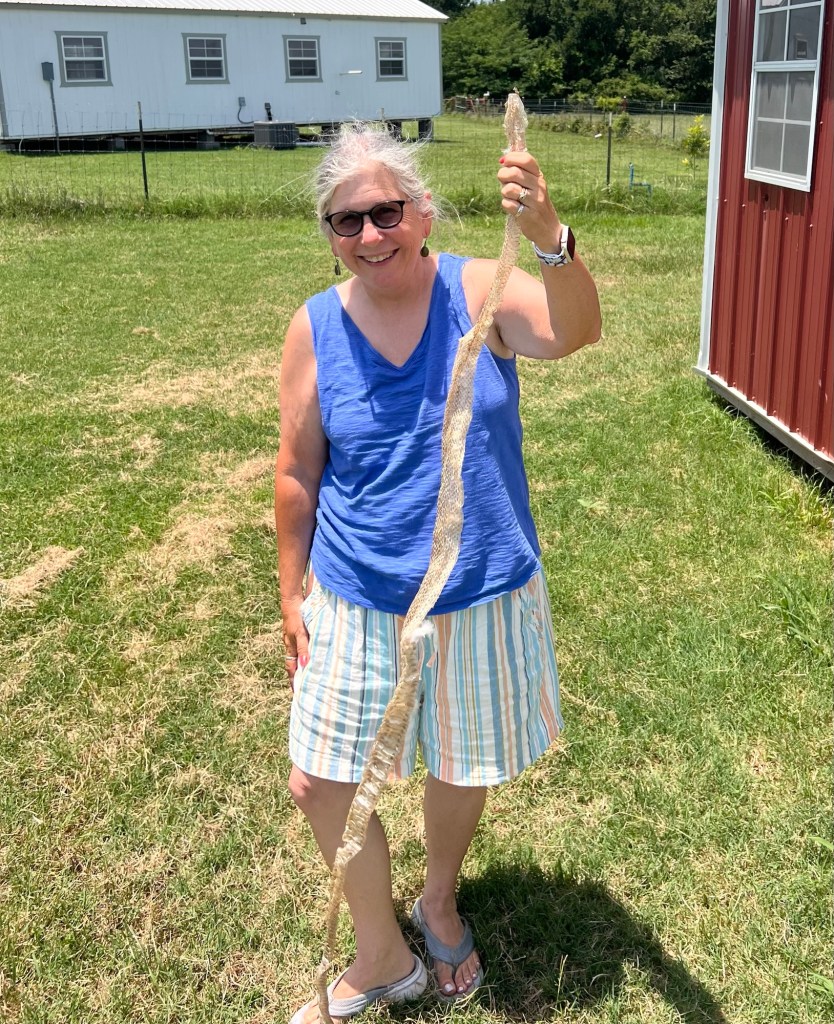
Ignore my hair and look at the snakeskin! Photo by Asphalt.

They are constrictors, so that’s how they subdue small mammals before eating them. They will eat pretty much whatever animal they find. Their predators are hawks, especially Red-tailed Hawks, and where they have them, minks. I don’t think we have minks in Milam County, so that’s one less thing for the snakes to look out for.

Checking the hen house.

I really enjoy observing these snakes and consider any eggs they eat to be payment for mouse patrol. Note that they are great at climbing, and it’s fun to watch them climb walls. In fact, when we kept one as a pet for a few years, its name was Climber.

Climbing

By the way, this is prime snake season. I saw two plain-bellied water snakes today, on the Walker’s Creek bridge and in Walker’s Creek, north of Cameron, Texas. My friend Pamela found one at her house in a bucket of water, too. They are non-venomous snakes, like the rat snakes, so I just watch them and let them do their thing.

Resources

Pantherophis obsoletus – Wikipedia

Texas Rat Snake – Wikipedia

Water Moccasin Alert

by Pamela Neeley

As usual, I was walking around the outside of the house checking flower bed for upcoming Spring cleaning, and I was wearing capris, flip-flops and no gloves. My friend pulled me back while saying, “Snake!”

Big, fat, black water Moccasin was right in front of me, but heading away from us. (Solid color usually indicates mature snake. Patterns refer to young or juveniles. ID can be confusing because of the patterns.)

A cottonmouth adult

 It’s been awhile since I’d spotted a viper. I used my single-shot shotgun and missed at less than 6 feet (?) and I couldn’t remember how to release the safety on the other.  So, I called my neighbor, who was at home, and asked him to dispatch this cottonmouth.  

A juvenile cottonmoutn

One shot from his pistol. He says he keeps snake shot handy just for me! I believe this.

I hung it on the fence, to alert other snakes. Legend has it that snakes will continue moving until sundown.I don’t know. It wasn’t on the fence when I looked. I didn’t go search for a moving, dead snake, either.

AI made this pretty version.

Cautionary tale: It is Spring and suddenly moist. The frogs are back. Cottonmouths, or water moccasins, are very nasty-tempered poisonous vipers. It will stand its ground, and possibly move toward you if you disturb it. They will try to stare you down, and possibly chase you – not a myth.  Both on land and in the water.

The frogs have returned and are a favorite food. Flowerbeds often have mulch.  Texas is famous for drought. The cement slab houses have to be kept moist around the base, about 18″ from base of house, and create a perfect environment for meal-seeking snakes.

Wear protective clothing.  Review use of firearms. Although poisonous, infection is common because their mouths are nasty and full of exotic bacteria, etc.

There is a viper antivenom,  CroFab antivenom (Wikipedia). I do not know if local medical facilities have this in stock.

A Summer’s Day in Late October

by Donna Lewis

Yesterday ( 10-23-2024) , I went outside to be with nature and take a few photos. It’s so hot I thought it was a summer’s day.

I took photos of some Goldenrod, a favorite of some butterflies, including the Monarch.

Next was an Armadillo, which should have been laid up somewhere in the shade.

Then there was a Black Water Snake near a bird feeder. They are non-venomous.

And last one of my bird baths with lots of native honey bees getting water for their family.

I also saw, but was not fast enough to take photos of, an American Kestrel, A Ruby-throated Hummingbird, and a single Monarch butterfly.

All in a one hour period in the morning here in Central Texas. We are so lucky to see these things.

Let us hope that all of us humans keep them safe for the next generation to enjoy.

Toad Rescue

By Pamela Neeley

Thanks to the cautious behavior of my cat, Apollo, I interrupted the swallowing of the largest toad ever!

Apollo spots the problem.

The black snake was having trouble swallowing the toad because it was so large. I had to choose between my camera and using a stick to annoy the snake. I poked the snake with the handle of broom I had in my hand. It released toad.

There was a bad smell and it curled and headed my way. I maneuvered away! At last the black snake went the other way.

Thanks for saving me!

I placed the toad in a water dish while I settled my nerves. The photos are of the toad in the water feature and in the last, I imagine he’s smiling at me.  

I get to live to croak again.

Once I got back in the house (this had occurred at the back door) I looked up the snake, and I’m pretty sure it is a western cottonmouth.* I’m glad I didn’t know that earlier or the toad would be dead.

Cottonmouth photo by Railprof on iNaturalist — many are much darker than this.

The snake was large, black, thick, and with a skinny short ending to its tail. It also had a musky smell. It did want to escape. I only had an Asian broom but it worked.

The cat was no further help.


*Actually most of the observations in Milam County come up as northern cottonmouths, so who knows? (Inserted by curious editor)

Take Care for Snakes

by Joyce Conner and Donna Lewis

If you have been paying attention lately in your garden or yard, you probably will have noticed that our friends, the snakes are back.

They are out grocery shopping for lizards, frogs, birds, eggs, and other small mammals. Humans are NOT on the list, but they will bite us if we scare them or step on them. Can you blame them?

So, when you move leaves around or pull weeds, you need to be observant.

Sticking your hand down into the brush might not be so smart. (Wasps might not like us to disturb them either, so beware of their bites and stings too!)

Texas Rat Snakes, Broad-Banded Copperheads, and Western Cottonmouths are the main ones out on our properties, so you probably have them too.

There are many more Texas Snakes in Central Texas, but these are the recently observed species.

Most people are really afraid of snakes. But, they serve a purpose in nature as all wild things do. As they go about their business of finding food, reproducing, protecting themselves from their enemies, and maintaining a comfortable body temperature, they are no different from any of the other wild animals on this planet. And, as a member contributing to the cycle of life on earth, they play an important role in maintaining balance. Without snakes, we would have an overabundance of insects, rodents, amphibians, etc.

Almost all snakes are docile and will not bite unless provoked. We just have to remember that “provoking” them may be no more than walking/reaching too near where they are lying in wait for a lizard to come by.

Yes, the snakes are definitely out of their dens and enjoying the change in weather!

On Wednesday, April 24, Joyce and Mike dealt with two snakes that same day. First, a rat snake was found in the chicken coop.

Here Joyce is taking the Texas Rat Snake out of a nesting box. Notice the black blotchy purplish pattern on its back in the second picture. Rat snakes are not venomous but can bite. Use caution when handling them.

According to Texas Snakes: A Field Guide by James R. Dixon and John E. Werler, the Texas Rat Snake is one of Texas’ longest snakes. Most adults measure between 42 and 72 inches. It is found in brushy and wooden areas and can easily climb trees. After checking out its length, Joyce put it in a bucket and released it at one of the ponds away from the house.

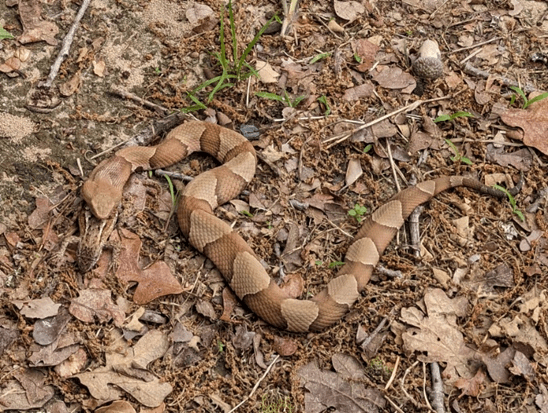
Later that same day, Mike nearly stepped on a copperhead just off the porch. According to Texas Snakes, the Broad-Banded Copperhead “is marked with wide, reddish brown crossbands that alternate with narrower tan to pale brown interspaces.” The adult grows to usually 30 inches long.

This one appeared to be young (they can live up to 18 years) and short (we estimated around 2 feet). It blended in nicely with the dead leaves and dirt. While Joyce photographed, it stayed completely still. Until she reviewed her first photos, she didn’t notice that it had stunned a lizard.

Each time the copperhead was checked, the lizard was a little less visible, as it was being swallowed whole.

After a while, the lizard had completely disappeared inside the snake.

Mike and Joyce do not handle venomous snakes and do not recommend anyone doing so unless well trained and outfitted with special snake-catching equipment.

When checked later, the copperhead was no longer found around the porch.

However, the next day, Mike and grandson Bryce saw a long rat snake in another area of the yard. Joyce wonders whether it could be the same snake she took away from the house the day before. Snakes can find their way back to an area by smell. Since Joyce is the snake wrangler at the preserve and she wasn’t around, the boys were unable to catch and release it that day. But no worry – if it goes into the chicken coop, Joyce will catch and release it elsewhere!