Fighting the Invaders in The Mini Wildscape

By Carolyn Henderson

A small but intrepid group took on the fight of the non-native, invasive plants in the Wildscape – again. Chad Cryer, Alan Rudd, Liz Lewis, Phyllis Sheffield, Pamela Neeley and I implemented a new method to attempt to get rid of the seriously invasive persimmons and Tree of Heavens. 

Small but mighty

I would call it isolated poisoning. Chad clipped the multitude of pomegranate trees, many that had managed to reach at least 5 to 6 feet this season. Alan then put a tree poison only on the cut limbs.  We cut them back in February. Alan had already done it to the Tree of Heavens that weren’t as numerous. 
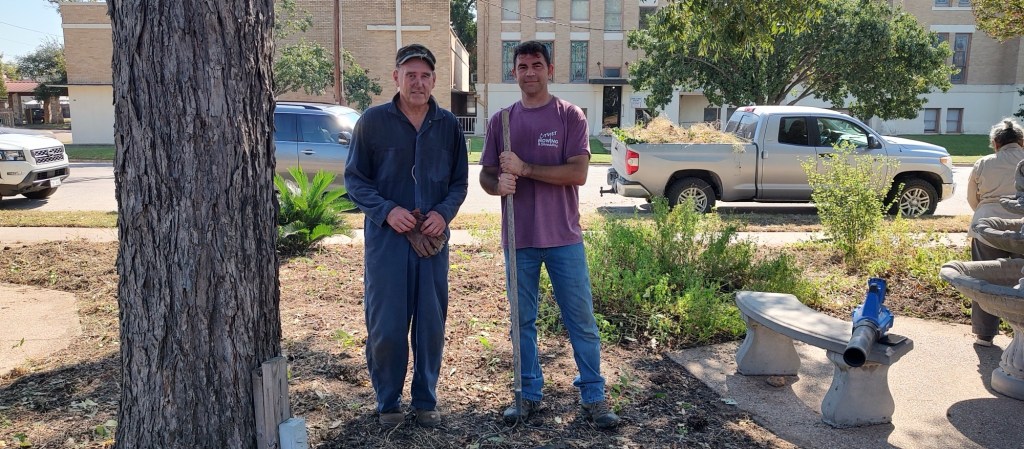
The invasives elimination committee.

We put all the limbs in Alan’s pickup bed. The pile stood taller than the truck cab. 

We also fought off the Tievine that had totally covered the Gulf Muhly grass among other things. We also removed the other invasives in the Wildscape. A good deal of what had been planted was there, but scraggly looking from being overshadowed by all of those. It knocked out a few completely. 

The weeding committee

We vowed to be back in two weeks to evaluate our efforts. 

Fight of the Invasives to Continue at City Wildscape

By Carolyn Henderson

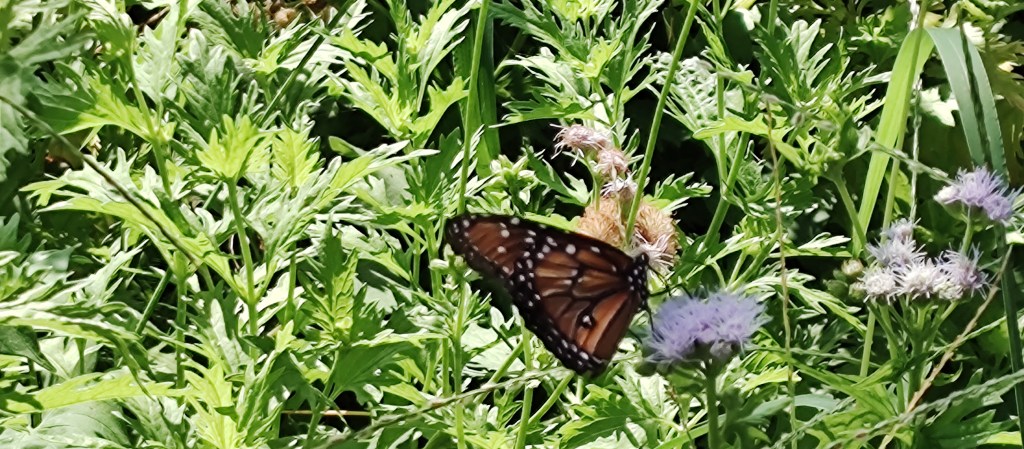
On Saturday morning I took a side trip to the El Camino Real Texas Master Naturalist City Wildscape to find a pleasant surprise in the overgrown mess. Queen butterflies had found the place. I counted about 20 that morning – all on the Gregg’s Mist. That is by far and away the Queens’ favorite nectar producer. 

Not only had the Queens landed, American Bumblebees had also located nectar sources for themselves – mainly the Common Sunflower that planted itself in the city wildscape and reproduced many more this year. 

I also saw Ligated Furrow Bees and Jagged Ambush Bugs. Those are pending identification verifications in iNaturalist. I also saw Oblique Longorn Bees – a second time for a new to me bee. They are very tiny and in near constant motion. All of these were on the Sunflowers.

Other things we planted were in bloom, but they are mostly overwhelmed by the terrible invasive “Tree of Heaven” and the Persimmons. Persimmons have taken over the right half of the wildscape (if you’re looking at it from the street) and the Tree of Heaven, an invasive from China, has the left side. 

I met with the church directors Sunday morning, and they agreed to let us make a last ditch effort to eliminate both of those. Crape Myrtles also are spreading, which are not native to this area either. They have lots of pretty blooms, though. More Queens had arrived.

Alan Rudd has devised a plan to kill these invasives. We believe that we can do it without harming the Pecan tree in the wildscape, but there is no guarantee of that, so we needed approval from the All Saint’s Episcopal Church to do it. They were in agreement, since they also were dealing with the Tree of Heaven in most other parts of their landscape. 

Liz Lewis is having the source of the Tree of Heaven, three trees nearby, removed, too. Otherwise, they’ll just come back. No one knows where the Persimmons came from, but we hope we can get them out, too. 

Once that is done, the wildscape needs weeding. Good for volunteer hours, everyone. 

Viper’s-Bugloss Invades Texas

by Carolyn Henderson

A new invasive plant has made it to Texas. It has only been spotted with verification nine times in the state, and one of them is in Milam County. The other eight are in a small area of Burnet County.

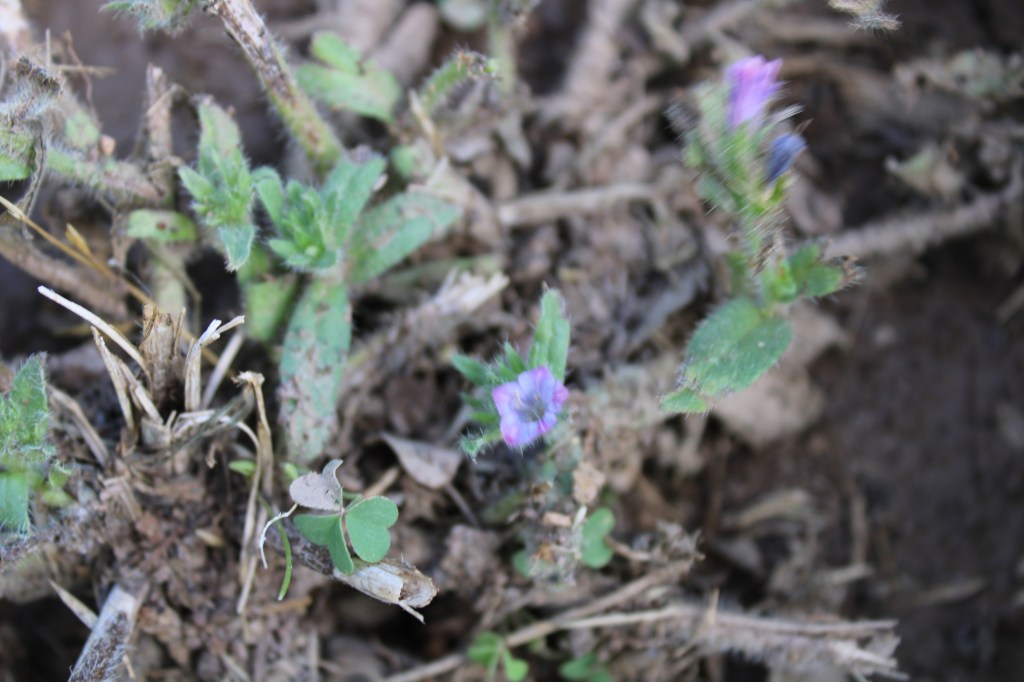
During the field trip to the McCormack Purple Martin conservation place, I took a photo of a flower I had not seen before. Of course I put it on iNaturalist. It got one “favorite”, but it couldn’t be verified as the Viper’s-Bugloss (genus Echium ) I had chosen to identify it. I had noted that I wasn’t sure, but it looked just like it.

My original observation image

Then an iNaturalist ecologist took note of it. He was very concerned about it, and he asked if I would go and take more photos of it for verification purposes. The gentleman has a PhD from the University of Texas and is a retired Wildlife Biologist at Balcones Canyonland NWR.

Mike McCormack said I was welcome to do that. I met him out there last Saturday and we went looking for some. McCormack noted that they had been dying out when I called, so he watered for me where he knew a cluster of them to be growing. They were blooming. The blossoms were smaller than the one I had seen earlier and had different colors.

The ecologist had warned me to wear heavy gloves and not touch them otherwise. They sting severely and cause a rash. You’ll see an ungloved hand in one of the photos. That’s Mike. He had handled them before and he said it wasn’t that bad, but they do cause an uncomfortable rash. I didn’t risk it. Mike said he first noticed them two years ago. He didn’t know their name until now. His theory is that they were transferred here via a pair of Black-bellied Whistling Ducks that were nesting in a tree above the main site of their location. 

I posted several more photos, and the ecologist verified that they are Viper’s-bugloss plants. 

They are native to Europe and temperate Asia. They are used in landscaping in a few European countries. They have been spotted in the northern United States and some other countries that didn’t use to have them.

These plants are actually harmful to horses and cattle because they produce a type of Alkaline that harms their livers. The ecologist recommended strongly that “the plants should be herbicided and dug out, bagged, and disposed of – being very careful not to drop any seeds.”

Years ago in Asia, they were thought to resemble snakes on some parts and were used to treat snake bites. Needless to say, that practice fell by the wayside. If you see any, it’s advised you remove them quickly – wearing heavy gloves.