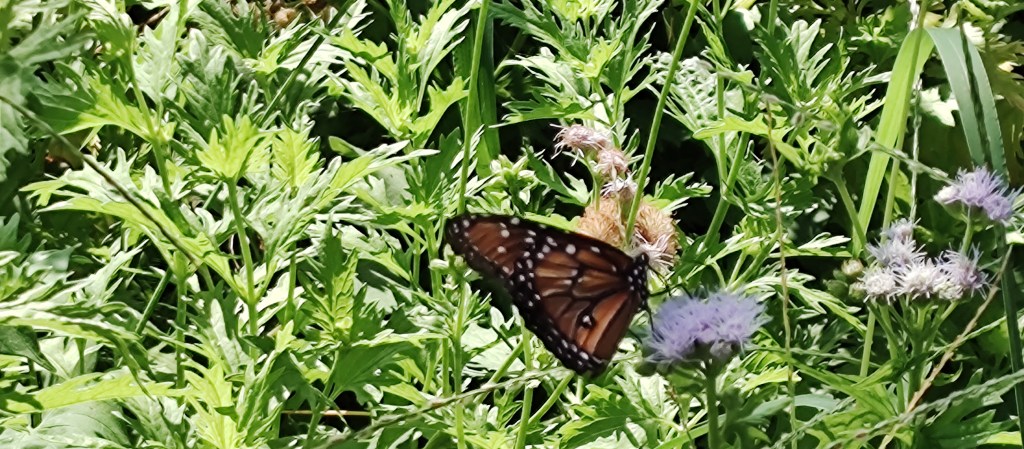
On Saturday morning I took a side trip to the El Camino Real Texas Master Naturalist City Wildscape to find a pleasant surprise in the overgrown mess. Queen butterflies had found the place. I counted about 20 that morning – all on the Gregg’s Mist. That is by far and away the Queens’ favorite nectar producer.
Not only had the Queens landed, American Bumblebees had also located nectar sources for themselves – mainly the Common Sunflower that planted itself in the city wildscape and reproduced many more this year.
I also saw Ligated Furrow Bees and Jagged Ambush Bugs. Those are pending identification verifications in iNaturalist. I also saw Oblique Longorn Bees – a second time for a new to me bee. They are very tiny and in near constant motion. All of these were on the Sunflowers.
Other things we planted were in bloom, but they are mostly overwhelmed by the terrible invasive “Tree of Heaven” and the Persimmons. Persimmons have taken over the right half of the wildscape (if you’re looking at it from the street) and the Tree of Heaven, an invasive from China, has the left side.
I met with the church directors Sunday morning, and they agreed to let us make a last ditch effort to eliminate both of those. Crape Myrtles also are spreading, which are not native to this area either. They have lots of pretty blooms, though. More Queens had arrived.
Alan Rudd has devised a plan to kill these invasives. We believe that we can do it without harming the Pecan tree in the wildscape, but there is no guarantee of that, so we needed approval from the All Saint’s Episcopal Church to do it. They were in agreement, since they also were dealing with the Tree of Heaven in most other parts of their landscape.
Liz Lewis is having the source of the Tree of Heaven, three trees nearby, removed, too. Otherwise, they’ll just come back. No one knows where the Persimmons came from, but we hope we can get them out, too.
Once that is done, the wildscape needs weeding. Good for volunteer hours, everyone.
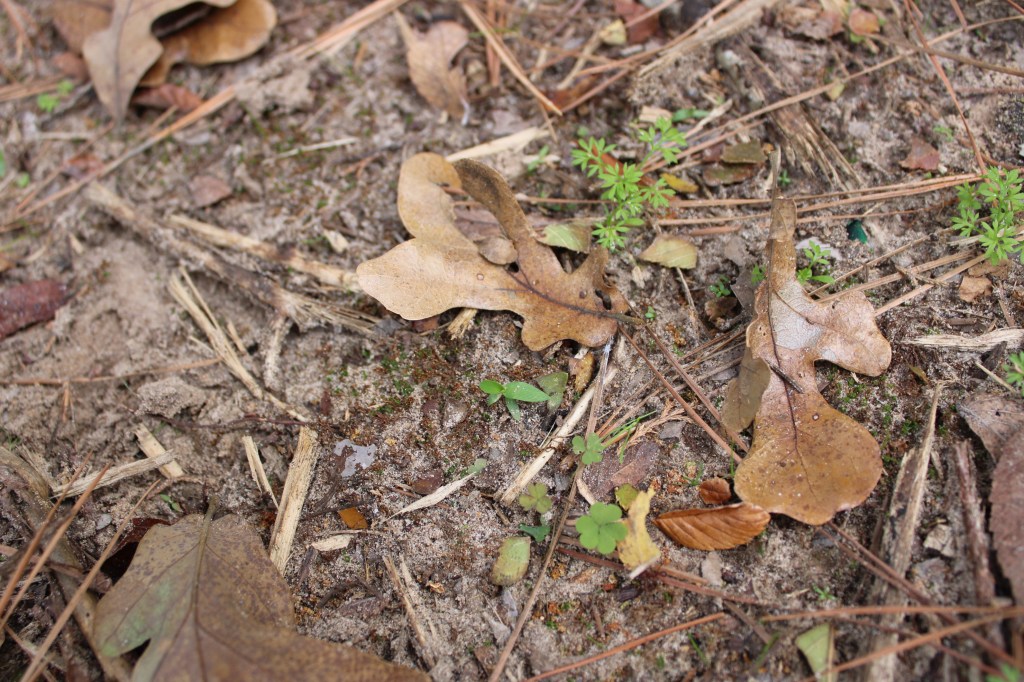
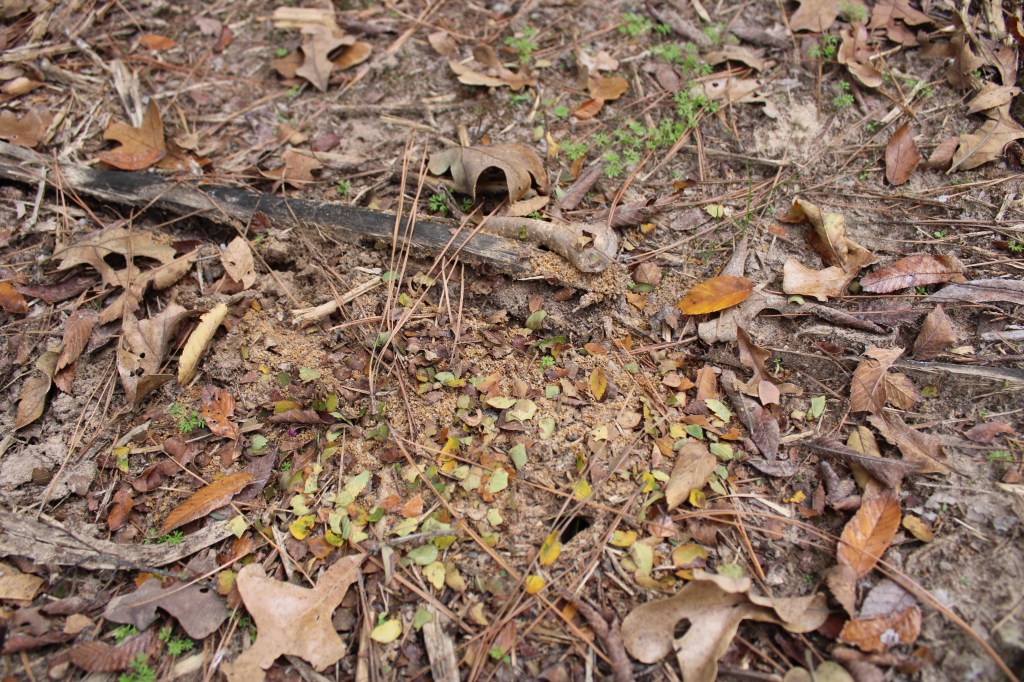
Hello all! As usual, I walked around this week looking at nature on our property. I was in our small, wooded area looking for tracks of various animals. I noticed small bits of leaves moving. Upon closer inspection I saw that the leaves were being carried by Leaf Cutter Ants. I watched them for a while because they were so interesting and amazing.
Can you spot the ants?
You have to be paying attention to notice such activity.
These ants are one of the strongest living things for their size. There are about 40 different species of them. The members in the colony who are responsible for actually cutting the leaves have jaws like chainsaws!
How about here?
Each ant can carry up to 50 times its own body weight. I’d say that’s Olympic medal weight lifting. Their colonies are huge. Each one can house up to 10 million ants.
Another interesting fact is that the ants do not eat the leaves. They make a fungus from them and eat the fungus. Pretty amazing.
These little animals are not too popular with farmers. They strip leaves from plants humans like. But you have to give it to them, they are very resourceful.
I saw a stink bug on Friday. I thought it looked a bit different, so I took some photos. It turned out to be in the Brochymena genus, which I had found before. These have intricate patterns that remind me of Persian rugs. Anyway, it turned out to be B. chelonoides and is a first-in-county observation on iNat. Nearest other observation is in College Station. So, when you walk by something that seems to be ordinary, take a second look. It might not be so ordinary after all. Also, if you go out looking for something with your camera, it may be something you didn’t expect that makes the day special.
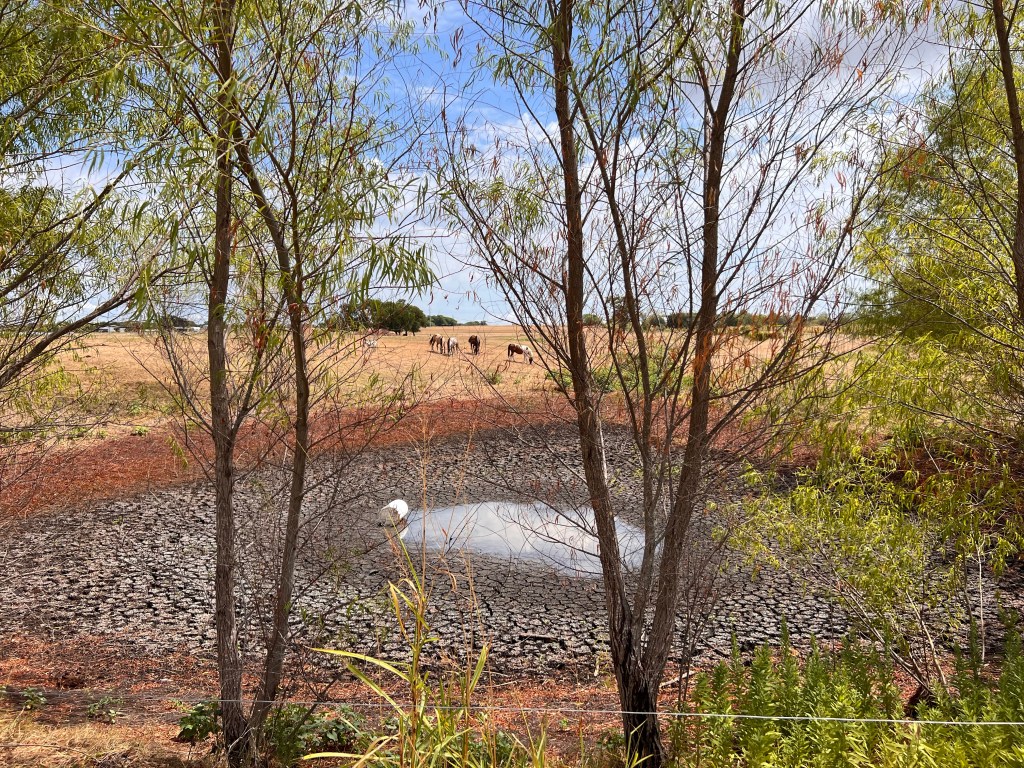
Over here in northern Milam County, we’ve had some rain three days in a row, which has been a welcome relief after pretty much nothing since May. Today there was even a little bit of rain in our front pond (tank in Texan), which had dried up completely as of last week. This was too late for all the fish, who made all the egrets and herons happy as they all died. I assume more will show up.
Last weekAfter the rain
Today I went out around our ranch, the Hermits’ Rest, to see what had made it through the drought. Was anything blooming? What insects are still there?
This made me very happy yesterday.
I can tell you that the bees survived just fine, and you can thank some humble plants for that. The turkey tangle frogfruit (Phyla nodiflora) has not stopped blooming and has formed mats where the grass once was. Bees and wasps are all over it. The other plant that’s attracting so many bees you can hear it from a distance is the scarlet toothcup (Ammannia coccinea). Now, the latter is a bog plant, as is its friend the floating primrose-willow (Ludwigia peploides). We seem to have some kind of springy area that has supported them all summer, to the delight of the flying insects.
FrogfruittoothcupprimroseThe bees’ friends
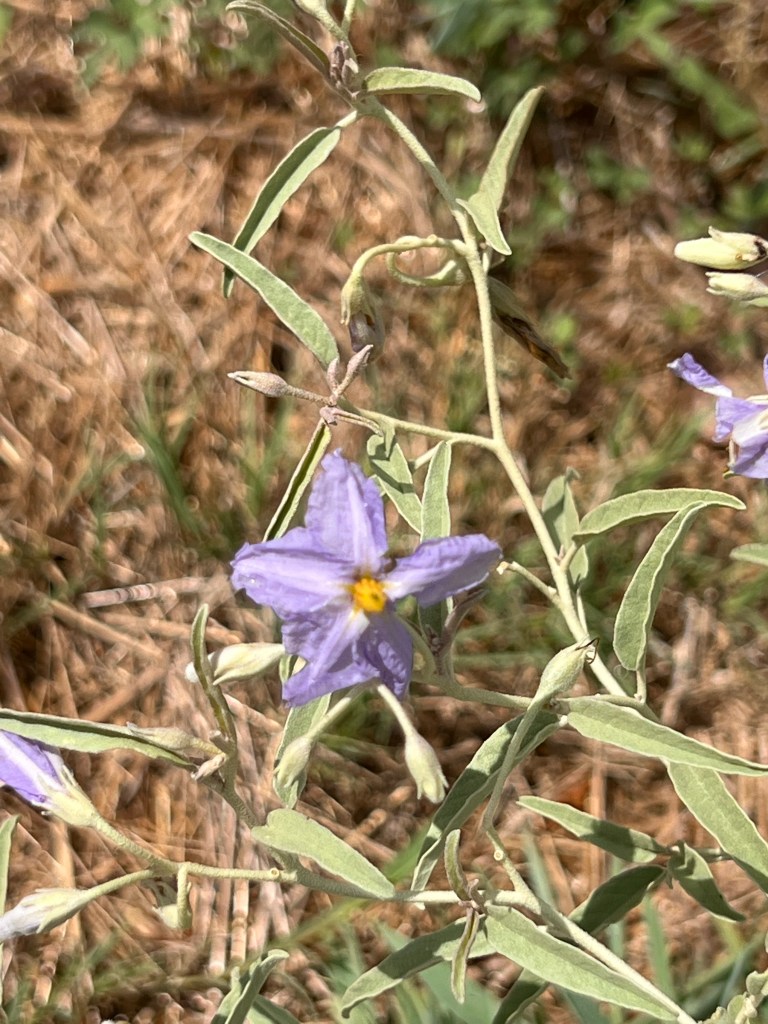
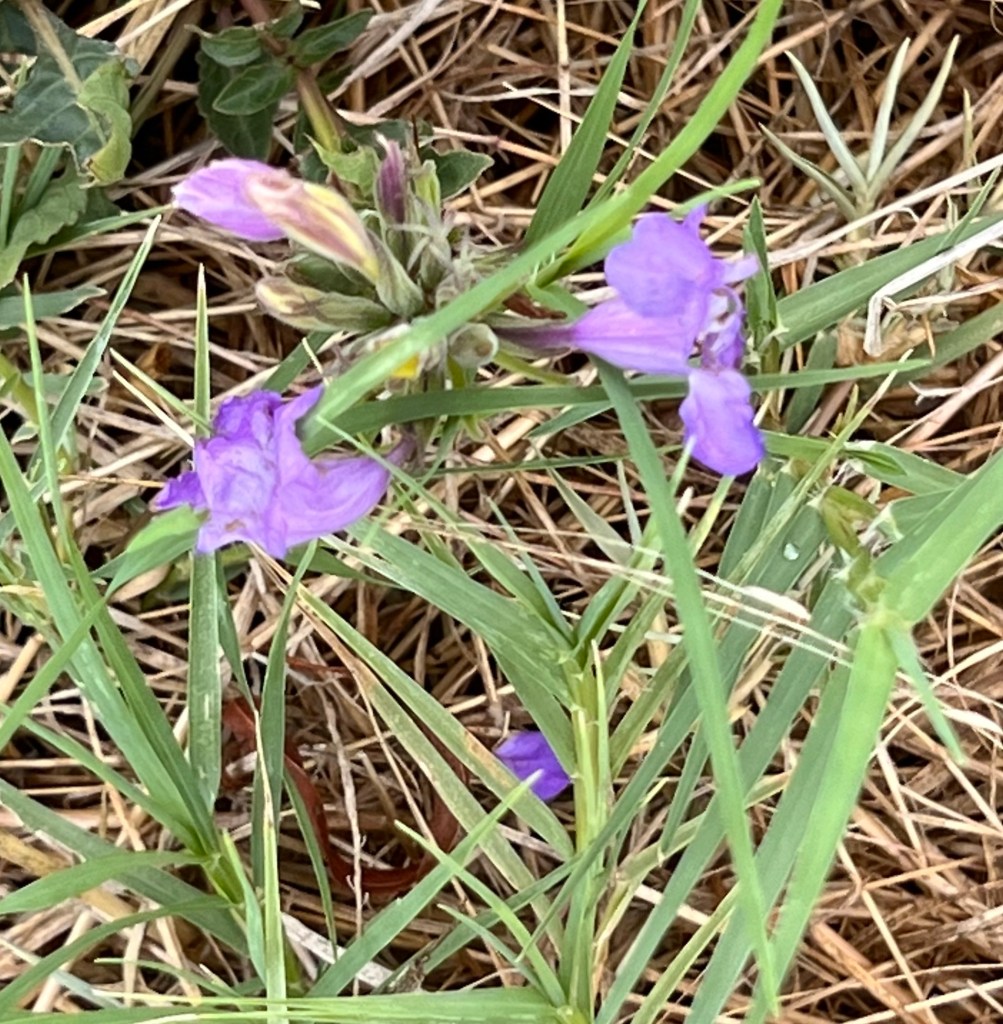
Other plants have been thriving. Of course, the silverleaf nightshade (Solanum elaeagnifolium) is fine. It’s like iron. In fact, some of them have fruit large enough that they look like cherry tomatoes! I wouldn’t eat them, though. I don’t trust anything named “nightshade.” The lesser balloon vine (Cardiospermum halicacabum), which just loves our ranch, is also plugging along happily. There are so many of the vines in the dried-up bed of Walker’s Creek that it smells like a Bed, Bath and Beyond store! I had no idea how fragrant those tiny flowers were until I encountered thousands of them in a confined space! The other thriving plant is the violet ruellia (Ruellia nudiflora), which is having a great year, according to Linda Jo Conn, our iNaturalist approval maven. One of our rental houses seems to have a purple carpet in the yard. Way to go, little flowers!
nightshadeballoon vineruellia (eaten by grasshoppers)
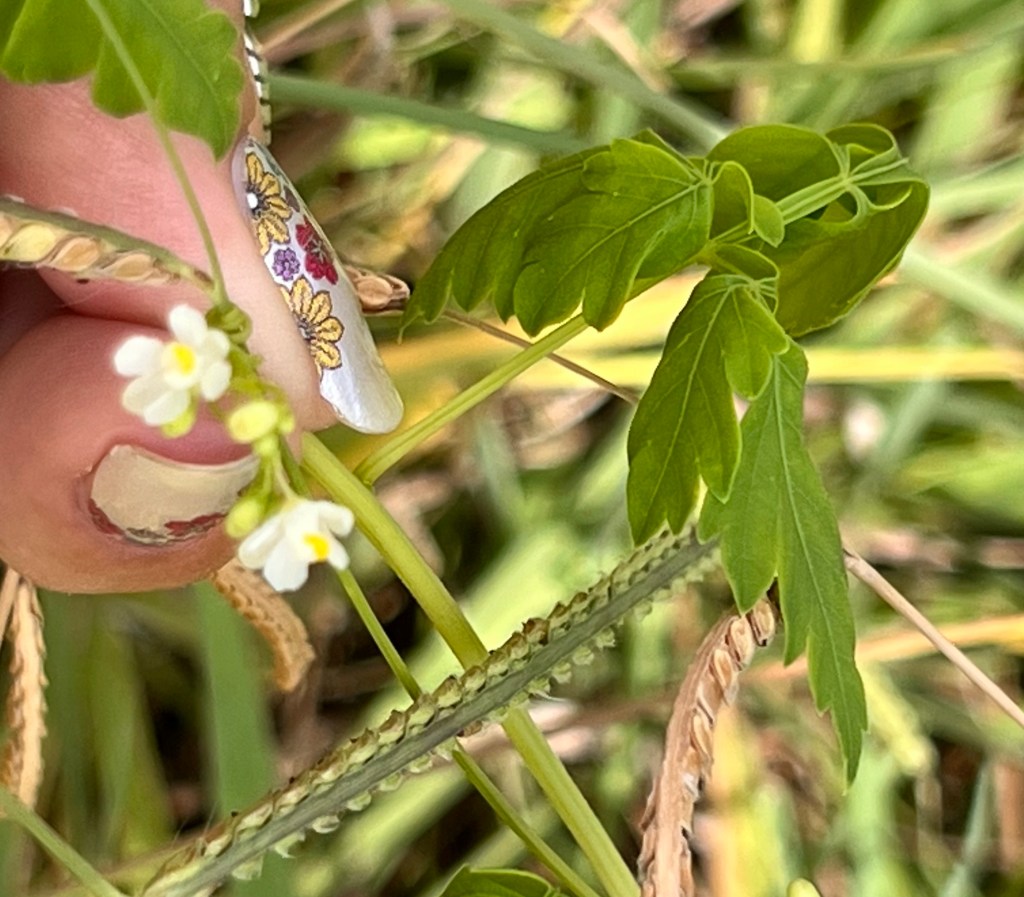
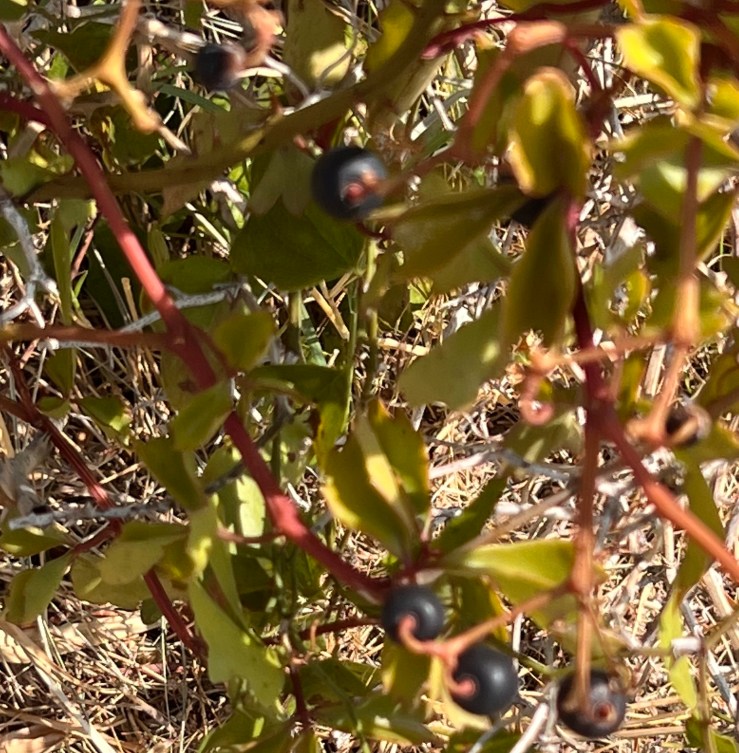
One more happy vine is the sorrelvine (Cissus trifolioata), which is more numerous than the smilax this year. It has some healthy-looking fruit, which I learned just this year is related to the grapes (none of which fruited here this year).
Blurry, but you get the idea
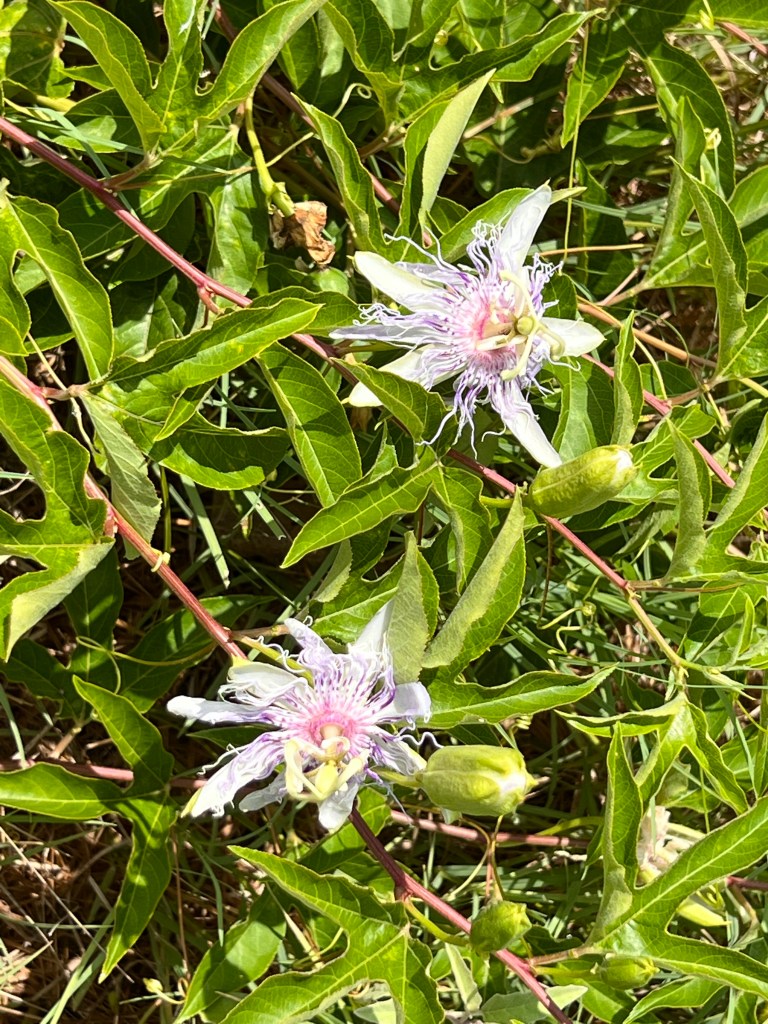
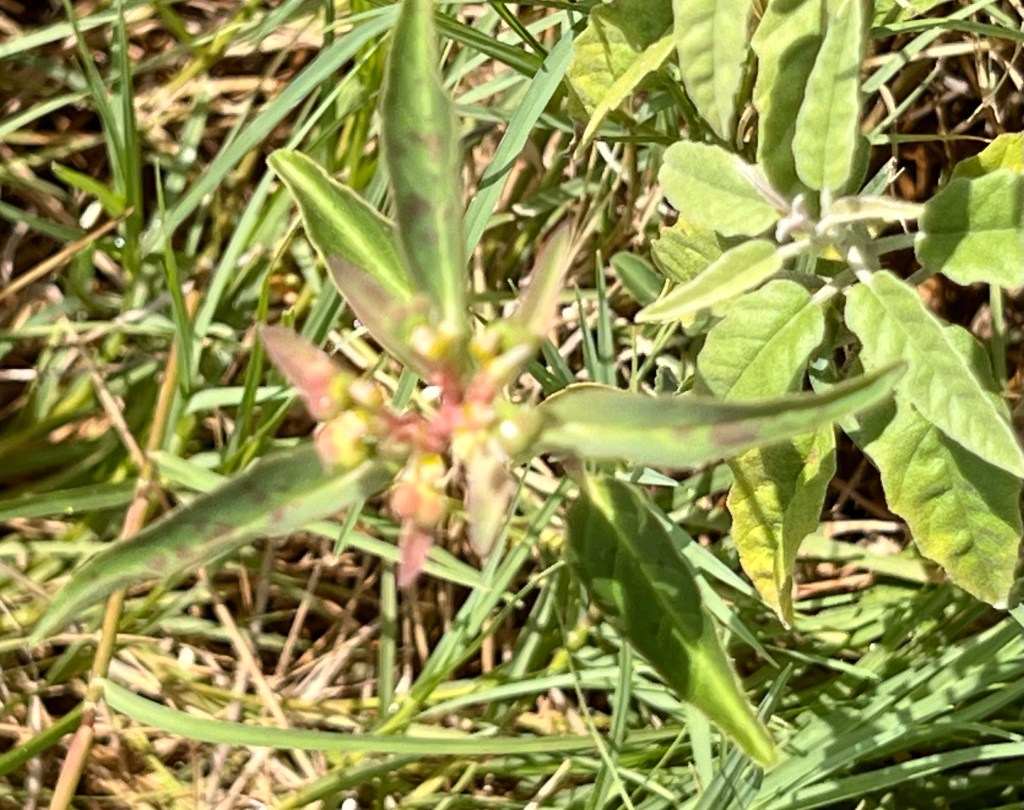
A few of our usual summer stalwarts are barely hanging on, though. There are many passion vines, but the flowers were looking pretty straggly until after the rain. They finally look normal. I have found one sad little Texas bindweed (Concolvulus equitans), a couple of prairie coneflowers/Mexican hats (Ratbida columnfera) (my photo is too blurry to share), a few velvetweed (Oenothera curtiflora), and sparse Lindheier’s doveweed (Croton lindheimeri) (it’s usually everywhere – in fact, my chickens had a tree version last year by the time it got cold). And there’s vervain (Verbena halei) and green poinsettia (the native one Euphorbia dentata).
passion vinebindweeddoveweed, with water dropletsvelvetweedvervainpoinsettia (poorly focused)
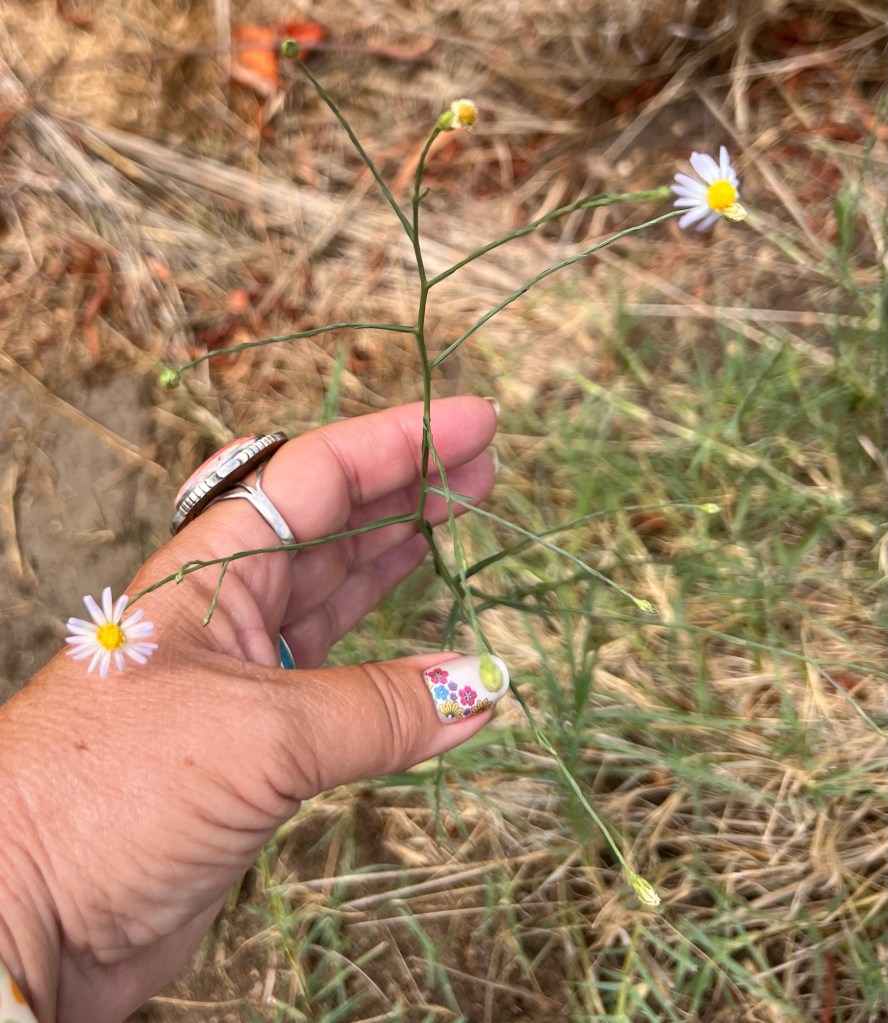
Two plants are here in large numbers, but I didn’t recognize them at first. The asters (Synphyotrichum sp.) and the broomweed (Amphiachris dracunculoides) have had all their foliage eaten by the eight gazillion grasshoppers of the season, so it wasn’t until I found a few sad little blossoms that I realized what they were. Yes, it was a fine year for differential grasshoppers, obscure bird grasshoppers, and prairie boopies (look them up, I’m tired of typing in Latin).
no leaves on the astersno leaves on the broomweed
Speaking of insects, in addition to the grasshoppers, we’ve had lots of dragonflies and damselflies this summer, and a variety of small crickets (not the usual giant annoying ones). The chickens love them all. The cicadas Donna wrote about recently are few and far between, but I’ve heard them.
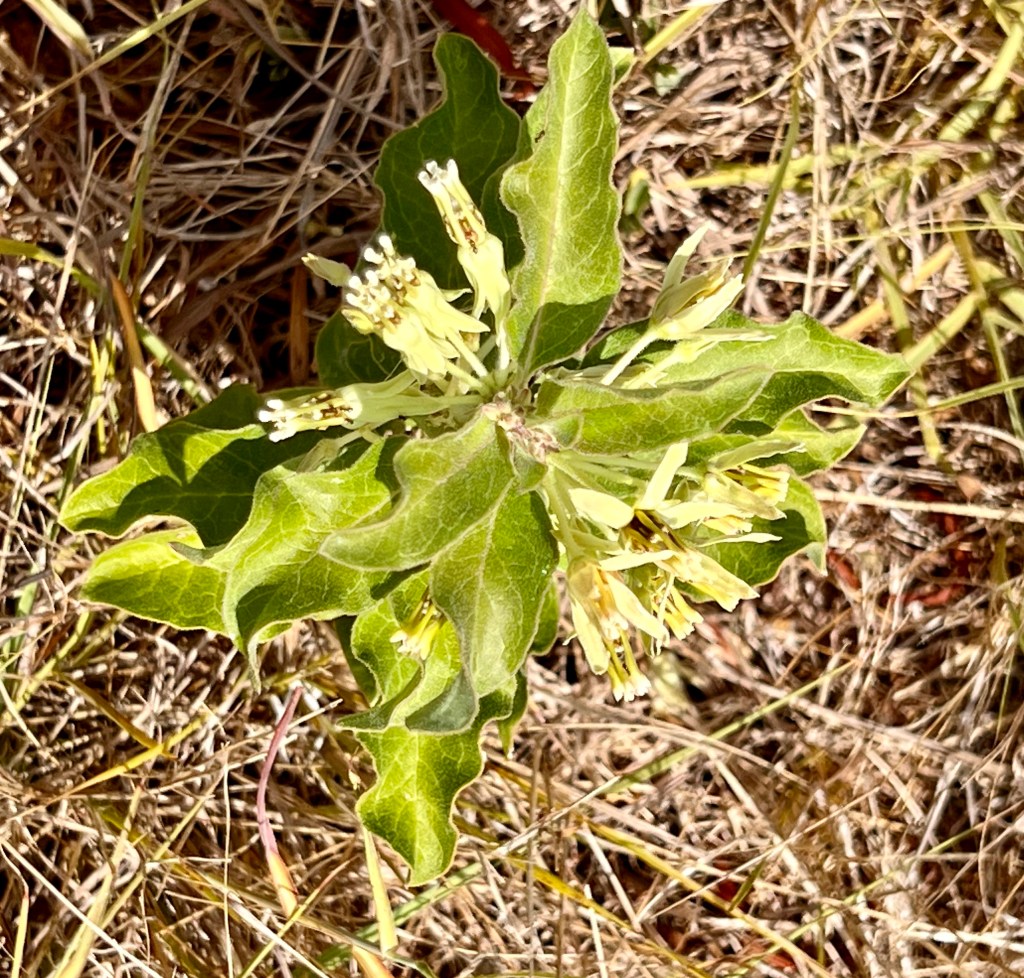
One way I’m hoping we are attracting insects is the number of milkweed plants on the ranch. I’m happy to see lots and lots of zyzotes milkweed (Asclepias oenotheroides) and a good number of green antelope horn (Asclepias viridis) out in the fields. Even better, I’ve seen many dispersed seeds. Come on over, monarchs!
zyzotesantelope horn
I’m glad some of our plants and animals have made it through the summer. I will be interested to see how many trees we lose in this drought. The previous one was very hard on the older trees on our property, which slowly keeled over from 2012-2015. I hope you got rain where you are, but not too much. Some of our chapter members had a hard time in the past couple of days. We are due for more rain, but I won’t complain. I miss the ponds and my horses miss the grass!
Story by Sue Ann Kendall, photos by Carolyn Henderson
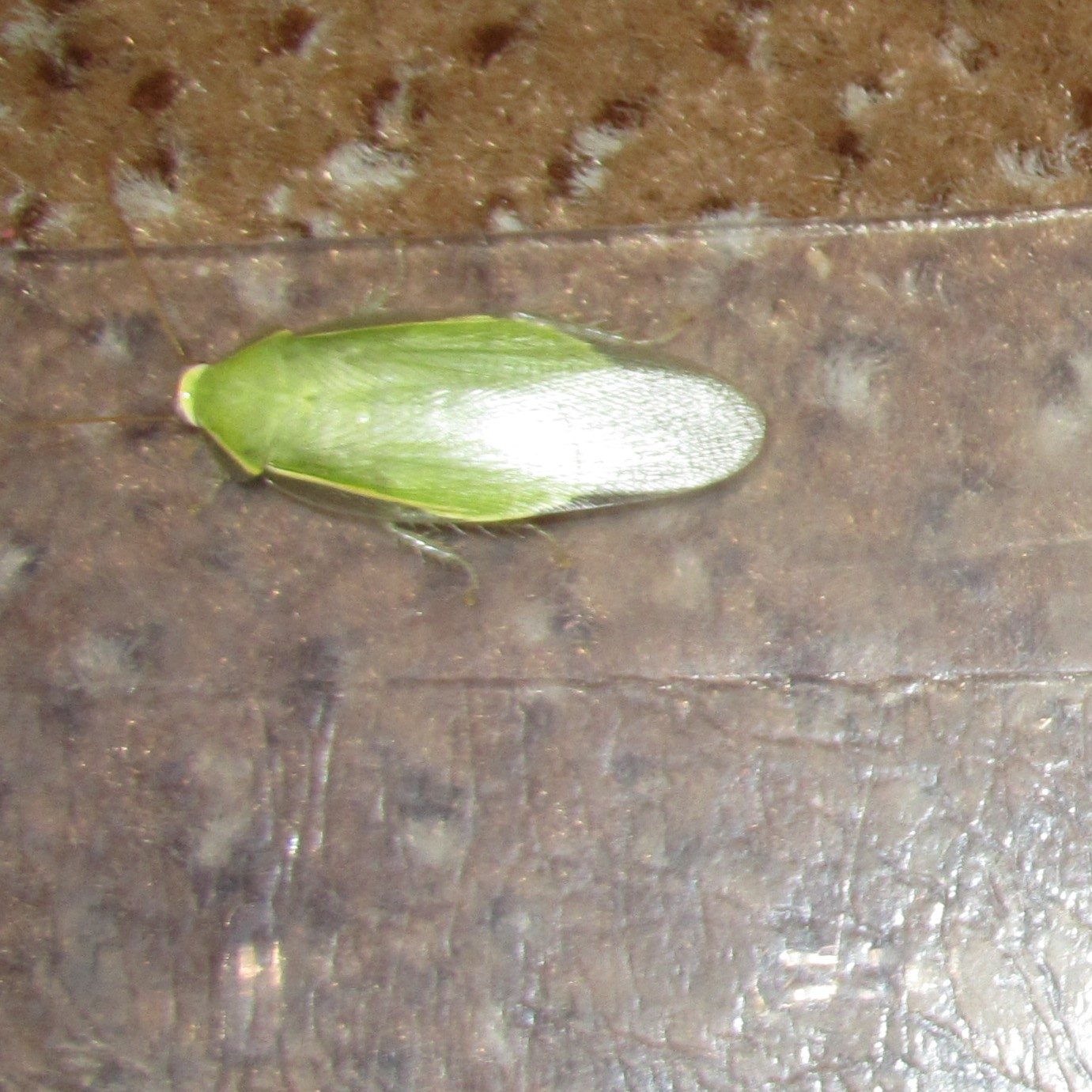
Carolyn Henderson, our Chapter President, spotted an unusual insect in her house last week. Being a Master Naturalist, she didn’t squish it. Of course, she photographed it. Neither she nor any of her friends had ever seen one of these little green creatures before.
Not your usual cockroach.
She looked it up on iNaturalist, and even though none of us had seen one before, sure enough, it’s common around here; it just doesn’t usually visit our houses, a trait we all appreciate. Here’s what she read about the unusual green banana or Cuban cockroach (originally from Wikipedia):
“Panchlora nivea, the Cuban cockroach or green banana cockroach,[2] is a small species of cockroach found in Cuba and the Caribbean, and along the Gulf Coast from Florida to Texas, and has been observed as far north as Summerville, South Carolina. It is found in subtropical or tropical climates.
“The females can grow up to 24 mm and the smaller males are 12 to 15 mm long. It is winged and a strong flier, pale green to yellowish green in color, with a yellow line running up the sides. The nymphs are brown or black in color and are burrowers.
“It is usually an outdoor species and is rarely found indoors, so is not considered a pest. The adults can often be found in shrubbery, trees, and plants. The young can be found under logs and other debris. It is often attracted to both indoor and outdoor lights and it is mainly a nocturnal species.
“It is often a popular pet roach due to its relatively pleasant green color, and because it is not an invasive indoor species. It is also used as food for other pets. [emphasis mine]”
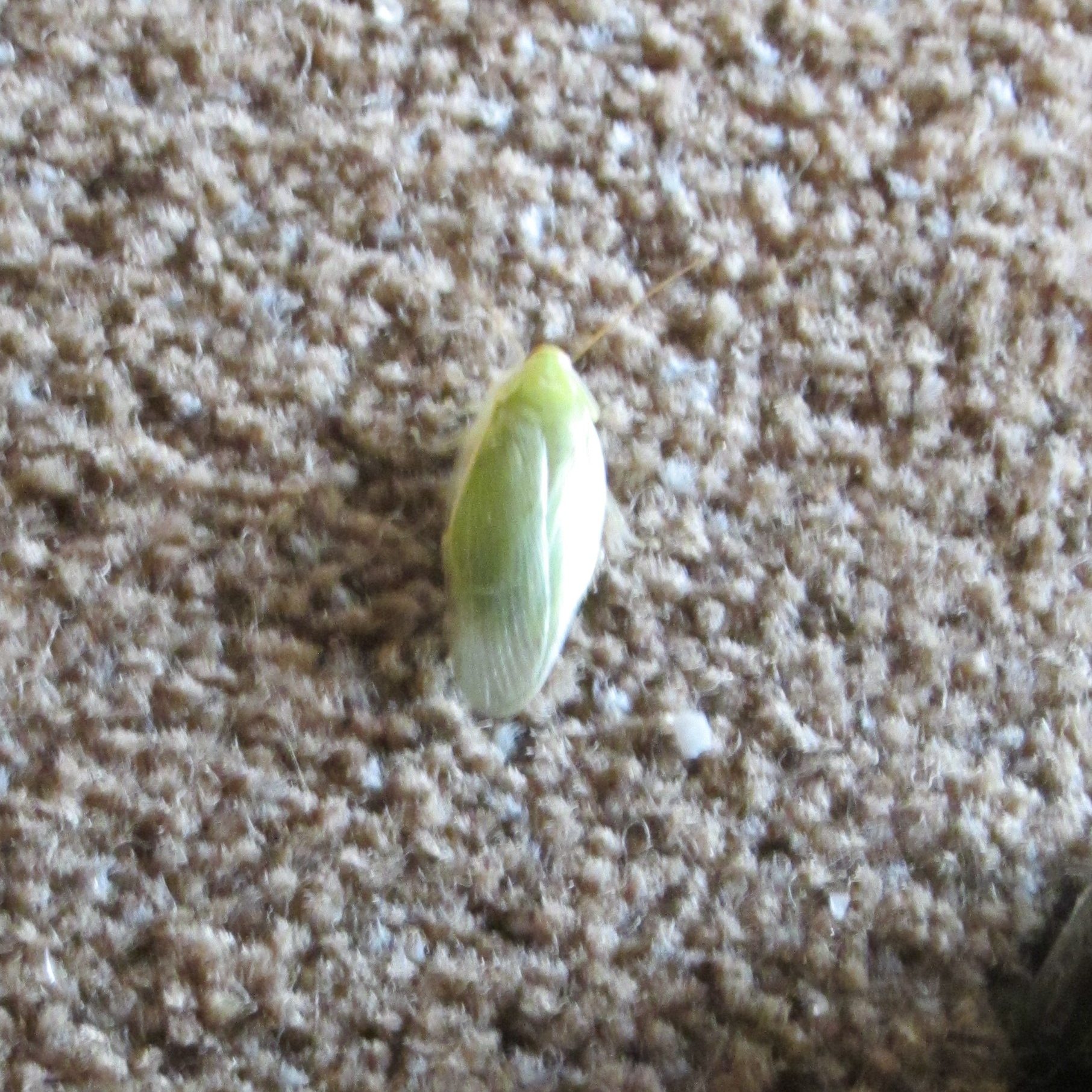
Cute?
That last part is interesting. I guess Carolyn had a new pet! The color is “relatively pleasant.” I think I’ll let them live outside, but it sure is interesting to know they live here! Let us know if you run across any in your nocturnal excursions.











 Nature Along the El Camino Real