Wolf Spider Identification

by Eric Neubauer

Although some wolf spiders are active year round, this is the time of year when they start to become more noticeable. Except for a few species that are relatively easy  to identify on sight, these can be very difficult to get down to species level. There are two main reasons. First, there a lot of genera and a lot more species. You are most likely to see are Rabidosa, Schizocosa, Pardosa, Hogna, and Tigrosa in our area which isn’t too overwhelming. However, the second and third of these include over two dozen species locally. The second reason is that most keys rely on microscopic details. There are macroscopic differences, but these haven’t been compiled in any comprehensive way. It may be some time before wolf spiders become as easy to identify as birds or butterflies, but I believe it will happen.
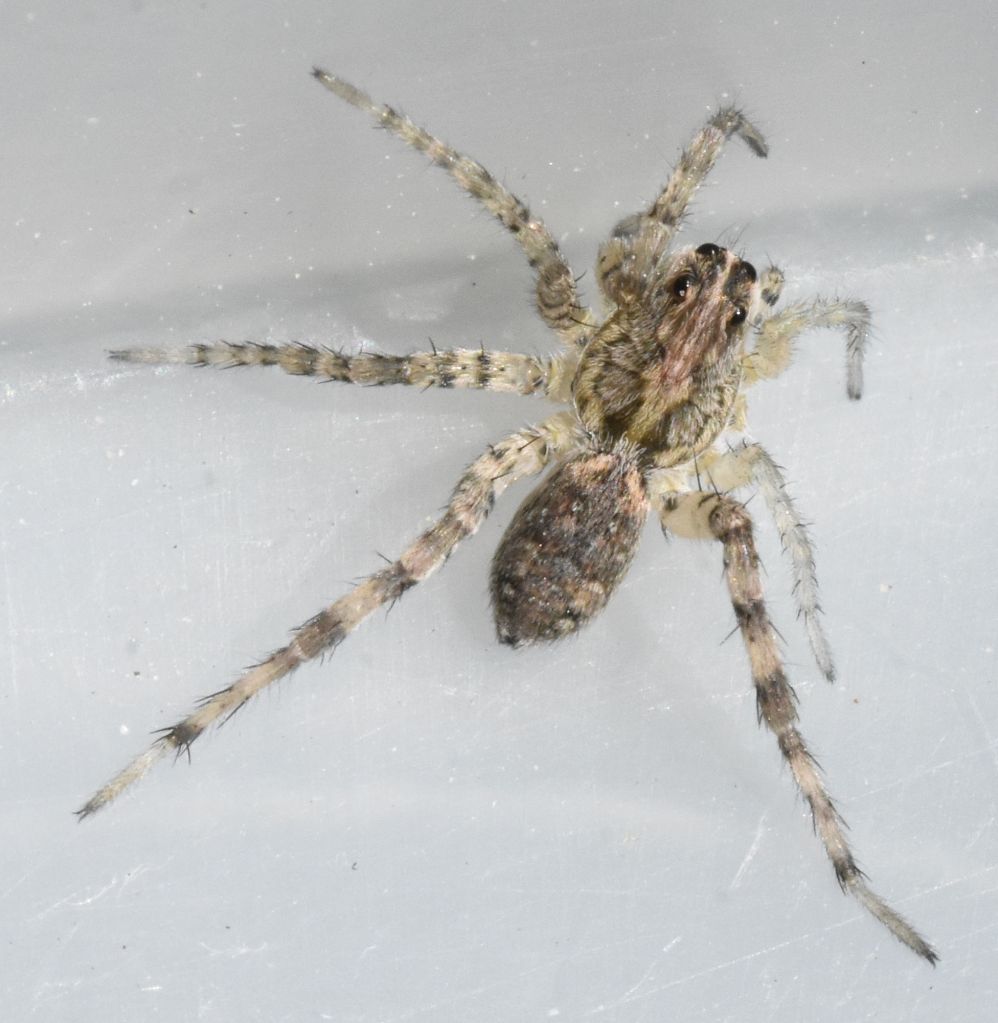
Unidentified juvenile Hogna. More on this one below.

Where to find them: wolf spiders live in diverse habitats. Margins of mowed areas, shorelines, road edges, and leaf litter are good places to look. They are noticeable because they run around in the open looking for prey. They they like to be where there is a way to escape whether it’s into tall grass, under leaves or onto the water’s surface. Many live in colonies, so if you find one, you can probably find more. I find the best time to look is when the temperature is above 70 and humidity is high. On sunny calm days, you can find them active at lower temperatures because the ground warms before the air. And, they aren’t always large. There are some species that have a body length of 0.15” or 4 mm when mature. Males tend to be smaller and a bit more lively than females, and they are harder to catch. As far as I know, none of the local wolf spiders have a dangerous bite, and they won’t bite without a lot of  provocation.

Rabid wolf spider Rabidosa rabida in a clear container

How to photograph them: good photos are important if you hope to make a species ID. Wolf spiders can usually be encouraged to run into an open container. Wolf spiders can jump, but do so more in a horizontal than vertical direction. They can climb, but not as well as other spiders. They will remain in the container until you get some good photos. Size is important, so if the bottom of the container has markings, you use them to scale the body length. Ventral views are important too. Looking up though the bottom of a clear container works. Others put the spider in a plastic bag so it can be flipped over. I try to release spiders close to where I found them when I’m finished with them. If you do all this, you might just have the clue that points to the species.

Unidentified Hogna, from the bottom (Hogna incognita)

Study populations, not individuals: Once you find a colony of spiders, visit it often and make a full collection of photos including males, females, females with egg sacs, females covered with spiderlings, and juveniles. Most experts wouldn’t dare identify a juvenile from a photograph at present. They do look a little different than the adults. However, from my experience working with two species, the juveniles are not only distinctive, but are more consistently patterned than the adults which will have developed some individual “character” in their appearance. In the future, the juveniles may provide the necessary clue for the species of an entire colony.
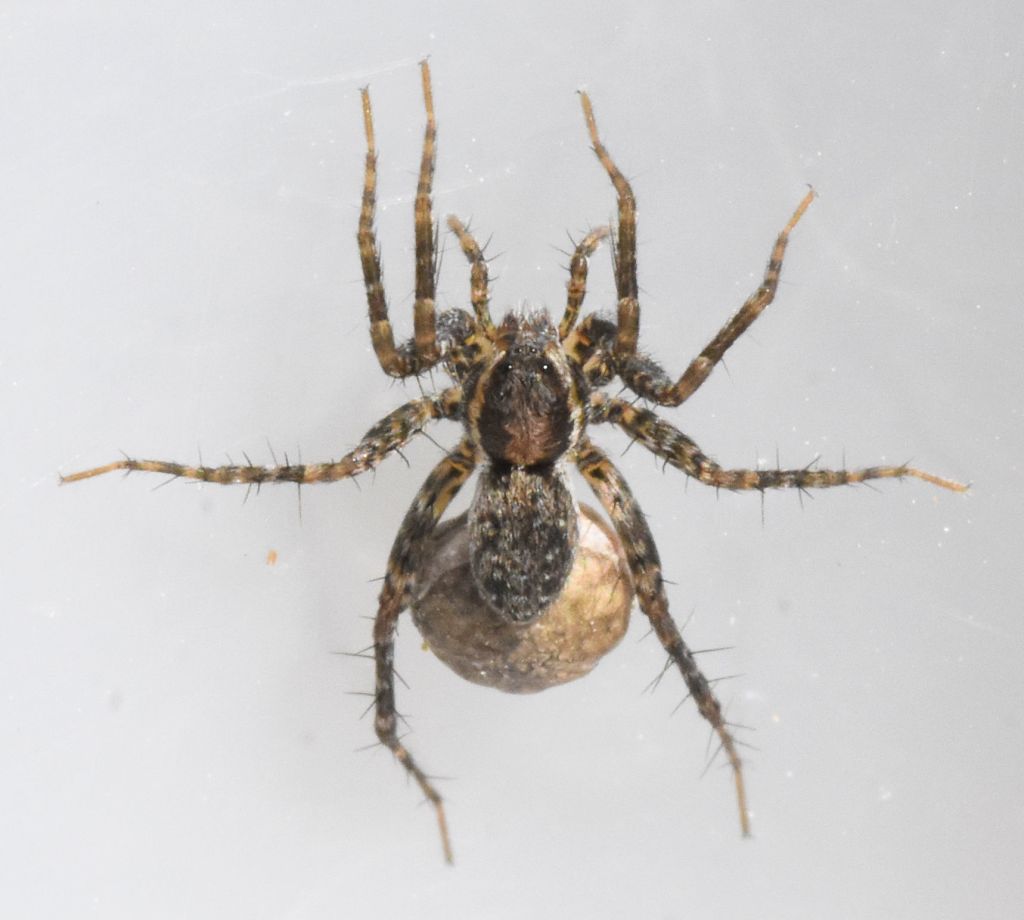
Thin legged wolf spider, genus Pardosa, with egg sac

Legs: I’ve noticed wolf spiders missing legs. Usually it’s one or two, but I have seen as many as four missing. Males are more likely to be missing legs than females. Legs can regrow, so you may notice a leg that doesn’t look like the others.

Pardosa male missing two legs, with a third that doesn’t look too good.

Recent Observation Notes from Bird and Bee Farm Trip

I continue to be surprised how finely placed the populations of wolf spiders are. At the pond dam, I found a couple of juveniles near the highest point. The first was one of my Hogna incognita (undescribed species). The other was Rabidosa rabida which seems to be species that appears everywhere in small numbers rather than being clustered in populations except perhaps around buildings. I found no more spiders until I got to the boat ramp at the far end of the dam. That’s where all the Pardosa were. The Pardosa may be all one species which would be good since most places I see them there appear to be multiple species that I haven’t been able to sort out.

I stopped at the Little River bridge north of Gause and found no spiders there. Then, I checked out the San Gabriel bridge on CR 487 east of Crossroads, which has an inspection road around and under the bridge. A bunch of spiders were in a pile of leaves that someone had dumped. I’d thought they were Pardosa at the time, but a closer look at the photos suggest Schizocosa juveniles. So, I found all four of the most prevalent genera in Milam County on my tour.

The H. incognita find was of interest. Although it seems to be mostly a Blackland species, this personally confirms it is present elsewhere, which I already figured would be true from other people’s observations. Nevertheless, its range may stop abruptly at the Brazos River. I’ll be testing that out in the next few months when they are active.

Here are some more wolf spiders to practice on. All photos by Eric Neubauer.

The Great Escape: A Bioblitz Tale

by Eric Neubauer

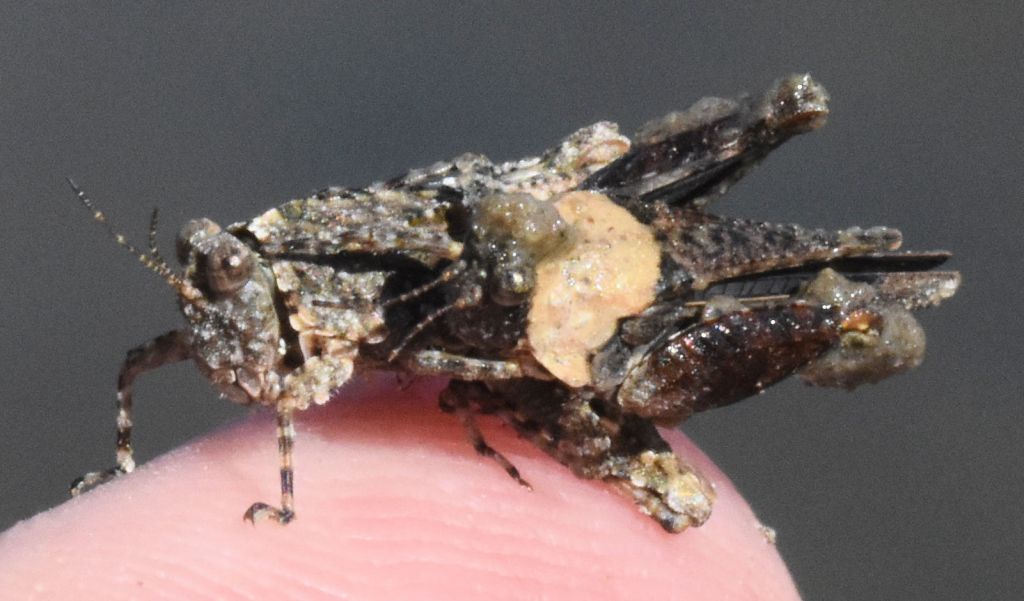
Way back when TMN training was beginning, I heard Alan Rudd’s stories about little grasshoppers that jumped into the water to eat algae or escape with interest. Over the next year I encountered pygmy grasshoppers in just three places, locations including Taylor Park on Granger Lake on Day 1 of the Bioblitz.

On Day 3 I encountered some again, this time at Alan Rudd’s place, where I had seen some in the fall. It seems they remain active through winter in very sheltered areas. Unbelievably I ended up with a mating pair sitting on my finger, something that isn’t likely to ever happen to me again.

Give us some privacy!

How did this happen? I saw one sitting near the water and tried to scoop in up in a container I had along for photographing Pardosa spiders. Of course, being a grasshopper it immediately jumped out as I expected, but landed upside down in wet mud, and I could see her tiny feet waving around in the air. So I offered her my finger, which she grabbed onto and was happy enough to sit there while I took as many photos as I wanted.

As I started taking photos, I realized there was more than just mud stuck to her. Eventually I realized it was an entire male grasshopper. When I finished with the camera, I put the grasshoppers back where they came from.

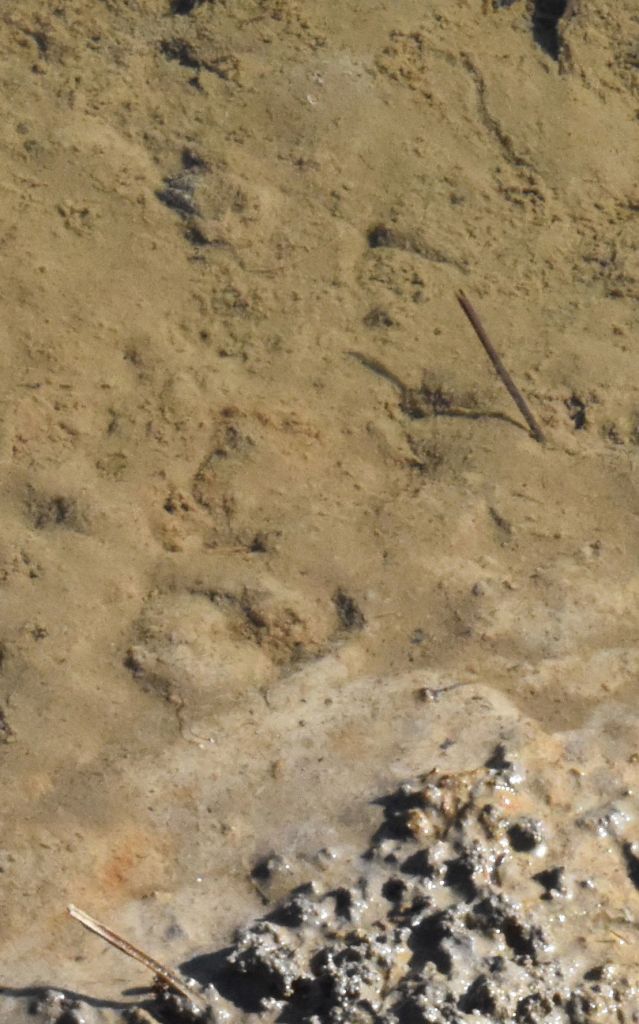
A little later I thought I saw a grasshopper jump into the water and burrow in the mud. I wasn’t sure, because little frogs were doing exactly the same thing to avoid me. I took a photo, and sure enough it was a grasshopper, proving that Alan hadn’t been exaggerating.

Something in the mud

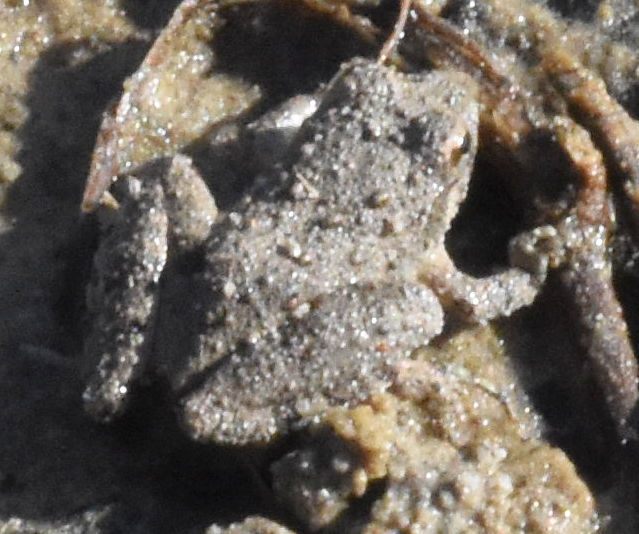
Whoops! After carefully looking at the supposed Paratettix hiding in the mud, I believe it is actually a frog, Acris blanchardi, so my underwater photo of Paratettix hasn’t happened yet. You’d think it hard not to be able to tell a grasshopper from a frog, but there you go. I’ve deleted the observation and resubmitted under Acris.

Acris blanchardi, not in the mud.

Linda Jo commented that this isn’t the first time such a mis-identification has occurred!

Spider Bonanza

by Eric Neubauer

If you’ve searched Texas spiders on iNaturalist lately, you’ll probably found a tremendous increase in species. This is largely due to Justin Williams (jgw_atx) in Austin, who has done a lot of work on it lately. I searched Lycosidae (wolf spiders) yesterday and there were 402 species.

I’m sharing this information in the blog, since it makes iNat a lot more useful for spider identification in Texas. This kind of community science is what makes us Master Naturalists happy, and shows how much our own work can contribute to the knowledge of the natural world.

Here are a few pictures from Justin. Click on them to see them full size. They are gorgeous. They have Creative Commons copyright.

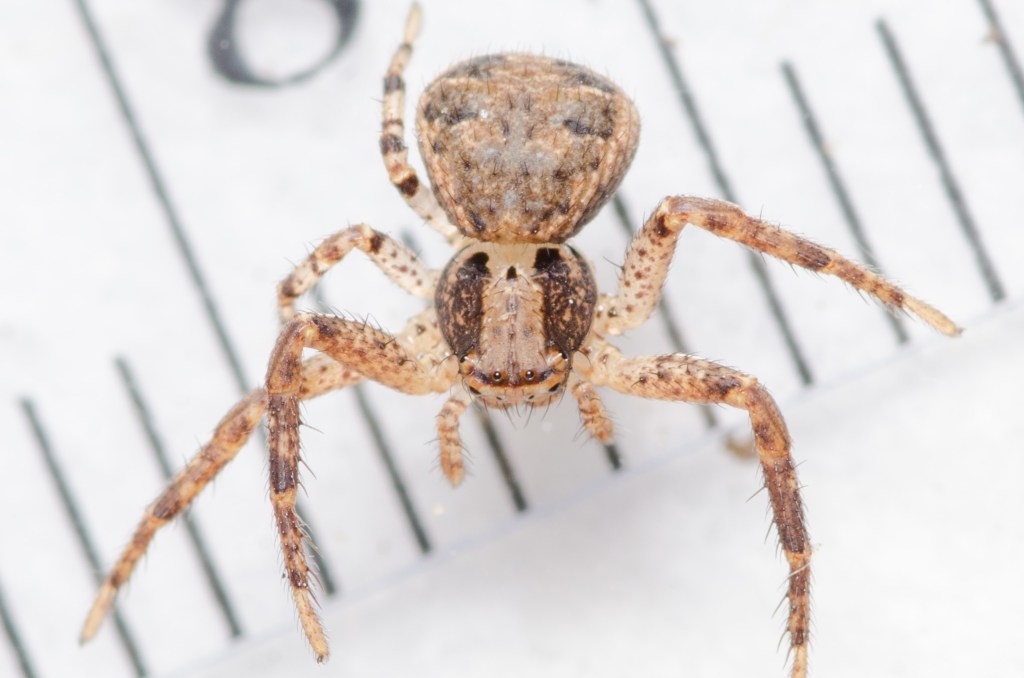
By the way, I also got a new and interesting spider observation! This is the first time Zora pumila has been observed in Texas, according to Justin Williams. The discussion on my observation is quite interesting.

Zora pumila observed by Eric Neubauer on January 12, 2021

Feast Time for Hawks

by Eric Neubauer

Much has been written for those of us who want to attract wildlife, but sometimes luck plays a part. It turns out this is an ideal venue for hawks, validated by the hawks themselves.

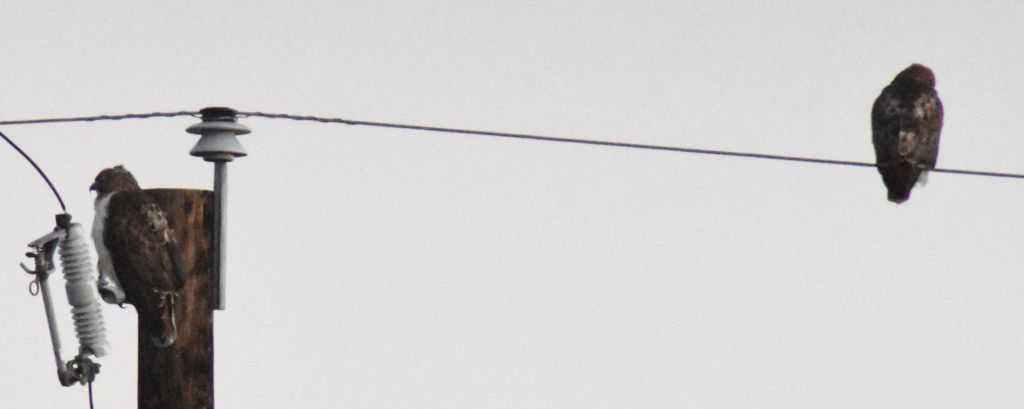
Two hawks hanging out.

I planned to make my former farmland a prairie rather than a lawn because that’s what would be natural for the area. Doing nothing was a great start. While I decided how best to proceed, nature took over. All kinds of plants came up, both native and non-native. By then I knew I’d have to mow once in a while to control the growth of brush since burning wasn’t a safe option. I mowed several paths through the grass and weeds and around the house so I’d could access various parts of the yard without walking through head-high grasses and forbs. Next I started mowing in from two edges of the property before stopping and leaving the rest as cover for wildlife. This included the margin along the north edge of the property under the power line next to the road.

The hawk hunting venue

When late fall arrived I noticed how often a hawk was sitting on the power line. At first a Prairie Falcon was there on a regular basis, then an American Kestrel, Cooper’s Hawk, and Red-Tailed Hawk showed up. After a couple of months it looked like they’d finally hunted the area out, and started watching across the road instead. Today they are gone except for the American Kestrel. On the last busy day, the Cooper’s was on the power line just as it started to get light. Then a Red-tailed Hawk (I think) flew up to the transformer on the pole about 15’ from the Cooper’s, before moving down a couple of poles. Right after that an American Kestrel came along and buzzed the Cooper’s before landing on the wire midway between the other two. It wasn’t the first time I’d seen that happen. Loggerhead Shrikes are also on the wire a lot, but that’s a year round occurrence. I know hawks are also perching on my roof and using the mowed area around the house in the same way.

Here is why I think the venue worked so well;

  1. The tall grass provided cover and food for grasshoppers, small birds, and rodents. The mowed area next to it made them accessible to the hawks when the prey strayed.
  2. The wire was on the north side of my property so they could approach their prey with their shadows behind them and the prey wouldn’t be warned as a shadow passed over them.

The grasshoppers are also giving out now. The only ones left  are a very few Schistocerca americana and Melanoplus femurrubrum adults, and some Chortophaga viridifasciata nymphs. In late summer, there were hundreds of thousands of M. femurrubrum nymphs, and a plague of Biblical proportions appeared to be brewing. It appears few ever made it to adulthood, and those that did suffered heavy predation. I’m sure the little birds did their bit, but the hawks did too. Attracting birds isn’t purely for entertainment.

Flying Spiders and Other Arachnid Tales

by Eric Neubauer

Flying Spiders

A while back a friend directed me to an article suggesting that spiders use the electrical gradient in the atmosphere to become airborne. When they produce silk, it has a charge and is attracted upward. Enough silk, and they’re up and away. So, the thing that causes lightning can also be used by spiders to fly.

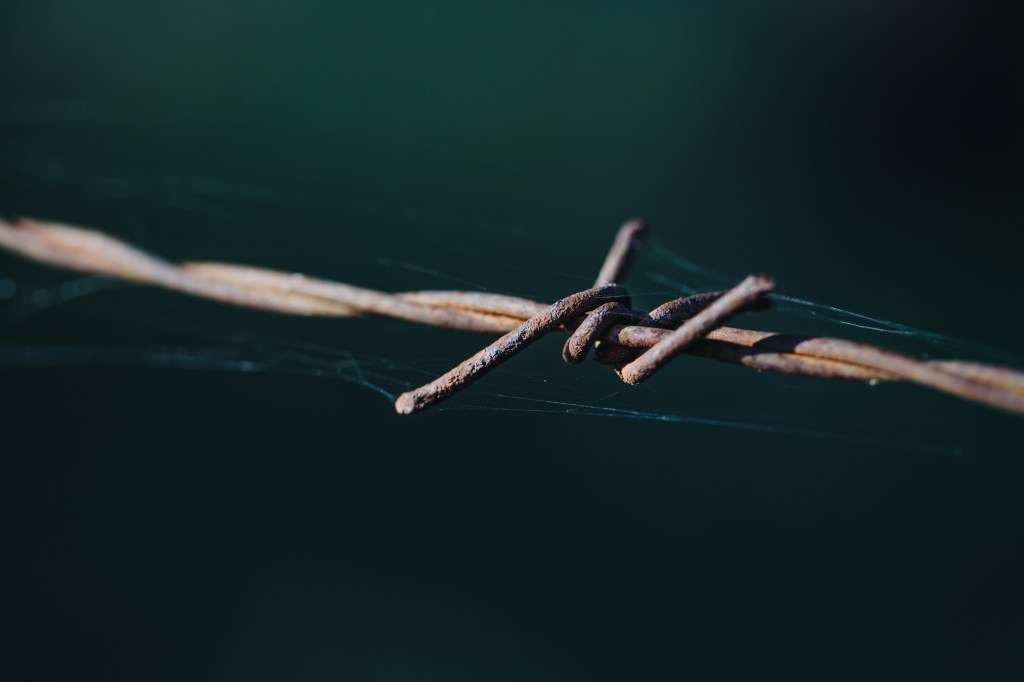
Sometimes the webs get caught on fencing. Image by @Donatellaloiphoto via Twenty20

After I read the article, I’ve wanted to see a flying spider. Yesterday, I was lucky and saw one go by at about 5 mph and 6 feet above the ground. I saw the spider, one of my guests saw the silk thread it was suspended by. Unfortunately it went by too quickly for either of us to  see what was at the other end of the thread.

Whether it is pure instinct or involves some thought, the spider is purposefully flying. By dropping down on the thread, the spider can land at will. I have seen what I take to be silken spider balloons lying on plants.

I’ve also wondered how those silken threads that span the tall grass on either side of the driveway got there. It would be tedious for the spider to go down, across, and up while risking the thread getting entangled along the way. They probably simply fly it across. I’ll be looking for more flying spiders.

Additional information from Sue Ann

I’m busting in on Eric’s article, because this is also one of my interests. I found on Wikipedia that this is called ballooning. Apparently lots of spiders and some other organisms do this, and yes, it’s electrical!

I’ve also read that the wolf spiderlings are blown out of their nests on these little parachutes of silk, which is how they disperse. Here’s a close-up I found. At some times of the year at our ranch, they are everywhere. I can remember getting covered by the sailing webs while driving in our utility vehicle.

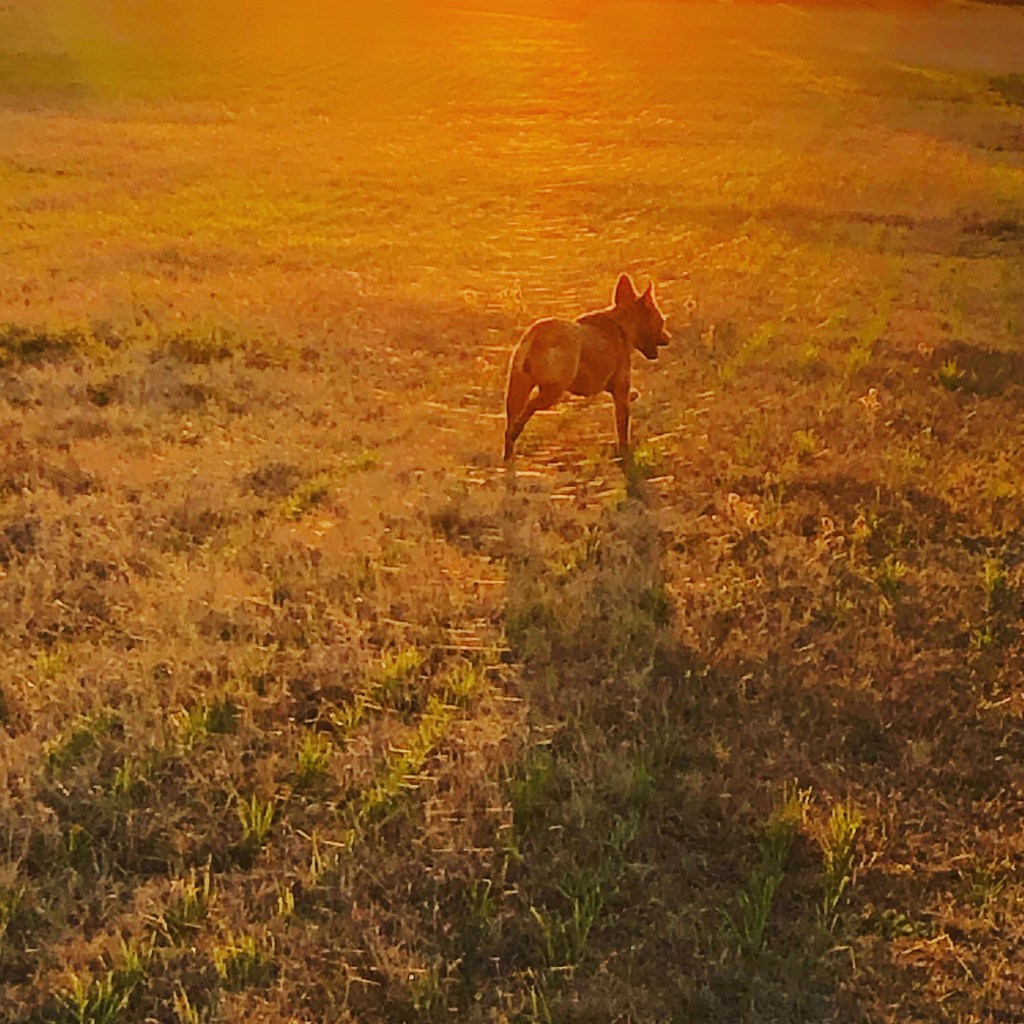
From Sue Ann: this is a photo we have framed and hung on the wall. Our dog, Penney, was running through the field at sunset during the time all the spider babies are flying off. The sun is reflecting off the webs.

Are spiders disgusted by humans?

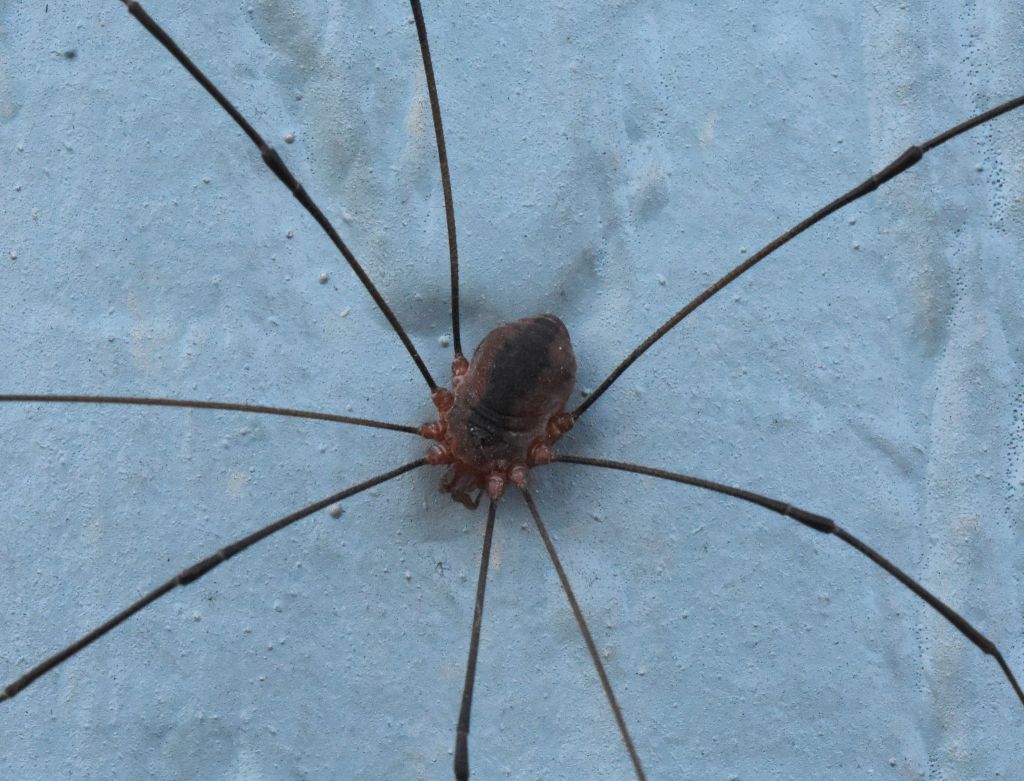
As the season winds down and the avian predators clean up the last of the grasshoppers, the mating season of Eastern Harvestmen (and women) is in full swing. Perhaps because of this they seem to be very curious.

Have you ever seen a daddy longlegs this close up? Wow! Photo by Eric.

Twice I’ve had them come to investigate while I was fussing around with something. Rabid Wolf Spiders also do this, but I figured in their case they were hoping for a meal like the swallows that appear when you’re out on a lawn tractor.

The funny thing was when I stuck my finger out to see what the Harvestmen would do with it, they turned tail and ran away immediately upon contact. It seemed as if they had the same gut reaction that some people have when they see a spider. It also suggests they have really poor eyesight and are probably as comfortable in total darkness as they are in light.

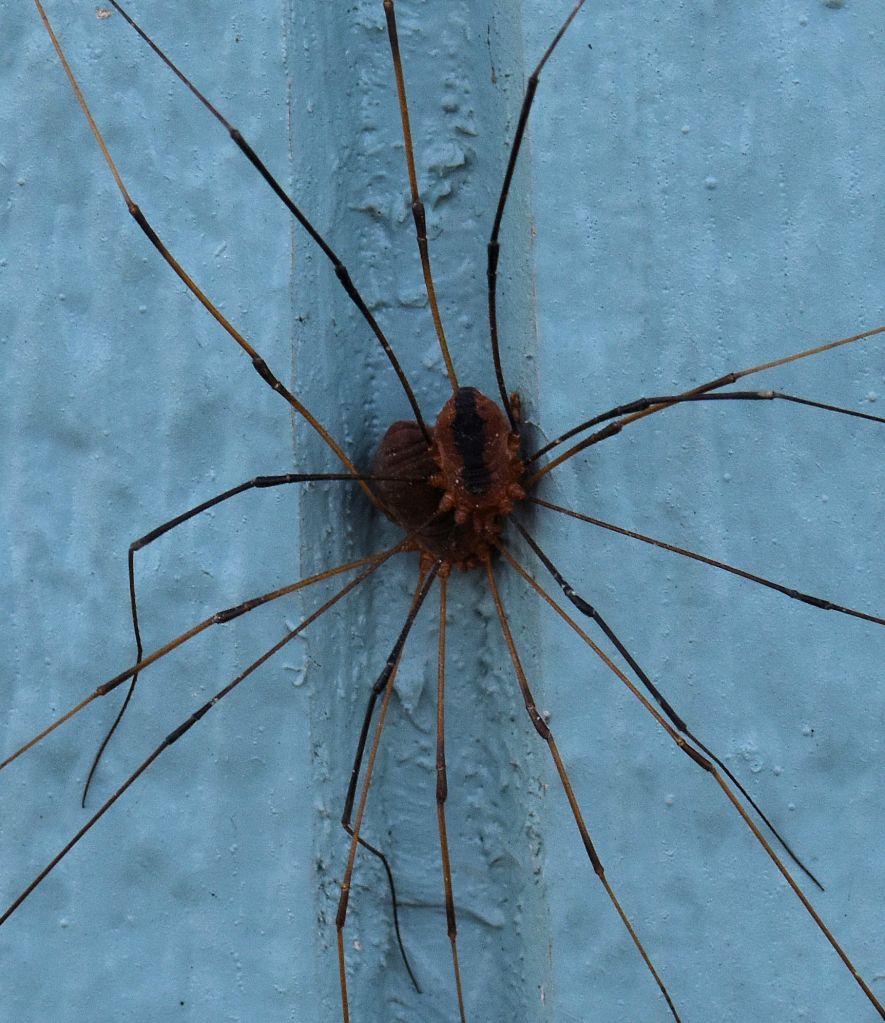
This is apparently a harvestman and a harvestwoman. (ha ha)

I later had another encounter with a harvestman. I kept my finger still as it approached. As soon as its leading foot touched me, it turned and ran. Primatephobia at its  best!