Believe it or not I just found this beautiful caterpillar this week, on October 14, 2020.
Eastern Black Swallowtail (PAPILIO POLYXENES)
It’s not really the time of year I would expect to find it, but here it is.
Also, if you notice this is not the normal color of this species. It would most often be more green with white stripes and yellow spots.
It’s black!
Since it was on a fennel plant in my garden, that gave me a hint of what it might be. When I looked it up, it was noted that once in a while this butterfly’s caterpillar is black. I have never seen this myself in my garden. Interesting!
The Pipe-vine caterpillar is the only other species that has the two colors on a regular basis in my area. So the lesson we have here is that the plant has a lot to do about identifying a species.
I have to say, it’s pretty neat that this caterpillar has the ability to have two different morphs.
The summer heat and dry conditions make us wonder… what the heck can I plant that will help the hummingbirds and the butterflies? And of course, it has to be something that is easy to take care of.
I have found that the Coral Honeysuckle Vine and the Flame Acanthus bush fit the bill. Both are visited by butterflies and hummers. A two-for-one deal.
The coral honeysuckle is in the back on the fence. In front is our friend the passion vine.
The Coral Honeysuckle (Lonicera sempervirens) is a climbing vine that can also grow as a ground cover. It is ever blooming in some years. It likes sandy loams, clay, and poor soils.
How much better can it get? You can grow it in the full sun or part shade. It goes great on an arbor or on a fence like I have it.
By the way, this is not the invasive Japanese Honeysuckle.
The flame acanthus is in the rear, on the fence. In front of it are zinnias and Salvia gregii.
The next plant that loves our summers is the Flame Acanthus bush (Anisacanthus quadrifidus). It’s extremely drought tolerant , gets no diseases, and is easy to grow. Again both hummers and butterflies like it.
This bush will die down in the winter. Cut it back in the spring before it starts to green up.
Both of these are great plants for hot and dry conditions. They need no fertilizers and little water once established.
Be adaptable and watch what your garden and wildlife like. Then your garden will be successful in an ever changing world.
I hope you will always see the wonder and beauty in nature.
Most of us have these beautiful vines that come up on the ground, fences, and trellises. So besides being magnificent, who else appreciates them? Butterflies and birds, that’s who.
Passionflowers
The vines only show up when it’s hot. Pretty lucky for us, because it’s hot here.
The Latin name for the passion vine is Passiflora incarnata. What you may not know is that many of the vines we have here are actually naturalized, not native. You can tell by the number of leaves on them which one they are.
Another view.
If they have five leaves, they originally came from Asia and naturalized here. If vines have only three leaves, they are true natives. Both work well here and are host plants for the Gulf Coast and Variegated Fritillary butterfly. The vine also provides cover for other insects.
Fritillaries
The Gulf Coast species is orange and black with silver under parts.
Gulf Coast Frittilary
They use the passion vine as a host plant. They love hot weather, so only appear when the vine emerges. Pretty smart of them.
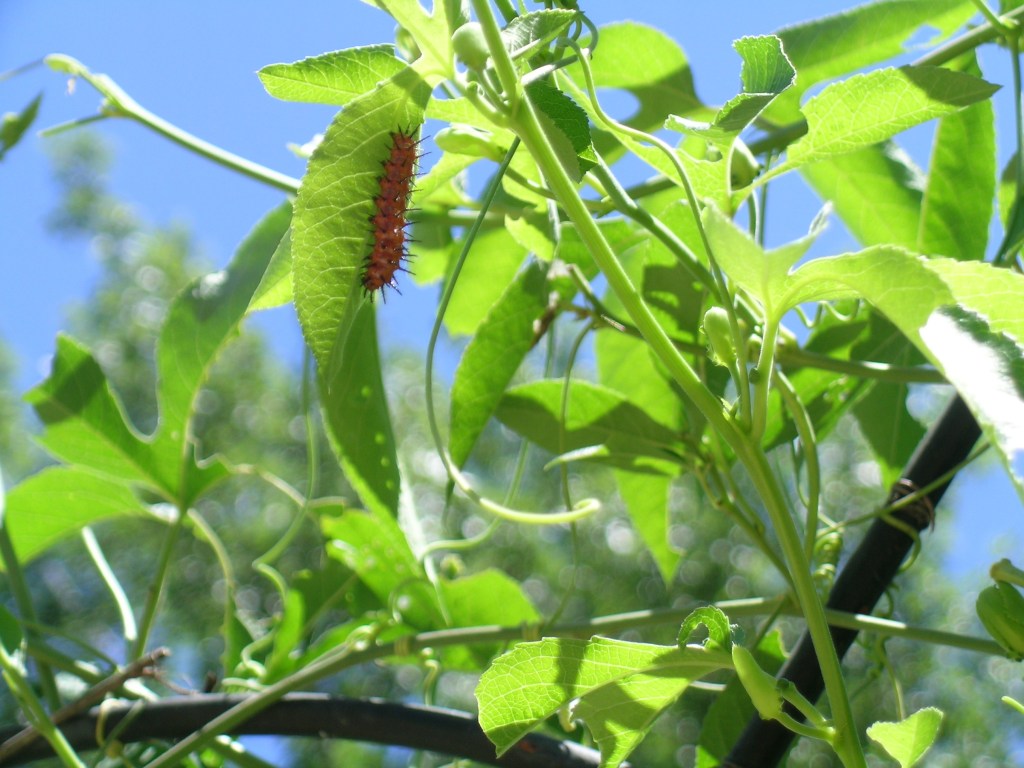
Gulf Coast Fritillary caterpillar
The second species of Fritillary is the Variegated variety.
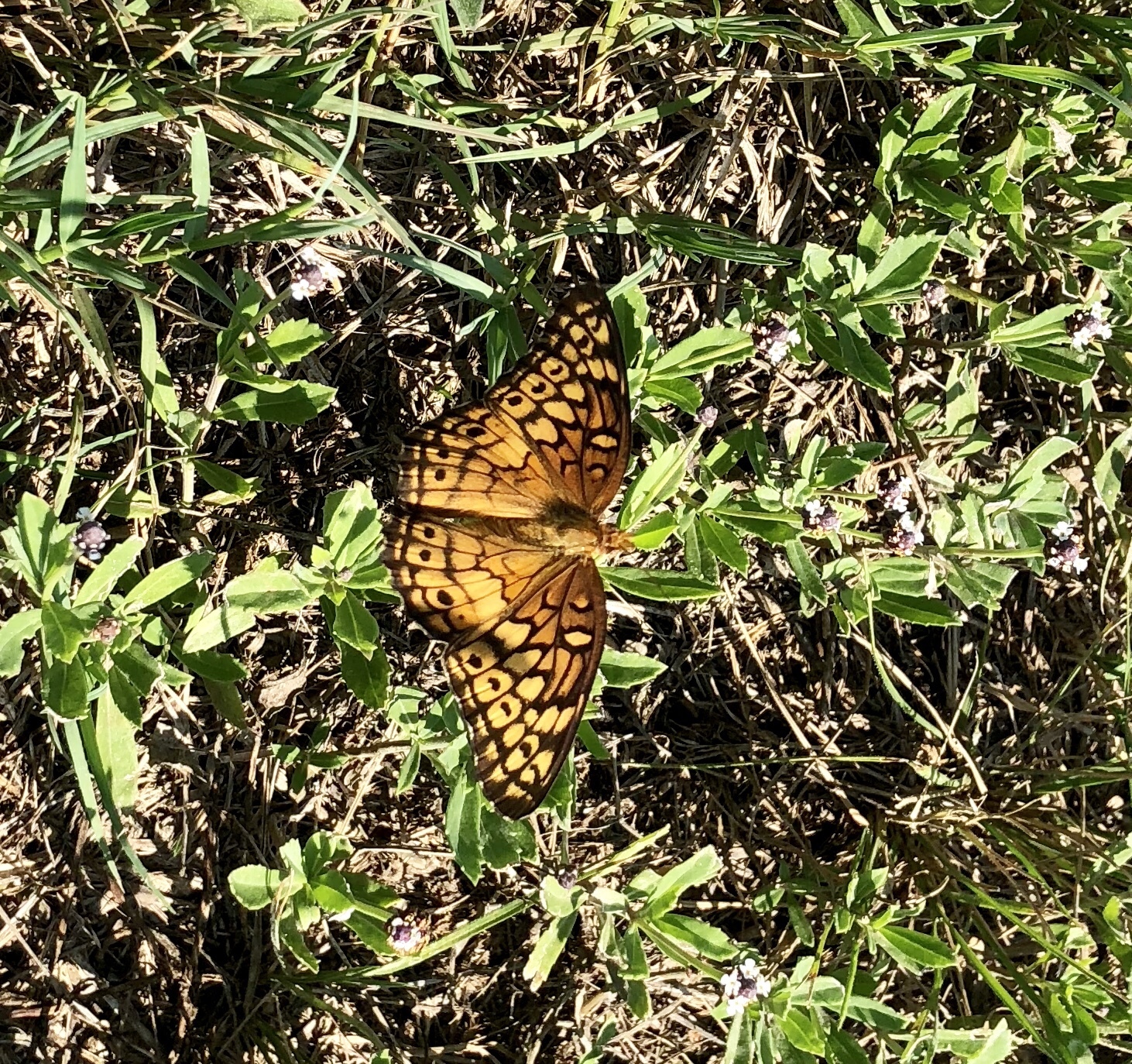
Variegated Frittilary. Photo by Sue Ann Kendall.
Variegated Frittilary caterpillar. Photo by @susanmco on iNaturalist.
They also use the passion vine as a host plant to deposit their eggs on.
The Vairegated Frittilary does not have the silvery underwings of the Gulg Coast. It looks more like a dried leaf when it has its wings up. Both Fritillaries appear in the summertime, and will leave when the weather turns cooler.
The passion vine is a great way to cover a large area in your garden. [Suna points out that the fruit is also edible and makes a lovely jelly.]
This vine has five-leaf clusters, so it’s naturalized.
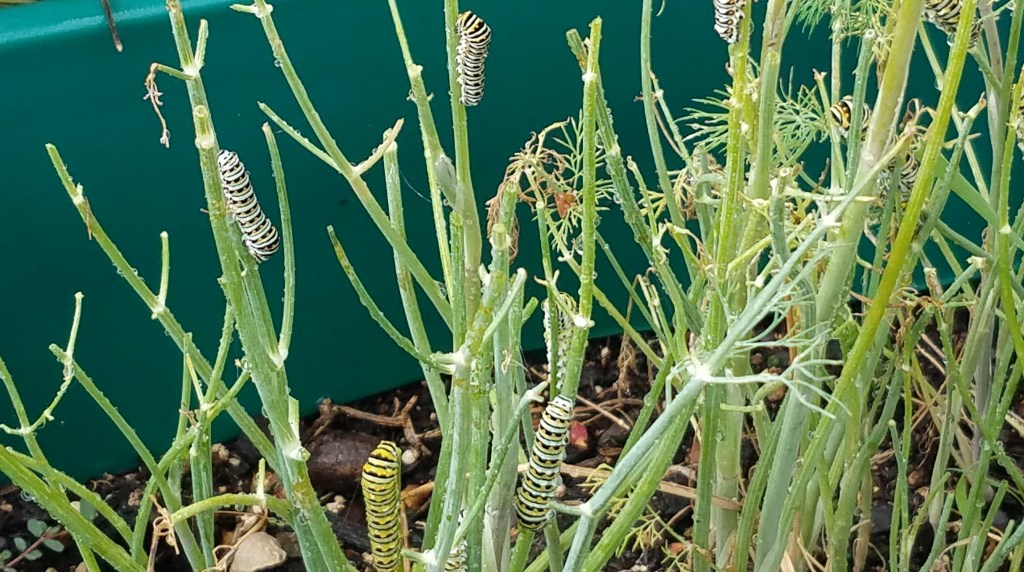
I found a dozen of these caterpillars devouring my dill. When there was nothing but a stem left, they crawled up the side of my planter and crawled away. I thought they might find the nearby parsley and ingest it too, but no sign of that and no sign if them.
Hungry caterpillars in Cindy’s dill. Click to see them full size.
I suppose they are somewhere nearby spinning their cocoons. Maybe I’ll see some pretty black swallowtails around soon if my nesting phoebes and barn swallows or bluebirds don’t get them first!
From Sue Ann:
I have had many of these in my bronze fennel plant, and I hope they have gone off to pupate, too! The fennel also hosted the caterpillar of the cabbage looper moth. I’ll plant dill next year, for sure. The more black swallowtails, the better!
Black swallowtail and cabbage looper moth caterpillars on bronze fennel. Click to see them full size.
More about the Black Swallowtail, from Cindy
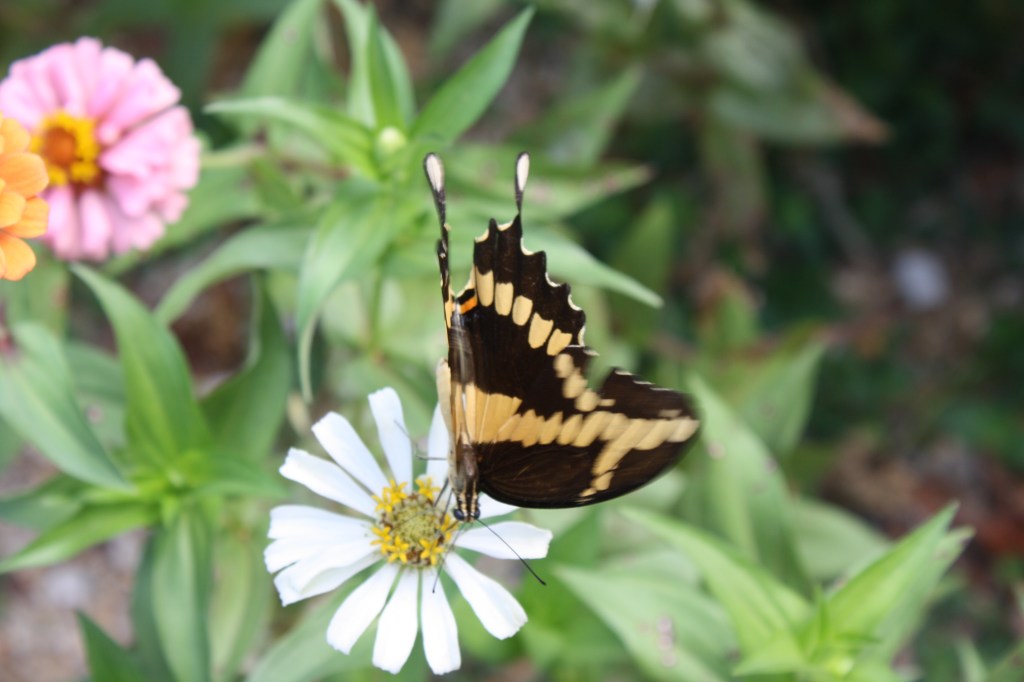
Papilio polyxenes, the black swallowtail, American swallowtail or parsnip swallowtail, is a butterfly found throughout much of North America. It is the state butterfly of Oklahoma and New Jersey. Wikipedia
Eastern black swallowtail. Photo by @AngelsLight via Twenty20. Licensed use.
Black Swallowtail Life Cycle: Overview and Timings
Stage
Typical Duration
Egg stage
Generally 4 to 10 days, depending on temperature and host plant
Caterpillar (larval) stage
3 to 4 weeks
Chrysalis (pupal) stage
10 to 20 days (except for overwintering pupae)
Adult butterfly stage
6 to 14 days
Facts about the Black Swallowtail
And More from Sue Ann
I had to add this observation from last night, as I was dining outdoors at the Central Avenue Bistro in Cameron (with safe distancing and all that). I felt something prickling my ankle and looked down to find this fellow. It must be on the last instar, because it’s big! I believe it’s a live oak metria moth (Metria amelia) given that it and many friends were falling from the live oak tree we were sitting under, though iNaturalist has yet to confirm me.
Hard to tell the front from the back of this one!
The moth looks like this, which really would blend right in with an oak tree!
Live oak metria moth. iNaturalist photo by xylochic627 (CC-NY-NC)
I hope we are all using this forced time at our home’s to look at the beautiful things that nature provides for us. I hope you enjoy these photos of the life in my garden as I share this story.
Earth Day, April 22nd, is coming up. But every day should be Earth Day.
Last evening I had a concert put on by the frogs in my small pond.
In the morning the doves, phoebes, cardinals and purple martins sang to me.
In my garden the bumble bees and Hummingbirds busied themselves with the business of breakfast, paying little attention to my presence.
The breeze started to move the grasses and wildflowers around in the pasture.
Nothing short of magnificent!
Nature goes about her business no matter what is going on with humanity.






 Nature Along the El Camino Real