Sometimes I forget to replace the lid on the dog and cat food stored in galvanized containers during the day. I arrived home after dark from a meeting. I went out to feed the dog and cats.
Before I put my hand in the container I saw a little opossum face outside of the dog food bag.
Then I saw a snout move, and saw the second opossum IN the dog food bag.
I went into the house, (the food is in the art studio), to get my phone and put Ruby the dog in the house. She chases and tries to kill opossums.
Back in studio I snapped a few photos. Found a large towel, doubled it and picked up the little one. Took it outside to let it go in the pasture.
The second one was in the dog food bag. I picked up the bag, with top closed, and walked it out to deck. After a bit, that possum came out and went for the field.
I encouraged them to stay away from this farm because of the “hound” that is on patrol. I may not always be around to free them.
Opossums do so much good for us and the environment. They love ticks and enjoy eating a variety of insects, small rodents, seeds, eggs, fruit. And pet food!
The Famous Endangered Houston Toad also attended the Wildlife & Woodlands Post Oak Savannah Landowner Workshop, where our chapter had a booth last week.
The male toad saying hello.
The pair traveled in customized carriers with their chauffeur, back to the Ft Worth Zoo (a 2.5 to 3 -hour trip each way). I only managed one photo of his handsomeness. This species is leading the resistance against riparian and native species destruction.
A few live in the southern part of Milan County. The Brazos River splits this county. I’m on North side of the river, and the soil is Blackland. South of River is sandy soil and that’s where our small Houston Toad population lives.
I enjoyed getting to see their huge back feet, which are all the better for excavating their holes while moving backwards! They don’t have to turn around to watch their world!
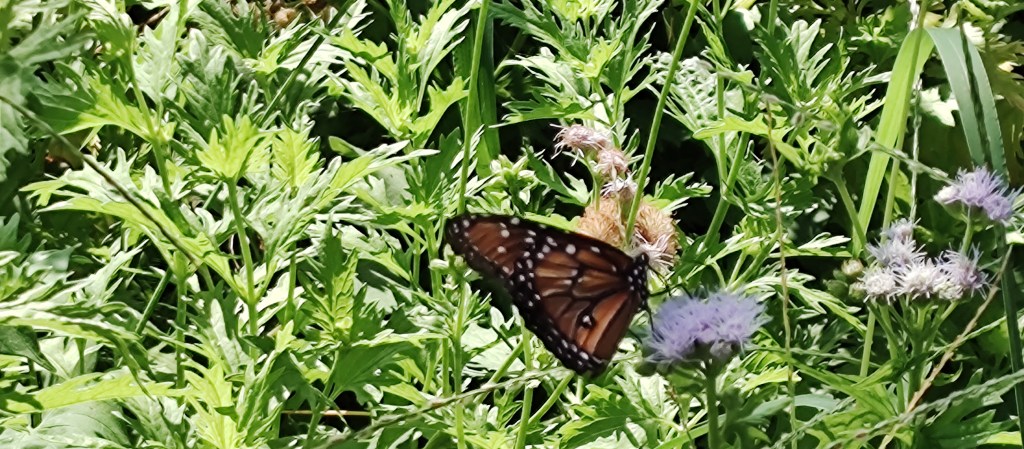
On Saturday morning I took a side trip to the El Camino Real Texas Master Naturalist City Wildscape to find a pleasant surprise in the overgrown mess. Queen butterflies had found the place. I counted about 20 that morning – all on the Gregg’s Mist. That is by far and away the Queens’ favorite nectar producer.
Not only had the Queens landed, American Bumblebees had also located nectar sources for themselves – mainly the Common Sunflower that planted itself in the city wildscape and reproduced many more this year.
I also saw Ligated Furrow Bees and Jagged Ambush Bugs. Those are pending identification verifications in iNaturalist. I also saw Oblique Longorn Bees – a second time for a new to me bee. They are very tiny and in near constant motion. All of these were on the Sunflowers.
Other things we planted were in bloom, but they are mostly overwhelmed by the terrible invasive “Tree of Heaven” and the Persimmons. Persimmons have taken over the right half of the wildscape (if you’re looking at it from the street) and the Tree of Heaven, an invasive from China, has the left side.
I met with the church directors Sunday morning, and they agreed to let us make a last ditch effort to eliminate both of those. Crape Myrtles also are spreading, which are not native to this area either. They have lots of pretty blooms, though. More Queens had arrived.
Alan Rudd has devised a plan to kill these invasives. We believe that we can do it without harming the Pecan tree in the wildscape, but there is no guarantee of that, so we needed approval from the All Saint’s Episcopal Church to do it. They were in agreement, since they also were dealing with the Tree of Heaven in most other parts of their landscape.
Liz Lewis is having the source of the Tree of Heaven, three trees nearby, removed, too. Otherwise, they’ll just come back. No one knows where the Persimmons came from, but we hope we can get them out, too.
Once that is done, the wildscape needs weeding. Good for volunteer hours, everyone.
Those of us in and around Milam County, Texas know there are more native mammals out in our area besides deer, cottontails, raccoons, opossums, and armadillos. But many aren’t easy to spot. I’ve never seen a porcupine, for example, but I know they’re out there. Occasionally we will spot coyotes, bobcats, or (very rarely) mountain lions. The most fun mammals we look for, though, are beavers and river otters.
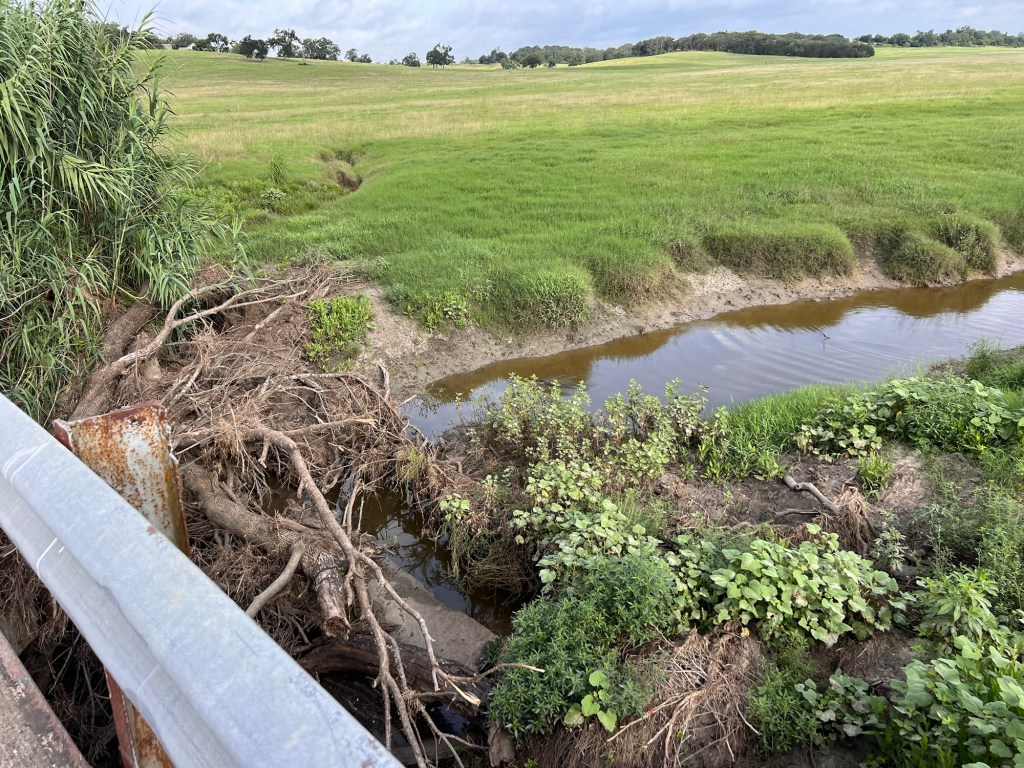
A likely sighting site, Walker’s Creek bridge on County Road 140, featuring: flood debris.
This morning I was doing my daily walk to the bridge and back, dreading the inevitable scattering of annoyed vultures (today both Black and Turkey) who have been patiently working on what appeared to be a deceased Holstein steer, which must have come a long way, since we have no Holstein cattle nearby.
Cow mercifully not shown. Zoom in. There are many vultures.
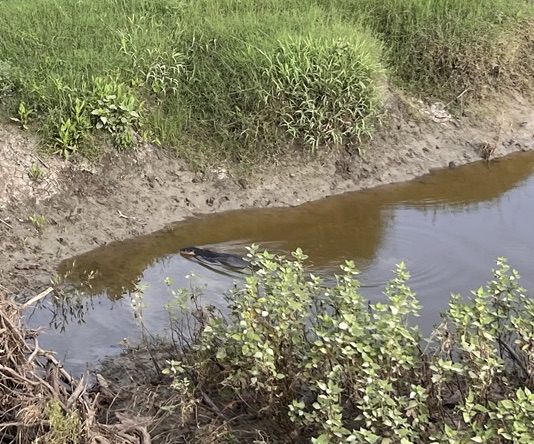
Sure enough, I scared the giant birds off. Then I noticed a head larger than that of a turtle or snake in the creek. Ooh! A mammal! I was instantly ready to snap a photo, figuring it would see me and exit.
Aha!
Sure enough, something brown and wet was exiting. Was it a beaver or an otter? I was ready to verify by checking its tail.
Looks skinny.
Yay! It was a river otter! How fortunate I was to see this water mammal! I’ve seen two swimming together here a few years ago, and one crossing our field after a big rain. That was very cute.
100% otter.
I didn’t take too many more photos, because I was enjoying the moment. But I was very happy to finally document one on iNaturalist!
Getting the heck away from me.
River otters are also called common otters (Lontra canadensis). As their scientific name suggests, they are found all over North America, except for a swath of territory in the center of the country.
Hmm.
They love to eat fish, crayfish, and turtles, but will also eat other small animals. They aren’t a danger unless you own a fish farm, which would lead to happy otters. River otters also love to play, which makes them very popular in zoos.
Not playing, getting away!
I’m glad we still have some otters here in Milam County, because they’re a sign of healthy waterways. I guess Walker’s Creek is pretty good other than pooping and dying cattle.
I’m still looking for a beaver, though I’ve seen evidence at a fellow Master Naturalist’s property nearby.
Bonus observations:
I saw a Northern Cardinal eating away at the berries of a nettle-leaf noseburn vine. more fell to the ground than went in.
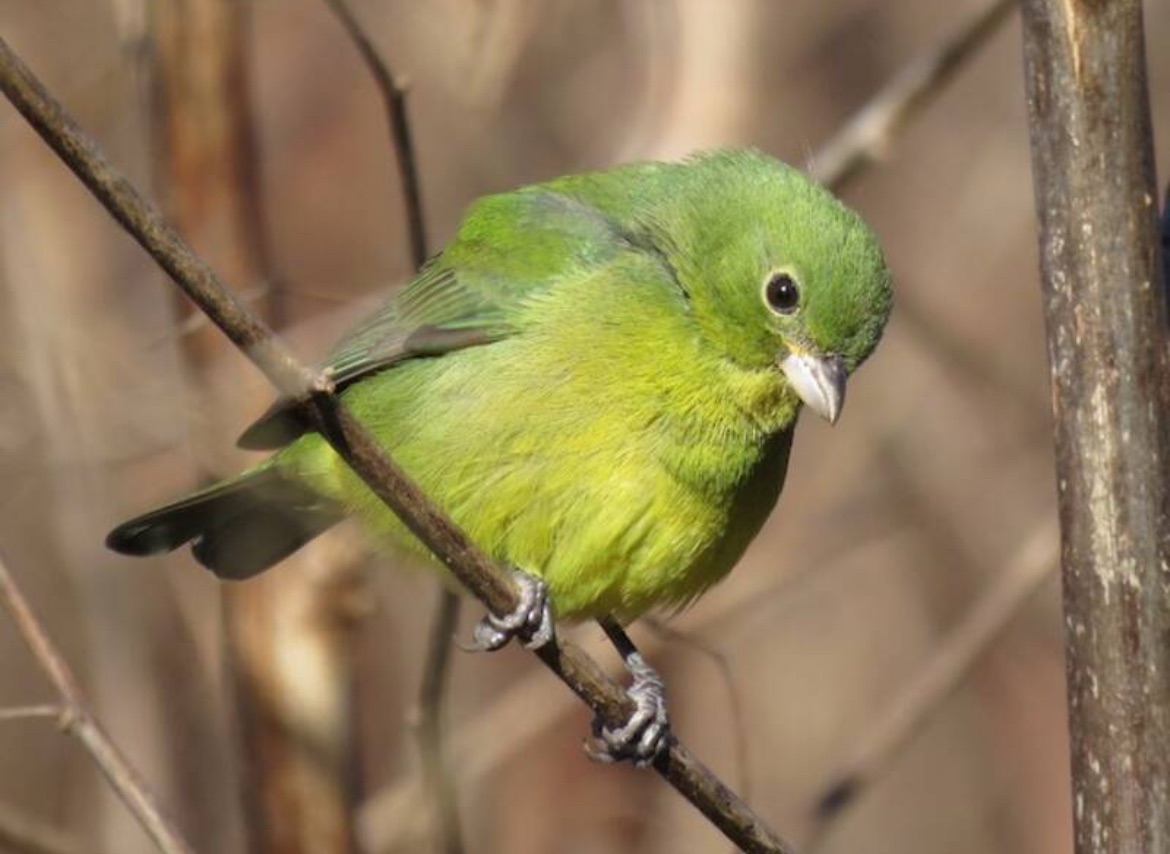
Yesterday I was swimming when I saw a small bird bathing in the shallow “beach” end of our pool. I figure it was a House Sparrow, but her breast was yellowish. Then she shook her wings. She was a Painted Bunting! I’d never seen one at the pool before!
Also yesterday I heard a Summer Tanager, and something chirped back. It was the female, for once not hiding. I’m always impressed with myself if I can ID a female bird of a species with drab females.
Nettleleaf noseburn Tragia urticifolia – photo by Sue Ann Kendall Female Painted Bunting Passerina ciris – photo by Lloyd DavisFemale Summer Tanager Piranga Rubra – photo by Don Danko
I noticed I hadn’t taken a wolf spider photo at all in June. It wasn’t as if I didn’t have spiders on the brain. We were working on a species group that’s prevalent in South Texas. Still, I thought I’d like to do something with live spiders, and I thought it would be nice to find several big ones and bring them in to the El Camino Real Texas Master Naturalist booth on the 4th of July for show and tell.
Before the sun was up, I was out looking and found two out of the three I hoped for. By early afternoon those of us at the west end of the county could see the impending storm looming over us but we had no way of knowing it was about to stall. So I decided not to drive into Cameron.
As the day ended, I photographed the two spiders and then released them. The first was a mellow and self assured adult male Rabidosa rabida with black forelegs. His leg span was nearly 3″, and he required special treatment, because he easily climbed out of containers that work for most wolf spiders.
The second was a cautious adult female Hogna antelucana who gave me no trouble at all except for fidgeting during her face shots.







 Nature Along the El Camino Real