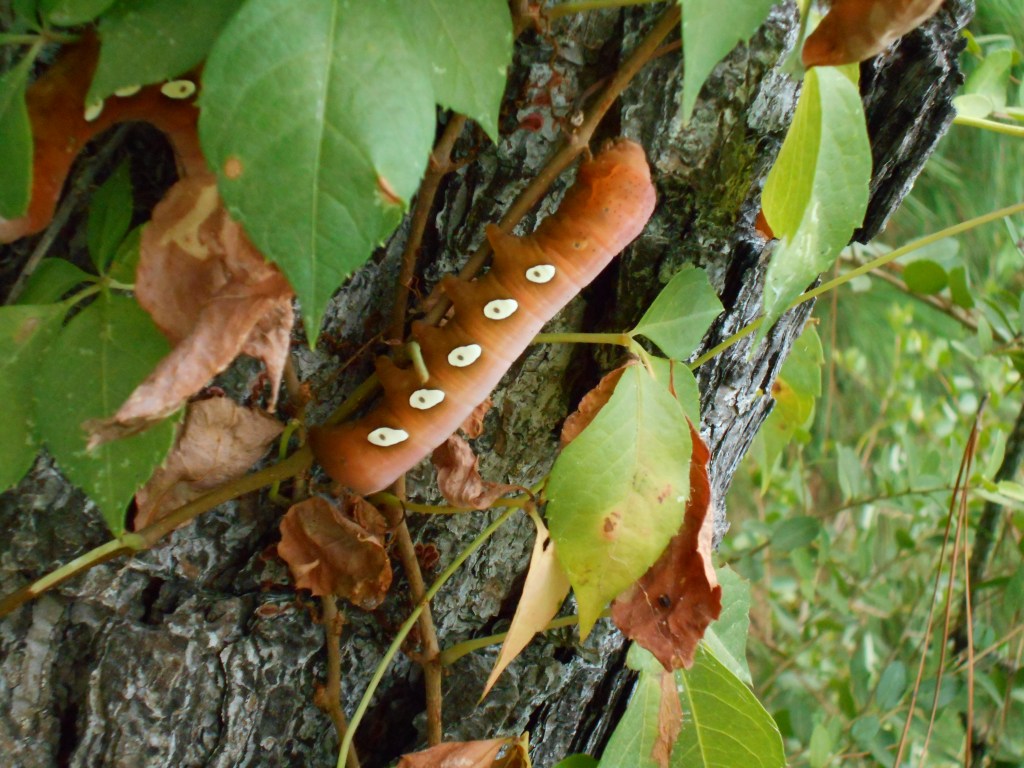
This Pandora Sphinx was a very interesting caterpillar I found one day while walking around our place.
Pandora sphinx moth from 2015.
It’s rust colored, very fat with bright yellow almost tear-drop eye patches. I had never seen one before or since then. I was excited to find it.
It was eating leaves on a Virginia Creeper vine, a vine with five leaves.
Here’s a picture of Virginia creeper taken by Ann Collins from iNaturalist (Creative Commons copyright).
The Virginia Creeper is a great native vine to have around. It tolerates most soil conditions and climates It has many uses for wildlife, and can be used as a vine in gardens.
Many birds such as Bluebirds, Titmice, Cedar Waxwings, Robins, Chickadees, and more love its berries. Several species of Moths and Butterflies use it as a host plant.
This is also the vine that created the saying we were taught as children.
Leaves of 3 leave it be, leaves of 5 let it thrive….
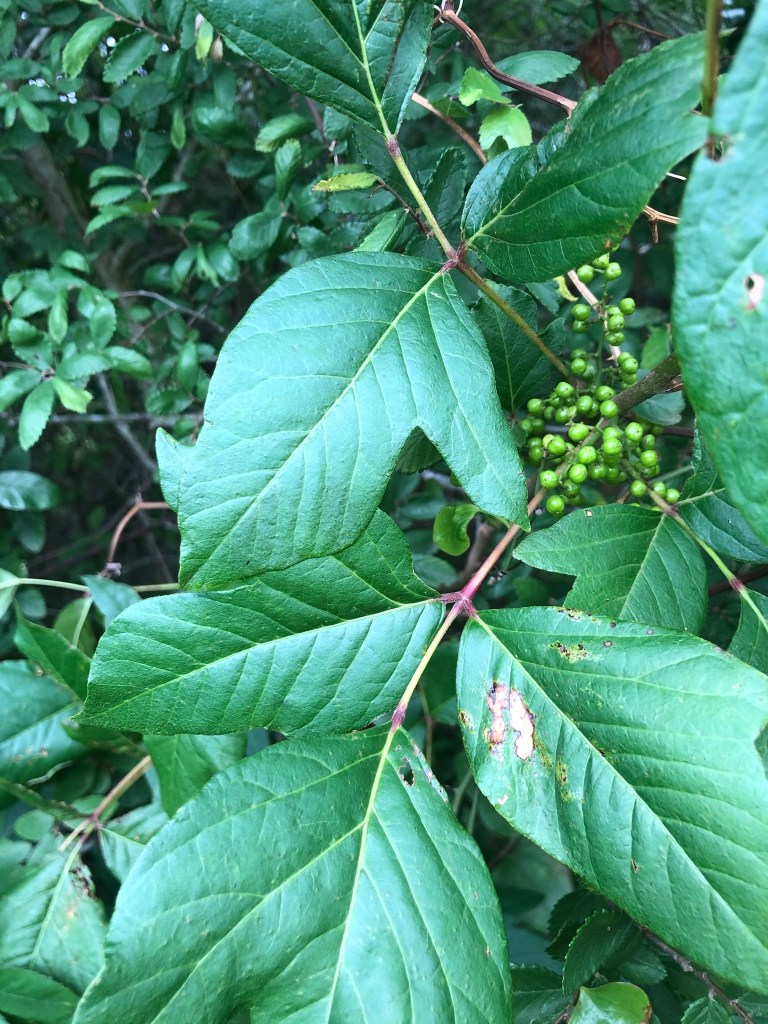
Poison ivy near Cameron, by Sue Ann Kendall from iNaturalist. Creative Commons copyright.
This vine is often mistaken for our favorite vine, Poison Ivy, but Poison Ivy has three leaves.
Right now you can find both vines just about everywhere in the country especially around wooded areas with part shade, so be careful to identify which one you just touched..
I have personally found that an over-the-counter product called “Tecnu” Poison Ivy Scrub. If used within 8 hours, it can really help get rid of the oil that causes the itching.
Most of us have these beautiful vines that come up on the ground, fences, and trellises. So besides being magnificent, who else appreciates them? Butterflies and birds, that’s who.
Passionflowers
The vines only show up when it’s hot. Pretty lucky for us, because it’s hot here.
The Latin name for the passion vine is Passiflora incarnata. What you may not know is that many of the vines we have here are actually naturalized, not native. You can tell by the number of leaves on them which one they are.
Another view.
If they have five leaves, they originally came from Asia and naturalized here. If vines have only three leaves, they are true natives. Both work well here and are host plants for the Gulf Coast and Variegated Fritillary butterfly. The vine also provides cover for other insects.
Fritillaries
The Gulf Coast species is orange and black with silver under parts.
Gulf Coast Frittilary
They use the passion vine as a host plant. They love hot weather, so only appear when the vine emerges. Pretty smart of them.
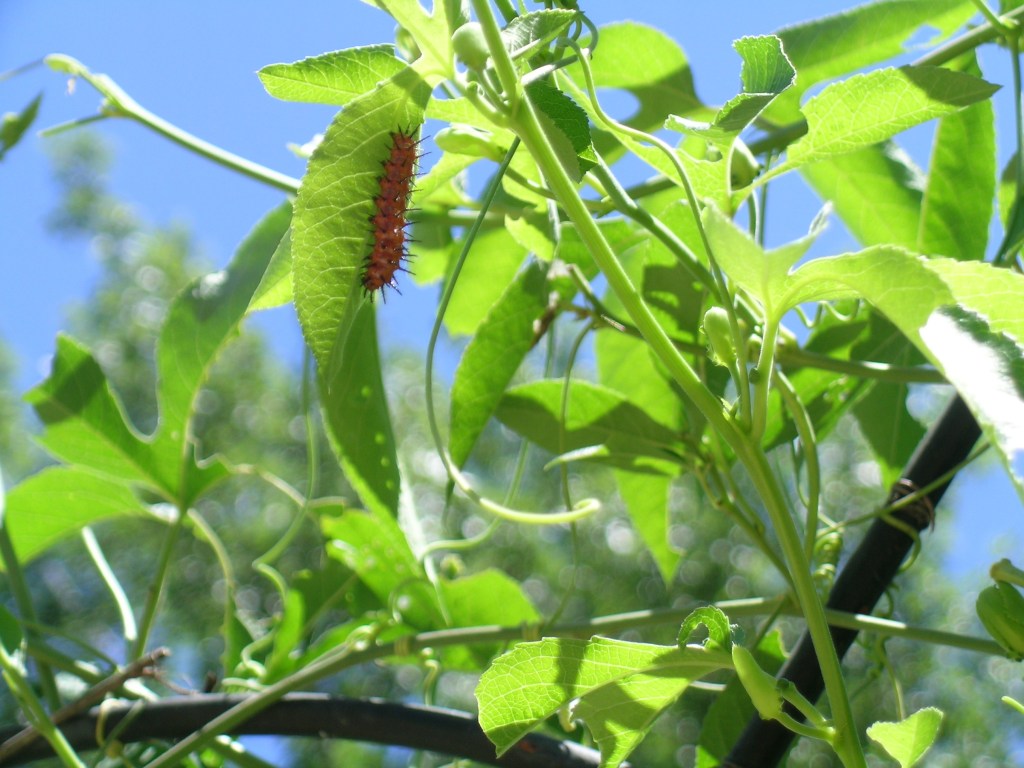
Gulf Coast Fritillary caterpillar
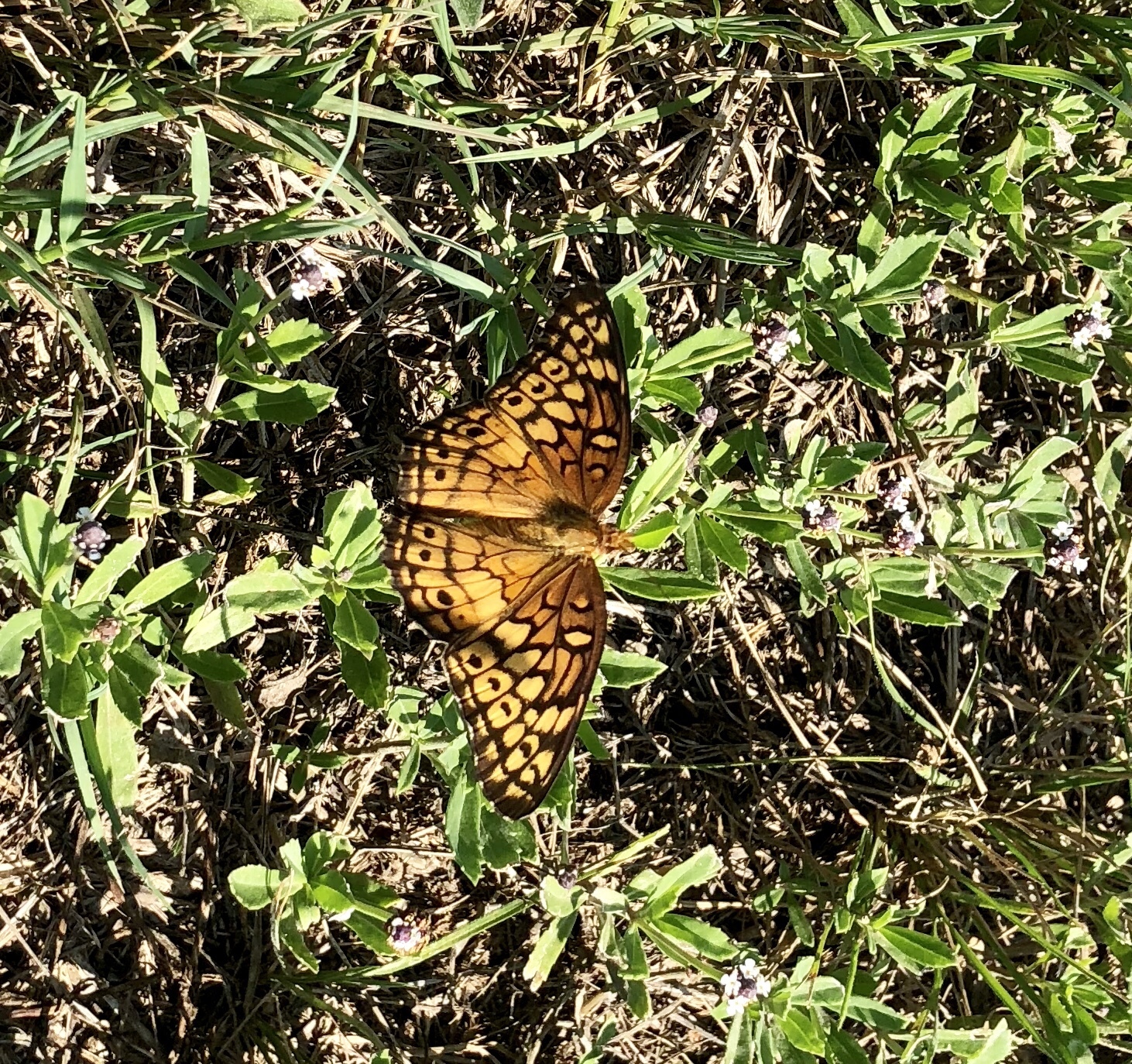
The second species of Fritillary is the Variegated variety.
Variegated Frittilary. Photo by Sue Ann Kendall.
Variegated Frittilary caterpillar. Photo by @susanmco on iNaturalist.
They also use the passion vine as a host plant to deposit their eggs on.
The Vairegated Frittilary does not have the silvery underwings of the Gulg Coast. It looks more like a dried leaf when it has its wings up. Both Fritillaries appear in the summertime, and will leave when the weather turns cooler.
The passion vine is a great way to cover a large area in your garden. [Suna points out that the fruit is also edible and makes a lovely jelly.]
This vine has five-leaf clusters, so it’s naturalized.
In the afternoon of June 2, 2020, three young Great Horned Owls were gathered and placed in a large dog carrier.
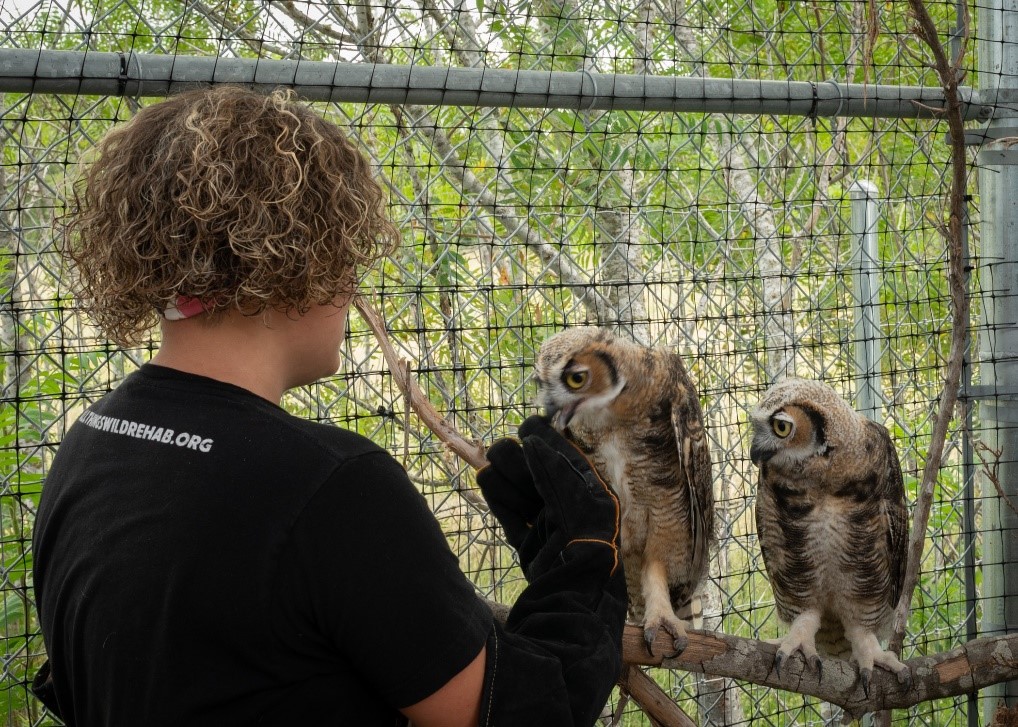
1: Sara Prepares the Owls for Their Journey
Their destination was Cedar Hill Ranch, Gause, Texas, for release into the wild after being saved and rehabilitated by All Things Wild Rehabilitation.
Later that evening they and their human volunteers arrived at Cedar Hill Ranch.
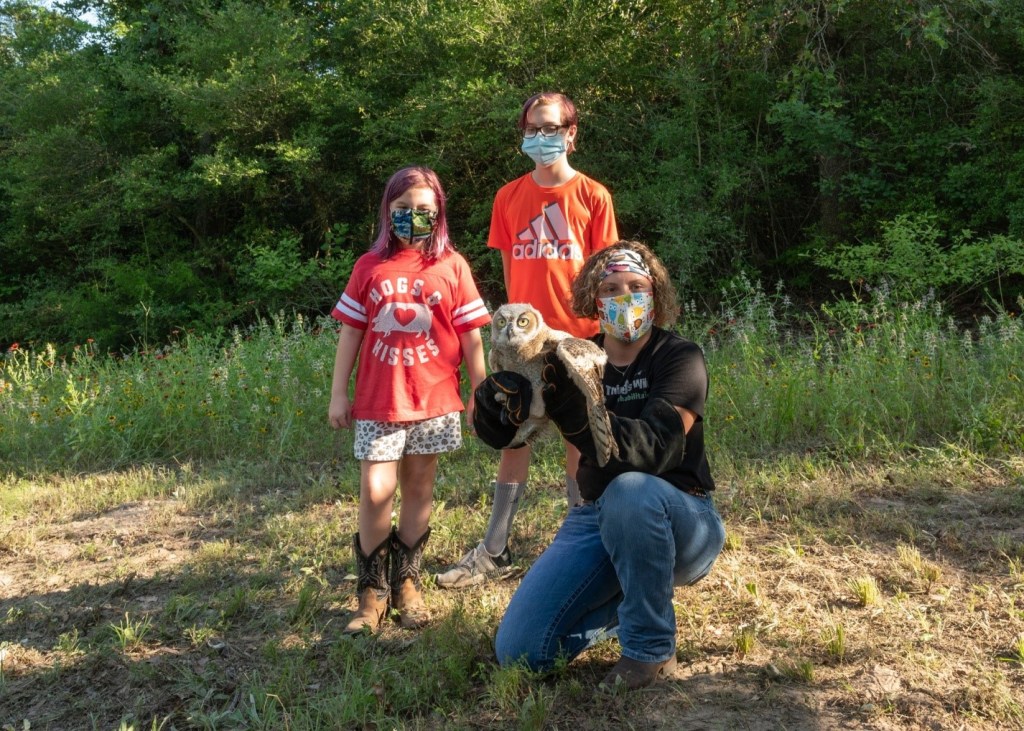
2. Owls in Carrier3: Conners and Sara Ready for a Release
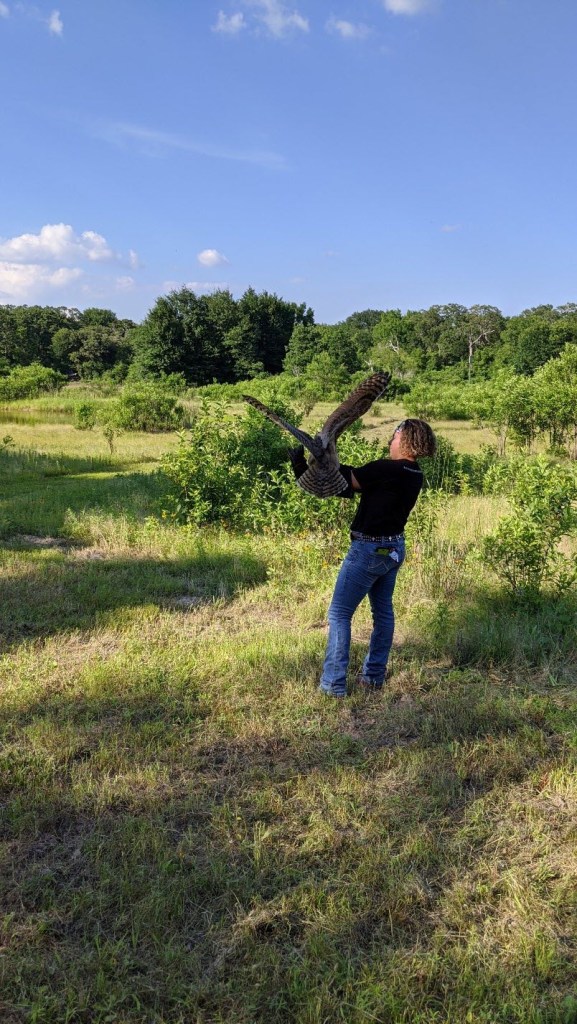
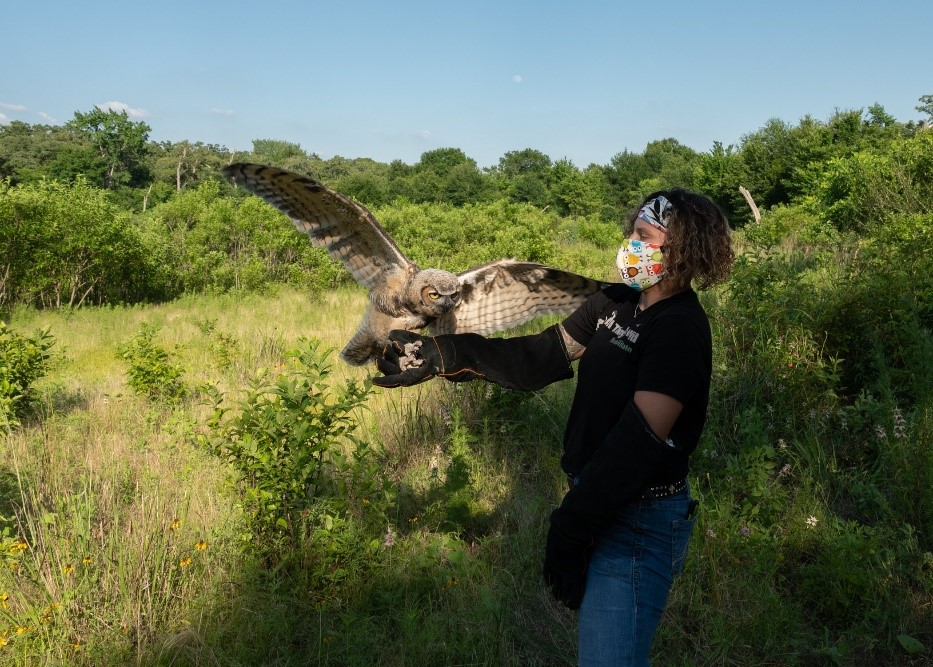
After a short drive to a meadow with ponds surrounded by mixed forest, the birds were released one by one. Conner grandchildren were visiting the ranch that day and were able to participate in the release.
5: Sara Releases Another Owl4: Sara Releases an Owl6: One of the Released Owls
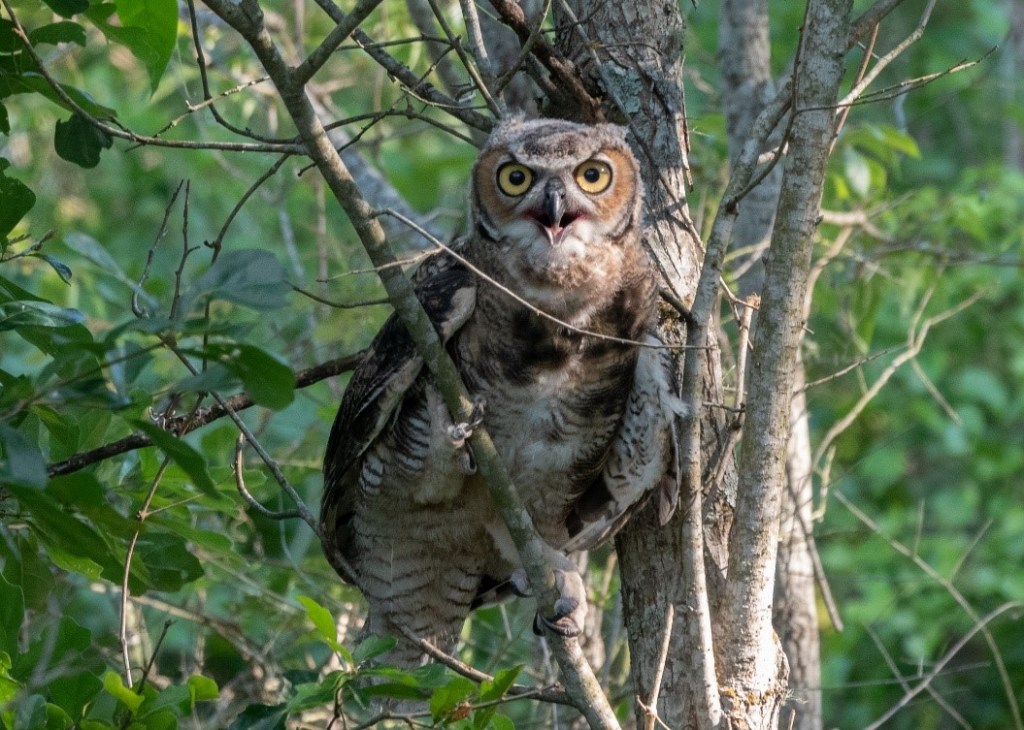
One owl posed for photos high up in a nearby tree before heading farther out into his new home environment.
Little Foot, 6/2/2020
Another owl, four weeks younger than the other two, stopped in a nearby cedar tree, and posed for a long time. We later learned that his human caretaker had named him “Little Foot”.
After about an hour, the humans returned to the ranch house and left the owls to live out their days wild in the area.
Update
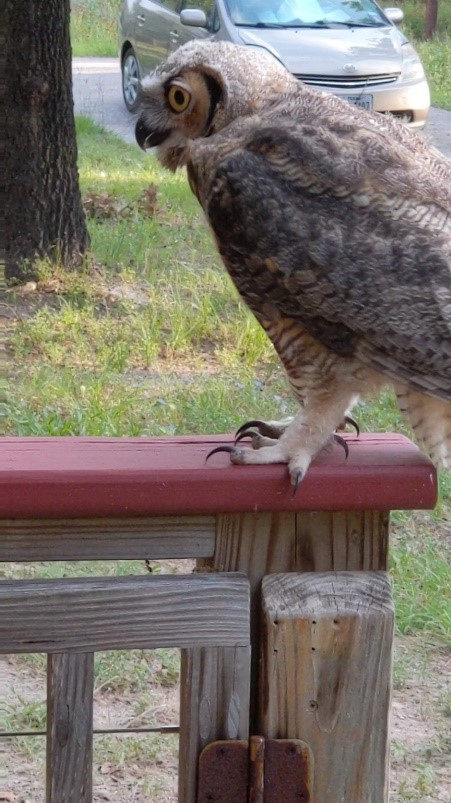
Six days later Little Foot appeared at the Cedar Hill ranch house begging for food by clicking his beak and screeching.
Watch Little Foot asking for food.
8: Little Foot Returns, 6/8/2020
We were advised by the All Things Wild staff to make noise with pots and pans so that he would not be comfortable near the house and would return to the woods. Although he flew away that evening, he reappeared the next morning. This time he flew directly up to us and pecked at our legs. This behavior indicated to everyone that he was not ready for release in the wild, as he was still relying on humans to provide food to him.
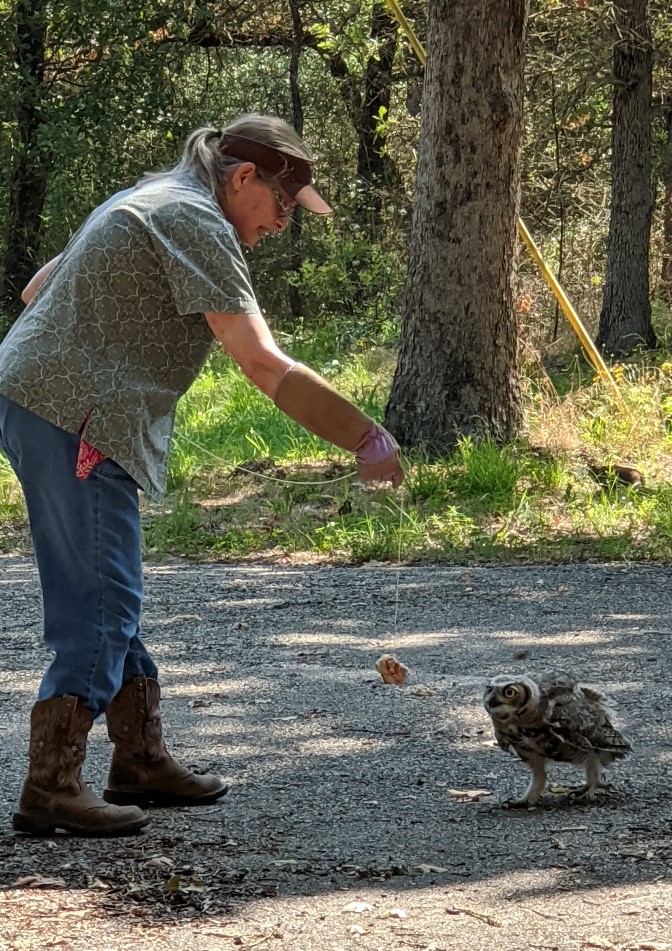
We were then told to lure Little Foot into an enclosure to hold him until Sara was able to get him that evening. Joyce tied a piece of raw chicken to a string and led him slowly several hundred feet into one of our chicken coop enclosures.
9: Luring Little Foot
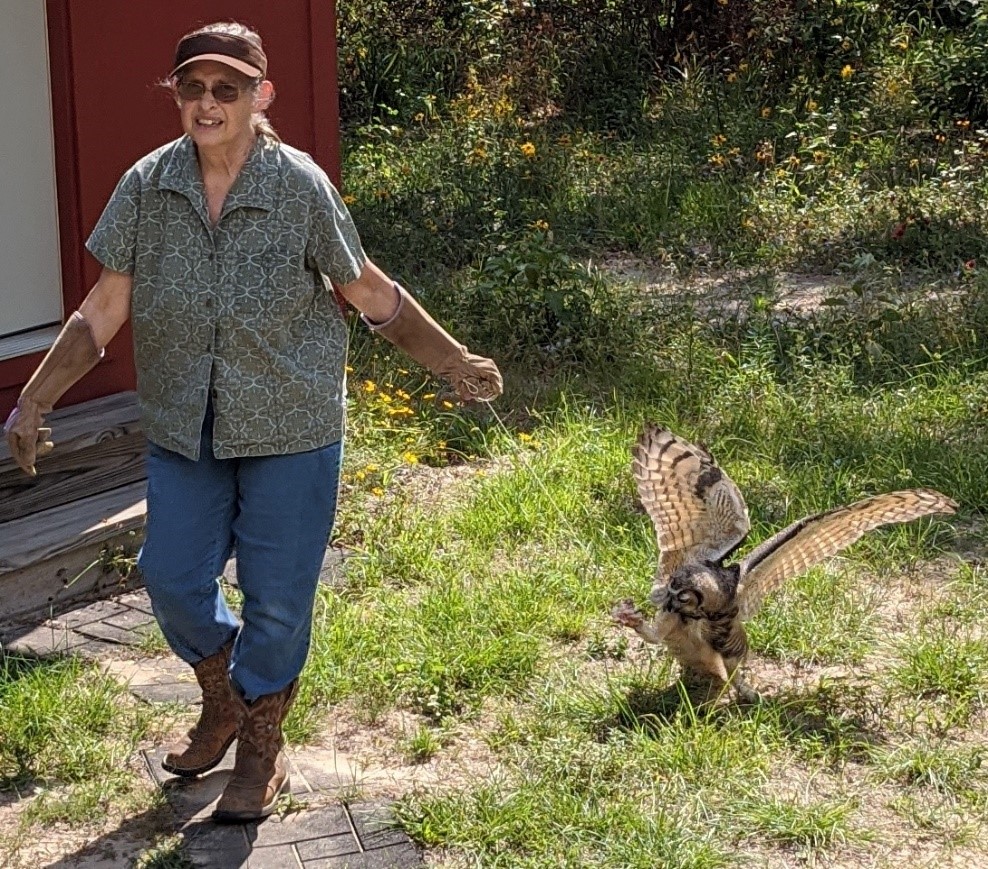
At one point Little Foot grabbed the chicken and tried to get it away from Joyce. Although hungry, he was surprisingly strong.
10: Little Foot Grabs the Chicken Piece
11: Little Foot Waits in a Chicken Coop Enclosure
Sara and friends arrived that evening. They took Little Foot back to the All Things Wild Rehabilitation Center where he will live in their “flight” cage. They will feed him only live food for about a month to get him ready for a second release attempt.
12: Sara and Friends Recapture Little Foot, 6/9/2020
Can You Help?
All Things Wild Rehabilitation (ATW) is looking for places to release animals to the wild. Usually, they like a site to have a source of water and for landowners to be willing to put out food for the young animals for about 2 weeks until the animals learn how to forage on their own. However, we have been a release site five times and have never been asked to put out food.
If you find a wild animal that you think needs help, visit the ATW website at and review “Found An Animal?” information. If after reviewing that information, you decide you need to contact the center about the animal, call 512-897-0806.
If you are interested in becoming a release site, the following information is from their website.
How to Become a Release Site
The goal of wildlife rehabilitation is to return the bird or the animal to the wild. We release the rehabilitated animals on private property with permission from the owner. All Things Wild is always looking for good release sites. Here are our dream criteria for releasing most small mammals and raptors:
Acreage, preferably 10 acres or more, with woods,
No high fences,
Water year-round,
Away from busy highways, communities, houses, and lots of people,
Accessible by vehicle or hiking,
Willingness to do a soft release* if necessary, and
An appreciation of wild animals.
If you would like to offer your land as a release site for ATW, please email allthingswildrehab@gmail.com.Thank you!
*A soft release is when food is left out for released animals until they become accustomed to foraging in the wild.
More about Great Horned Owls
If you’d like to learn more about these amazing birds, please download this PDF fact sheet that Joyce made to help educate her grandchildren, based on information she found on the web.
Catherine Johnson and I had a spectacularly rare treat this week. We were visiting the Bird and Bee Farm, where Catherine has created a marvelous wildflower garden. If you haven’t seen it, you really must go. It is full of color, texture, and scents. Guinea fowl and chickens roam free, gobbling up grasshoppers and other noxious critters. Catherine even shares the overflow (flowers, not grasshoppers!).
Bobwhite quail. Image by @JBL via Twenty20
Gene and Cindy Rek have turned their hundred-acre property into a prairie paradise. You may already know they sell laying hens of every description. They also sell Rio Grande turkeys, guinea fowl, and Peking ducks.* This week they added another member of the feather family: Bobwhite Quail.
After an early morning trip to Bastrop, they came back with two flax boxes with breathing holed punched in them. Inside were thirty pairs of breedign quail. Gene carried the boxes out in some tall grass and gently set them down. He cut the strings on box #1 and carefully lifted the lid, revealing an almost-solid carpet of mottled brown feathers.
Just as we were taking in the scene, it suddenly erupted and flew away. Not at all what I was expecting!
Here’s what we saw:
The next box we were somewhat prepared for, but it was just as exciting when it was opened and thirty quail breathed a sigh of ecstasy and got their first taste of prairie freedom.
While we stood, adjusting to this miracle of Nature, the birds immediately started calling to one another with their signature whistle of, “Bob White!”
Later we saw several of them on the pond margins, trying to make sense of this incredible gift they had been given. Hopefully, most will survive to repopulate an area that was once their native habitat before every scrap of nature was cleared away for cattle, monocultures, and civilization, before pesticides, GMOs, and chemicals.
This is supposedly quail. Photo by @Tereza via Twenty20
These birds were all full grown, but future plans include day-old chicks to be raised in the barn and released later this summer.
There will be a coming out party when they are old enough, and all of you are invited to the celebration. Cindy will let us know when it is. It will be fun: a step back in time and a step forward toward restoration of a native prairie, right here in Milam County.
Mark your calendars!
*The farm is open only by appointment, and they are booked many weeks ahead. Please call them at (512) 808-8533 to reserve an opening! You can drop by and look at the gardens at any time.
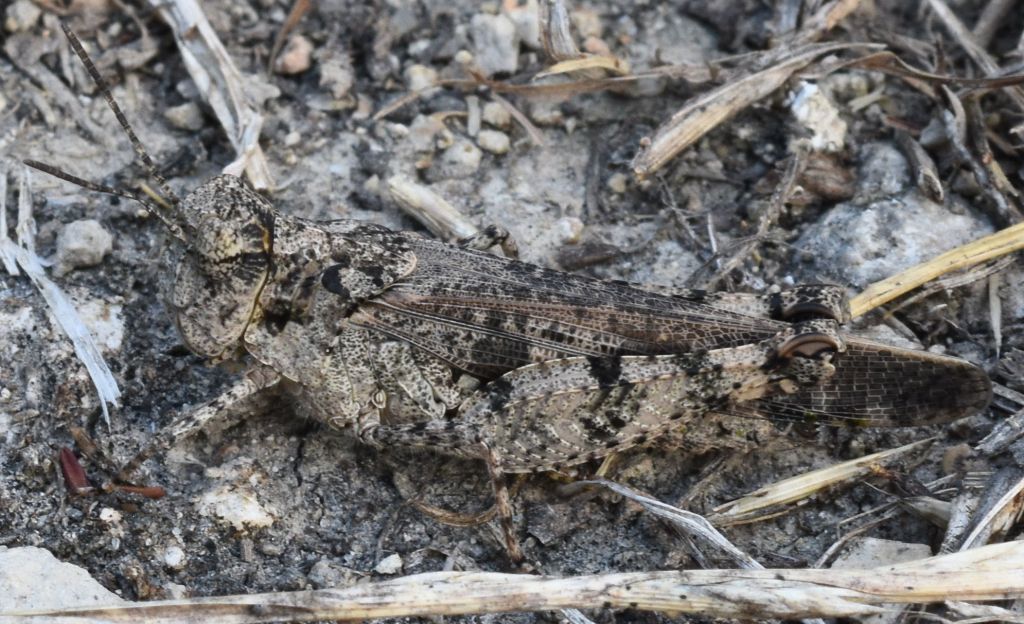
This grasshopper wins the award for best Texas Blackland camouflage. It is so good that it could well have evolved here. Nymphs are especially difficult to see.
Unlike some other grasshopper species, its appearance is fairly consistent from individual to individual. It is also relatively common, at least in my neighborhood. Observations at iNaturalist suggest a range from just over the border in Mexico, north up through the center of Texas, and just into Oklahoma.
This was my first big ID challenge. I started noticing these last fall soon after I joined iNaturalist. There wasn’t much help on iNaturalist with less than 24 observations, most misidentified, and few if any research grade. How can this happen with an everyday species? Well, first this species was named Encoptolophus subgracilis until recently. A recent genetic study of the Chortophagini resulted in a new genus and realignment of several species. The second is that grasshoppers don’t have a lot of fans and people tend to concentrate on the easy ones.
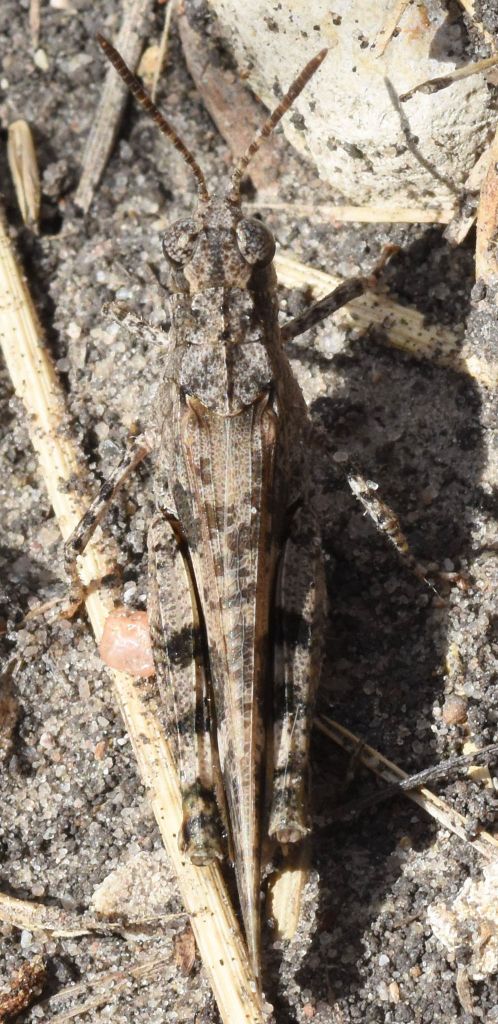
The view that gives the accurate ID.
Eventually I found the published article on line which provided some guidance. While a lot of the focus was on genitalia, which are rarely visible in live photographs, there were also details of the cranial ridges between the eyes for this and a half dozen related species. From that point on, all that was necessary to confirm an ID was a sharp, overhead photograph (at right).
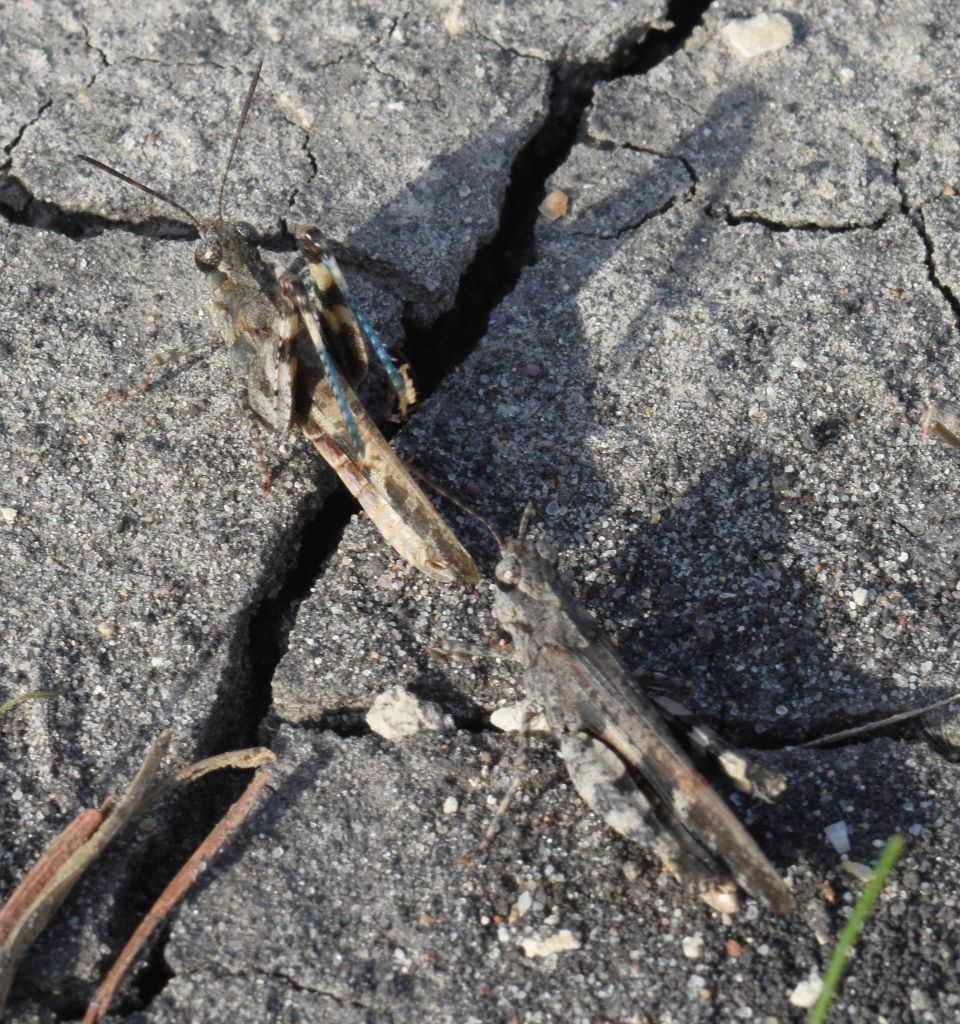
The cranial ridges look like a bottle with slightly curved sides an a short neck to me. Another characteristic is the bright blue tibia which stands out against the salt and pepper body when the hind legs are flicked out during mating displays (see photo below).
This species can probably be found throughout Milam County from at least May through October.
Fun times for the dusky grasshoppers – blue area visible.










 Nature Along the El Camino Real