I love the Bluebirds. In the winter I try to help them out by feeding them dried mealworms. They probably like live worms more, but they are more expensive and harder to get. But a little help during harsh weather is still a good thing.
Every year I hate to see the dried worms ruined by rain or ice. However, the Bluebirds will not use any feeder that is closed in. They want an open platform with a perch on it. They do not like anything that they have to go inside.
I have tried many types of feeders marketed for them. They have not worked.
I have been watching the birds for years, so I know what they do. I thought maybe a clear container with a small cover might do. I placed it on a square plywood board, put a back board on the North side to block some of the rain and wind, then watched to see if that would even take a chance and go for the worms.
Success!! They did. Boy, was I excited. Now, I will see what happens when the severe weather arrives. That will be the real test.
They do not like rope or bungee cords attached to the feeder. They might think they are snakes? I don’t know. I hope the wind does not blow the feeder off.
Anyway, we will see soon if the feeder keeps some of the worms dry.
You have to observe our wild friends to see how they feel about something we have made for them. Think like a bird. Keep learning by observing.
Success with growing Pink Turk’s Caps from seed is looking more possible every day. I now have seven growing from seeds that wintered in the refrigerator. Then I was surprised to find that the one whole seed pod I planted in the ground last November had come up. I had flagged the site, so I could remember exactly where I put it.
So, they will come up from a baby plant planted in the fall, seeds that have been removed from the red pod covering, cleaned, dried, and refrigerated over the winter, and a whole pod placed in a flower bed in the fall. The only version that didn’t produce plants were the cleaned and dried seeds planted in the fall in containers and left outside.
Now, I’m waiting to get them a little larger, so I can transplant them to the mostly shaded flower bed.
A Turks Cap with pink flowers was planted at the El Camino Real Master Naturalist Wildscape last year. Due to its prolific growth, which was over six feet tall and wide, and it being covered in many pink flowers, it was the wonder of the season, including with me.
I was determined to grow some myself! Catherine Johnson, site manager, felt compelled to give me a “baby” plant that had sprouted up under the big plant just in case my attempt to grow some from seeds didn’t pan out. I should point out that a few “baby plants” of another species had not made it at my house.
One of the reasons I really liked this plant was that it likes shade. It can grow large even if it’s in the shade most of the day. My front yard was covered in shade all day long due to some very tall and old Live Oaks that run across my front yard. Notice I said “was.” It is not quite as covered now. The freeze/ice of 2021 and freeze/lots of ice of 2023 has severely pruned those trees to the point of blue sky now being visible when one looks up.
I have planted a few other things from the Wildscape that are alleged to be shade tolerant, and they are to a degree, but they are stunted in growth by too much shade. A Flame Acanthus reached about 12 inches tall and finally put on two blooms last year. This pink-flowered Turks Cap was in shade for a good part of the day, and it grew like crazy. It did get chicken poop fertilizer, so that probably helped.
So, I took about 10 of the small, red apple-looking seed pods late last fall. I did some research on how to grow them from seeds and proceeded to try all versions. There were basically three different methods suggested by different people. First, it was suggested to stick the whole seed pod in the ground. I did two in that manner. I put one in the ground and one in a small potting container. Neither has come up yet.
Second, it was suggested to open the seed pods, remove the seeds and clean them of any of the pod then dry them in the sun. After the drying, it was suggested to pot them in very small containers and put them in the sun. I did eight in this manner. I started them inside in a window that doesn’t get much sun. The weather was staying pretty moderate, so I moved them outside. I watered them periodically, and left them out during the freeze. Nothing has sprouted yet.
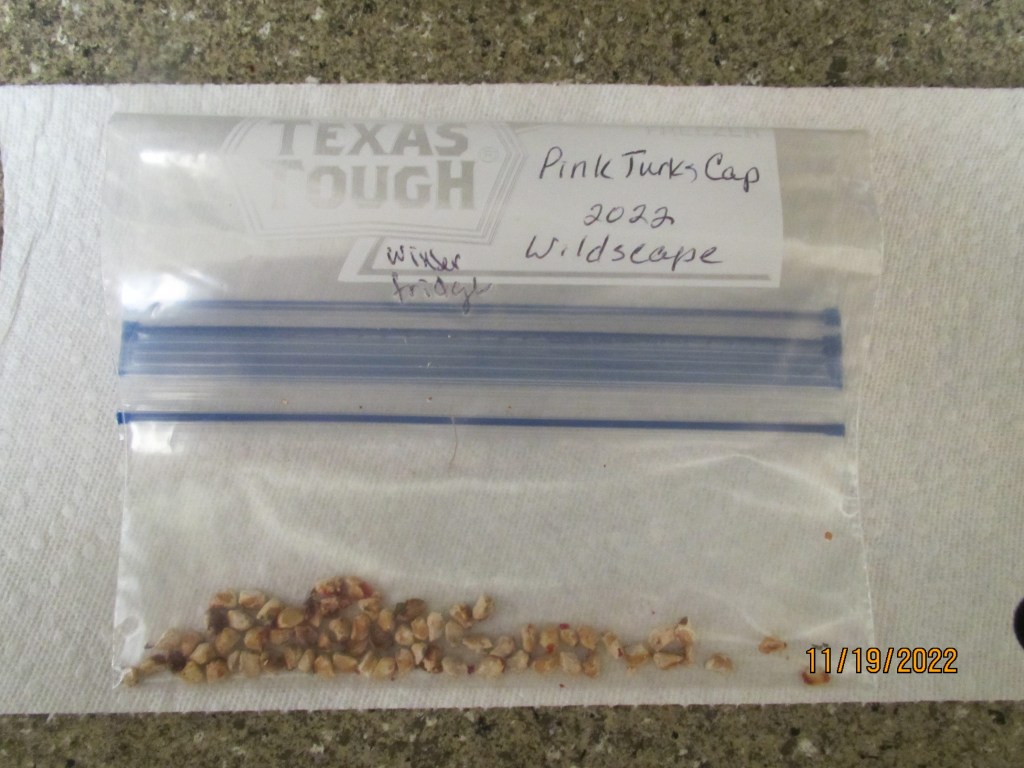
Third, follow the cleaning advice in the second version, then put them in an airtight bag in the refrigerator for the duration of winter. I used a zip lock bag. Plant them in late February or early March. Two weeks ago, I purchased a container made for starting seeds that would fit on my kitchen window – the only window that is accessible and gets several hours of sun in my house. I took some dirt from the empty flower bed where I intend to plant them if they grow and planted them. I dropped several seeds into each section of the container. I had seeds left, too. This window is in my kitchen, so I’m paying close attention to them.
My first positive sign of growth was the “baby plant” that I put in a large flowerpot last year. It is back! I should note that it is in a sunnier area.
My eureka moment came on Tuesday this week! One of the refrigerator seeds has sprouted. I excitedly yelled “Yea!”, which caused my son to come into the room to see what was wrong with me. He reminded me that I had not invented something new. But I had grown it from a refrigerated seed.
I’m hoping it really will like all the tree shade in my front yard.
Carolyn Henderson is one of the many folks in our Chapter who participate in a program to track the rain on our properties. It’s sponsored by CoCoRaHS, Community Collaborative Rain, Hail and Snow Network. Our data is collected daily to create one amazing database of precipitation!
Ideally, reading the rain gauge (or precipitation collection device) must happen daily, or we sure try to do it every day. Carolyn shared this with us yesterday:
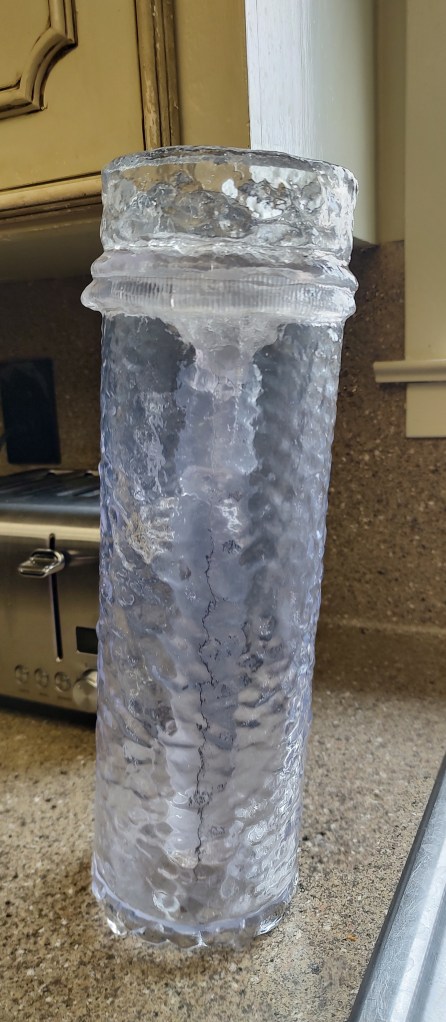
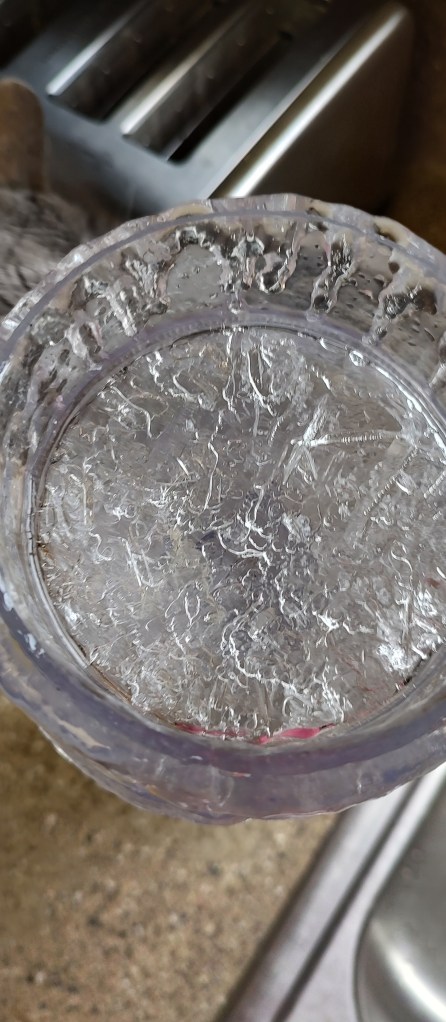
“Here is what the CoCoRaHS precipitation collection device looks like. It looks like about .75 in the inner section with about .5 inch frozen where it enters.”
If you have tales of citizen science during the ice storms in Milam County, feel free to share them with us. We can be reached at ecrmnsecretaryATgmailDOTcom.
It is now time to have your Martin Housing ready to open. If you noticed, I said ready, NOT open yet. You do not want to open the cavities till you hear the Martins at your site.
If you do, you will have a House Sparrow hotel. You cannot allow the House Sparrows to live in the Martin housing. They will kill the Martins for the nest.
So, when you see or most likely hear your first Martins arrive, roll down your gourds or apartments and open only a few of the entrances. Open more as more Martins arrive.
It’s a delicate dance for sure. The more you do it, the better you get.
Putting everything back after the Martins have been gone for six months is hard on us senior folk. So, I was lucky this year to have some wonderful volunteers from our Master Naturalist Chapter come over and install the gourds and the Owl Guards for me. Cindy and Gene Rek came last week and did this for me.
The photo of my gourd rack shows the Reks installing the gourds.
As of 1-20-2023 the updated scout report has Martins arriving in Louisiana and Florida. So, they could arrive here in three to four weeks.
The rack is in its down position for now.
I get asked why I would go to so much trouble for these birds. Once you hear their beautiful songs, you will know why. It’s truly a wonder you will not forget.
The Gourds with our friends in 2020.
I will run the houses up the first week in February and I will let everyone know when my first Martin arrives. Martins depend on human-supplied housing now, almost exclusively.
“How wonderful it is that nobody need wait a single moment before starting to improve the world”






 Nature Along the El Camino Real