Monarchs Passing through Milam County

by Donna Lewis

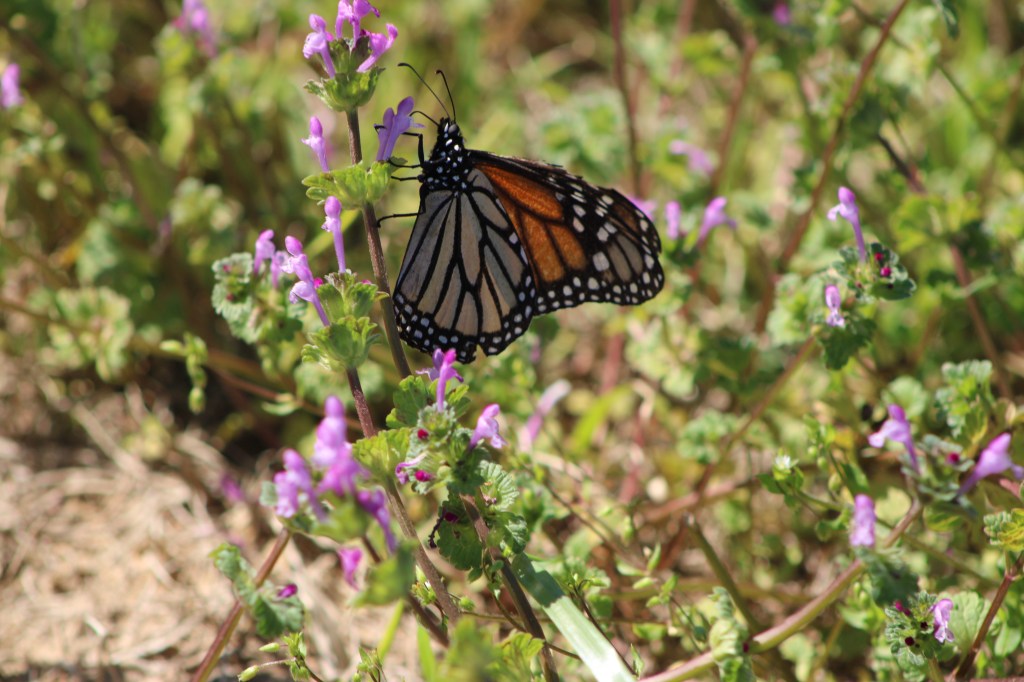
A few weeks ago I had the few Monarchs that I was able to see on our property here in Central Texas.  I have only counted about one dozen in all. That is a sad number considering there used to be hundreds crossing our pastures. I have been counting them for years and reporting this information to Journey North and several other organizations.

This serious decline is happening to most butterfly species. The Monarch is just an iconic species that we all recognize.

There needs to be more citizens who try to help them. Probably all who read our Master Naturalists blog will do something. But most people will not. This could be that they don’t know what to do, or they think their small actions won’t matter. Everything matters.   Remember that.

So, action means leaving natural area’s unmowed till after all the milkweed has gone to seed. It means learning about all of our pollinators and planting appropriate native plants for where you live. There are lists online about these plants. Yes, these plants can be hard to find. It means looking to volunteer groups like Texas Master Naturalists for advice.

These are the things we love and work hard to educate ourselves about them.

As humans we like to neaten up our yards and pastures. That is not what butterflies, birds and mammals like. A mower means death to them. So just taking a little more time to be aware of what is living near you. If you loved moving to the country, then do not change it.

The Beatles have a song by John Lennon that talks about this. The song is, “Let it be, let it be, speaking words of wisdom, let it be…”

Remember what something beautiful means to you…and work to save it.

A New Toy Wizard

by Ann Collins

I have a new toy! And my life has changed forever! Not sure if it’s for the better, but it lets me be totally lazy. My phone is my window on the world. Living on a downward slope almost to a deep gully, service here is sketchy, often not available at all. Anyway, my new toy is the Merlin phone app, which identifies birds by sound and records a list for me. I’m excited to see what the Wizard has found and I question frequently his ability.

Is it Merlin the Magician or a Merlin bird, or both? (Thanks, AI)

For instance, it has always been a bit of undeserved pride that I’ve never seen a house sparrow on my property. I still haven’t, but Merlin hears them every day or so. House sparrows can be a major pain if they camp out in large enough numbers. They really are considered invasive. They were brought over by some well-meaning moron who thought they would be a nice addition to our native birds. Ironically, in their native England they are becoming quite rare while they have become a real pest here. It’s never a good idea to introduce a plant or an animal you think is cool. Example: the Burmese pythons in the Everglades.

I can’t believe Ann doesn’t want me pooping all over her birding area. Photo by Miriam Fischer on Pexels.com

As I sit inside my cozy sunroom drinking hot, spicy tea on this deliciously cool early autumn morning,* Merlin is busily making a nice list for me. I take my phone out to the deck and conjure up the Wizard and he eagerly gets to work. I’m glad for that, because with encroaching old age many things don’t work like they did in my youth! For istance the high-pitched frequency of many bird sounds simply don’t register in my increasingly deaf ears. Merlin is a relatively new app, so his hearing hasn’t failed him yet – probably just a matter of time.**

Example of Merlin’s observations (Walkers Creek, Texas, October 15, 2024)

I wonder what Merlin’s range is? Are the birds he hears actually in my yard or can he hear the ones a mile away? Just up the driveway? Does that depend on my service or just how he’s programmed? Who knows? Guess I could ask him.

Don’t ask me. I’m Merlin the Bird. Photo by Sethulakshmi Sajeev on Pexels.com

It’s kind of hard for me to trust technology. I didn’t grow up with it like so many of the younger folks. When Merlin IDs a Blue Jay and the next bird is a Red-shouldered Hawk, my skeptical nature questions, was it really a hawl? Some of the calls of these two birds really sound alike. Blue Jays are pletiful here at Chimney Hill and I do have Red-shouldered Hawks regularly. The hawks might even breed here or at least close by.

Blue Jay. Photo by Robert Jakubowski on Pexels.com

House sparrows? Never seen one here. I can thank my lucky stars for that. They can be a real nuiscance. How about a Blue Grosbeak or a Dickcissel or an Indigo Bunting? I did have a number of them a few years back but haven’t seen them in quite a while. I don’t doubt the Merlin reports of Red-winged Blackbirds or the grackles (Common and Great-tailed). Large flocks are not uncommon, so the Red-winged Blackbirds could be traveling with them.

Who knows what kind of birds are in this flock. Photo by Mehmet Suat Gunerli on Pexels.com

In spite of my skepticism and questions I still love my new toy. It really gives a new dimension to my census and wildlife evaluation. I love it!

Thanks to my buddy Suna for programming the app for me!


*This was written during the September cool spell.

**Suna points out that Merlin often has trouble with low sounds like owls and doves.

Reduce and Reuse Plastic, but Don’t Recycle

by Mike Conner

The following are my opinions, based on a good bit of reading but not rigorous research.

Paper, steel, modern-tin, aluminum, and glass cause minimal harm if they are “lost” into the environment. (Roadside non-plastic trash is more an esthetic issue than an environmental issue.) Many chemicals and metals are also harmful, but these should not be present in household recycling.

Plastic on the other hand causes lots of problems if it is “lost” into the environment.

Tiny, micro, and nano particles of plastic are polluting our food, soil, and water to a remarkable extent. Much of this comes from Styrofoam which quickly breaks down into micro pieces that don’t further decompose. A lot comes come coatings that break down into “forever” chemicals. Pretty much all plastic breaks down in the ocean into smaller and smaller pieces, but these pieces remain plastic; they don’t decompose.

Plastic film, complex shapes (like the harness for a six-pack of cans, or a net, or a tangle of string or rope), and small, swallowable parts are causing lots of harm to wildlife, especially in the oceans.

Plastic recycling barely works. Most estimates guess that only about 10% of recycled plastic is actually recycled and the rest is discarded. Actually, the percentage is much lower for everything but standard plastic drink bottles. Plastic bottles are more readily recycled because they are easy to identify and because they are all made from the same somewhat-recyclable plastic. Note that they are, sadly, not very reusable, as cleaning them causes them to start leaching chemicals into their contents.

In North America (including the USA) there are essentially no open public trash dumps. Here we have landfills, which are regulated, and modern ones are quite well designed and managed. The rest of the world, and especially the countries to which recycling materials are shipped, still heavily rely on open trash dumps, many located near rivers. These dumps, plus fishing fleets, account for most of the plastic that pollutes many rivers and all oceans.

In the US it seems that the processing stream for recycled plastic is poorly documented, but it is estimated that about 40% of US recycled plastic is still shipped overseas. So, when you recycle plastic, you have two possibilities:

1) It gets sent to a US-based recycler, where a small percentage is recycled, and most is disposed of in a well-managed landfill. In this case, you have increased the energy cost of disposing of your plastic with the benefit that some may have been saved from going into a well-managed landfill.

2) It gets shipped overseas, where the vast majority of it will end up in an open dump, and a good fraction will end up polluting the environment.

So, my conclusion is that we should recycle everything we can (especially things like electronics that contain heavy metals and bad chemicals) except plastic. I think the case for recycling plastic drink bottles is borderline, but for everything else it is better to put plastic in the trash.  And, of course, we should avoid single-use plastic when reasonable to do so. (The case for some plastic packaging (like shopping bags and containers) is complex, as sometimes the environmental cost of non-plastic packaging is considerably higher.)

And always remember that recycling is the last term in — reduce, reuse, and recycle.

An article with some interesting background information about landfills and municipal recycling is: This California city asked where its recycling went. The answer wasn’t pretty.  

The Bee Story

By Dorothy Mayer

So, I saw the following story online today (see screenshots from Facebook below). Some time ago, I’d likely have blown it off as a pretty farfetched tale. But I couldn’t help but think about an incident I experienced at my house a couple of years ago.

This story brought to mind about me seeing a wasp nest on our RV bumper about sixty feet from our house. I was worried about somebody getting stung, so I told Hubs that we should probably do something about them. So, he takes his handy pliers and pulls it off the bumper, as nothing was on it at the time. Then, he laid it on a little table by our porch swing that was 60 feet away from and out of sight of the RV bumper it came off. After that, we pretty much forgot about it.

Later that evening I happened to look over there and saw about three or four wasps back on it lying on that little table far away from that bumper we pulled it from. I was amazed that they’d looked for it and found it in a totally different place than it was supposed to be.

So, do I think this bee story is farfetched? I think not.

I think insects have way more sense than we realize. After all, we don’t know what we don’t know.

[saw]

To learn more about insects and all the other nature in Milam County, consider signing up for our next class! Contact ElCaminoRealMasterNaturalist@gmail.com and we’ll get you in touch with our new class team.

The Rhythms of Nature

by Sue Ann Kendall

I have a project on iNaturalist where I record the flora and fauna on the ranch where I live. I started it right after I became a Master Naturalist in 2018 and am still contributing to it. My goal is to eventually analyze the data to see if flowers or birds are appearing around the same time or if there’s difference due to weather or climate, or what.

I especially love the tiny flowers, like this birds-eye speedwell.

I accumulated a lot of Master Naturalist hours while working on this project, since I go out on almost every nice day to see what’s new on the property. But, last year the program changed its policy, and now we don’t get credit for hours spent observing nature on our own property. I can see not wanting observations of the same twenty plants in a suburban yard, but we have 500 acres. I stopped for a while, but then I realized the project is still important to me, so I am still taking pictures and uploading, especially in the spring.

Last week I shared some of the earlier flowers in our fields and woods. This week some new ones have showed up, which always thrills me. I’ll share some photos of the new arrivals below.

We are also losing some birds and gaining others. The hawks are still here, red-tails and red-shouldered, along with the tiny merlins and peregrin falcons. And our resident harrier keeps hovering over the fields, hopefully eating a LOT of mice.

The amazing pair of great blue herons seems busy bonding, and the belted kingfisher who showed up over the winter is still flying around and making its unmistakable chirps. In addition to the crows and starlings, we have some visiting blackbirds that make a beautiful sound. I’m not sure what type they are but enjoy listening to them. And cardinals. Wow, do we have a LOT of cardinals, too. I never knew they flocked until I moved here.

Just one male cardinal
Action shot showing the beautiful tail of this barn swallow.

Yesterday, I looked into a willow tree behind my house with my binoculars and saw a loggerhead shrike, a dove, English sparrows, a pair of cardinals, and a festive group of tiny chickadees bopping around. That’s my kind of decorated tree. Oh, and some red-eared slider turtles were holding down the trunks (this was in a tank).

I was happy to see barn swallows already in their nests just a couple of days after they arrived. The tiny insects are here, so they are looking pretty happy.

Speaking of tiny insects, I am always seeing tiny flies and bees on the flowers. They are pretty hard to identify. For example, the fly or bee in this picture is much smaller than you’d think. That is a dwarf dandelion it’s on, not a regular one.

So, yes, it’s a fun time over where I live, and I’m glad I’m able to document the variety of life here in the northern part of Milam County. I look forward to seeing what others are observing. I’ve noticed lots of plum and redbud trees elsewhere, but I just have the buds on cedar elms and coral berry.

Besides all this, I’ve seen a lot of butterflies, such as sulphurs and red admirals, but no one will hold still for me. I even saw something big and black from a long way off. I look forward to more!

Thanks for visiting my part of the world. No matter what, the rhythms of nature keep on going, and that’s a comfort.