Snow Report

By Cindy Travis

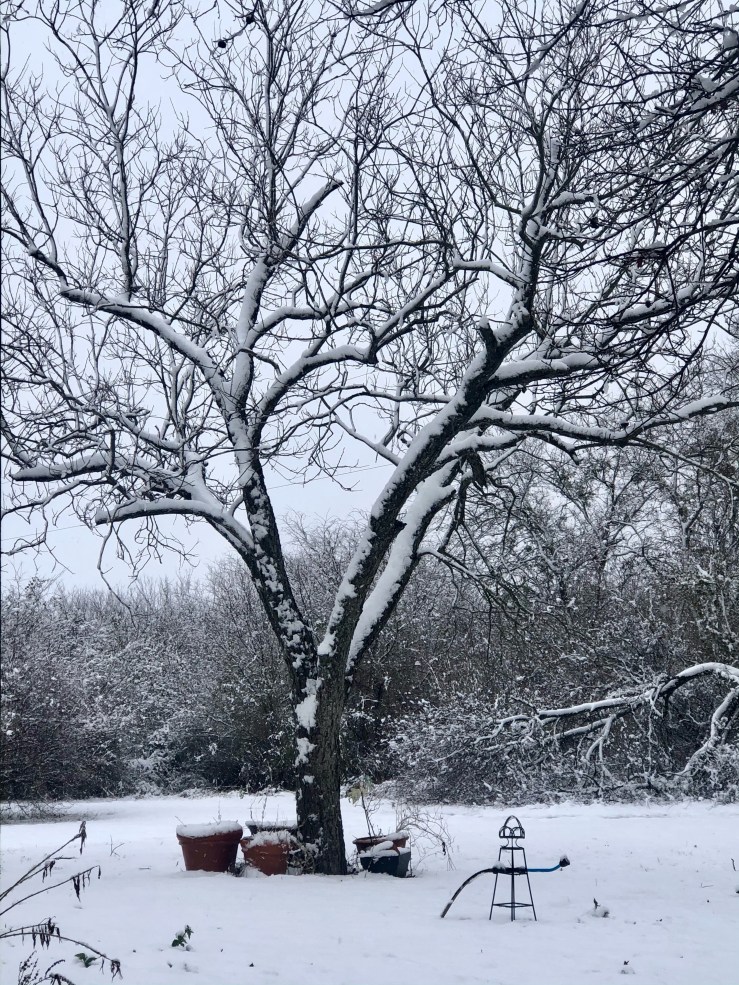
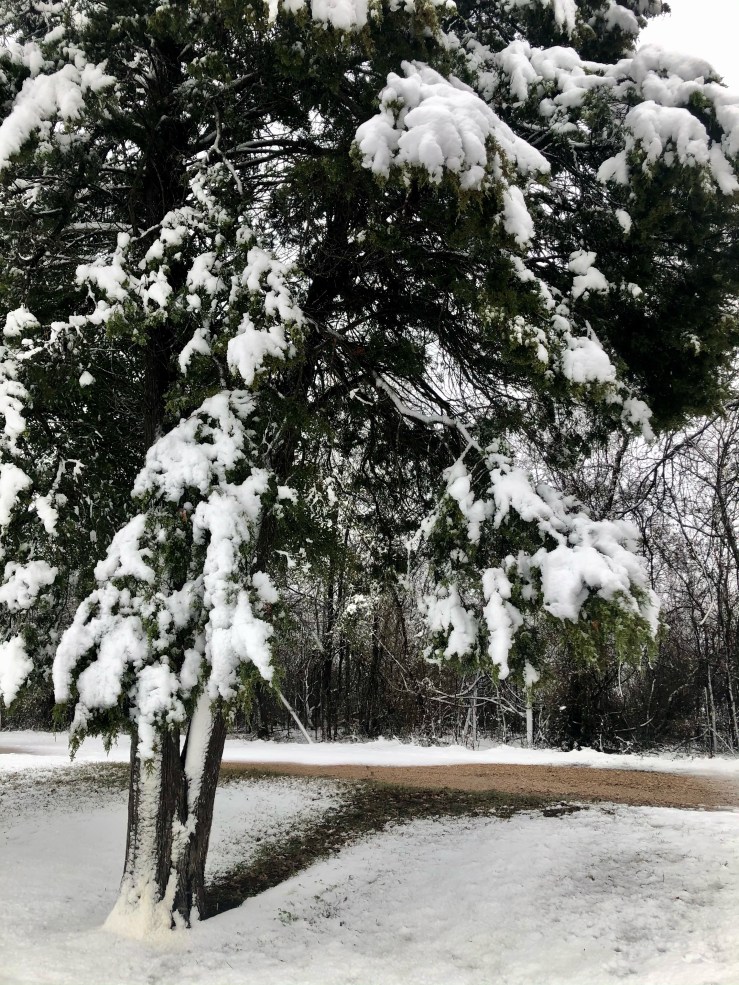
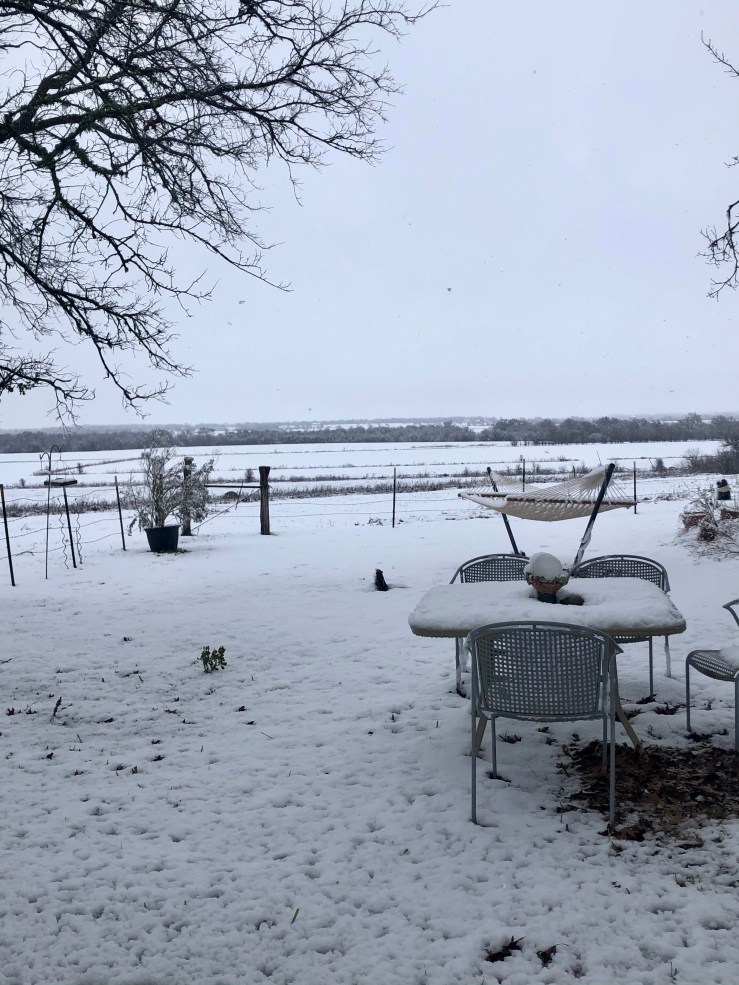
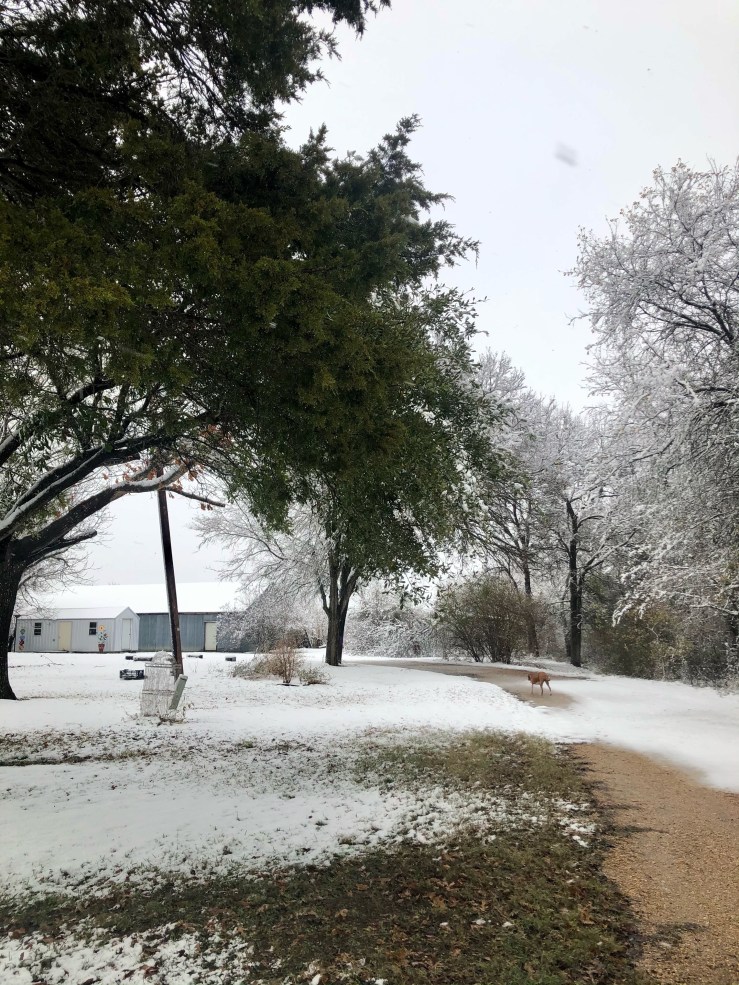
[From Sue Ann: it’s snowing in Milam County today, so we may get a few snow reports. This one came first, with beautiful birds!]

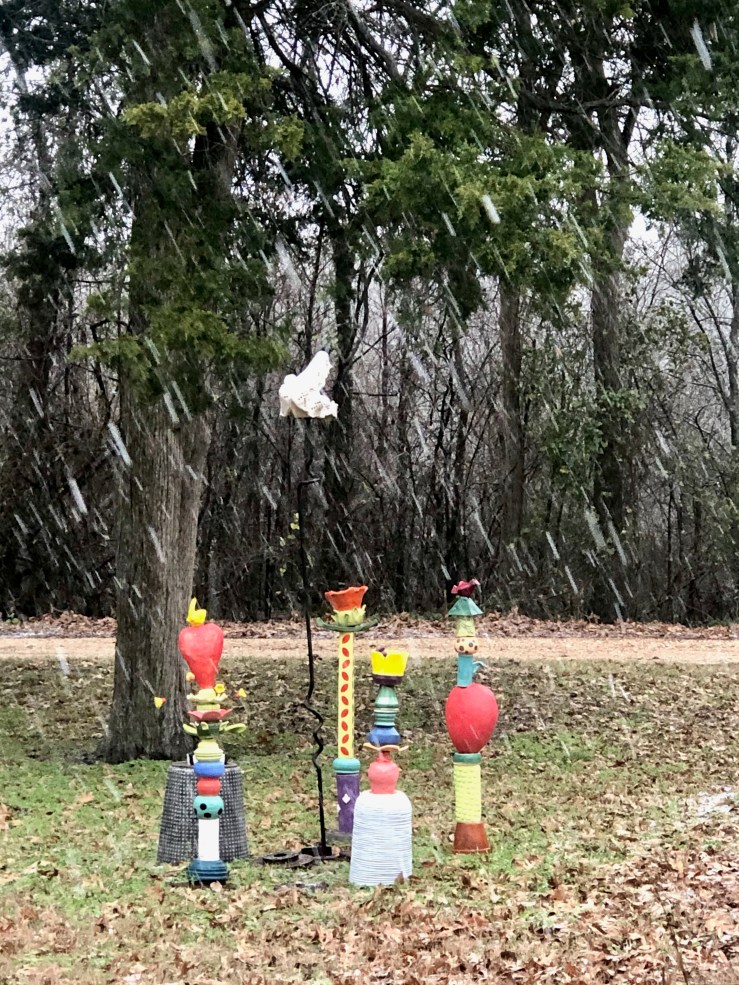
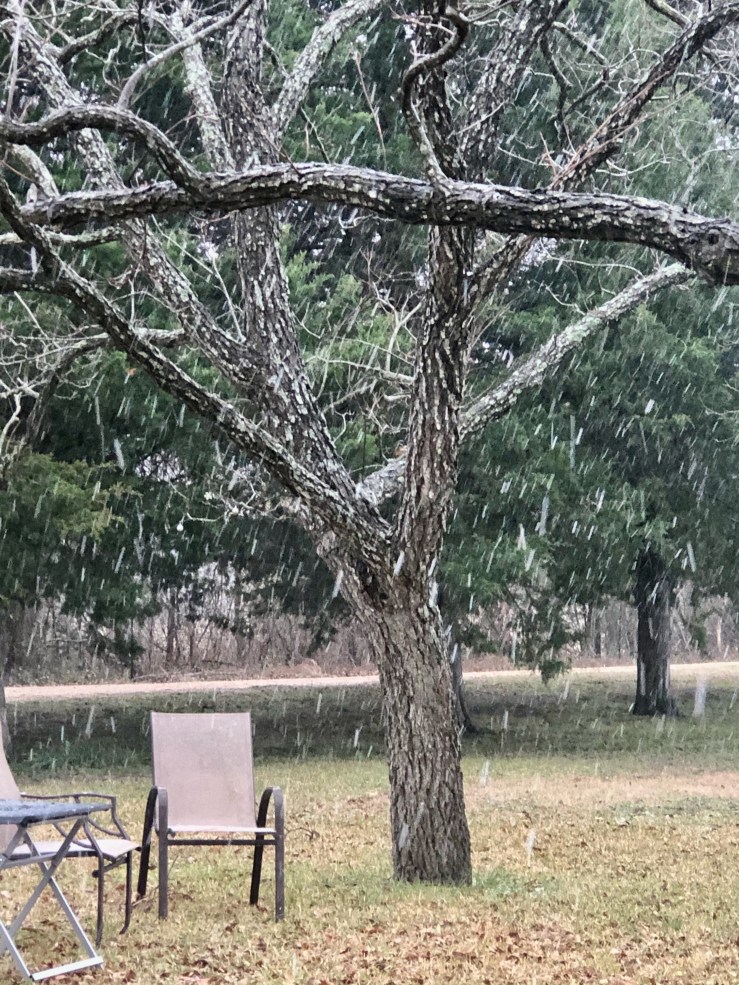
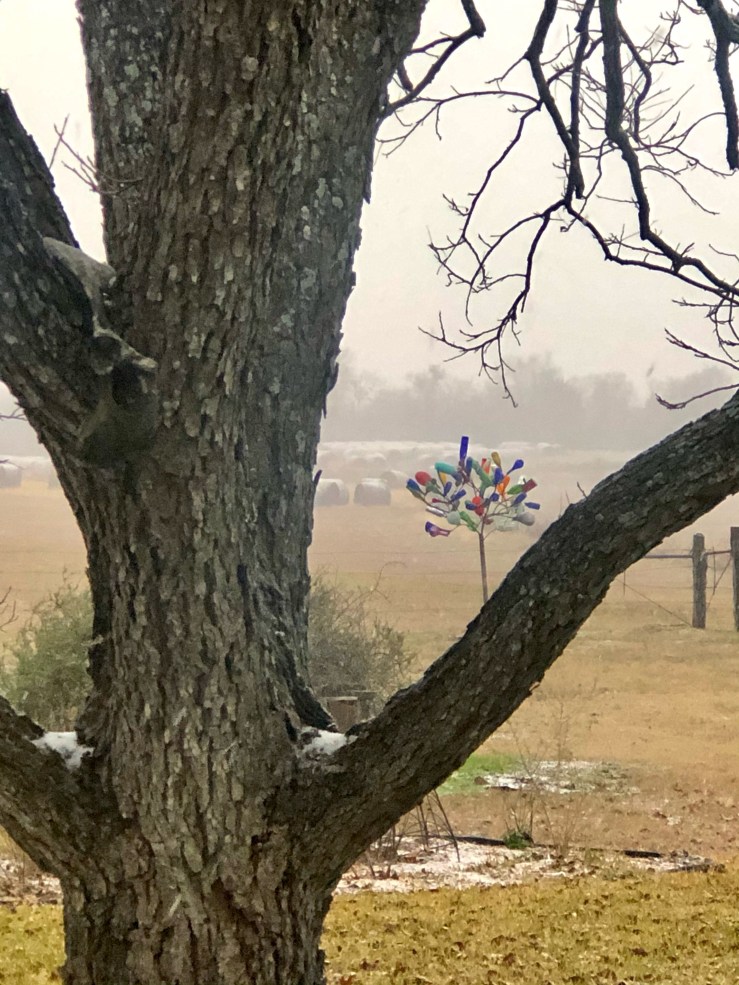
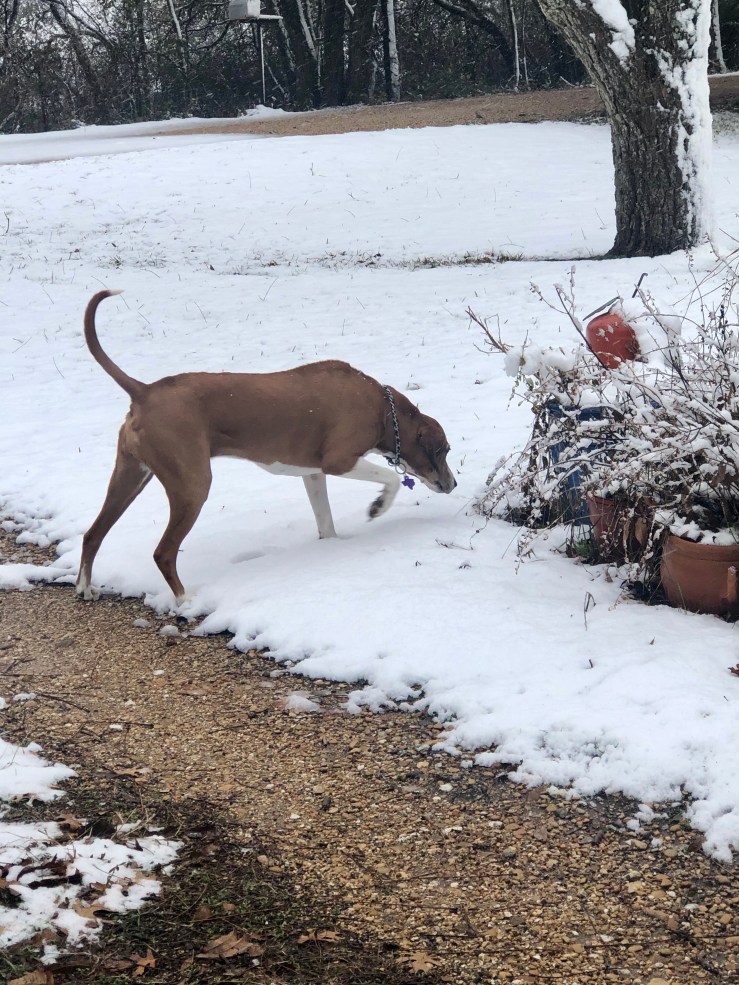
Snow coming down, bluebirds, chipping sparrows, yellow rumped warblers, pine siskin, orange crowned warblers and more enjoying my home made suet blocks (recipe on web site and on the blog here).

Barn snow
Woods snow
Happy birds
Mr. Bluebird loves Cindy’s suet recipe.

Soon It Will Be Time for Purple Martin Scouts to Arrive

by Donna Lewis

I’ve been out all last week taking advantage of the warm weather to get the housing ready to open for the returning Purple Martins. Martin Landlords everywhere are getting excited and waiting for that first magical song of the first scout seeking this year’s home. The scouts are the older birds who want first pick of the accommodations.

The first photo is the Gourd Rack. It has the gourds and owl guards attached now, and I have plugged the entrance’s with cloth. I will not raise it nor open any gourds until the scouts start arriving. Then I only open a few at a time, hopefully preventing non-martins from taking over the gourds. House sparrows, blue-birds, starlings, barred owls, and snakes would like to get in. Most will eat or just kill the martins for their nests. Only the sweet little blue-birds are just there looking for a home.

Ready to accept new friends, repelling all enemies.

I will also have to install the racoon baffle, the decoys and the snake guards soon.

Yes, it’s a lot of work.  Our friends the martins are on just about everyone’s menu.

The second photo is of the plastic decoys used to make the martins think their friends are there also. I call the decoys Heckle and Jeckle. They also serve as a target for owl attacks.

Heckle and Jeckle, all ready to attract friends.

The third photo shows one decoy attached.

That must be Heckle.

The last photo is the apartment rack. It is lowered for adding the nest boxes with fresh pine-needles and again blocking the entrance holes off till the martins arrive.

All cleaned out and ready for new tenants.

The houses were cleaned at the end of the year and plugged. I used the wet/dry vacuum to get any spider webs or other insects out.

I’ll raise the house as the scouts arrive. How exciting!

How do I know when the scouts are here?  They fly around the structures and call. Anyone would know when they have arrived.

It’s a wonderful event.

Feast Time for Hawks

by Eric Neubauer

Much has been written for those of us who want to attract wildlife, but sometimes luck plays a part. It turns out this is an ideal venue for hawks, validated by the hawks themselves.

Two hawks hanging out.

I planned to make my former farmland a prairie rather than a lawn because that’s what would be natural for the area. Doing nothing was a great start. While I decided how best to proceed, nature took over. All kinds of plants came up, both native and non-native. By then I knew I’d have to mow once in a while to control the growth of brush since burning wasn’t a safe option. I mowed several paths through the grass and weeds and around the house so I’d could access various parts of the yard without walking through head-high grasses and forbs. Next I started mowing in from two edges of the property before stopping and leaving the rest as cover for wildlife. This included the margin along the north edge of the property under the power line next to the road.

The hawk hunting venue

When late fall arrived I noticed how often a hawk was sitting on the power line. At first a Prairie Falcon was there on a regular basis, then an American Kestrel, Cooper’s Hawk, and Red-Tailed Hawk showed up. After a couple of months it looked like they’d finally hunted the area out, and started watching across the road instead. Today they are gone except for the American Kestrel. On the last busy day, the Cooper’s was on the power line just as it started to get light. Then a Red-tailed Hawk (I think) flew up to the transformer on the pole about 15’ from the Cooper’s, before moving down a couple of poles. Right after that an American Kestrel came along and buzzed the Cooper’s before landing on the wire midway between the other two. It wasn’t the first time I’d seen that happen. Loggerhead Shrikes are also on the wire a lot, but that’s a year round occurrence. I know hawks are also perching on my roof and using the mowed area around the house in the same way.

Here is why I think the venue worked so well;

  1. The tall grass provided cover and food for grasshoppers, small birds, and rodents. The mowed area next to it made them accessible to the hawks when the prey strayed.
  2. The wire was on the north side of my property so they could approach their prey with their shadows behind them and the prey wouldn’t be warned as a shadow passed over them.

The grasshoppers are also giving out now. The only ones left  are a very few Schistocerca americana and Melanoplus femurrubrum adults, and some Chortophaga viridifasciata nymphs. In late summer, there were hundreds of thousands of M. femurrubrum nymphs, and a plague of Biblical proportions appeared to be brewing. It appears few ever made it to adulthood, and those that did suffered heavy predation. I’m sure the little birds did their bit, but the hawks did too. Attracting birds isn’t purely for entertainment.

Things You Learn from a Flood

Last week, as we saw from the post about flooding in Burlington, we got lots of rain. I always like to explore around my property after a flood, because there’s always something to learn. Here are some photos of wetness around my ranch in the Walker’s Creek Community north of Cameron, and what I learned.

Water flowing into front pond.

We’ve been working on managing runoff to our advantage, so I was happy to see that the small trench we dug was directing water to our front pond. What you don’t see above is that we had a low spot close to our garage that we turned into a kind of “holding pond” instead of an annoying puddle. It’s already the home to turtles and bullfrogs. That pond drains into this bigger pond, which we created when we built a dam that made our driveway.

Water flowing from the front pond to our happy stream.

The new pond hasn’t gone dry since we created it, since water flows from across the road as well as from our fields into an arroyo that feeds it. We have a large culvert, plus a spillway culvert that lets water flow once the pond is full. Every time it rains, we know we’ve had two or more inches when the pond fills up.

This was before the big rain, thanks to the springs.

An observation I made before the rain is that while the flow you see above was dry, and the stream was dry up to the big willow you see in the background, the stream was still flowing. As I walked backwards, I was able to spot a spring flowing (which I didn’t get a photo of, thanks to not bringing my phone), one I hadn’t noticed before. That’s a good sign, I think, because it had not been a very wet year up until then. (We have another springy area that keeps the stream flowing a bit further down, too).

This stream keeps going, goes underground for a few yards, then flows into Walker’s Creek.

Our road (CR 140) did briefly flood deep enough that one should not drive through it (this truck had a hard time, which encouraged my neighbor to turn around). As it usually is, the crest of the flooding was brief, and the water went down after a few hours.

Photo by Amanda Shuffield.

There’s always interesting debris left on the roads after floods. My husgand, Lee, removed some of the larger pieces of wood and other debris from the road, so cars were safer. But, I enjoyed seeing what else washed up. It was mostly balloon vine, which floats really well (and did you know their seeds look like yin and yang?).

You can see how much higher the water was from the grass on the fence. All that brown is balloon vine, which floats.

One of the scary things you see when it floods is how powerful the water is. The bridge had quite a build-up of the remains of very large logs (still leftover from the drought in 2011). I keep wondering if they will ever knock out the bridge. They do play heck with the fence, so I’m once again glad we have someone who has to repair them (we lease to some cattle dudes).

The trees you see are the creek. I’m always amazed how quickly this happens.

I dawdled a while watching the water flow, which I probably shouldn’t have done, since it started raining again. But it was cool.

Here, watch how fast the creek is flowing! And check out that log!

As quickly as all that water built up, it got back to normal. I learn a lot about how the water flows around here, so my walks after rainstorms are so educational. I’m glad we had our Master Naturalist training about the river systems in Texas, because I know exactly where all this water is going. Our arroyo is a major contributor to Walker’s Creek (which is dry at least a few months of the year), which then heads over to the Little River, right near where Big Elm Creek joins it. Or, so I think. Maps aren’t helpful.

Skunk I saw from a good distance away, behind our house. I did not mess with it.

The flooding does displace some animals, and I saw a skunk wandering around in the daytime soon afterwards. It could have been a crazed rabid skunk, or just one who was displaced from its den (we have a lot, and some are in the creek bank). I’ll never know which it was, because I didn’t go check it out up close or let the dogs near it.

Much Needed Rain

By Marian Buegeler

After months of trace amounts of rainfall, we have finally gotten some much needed rain.  From the morning of Wednesday, December 30 to Thursday morning, I have received 3.81 inches of rain.  As I write this on December 31, over an inch of rain has fallen again today.

These first two photos are of Mustang Creek where it crosses County Road 133.  I am standing in my pasture looking across the road toward the neighbors property. It looks like the fences are going to need some repairs, again.

Mustang Creek near County Road 133
That fence won’t hold much longer with all that debris on it!

The next few photos are of Mustang Creek as it winds through the pasture.

Mustang Creek
Mustang Creek
Another view of Mustang Creek

This last photo is of North Elm Creek.  You have to know just how deep this creek bed is to fully appreciate the volume of water flowing through it.

North Elm Creek

Unfortunately these photos are not of the creeks at their peak.  Both had receded by the time I hiked out to the pasture to take these pictures.


PS: For more photos of flooding on Walker’s Creek, a little south of Marian’s and also in North Milam County, see Sue Ann’s blog from New Year’s Eve.

Walker’s Creek, usually a ditch over by those trees.