As usual, I was walking around the outside of the house checking flower bed for upcoming Spring cleaning, and I was wearing capris, flip-flops and no gloves. My friend pulled me back while saying, “Snake!”
Big, fat, black water Moccasin was right in front of me, but heading away from us. (Solid color usually indicates mature snake. Patterns refer to young or juveniles. ID can be confusing because of the patterns.)
A cottonmouth adult
It’s been awhile since I’d spotted a viper. I used my single-shot shotgun and missed at less than 6 feet (?) and I couldn’t remember how to release the safety on the other. So, I called my neighbor, who was at home, and asked him to dispatch this cottonmouth.
One shot from his pistol. He says he keeps snake shot handy just for me! I believe this.
I hung it on the fence, to alert other snakes. Legend has it that snakes will continue moving until sundown.I don’t know. It wasn’t on the fence when I looked. I didn’t go search for a moving, dead snake, either.
Cautionary tale: It is Spring and suddenly moist. The frogs are back. Cottonmouths, or water moccasins, are very nasty-tempered poisonous vipers. It will stand its ground, and possibly move toward you if you disturb it. They will try to stare you down, and possibly chase you – not a myth. Both on land and in the water.
The frogs have returned and are a favorite food. Flowerbeds often have mulch. Texas is famous for drought. The cement slab houses have to be kept moist around the base, about 18″ from base of house, and create a perfect environment for meal-seeking snakes.
Wear protective clothing. Review use of firearms. Although poisonous, infection is common because their mouths are nasty and full of exotic bacteria, etc.
There is a viper antivenom, CroFabantivenom (Wikipedia). I do not know if local medical facilities have this in stock.
(Recap of an Associated Press article from Carolyn Henderson)
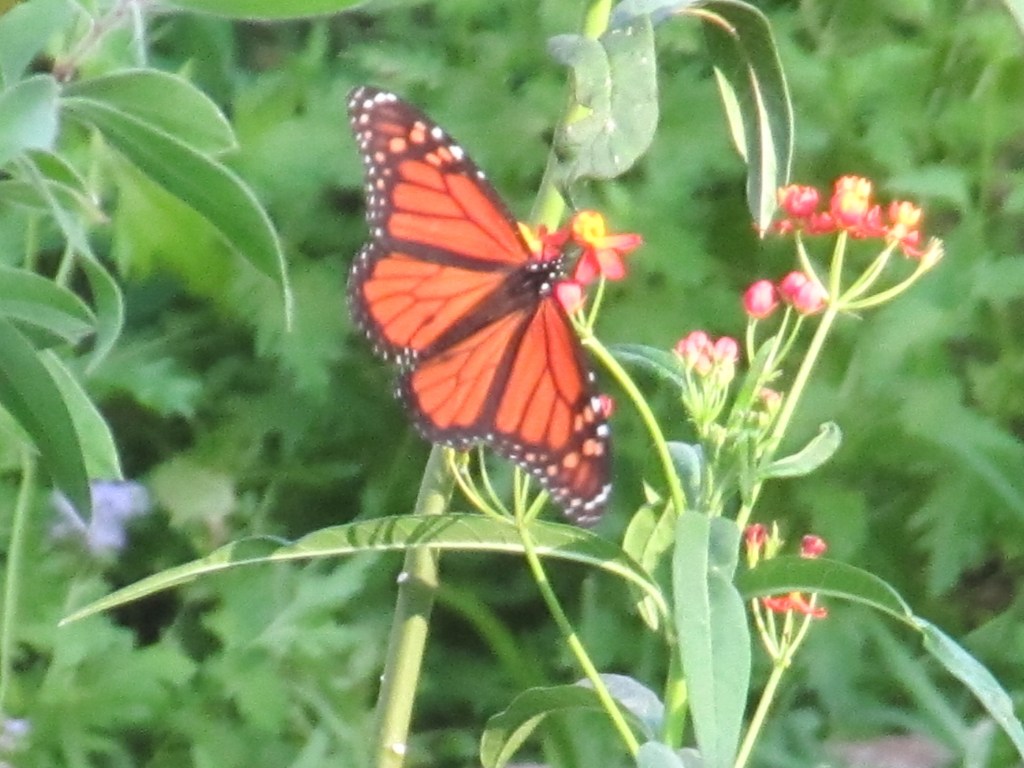
North America has approximately 650 species of butterflies and all but nine of them are in trouble. Approximately 114 of them are showing significant decline including the Monarch.
Monarch
Monarchs are reported to be down to 10,000 in 2024 compared to 1.2 million in 1997. The annual report that was just released about Monarchs from another group stated that there were slightly more hectares covered in Mexico, their winter home, than there were last year, but it still isn’t even close to a sustainable number. They covered approximately 1.8 hectares in 2024 compared to .9 in 2023. Scientist say they must cover at least 6 hectares. One hectare is equivalent to 2.471 acres.
All butterfly populations are down by 22% since 2000 in the lower 48 states. Their numbers are dropping on average 1.3% every year. There are 96 species that are so sparse, they didn’t show up on any of the counts in 2024. There are another 212 species whose sightings were so insufficient, a trend could not be calculated for them.
Two that I have seen in Milam County are on the high risk list. The Red Admiral population is down by 44%, and the American Lady population is down by 58%. Monarchs come through this area, too, but in small numbers. They are seen more along and west of I35 when they migrate.
Red Admiral
An entomologist that reviewed the collection of butterfly counts said he considered the numbers a sign “telling us the continent’s health is not doing well.” The numbers of parrots and porpoises also are dropping notably.
Butterflies are pollinators – not as much as bees, but they still contribute significantly. They are a major pollinator of Texas cotton crops – a crop often grown here. The driest and warmest areas, including Texas, are showing the greatest decline. They are doing better in colder climates.
American Lady (photo by SA Kendall)
Butterflies aren’t alone in their decline. Other insects that aren’t studied nearly as much also are thought to be in decline.
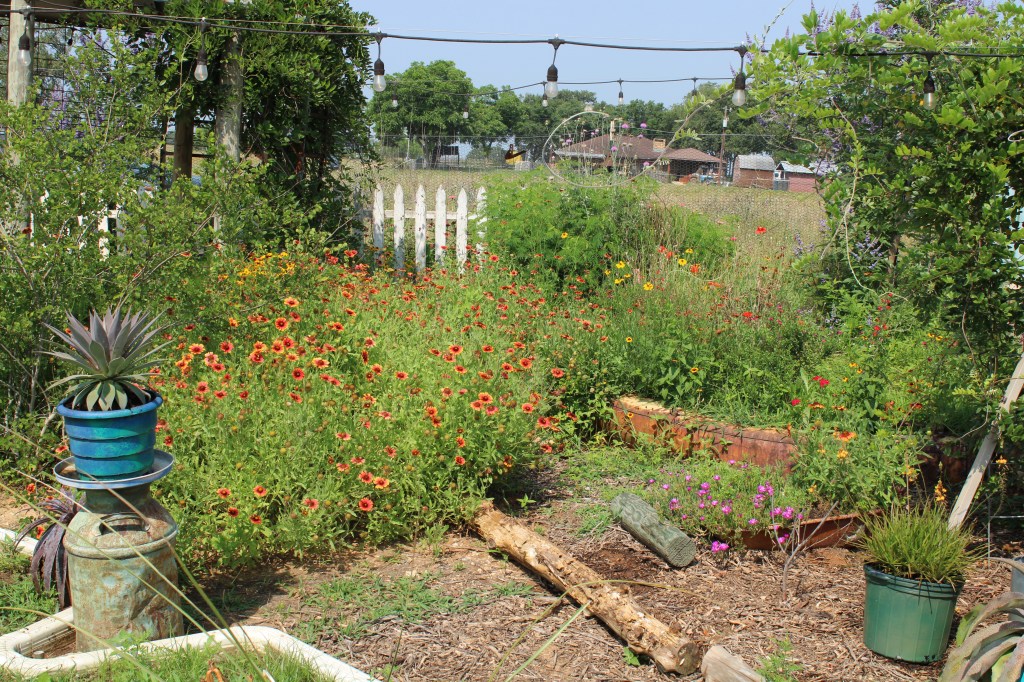
As usual, climate change, habitat loss, and insecticides are faulted. You can help by planting native wildflowers in your yard to help feed all species. Turn over some soil, throw some NATIVE Texas wildflower seeds out there, and create a butterfly garden in your yard. Native plants require very little effort once you get them growing. They need to be native to your area because butterflies need the nutrients provided by what nature normally would provide.
Our Chapter Wildscape
If you need seeds, go to the Cameron Public Library where Texas Master Naturalist – El Camino Real chapter is giving them away. At the library, you also have access to plenty of information from the Lady Bird Johnson Wildflower Center if you have a smart phone. To see these wildflowers in full bloom, wait a month or so, and come to the ECRTMN Wildscape out on CR 334. Announcements will be made when lots of them are in bloom.
One of my favorite pastimes is seeing how many birds I can identify in new places. I’ve found that taking along my favorite electronic helper, Merlin Bird ID is very helpful and also allows me to contribute to the eBird database. This may even get me some volunteer hours as a Master Naturalist, though I admit I do it for fun even when I’m on my property or out of state. Want to join me? Here are some hints.
Before You Start
Before you head out, be sure to download Merlin Bird ID onto your phone and get your account set up. It’s free! Charge your phone up, too. Then get your hat, notebook, binoculars, spare batteries, and water. You may spend longer with the birds than you expect to. It’s hard to stop!
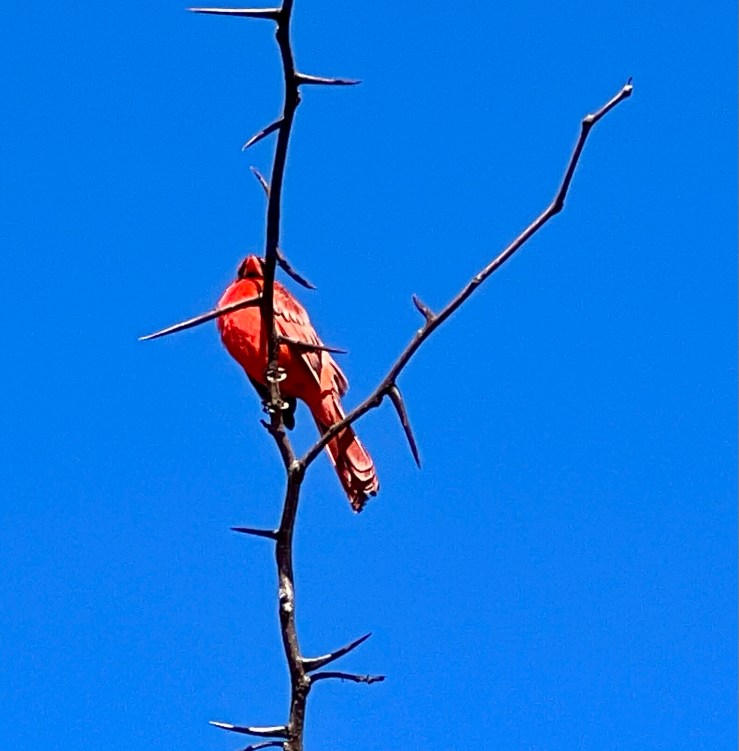
You will probably see a Cardinal if you are in Milam County.
You can go anywhere you want, but I prefer county roads with little traffic and a variety of habitats. Going past water may get you some herons, ducks, or a kingfisher. Fields and prairies are good for sparrows, meadowlarks, starlings, and hungry raptors. Woodlands have woodpeckers, owls, songbirds and more. I find the best birding in places with open space that are near cover (brush or woods). I often park at a friend’s house and take off from there.
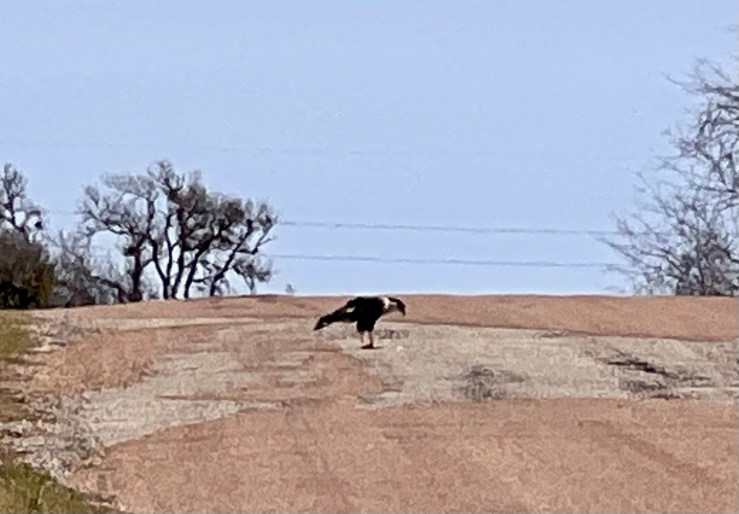
Caracara eating pizza off the road – the middle of the road is a good place to find scavengers.
Once I get to the area where I’ll be birding, I do an important thing in Merlin – I set the location for bird recommendations to where I am. That’s important, because Merlin suggests birds likely to be where you are. That may not matter if you’re just a mile or two from your house, but if you’re in another part of Texas or even farther away, you’ll want to know what’s likely to be there. You can use the list of birds found under the “Explore” option in Merlin to check what’s likely to show up so you’ll know what to look for (for example, does your locale have Ravens or only Crows? Does your area have Tufted Titmice or Black-crested?).* In the example below, I was making sure there are still Sandhill Cranes around this time of year at my house.
Another important preparation is to tell your phone to send your calls to voicemail. Every time you get a call, it stops the Merlin recording. I usually use an iPhone setting that lets important calls through, but not spam. Just save the recording if a call interrupts.
Bird Walking
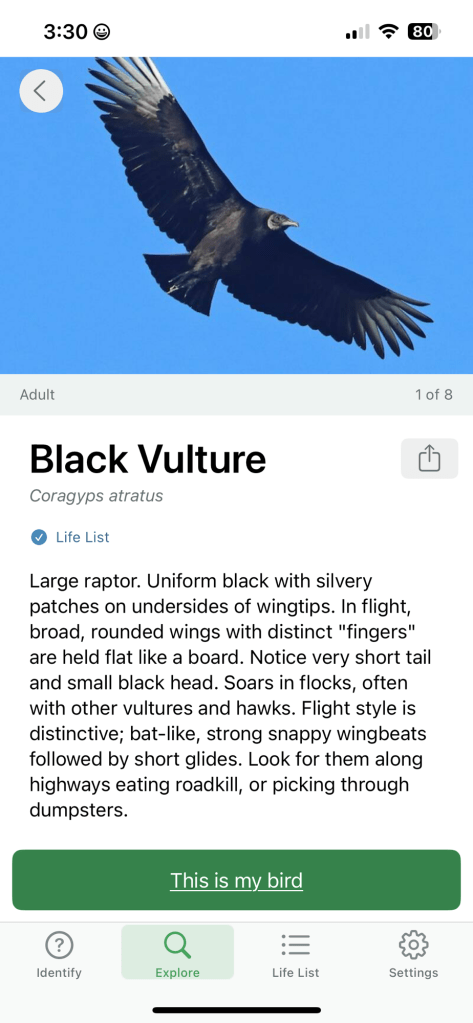
Now you can start your bird walk. Start Merlin on Sound ID as soon as you hear a bird. It’s a good idea to stand still while listening, so your footsteps don’t interfere and so the app can identify sounds more easily. Be ready to photograph any birds you see, because Merlin can identify birds from photos as well as sound. Remember that not every bird is going to make sounds, so be on the lookout for those vultures (Black have white wing tips and Turkey have the “thunderbird” shape on the underside of their wings).
This is a Black Vulture, which was easier to ID in person.
You may also hear birds that Merlin doesn’t register – for example, I just heard Sandhill Cranes flying overhead, but they were very high in the sky, so they didn’t get picked up by the phone microphone. I did get a photo of them, but even if I hadn’t, I could count them since I know what they sound like. Owls are also notoriously hard for Merlin to identify.
These Sandhill Cranes were flying high.
What I do on these walks is stop whenever I hear a bird or birds and let Merlin record them. You may not get very far if the birding is good, but move on when you’ve heard everything in the area. It’s so much fun watching birds show up on the app! I also look around to see if I can see or photograph the bird. Soon you will know what birds are around you by their calls and songs with Merlin’s helpful training. I love this in the summer when the trees are leafed out. I finally got to see Painted Buntings last year thanks to Merlin. And I’ll never forget the sound of passing Eastern Bluebirds and Lesser Yellowlegs as they go overhead out of sight.
I usually listen for 20-30 minutes, then save the recording. Those files aren’t too big and I can review them later to record them. You can select a bird Merlin identifies and click “this is my bird” to save it in eBird. Give the location a good name, so you can later figure out where you were. Good examples are the name of a trail, road name, landmark, state park name, etc. Record them as you see them, because if you try to add them later, you’ll not have the right location and you’ll have to find where you were manually. You can make an eBird checklist when you get home, if you like, though.
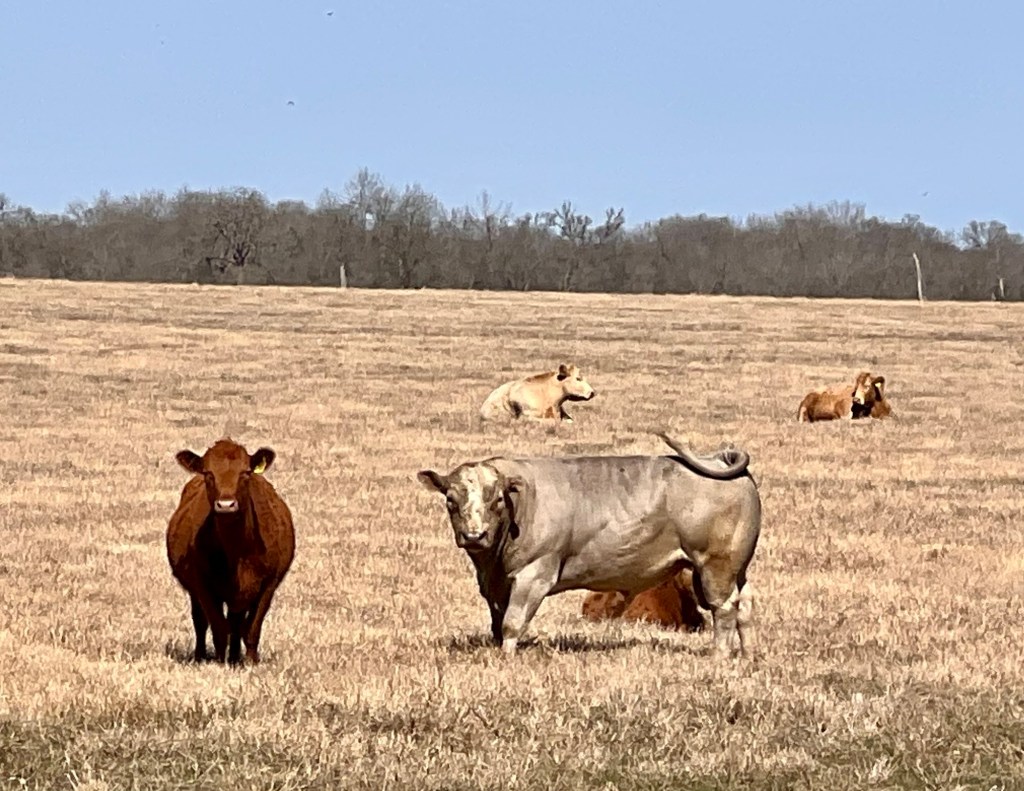
It’s a bullMaybe it’s a bullYou can enjoy the animals on your walk, too, of course. I like to look for bulls among the cows on my road.
On a long walk you might end up with two or three recordings, and a bunch of photos, which you can put on Merlin or in iNaturalist, too. You might get a surprising number of species if you’re patient. Use Merlin to read more about birds that are new to you. It will describe the bird and show you its range, which can be surprising.
The more you walk around with Merlin open and listening, the more you’ll learn about the birds wherever you are. I’ve learned all about the birds where I travel, and conveniently use Merlin to add them to a life list Merlin tracks. If you’ve got a few minutes to spare, take a walk down a country road with Merlin!
Barn Swallows
Just for your information, here’s what I usually do. At home I only put new birds or birds seen at an unusual time in eBird, since I’ve recorded them many times. I have a notebook where I write down the birds I see and hear on Merlin every day and I track sightings monthly on a spreadsheet, which then goes in my blog. It’s fun to see which birds show up in different seasons. I’m a little obsessed, but everyone needs a hobby, right?
A page from my notebook listing birds I saw on one day. I do use abbreviations, but I know what they are!
*Be sure to set your location back to your home base when you return. I realized this morning that Merlin was looking for birds at Inks Lake, not Milam County.
Yes, it is already that time when our Purple Martin friends will start their migration from Brazil back to North America. Yes, the early ones will still face freezing and other harsh weather events.
I wish I could ask them to wait a little longer, but instinct is urging them onward. The scouts (who are not the youngest birds) hope to find the best housing first…
As of today, 1/30/2025, sightings have been called in for San Antonio, Austin, Houston, and a few more Texas sites. Central Texas does not have a certified sighting as yet. I hope that myself or our Landlord in Buckholtz will win that honor. We’ll know soon. I am watching for them all day..
First of all, your houses (gourds, or apartments) should be cleaned, and with added pine-needles if you do that. I also added pine-needles to my Blue-bird houses. The openings should be blocked off so no sparrows, other birds, or insects can get in them. You need to check yourself. Do not open the housing until the first scouts land on the houses. If you are looking for the Martins you will see or hear them. Then open a few of the cavities, not all of them. I usually will pick four to open.
You do not want the non-native birds (House Sparrows or Starlings) to get in the houses. These birds will kill the Martins for the nests. Trust me, it is not a pretty thing to see. I think keeping predators and non-native birds out is the hardest thing landlords have to deal with.
Right now my gourd rack is lowered and ready to open. This coming week I will get the apartment house ready to raise up.
I have had back issues this past year, so I will have to have some help caring for my friends this year.. But I will help them out as long as I can. Their song is so addictive that most Landlords that love and care for these native birds will do it until the end of their life. A gift from Mother Earth. Their songs are like no other.
Here are some photos showing me stuffing the gourds with fresh pine-needles that will help keep the birds warm and give them a start on nest building that will come later.
We can expect to have Martins here with us for about six months, until they leave for their winter home in Brazil. again.
Birds can lift a sad spirit. No matter what the world is going through, every day they go about their business with joy and sing to us. How lovely.
Remember who you want to call to your home, and furnish what they need. They will come.
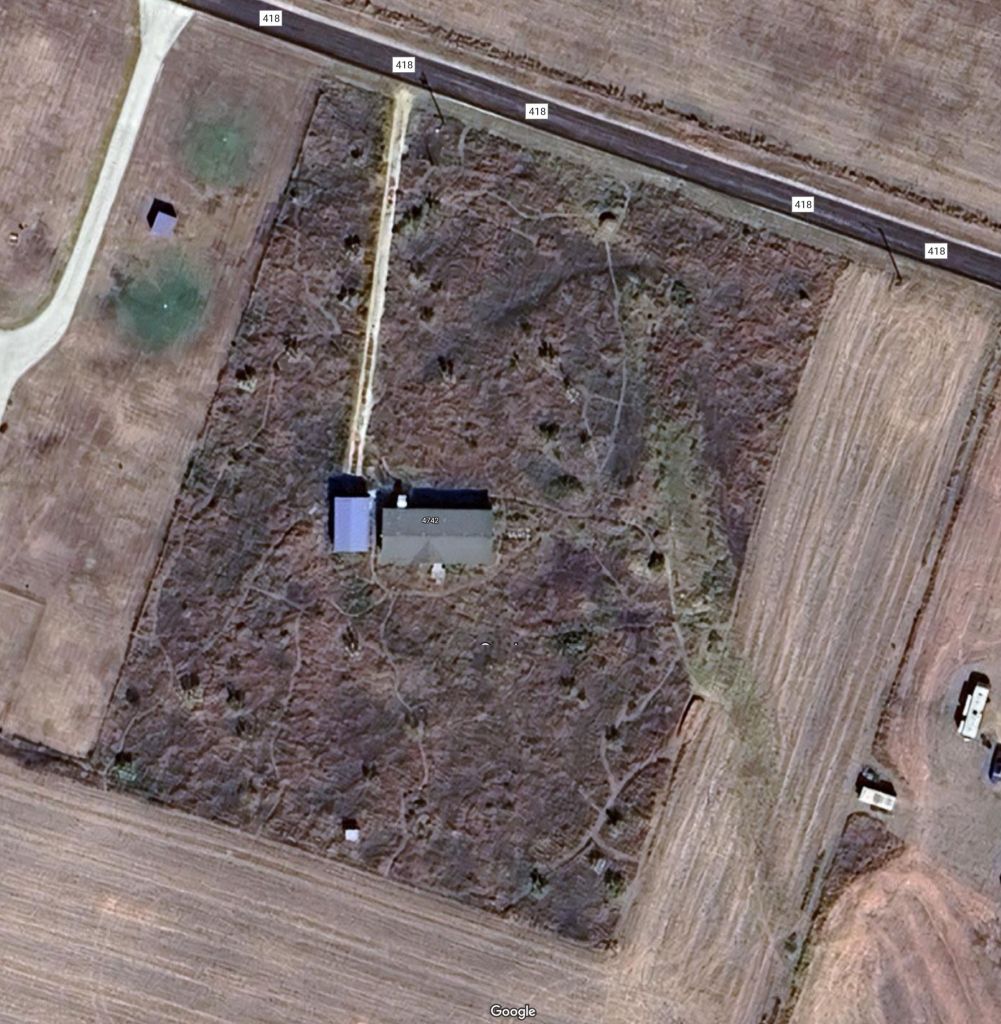
Thanks to google maps updating the satellite view in my neighborhood, I have a recent look at the part of my property that is turning into a three-acre modern prairie with little help from me except for pulling up Johnson Grass.
As you can see, I’ve been wandering all over the place during the last year pulling the damned stuff except for the upper right, where I suspect there was a large rattler about a month ago. I’d also done little in the lower left until recently but have begun expanding and deepening an area prone to flooding. The property is generally flat, and there is a drainage swale running across the northeast corner. The runoff from an eight-acre hay field comes in from the southwest along several terraces.
After a dry spell, about the first 2″ of rain disappears into the Blackland cracks. So, there is little runoff except in winter and early spring, and flooding is rare; it can even skip a year. When they form, vernal ponds last a week to two weeks and make the frogs, toads, and plains crayfish very happy.
I believe the multiple paths have been a plus for wildlife. During the last year I’ve seen the return of jackrabbits, at least three does dropped their fawns in my yard, and at least the pairs of dickcissels have nested. Several other species of birds have brought their fledglings in for foraging. Recently a bobcat has been around at night, although I’ve never gotten a good look at it. Pretty good for a place with no permanent surface water.








 Nature Along the El Camino Real