A First for Me

by Carolyn Henderson

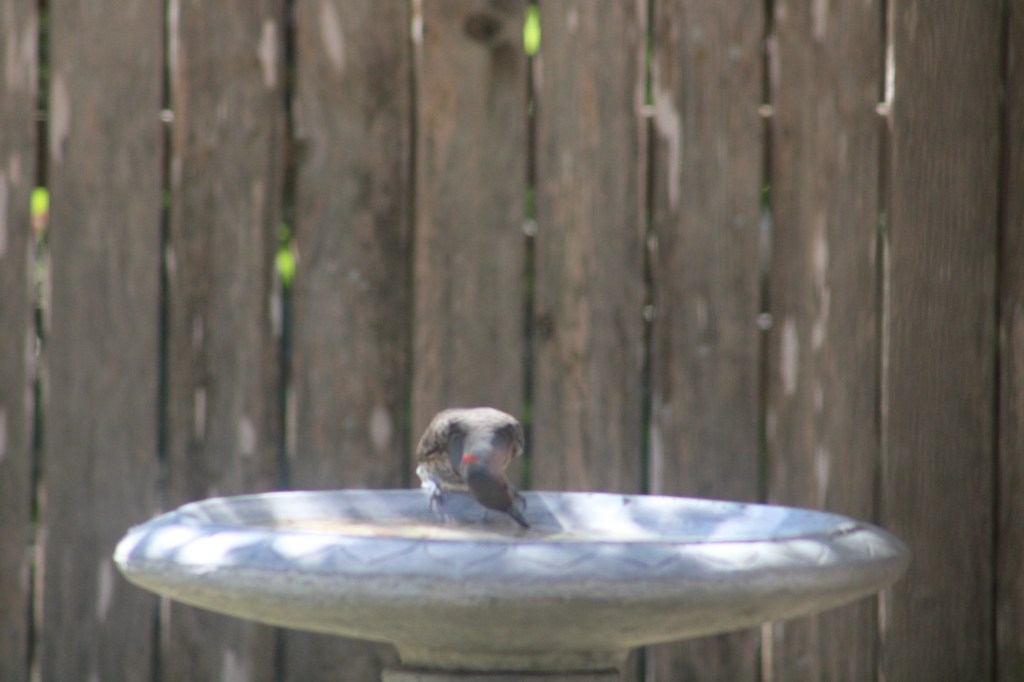
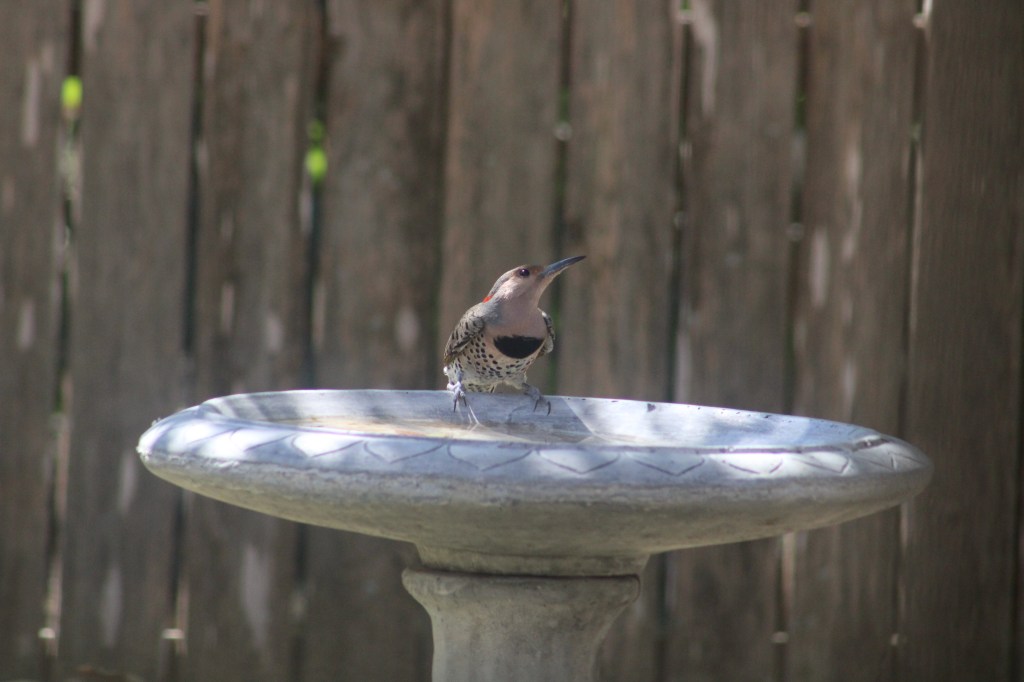
I went home for lunch on Monday and was nicely surprised by a first sighting for me. A Northern Flicker was drinking out of my birdbath. I did not know what it was, so I worked on some photos to put on iNaturalist. I had to take them from inside my house through a window, so they aren’t perfect, but they’re clear. 

It’s considered a woodpecker, but it has dappled brown feathers with a red spot on neck and black markings. An it’s unique from other woodpeckers because it hunts its prey on the ground. Flickers prefer ants! This explains why it’s in my backyard. Fifty percent of its diet is ants. It also lets the ants crawl on it to rid it of parasites. I have an ant problem. Plenty for it to eat. Another difference from most woodpeckers is that it migrates. It can’t find ants in frozen ground.

I looked to see if anyone else in Milam County had reported one, and I saw the only other one was Michelle Lopez in 2024. She first heard it with her Merlin then she got some photos. 

I really enjoy finding new sightings. When I tried to get to a better window to take photos it flew away. I hope it comes back and eats lots of ants. 

Geeking Out over Sound Patterns

By Sue Ann Kendall

[I wrote this for my personal blog but accidentally created it on this site, so enjoy my fascination.]

Bear in mind that I have been looking at waveforms most of my adult life, so this stuff interests me. I still edit myself talking a lot (yep, it’s my job), so I know when I’m gasping or clicking from saliva before I even listen. It’s interesting, not that fun.

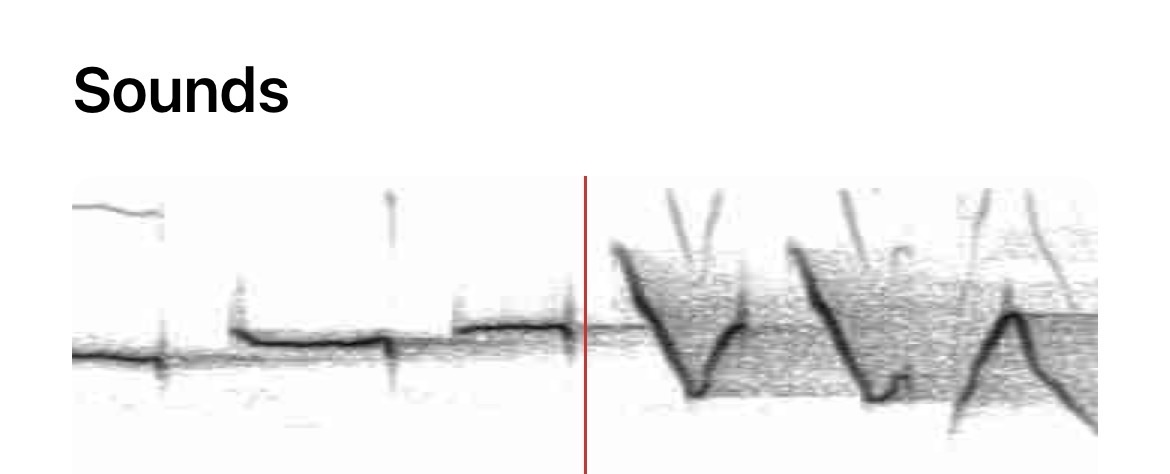
But it’s only in the past couple of years, since I e had Merlin Bird ID that I’ve been able to identify bird calls by how they look on a spectrogram.

Loggerhead Shrike – you can just tell it’s loud and harsh, not melodic.

This kind of knowledge is helpful in winter when there are so many sparrows around. Their spectrograms look different. Here’s one I also like.

Red-bellied Woodpecker

Songbird recordings look very different. Some are more horizontal lines going up or down with the pitch. Others have a mix of tones, but you can see the melody. These two I got from Merlin, of birds I’ve heard.

As I’ve been enjoying the sounds birds, there have been other sounds Merlin catches, like loud trucks, airplanes, and wind. And, of course there are insects. I was being deafened by the sounds of late-summer cicadas when I looked down at the waveforms. Wow!

They look three dimensional.

You can practically feel the pulsing by looking at those fascinating shapes. On the other hand, crickets just stick to one note.

This is wind and a cricket.

So if anyone ever asks me how I know a sound is a cricket versus a cicada, I can turn on Merlin. It may not ID it, but I can now from the shape.

Here’s a sound I’m glad Merlin heard: a Yellow-headed Blackbird. They only show up here a few days a year during migration. Photo by Dorian Anderson.

I used to have some frog images but I can’t find them. I’ll be paying attention and when I hear something interesting, I’ll stop the recording, since Merlin doesn’t save recordings over about 20 minutes long, due to storage constraints. My phone would be FULL.

Possum ‘Ranglin’

By Pamela Neeley

Sometimes I forget to replace the lid on the dog and cat food stored in galvanized containers during the day. I arrived home after dark from a meeting. I went out to feed the dog and cats.

Before I put my hand in the container I saw a little opossum face outside of the dog food bag.

Then I saw a snout move, and saw the second opossum IN the dog food bag.

I went into the house, (the food is in the art studio), to get my phone and put Ruby the dog in the house. She chases and tries to kill opossums.

Back in studio I snapped a few photos. Found a large towel, doubled it and picked up the little one. Took it outside to let it go in the pasture.

The second one was in the dog food bag. I picked up the bag, with top closed, and walked it out to deck. After a bit, that possum came out and went for the field.

I encouraged them to stay away from this farm because of the “hound” that is on patrol. I may not always be around to free them.

Opossums do so much good for us and the environment.  They love ticks and enjoy eating a variety of insects, small rodents, seeds, eggs, fruit.  And pet food!

A Visit with a Houston Toad

By Pamela Neeley

The Famous Endangered Houston Toad also attended the Wildlife & Woodlands Post Oak Savannah Landowner Workshop, where our chapter had a booth last week.

The male toad saying hello.

The pair traveled in customized carriers with their chauffeur, back to the Ft Worth Zoo (a 2.5 to 3 -hour trip each way). I only managed one photo of his handsomeness. This species is leading the resistance against riparian and native species destruction.

A few live in the southern part of Milan County. The Brazos River splits this county. I’m on North side of the river, and the soil is Blackland. South of River is sandy soil and that’s where our small Houston Toad population lives.

I enjoyed getting to see their huge back feet, which are all the better for excavating their holes while moving backwards! They don’t have to turn around to watch their world!

Anole Argument

by Donna Lewis

So, this week, I was out in my garden filling up all the water sources and I came face to face with two male Anoles having what I guess was a territorial fight.

I was about 10 inches from them when I saw this! Boy was I surprised. And if you knew me, you would know, I am not very tech savvy. I was fumbling with my phone trying to remember where the camera button was. It took me a few minutes to open the camera. I was afraid I would miss all the action. I just cracked up over this display.

I also forgot that my voice is on the video, so I am just as funny.

This was great!! I have never seen the Anoles fight before. Usually they are going after the ladies or catching an insect. No animals were harmed during the filming of this video!!

About Anoles

There are more than 250 species of Anoles: Family Polychride, the largest genus of lizards in the world. Only the Green Anole is native to the continental United States.

Green Anole

This lizard has the ability to change its color as a result of the movement of pigment granules within the cells of the skin. This can happen in response to stimuli such as temperature, humidity, emotion and activity. The colors can be gray, brown or green.

The Green Anole is arboreal, prefering to be up on a fence, tree, plant or higher than ground level. I see them among vines especially. Their diet is insects and spiders.

So, as I always say, you need to look around at nature. There is always something really new and exciting to see. But you need to look.

And always remember who you are gardening for.

Also give our expert Blog Master an  “atta girl”  for knowing how to transfer this video to the computer for me.

(Thanks, Donna)