
by Larry Kocian
It was Wednesday, March 16, 2022, and we were enjoying spring break. My wife was on her way to Bryan, Texas, with her mother, to pick up our niece for a spring break visit. It was about 3:00 pm and past Milano on the south side of highway 79, she saw a hawk just standing there. She thought the hawk must have prey on the ground and is trying to get. The hawk was standing right in the grass and almost on the shoulder of the highway. She continued her way and was in Bryan for several hours. Upon her return home, she noticed the hawk in the same location, when she passed the area. She turned around and pulled over in the grass passed the shoulder to see what was wrong.
My wife, her mom and our niece got out and saw the hawk was standing there looking around, but it was not moving its feet or wings. They were careful not to get too close because they did not want the hawk to fly into the highway. Her mom said the bird looked so pitiful, like it was seeking someone to help it. It was about 7:30 pm by the time they got back in the car and started calling any wildlife rehab center they could find on google. My wife knew there had to be a place to take the hawk, because when we go to the Renaissance Festival, we like to watch a presentation called “Birds of Prey.” In this live show, they explain how they acquired each bird and how it came to be rescued and rehabilitated. The birds in the show were not able to be released back into the wild, so they used them for educating the public. Everyone they called was closed and they could only leave a message. They did not want to leave the hawk there, but they were running out of choices. They did not have a cage or any idea of how to approach a hawk to attempt to detain it.

Then my wife remembered our friend, neighbor, and fellow master naturalist Catherine Johnson. My wife called Catherine’s daughter Rosie Johnson and then Rosie and Catherine got on the phone together. They gave my wife the number to the wildlife rehab called All Things Wild. However, All Things Wild is only an intake center, so they were still in the same boat, no cage, and no knowledge of how to capture the hawk. But thankfully they also gave her the number to another fellow master naturalist, Donna Lewis. My wife called Donna, and Donna was on it. Donna started calling all her contacts for wildlife rehab. Before Donna hung up to start her search for help, she mentioned the Game Warden.
My wife’s mom looked up the Game Warden, Derrik Rennspies, and my wife called and talked to him. He agreed to come and bring his raptor cage and secure the hawk. Before he got there, Donna and her neighbor and friend, Holly Jentsch, showed up. Holly put a white sheet on the shoulder of the highway so approaching vehicles would be cautious. When he arrived, the Game Warden turned on his lights to caution other drivers. He then put the white sheet over the hawk and the raptor cage, then carefully got the hawk inside the cage. When he was putting the hawk in the cage, he saw a dead animal, maybe a mouse or rabbit close to hawk. The hawk was most likely trying to get it.

Now they had the bird secured, but there was still the problem of where to keep it overnight. Donna and Holly agreed to keep the hawk overnight and then my wife and I would transport it to College Station the next day. Game Warden Rennspies put us in contact with a wildlife rehab that would accept the hawk.
The next day, 3/17/22, my wife and I, along with our niece, met Holly in Gause at Coats Grocery to pick up the hawk for transport. Once we secured the raptor cage in the inside of the truck, we took off for the wildlife rehab in College Station.

Once we got there, we met wildlife rehabilitator, Krista Bligh. Krista is a wildlife rehabilitator through Texas Parks and Wildlife with mission of taking in injured or orphaned wildlife and releasing them back into the wild. She is not funded by the state, so she does wildlife rehabilitation out of her own pocket, as well as donations. She currently takes in a wide range of species, and she never knows what she will get. Currently she is feeding a litter of baby opossums as well as nursing other red-tailed hawks. Last year, she got in two orphaned baby bobcats, three orphaned baby foxes, and numerous injured and orphaned opossums, raccoons, squirrels, and the list goes on. She explained that a huge part of wildlife rehabilitation is also educating the public. Not many people are taught about wildlife, so it is common for people to accidentally kidnap a baby from their mom, since they are left in odd spots for a wide range of time. The most common kidnapped wildlife are fawns (baby deer) and baby bunnies. By educating the public, she can save more animals by allowing the animals who are not needing assistance to stay and free up her time for those that do.
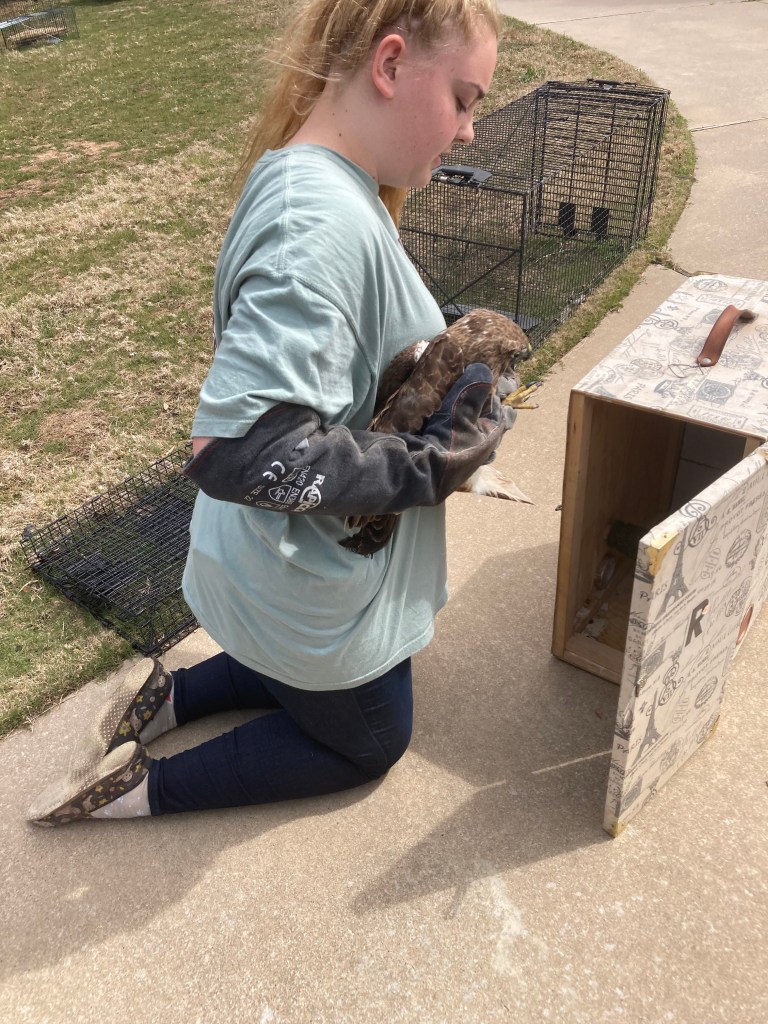
Krista is currently a senior Wildlife and Fisheries Zoology major at Texas A&M University. She aspires to attend Vet School with the eventual goal of opening an official wildlife center for the Brazos Valley since it is so incredibly needed.
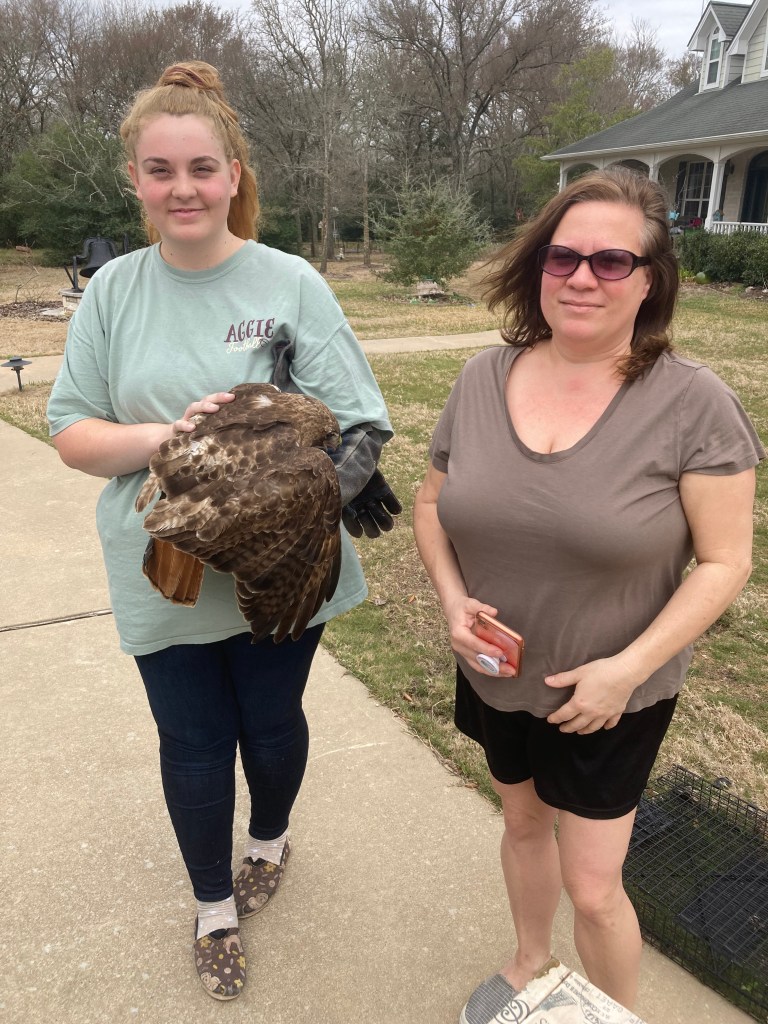
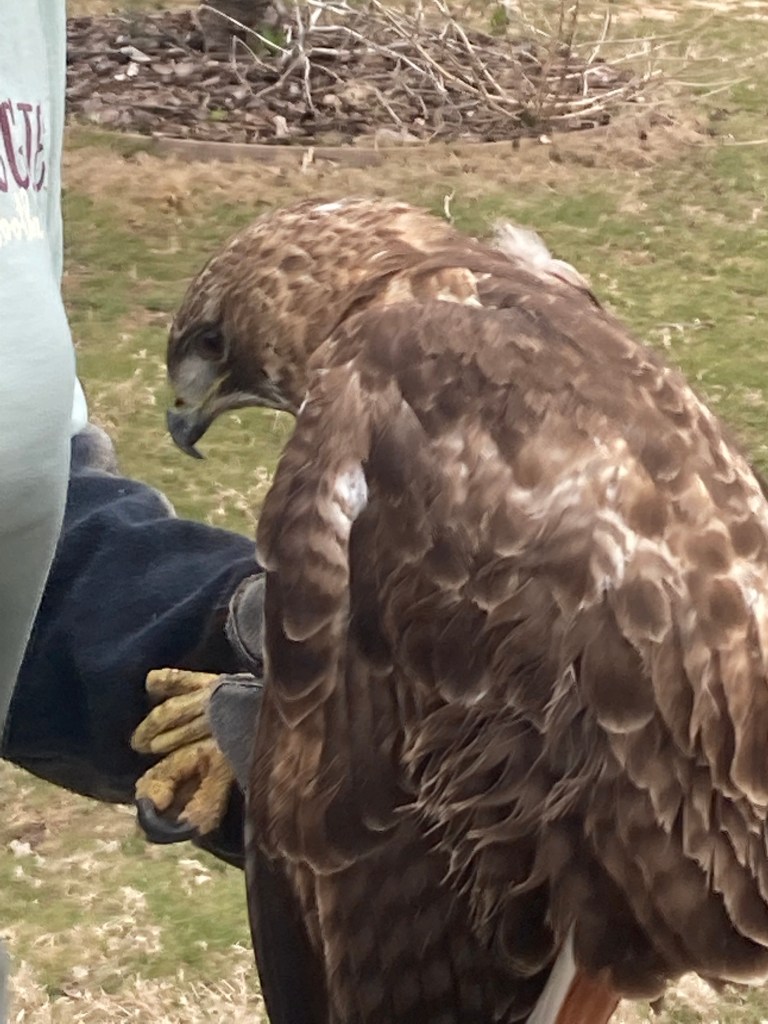
Once we got the hawk out of the truck, Krista was prepared to pick her up out of the cage. Her first impressions were the hawk had some neurological damage and possible internal injuries. She examined her and said she must have been grounded (not able to fly and hunt for prey) for a while because she was emaciated. Neurological damage can also come from eating poison or poisoned prey. Before we left, she said ask for updates at your own risk because the hawk did not look good. Based on the hawk’s size and weight, Krista believed the hawk was a female hawk.
We contacted Krista the next day, 3/18/22, and the hawk was doing well. She had her on oxygen to give her a boost while she was rehydrating her as well. She was going to start her on semi-solid foods that night. She had no apparent external injuries, but she was not quite stable yet. She wanted to go very slow with her since she suspected she had internal injuries on top of the neurological issues and slight emaciation.

Update a week after finding the female red-tailed hawk 3/23/22: She is doing great. She has been eating like a champ and Krista will be evaluating how well the hawk can fly very soon.
Update as of 3/25/22: She is doing well and will be doing a test flight tomorrow to see how strong she is and how far she can fly.
Update 3/28/22: After a few days of building her strength flying, she flew like a champ and is back into the wild.

What a great ending to this story. After 13 days from being found on the side of the highway, the hawk was rehabilitated and returned to the wild.
Game Warden Derrik Rennspies-254-482-0892
Wildlife Rehabilitator Krista Bligh-979-676-3974





 Nature Along the El Camino Real