Geeking Out over Sound Patterns

By Sue Ann Kendall

[I wrote this for my personal blog but accidentally created it on this site, so enjoy my fascination.]

Bear in mind that I have been looking at waveforms most of my adult life, so this stuff interests me. I still edit myself talking a lot (yep, it’s my job), so I know when I’m gasping or clicking from saliva before I even listen. It’s interesting, not that fun.

But it’s only in the past couple of years, since I e had Merlin Bird ID that I’ve been able to identify bird calls by how they look on a spectrogram.

Loggerhead Shrike – you can just tell it’s loud and harsh, not melodic.

This kind of knowledge is helpful in winter when there are so many sparrows around. Their spectrograms look different. Here’s one I also like.

Red-bellied Woodpecker

Songbird recordings look very different. Some are more horizontal lines going up or down with the pitch. Others have a mix of tones, but you can see the melody. These two I got from Merlin, of birds I’ve heard.
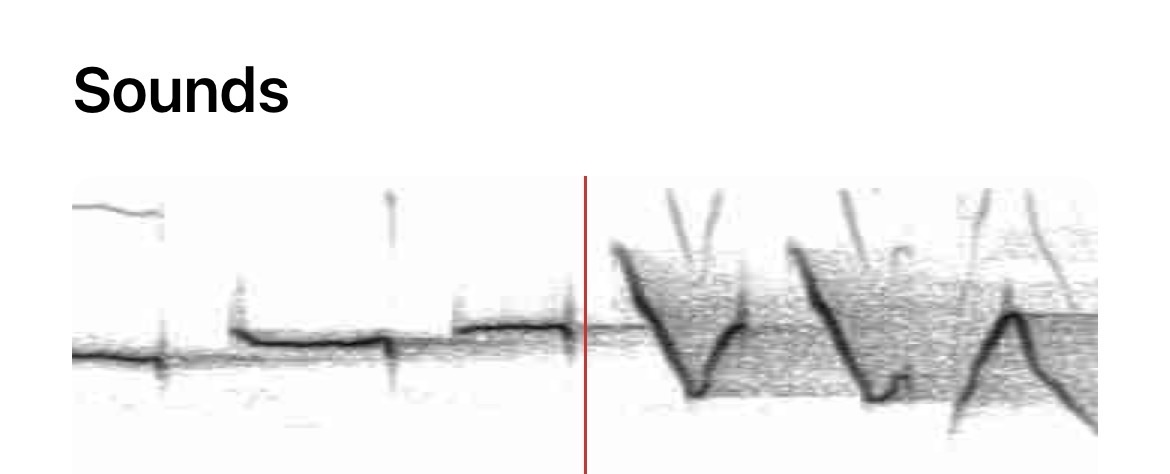
As I’ve been enjoying the sounds birds, there have been other sounds Merlin catches, like loud trucks, airplanes, and wind. And, of course there are insects. I was being deafened by the sounds of late-summer cicadas when I looked down at the waveforms. Wow!

They look three dimensional.

You can practically feel the pulsing by looking at those fascinating shapes. On the other hand, crickets just stick to one note.

This is wind and a cricket.

So if anyone ever asks me how I know a sound is a cricket versus a cicada, I can turn on Merlin. It may not ID it, but I can now from the shape.

Here’s a sound I’m glad Merlin heard: a Yellow-headed Blackbird. They only show up here a few days a year during migration. Photo by Dorian Anderson.

I used to have some frog images but I can’t find them. I’ll be paying attention and when I hear something interesting, I’ll stop the recording, since Merlin doesn’t save recordings over about 20 minutes long, due to storage constraints. My phone would be FULL.

Fighting the Invaders in The Mini Wildscape

By Carolyn Henderson

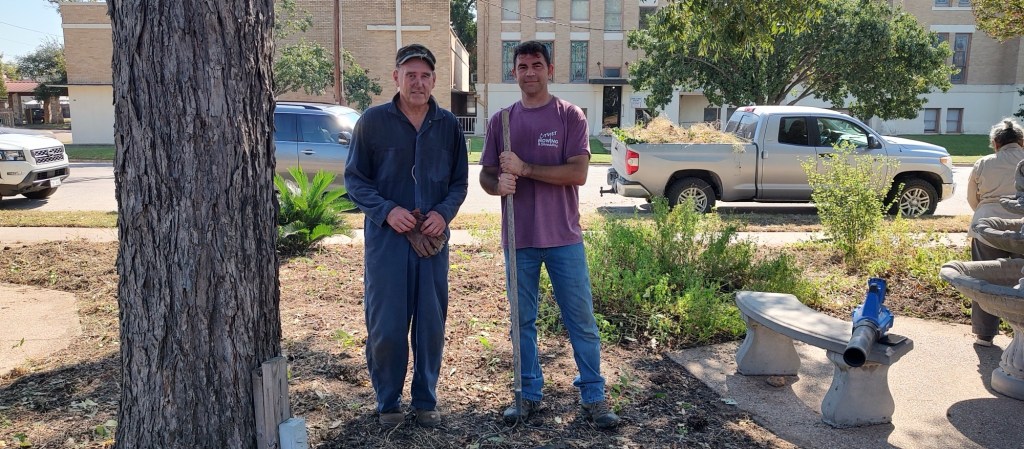
A small but intrepid group took on the fight of the non-native, invasive plants in the Wildscape – again. Chad Cryer, Alan Rudd, Liz Lewis, Phyllis Sheffield, Pamela Neeley and I implemented a new method to attempt to get rid of the seriously invasive persimmons and Tree of Heavens. 

Small but mighty

I would call it isolated poisoning. Chad clipped the multitude of pomegranate trees, many that had managed to reach at least 5 to 6 feet this season. Alan then put a tree poison only on the cut limbs.  We cut them back in February. Alan had already done it to the Tree of Heavens that weren’t as numerous. 

The invasives elimination committee.

We put all the limbs in Alan’s pickup bed. The pile stood taller than the truck cab. 

We also fought off the Tievine that had totally covered the Gulf Muhly grass among other things. We also removed the other invasives in the Wildscape. A good deal of what had been planted was there, but scraggly looking from being overshadowed by all of those. It knocked out a few completely. 

The weeding committee

We vowed to be back in two weeks to evaluate our efforts. 

Getting to Work on Our Grant

by Catherine Johnson

On the first cool day of Autumn, progress continued on the H-E-B Pollinators Across Texas Project at the Milam Wildscape Project.

Many native plants are thriving, including Buttonbush trees, host to Sphinx Moths. Barbados Cherry provides nectar, fruit, and seeds. Goldenrod that was provided by Chapter member Eric is ready to bloom.

We saw pollinators and the new residents.

Seeds and more seeds

By Linda Burgess

This past Tuesday, the El Camino Real Master Naturalists and the Little River Basin Master Gardeners came together to contribute to a shared volunteer opportunity. We meet the third Tuesday of each month to package native and adapted wildflower seeds, herb and garden seeds, and some landscaping plant seeds…..all for the Free Seed Library located in the Cameron Public Library.  

We are sharing stories, getting to know one another, and providing free seeds to the residents of Milam County. It’s become a great opportunity to learn and grow from each other’s expertise….. and there’s a wealth of knowledge in these two organizations!

Possum ‘Ranglin’

By Pamela Neeley

Sometimes I forget to replace the lid on the dog and cat food stored in galvanized containers during the day. I arrived home after dark from a meeting. I went out to feed the dog and cats.

Before I put my hand in the container I saw a little opossum face outside of the dog food bag.

Then I saw a snout move, and saw the second opossum IN the dog food bag.

I went into the house, (the food is in the art studio), to get my phone and put Ruby the dog in the house. She chases and tries to kill opossums.

Back in studio I snapped a few photos. Found a large towel, doubled it and picked up the little one. Took it outside to let it go in the pasture.

The second one was in the dog food bag. I picked up the bag, with top closed, and walked it out to deck. After a bit, that possum came out and went for the field.

I encouraged them to stay away from this farm because of the “hound” that is on patrol. I may not always be around to free them.

Opossums do so much good for us and the environment.  They love ticks and enjoy eating a variety of insects, small rodents, seeds, eggs, fruit.  And pet food!