Time for 2020 Blog Statistics

By Sue Ann Kendall

The start of a new year always seems to inspire folks to look back and analyze things. I got to thinking that last year was a hard year for our Chapter, since we had to stop meeting in person, couldn’t do a lot of the activities we’d planned, and only had a virtual conference to attend (nice as it was, it wasn’t full of hugs and chats). We certainly got more visitors in 2020 than in 2019 (granted, we didn’t start until February 2019).
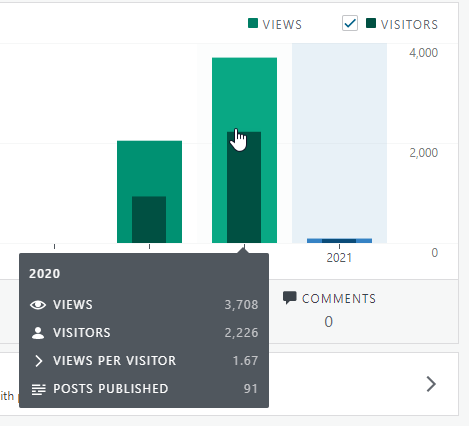
We had 3700 visitors last year, not bad for a little chapter!

Our blog, though, provided us with a way to communicate with each other and to share what was going on in our own little slices of the natural world. I was really grateful to see how our contributions grew and grew, as the blog transitioned from reports on our chapter meetings to contributions from our members. We have a nice group of regular contributors now, as well as some Chapter members who contribute whenever they can.

In fact, there were 12 different Chapter members who contributed last year: me, Donna Lewis (winner of the “most contributions” award), Catherine Johnson, Eric Neubauer, Linda Jo Conn, Carolyn Henderson, Debra Sorensen, Joyce Conner, Cindy Travis, Larry Kocian, Ann Collins, and Sherri Sweet. What? Don’t see your name on the list? You can fix it by sending me some words and/or pictures (my email address is in the member area of our website).

Blog hits by month.

You can see from the previous graphic that our hits went up and down. There were two big months. Last February, someone went through and read every single article, twice, which explains the jump. But, last month, December 2020, really spiked. Did we suddenly become fascinating?

Hmm, December 23 was a bonanza of visits.

When I look at a month’s stats, I can always tell when a blog post came out, because we get a spike in visitors. But, that was a BIG spike! The next day was pretty big, too. I was very curious to find out what the heck got published on December 23 that was so darned fascinating. A look at the most popular posts of the year gave me the answer to “what” but not to “why.”

All Time Blog Post Stats. Hmm. Two of those got a LOT more hits.

I only figured out yesterday why Donna’s sweet post about being nice to a snake was so popular. Because of all those flags people are flying these days, the phrase, “Don’t Tread on Me” has become popular. Donna’s post must have come up in searches!

The other really popular post, Let the Tours Begin, by Lisa Milewski, was from October 2019, and was about the big event we held with the Rancheria Grande Chapter of the El Camino Real de los Tejas National Historic Trail Association. That link got sent out to a lot of places and shared often, so no wonder people looked at it. (Sharing posts is how you get people to look at them; you could do that, too).

How You Can Help Our Blog Grow

We’d like for more people to be able to find and enjoy the writing and beautiful photos from our chapter members. It’s great that we are getting more posts from a variety of members, but it would be good for them to be seen! People clicking on our blog links and sharing them are what gets our blog promoted more by search engines and WordPress (blog site). So, here are some things YOU can do:

  • Contribute. Send me (Sue Ann/Suna) your nature observations, research, fun projects, or reports of activities. You can type them in an email, put them in Word, write them on a piece of paper…whatever works! I can make them into fun blog posts, even if you aren’t a professional writer.
  • Read. When you see a blog post announcement on our Facebook page (or in email if you are one of our 37 subscribers), click on it. See what fellow Chapter members have to say! You might learn something. Or laugh.
  • Comment. Do you have something to add to a post? What about a question for the author? You can comment on our blog posts. Just put your name in there and start commenting! That’s how blog readers converse and build communities.
We’ve only had 79 “real” comments. Help us out!
  • Share. Did you find a post interesting? Copy the URL (the web link, at the top of the page) and paste it in an email, Facebook post, or message to a friend. Or, click the Share button on a Facebook post. Maybe someone you know will enjoy reading what you or another member wrote.
  • Talk. Mention reading the blog in conversations, when you’re explaining to a potential new class member what fun it is to be a Texas Master Naturalist, or if you’re asked what exactly we do. The blog is a good record of that!

This can help you, too! Writing a blog post gets you precious volunteer hours. Taking the photos and doing the research for an article also counts. It’s under Chapter Administration > Website and Social Media. This is something fun, interesting, and helpful that we can do while maintaining our pandemic protocols.

Oh yes, thanks for reading! Y’all are all the best!
Feast Time for Hawks

by Eric Neubauer

Much has been written for those of us who want to attract wildlife, but sometimes luck plays a part. It turns out this is an ideal venue for hawks, validated by the hawks themselves.

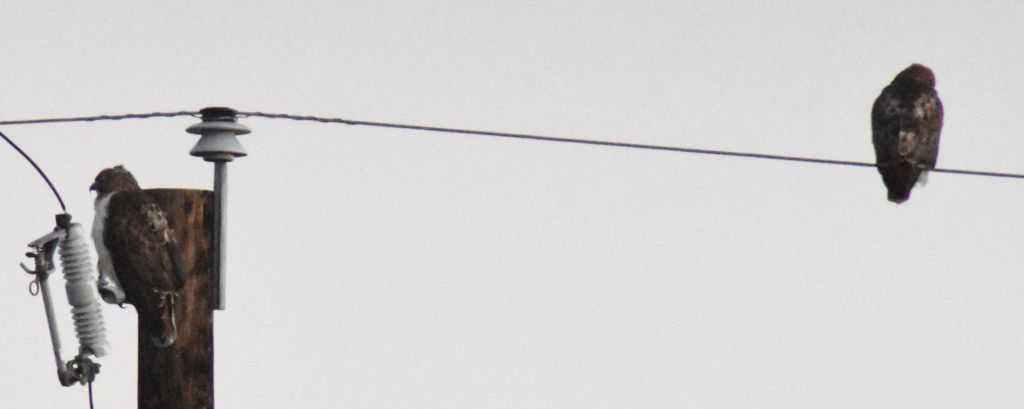
Two hawks hanging out.

I planned to make my former farmland a prairie rather than a lawn because that’s what would be natural for the area. Doing nothing was a great start. While I decided how best to proceed, nature took over. All kinds of plants came up, both native and non-native. By then I knew I’d have to mow once in a while to control the growth of brush since burning wasn’t a safe option. I mowed several paths through the grass and weeds and around the house so I’d could access various parts of the yard without walking through head-high grasses and forbs. Next I started mowing in from two edges of the property before stopping and leaving the rest as cover for wildlife. This included the margin along the north edge of the property under the power line next to the road.

The hawk hunting venue

When late fall arrived I noticed how often a hawk was sitting on the power line. At first a Prairie Falcon was there on a regular basis, then an American Kestrel, Cooper’s Hawk, and Red-Tailed Hawk showed up. After a couple of months it looked like they’d finally hunted the area out, and started watching across the road instead. Today they are gone except for the American Kestrel. On the last busy day, the Cooper’s was on the power line just as it started to get light. Then a Red-tailed Hawk (I think) flew up to the transformer on the pole about 15’ from the Cooper’s, before moving down a couple of poles. Right after that an American Kestrel came along and buzzed the Cooper’s before landing on the wire midway between the other two. It wasn’t the first time I’d seen that happen. Loggerhead Shrikes are also on the wire a lot, but that’s a year round occurrence. I know hawks are also perching on my roof and using the mowed area around the house in the same way.

Here is why I think the venue worked so well;

  1. The tall grass provided cover and food for grasshoppers, small birds, and rodents. The mowed area next to it made them accessible to the hawks when the prey strayed.
  2. The wire was on the north side of my property so they could approach their prey with their shadows behind them and the prey wouldn’t be warned as a shadow passed over them.

The grasshoppers are also giving out now. The only ones left  are a very few Schistocerca americana and Melanoplus femurrubrum adults, and some Chortophaga viridifasciata nymphs. In late summer, there were hundreds of thousands of M. femurrubrum nymphs, and a plague of Biblical proportions appeared to be brewing. It appears few ever made it to adulthood, and those that did suffered heavy predation. I’m sure the little birds did their bit, but the hawks did too. Attracting birds isn’t purely for entertainment.

Things You Learn from a Flood

Last week, as we saw from the post about flooding in Burlington, we got lots of rain. I always like to explore around my property after a flood, because there’s always something to learn. Here are some photos of wetness around my ranch in the Walker’s Creek Community north of Cameron, and what I learned.

Water flowing into front pond.

We’ve been working on managing runoff to our advantage, so I was happy to see that the small trench we dug was directing water to our front pond. What you don’t see above is that we had a low spot close to our garage that we turned into a kind of “holding pond” instead of an annoying puddle. It’s already the home to turtles and bullfrogs. That pond drains into this bigger pond, which we created when we built a dam that made our driveway.

Water flowing from the front pond to our happy stream.

The new pond hasn’t gone dry since we created it, since water flows from across the road as well as from our fields into an arroyo that feeds it. We have a large culvert, plus a spillway culvert that lets water flow once the pond is full. Every time it rains, we know we’ve had two or more inches when the pond fills up.

This was before the big rain, thanks to the springs.

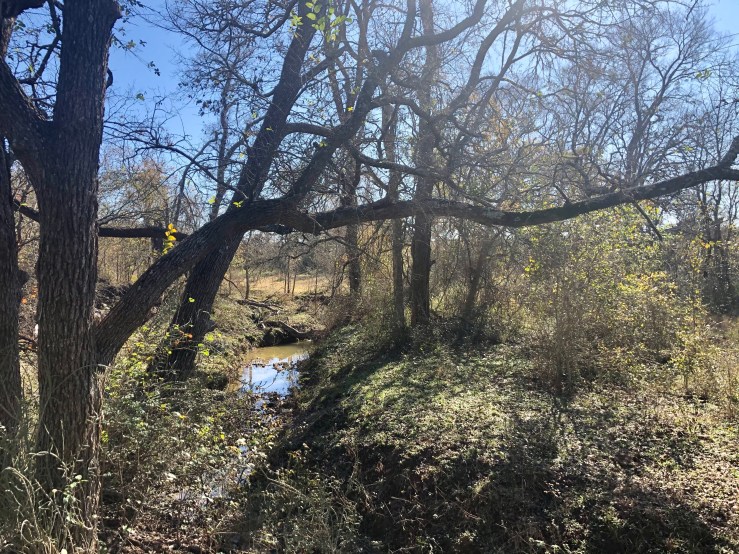
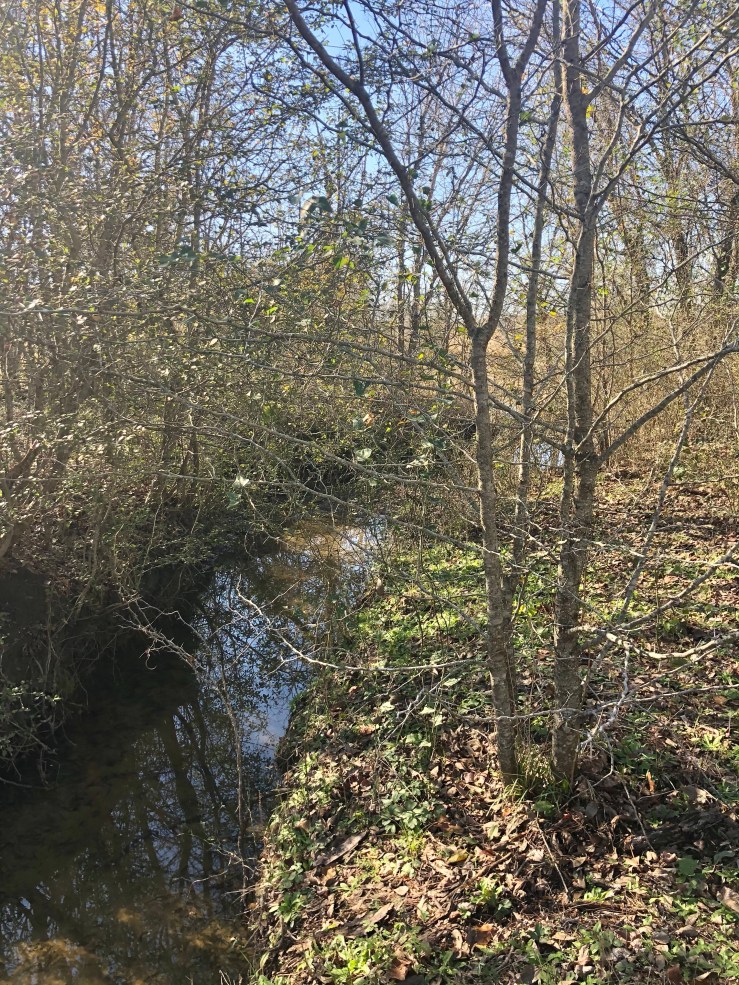
An observation I made before the rain is that while the flow you see above was dry, and the stream was dry up to the big willow you see in the background, the stream was still flowing. As I walked backwards, I was able to spot a spring flowing (which I didn’t get a photo of, thanks to not bringing my phone), one I hadn’t noticed before. That’s a good sign, I think, because it had not been a very wet year up until then. (We have another springy area that keeps the stream flowing a bit further down, too).

This stream keeps going, goes underground for a few yards, then flows into Walker’s Creek.

Our road (CR 140) did briefly flood deep enough that one should not drive through it (this truck had a hard time, which encouraged my neighbor to turn around). As it usually is, the crest of the flooding was brief, and the water went down after a few hours.

Photo by Amanda Shuffield.

There’s always interesting debris left on the roads after floods. My husgand, Lee, removed some of the larger pieces of wood and other debris from the road, so cars were safer. But, I enjoyed seeing what else washed up. It was mostly balloon vine, which floats really well (and did you know their seeds look like yin and yang?).

You can see how much higher the water was from the grass on the fence. All that brown is balloon vine, which floats.

One of the scary things you see when it floods is how powerful the water is. The bridge had quite a build-up of the remains of very large logs (still leftover from the drought in 2011). I keep wondering if they will ever knock out the bridge. They do play heck with the fence, so I’m once again glad we have someone who has to repair them (we lease to some cattle dudes).

The trees you see are the creek. I’m always amazed how quickly this happens.

I dawdled a while watching the water flow, which I probably shouldn’t have done, since it started raining again. But it was cool.

Here, watch how fast the creek is flowing! And check out that log!

As quickly as all that water built up, it got back to normal. I learn a lot about how the water flows around here, so my walks after rainstorms are so educational. I’m glad we had our Master Naturalist training about the river systems in Texas, because I know exactly where all this water is going. Our arroyo is a major contributor to Walker’s Creek (which is dry at least a few months of the year), which then heads over to the Little River, right near where Big Elm Creek joins it. Or, so I think. Maps aren’t helpful.

Skunk I saw from a good distance away, behind our house. I did not mess with it.

The flooding does displace some animals, and I saw a skunk wandering around in the daytime soon afterwards. It could have been a crazed rabid skunk, or just one who was displaced from its den (we have a lot, and some are in the creek bank). I’ll never know which it was, because I didn’t go check it out up close or let the dogs near it.

Much Needed Rain

By Marian Buegeler

After months of trace amounts of rainfall, we have finally gotten some much needed rain.  From the morning of Wednesday, December 30 to Thursday morning, I have received 3.81 inches of rain.  As I write this on December 31, over an inch of rain has fallen again today.

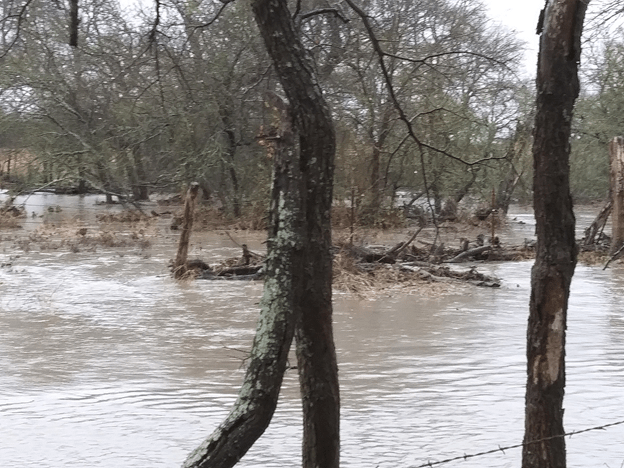
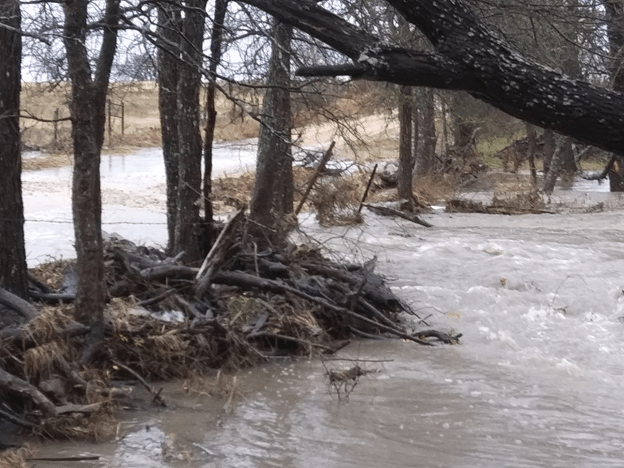
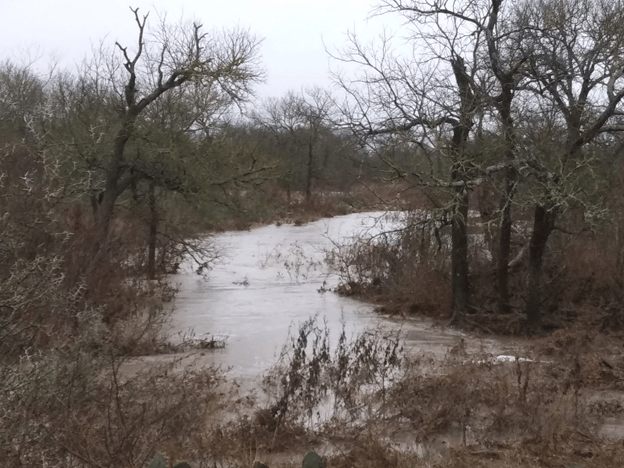
These first two photos are of Mustang Creek where it crosses County Road 133.  I am standing in my pasture looking across the road toward the neighbors property. It looks like the fences are going to need some repairs, again.

Mustang Creek near County Road 133
That fence won’t hold much longer with all that debris on it!

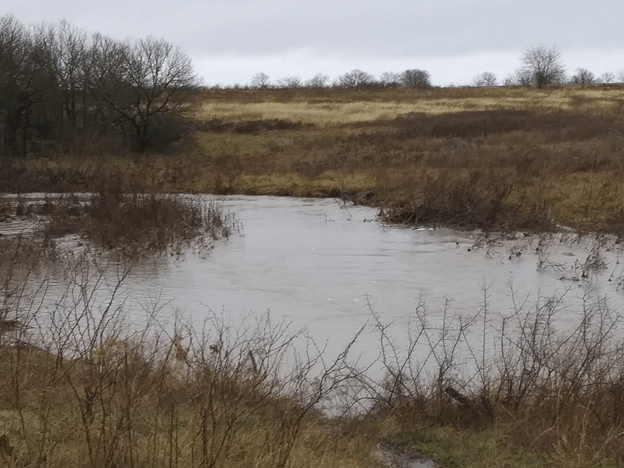
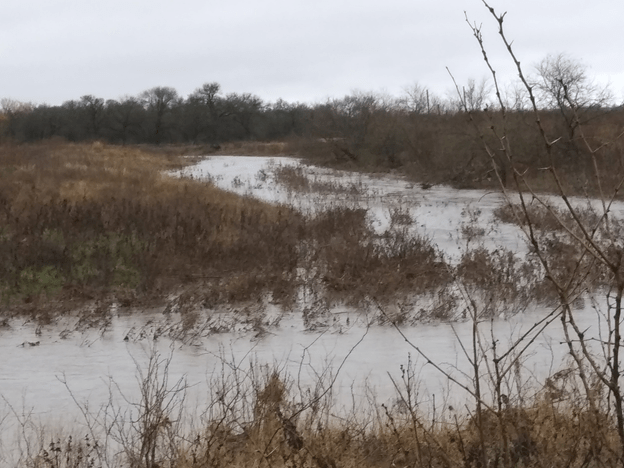
The next few photos are of Mustang Creek as it winds through the pasture.

Mustang Creek
Mustang Creek
Another view of Mustang Creek

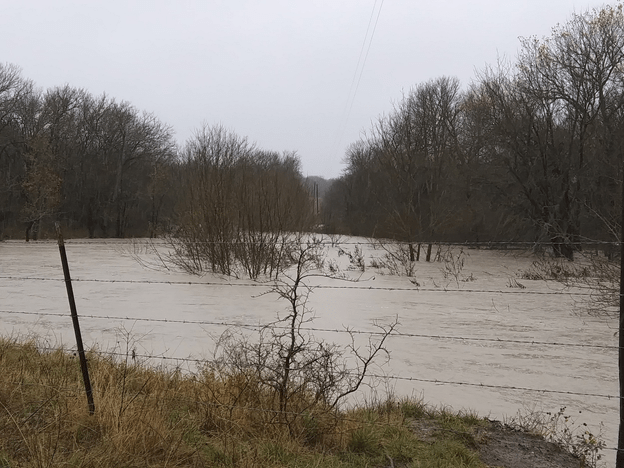
This last photo is of North Elm Creek.  You have to know just how deep this creek bed is to fully appreciate the volume of water flowing through it.

North Elm Creek

Unfortunately these photos are not of the creeks at their peak.  Both had receded by the time I hiked out to the pasture to take these pictures.


PS: For more photos of flooding on Walker’s Creek, a little south of Marian’s and also in North Milam County, see Sue Ann’s blog from New Year’s Eve.

Walker’s Creek, usually a ditch over by those trees.