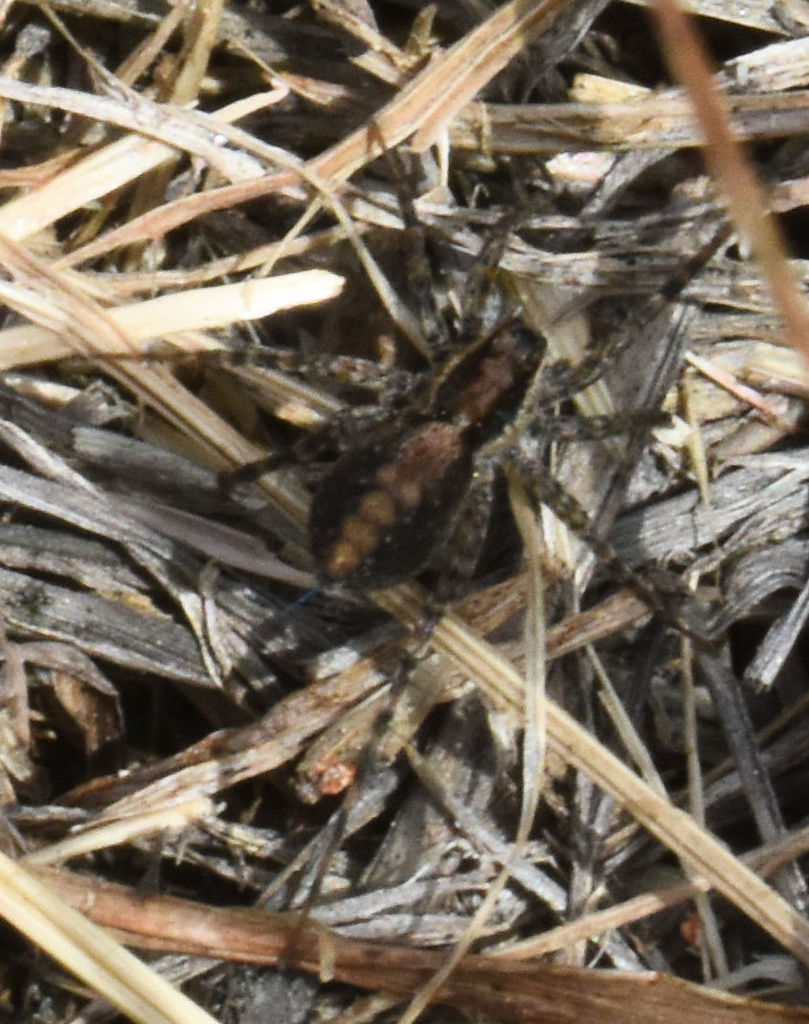
Wolf Spider Identification

by Eric Neubauer

Although some wolf spiders are active year round, this is the time of year when they start to become more noticeable. Except for a few species that are relatively easy  to identify on sight, these can be very difficult to get down to species level. There are two main reasons. First, there a lot of genera and a lot more species. You are most likely to see are Rabidosa, Schizocosa, Pardosa, Hogna, and Tigrosa in our area which isn’t too overwhelming. However, the second and third of these include over two dozen species locally. The second reason is that most keys rely on microscopic details. There are macroscopic differences, but these haven’t been compiled in any comprehensive way. It may be some time before wolf spiders become as easy to identify as birds or butterflies, but I believe it will happen.
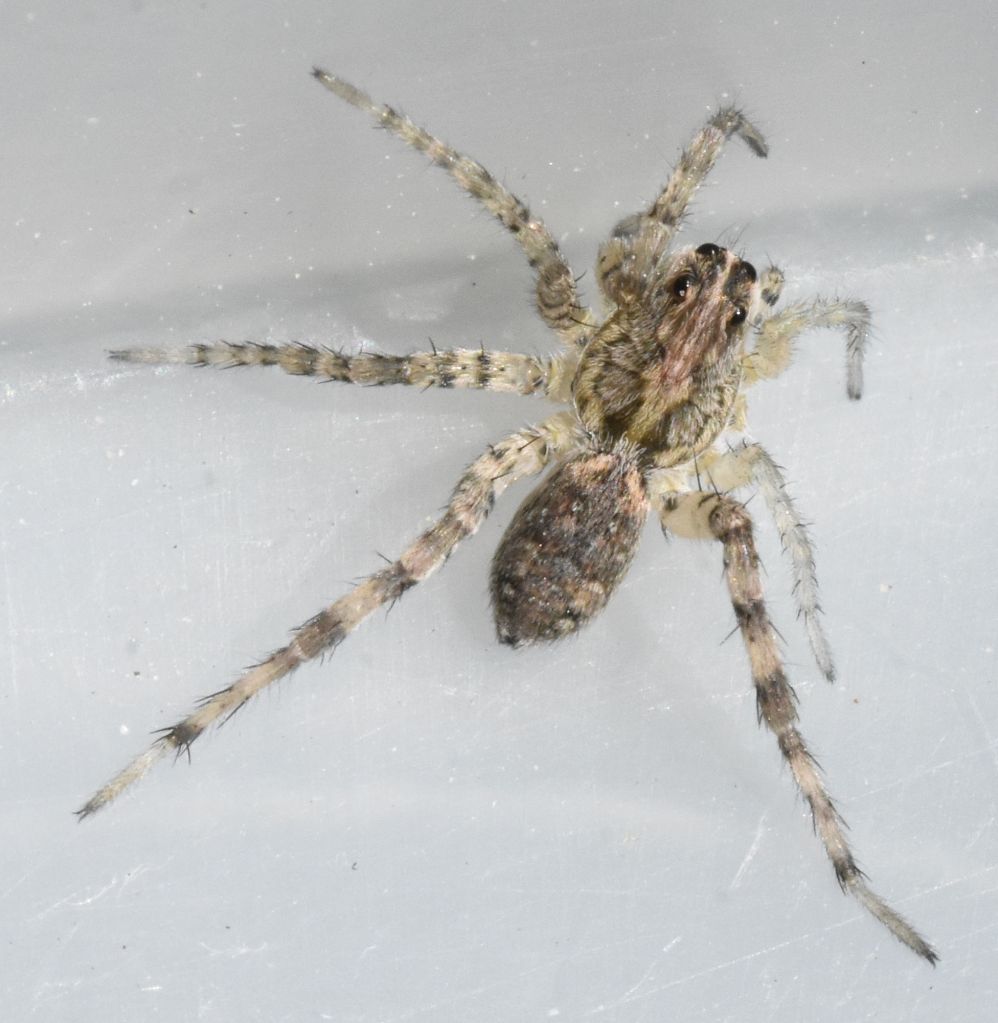
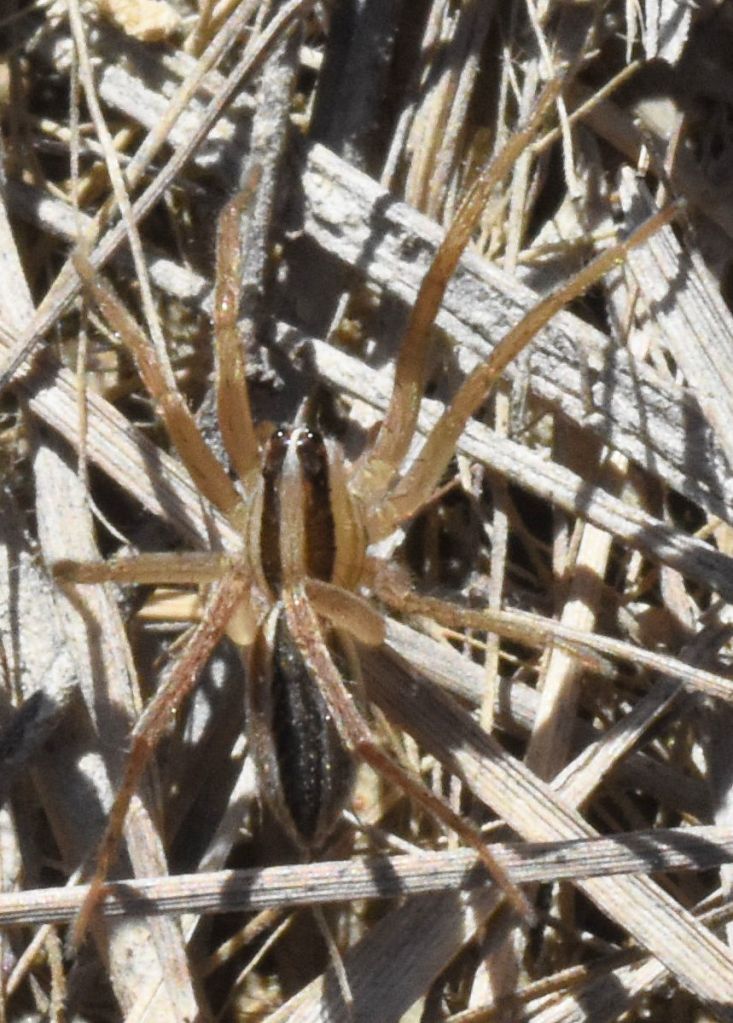
Unidentified juvenile Hogna. More on this one below.

Where to find them: wolf spiders live in diverse habitats. Margins of mowed areas, shorelines, road edges, and leaf litter are good places to look. They are noticeable because they run around in the open looking for prey. They they like to be where there is a way to escape whether it’s into tall grass, under leaves or onto the water’s surface. Many live in colonies, so if you find one, you can probably find more. I find the best time to look is when the temperature is above 70 and humidity is high. On sunny calm days, you can find them active at lower temperatures because the ground warms before the air. And, they aren’t always large. There are some species that have a body length of 0.15” or 4 mm when mature. Males tend to be smaller and a bit more lively than females, and they are harder to catch. As far as I know, none of the local wolf spiders have a dangerous bite, and they won’t bite without a lot of  provocation.

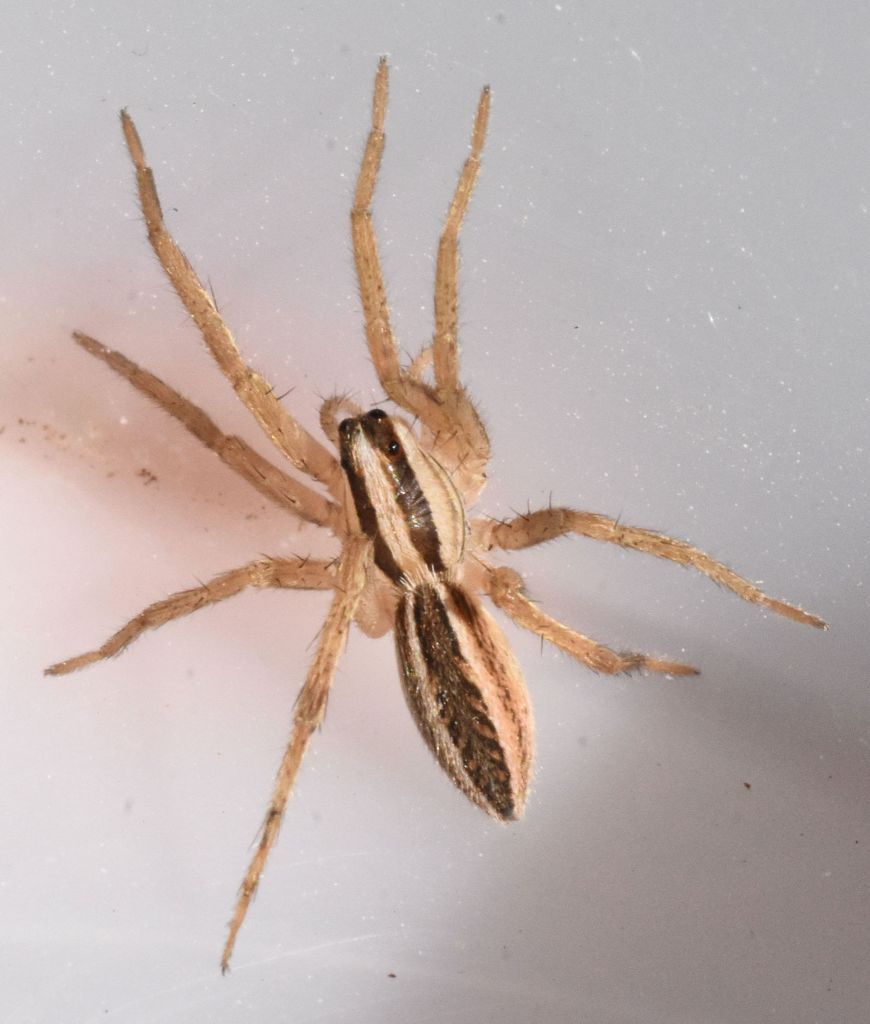
Rabid wolf spider Rabidosa rabida in a clear container

How to photograph them: good photos are important if you hope to make a species ID. Wolf spiders can usually be encouraged to run into an open container. Wolf spiders can jump, but do so more in a horizontal than vertical direction. They can climb, but not as well as other spiders. They will remain in the container until you get some good photos. Size is important, so if the bottom of the container has markings, you use them to scale the body length. Ventral views are important too. Looking up though the bottom of a clear container works. Others put the spider in a plastic bag so it can be flipped over. I try to release spiders close to where I found them when I’m finished with them. If you do all this, you might just have the clue that points to the species.

Unidentified Hogna, from the bottom (Hogna incognita)

Study populations, not individuals: Once you find a colony of spiders, visit it often and make a full collection of photos including males, females, females with egg sacs, females covered with spiderlings, and juveniles. Most experts wouldn’t dare identify a juvenile from a photograph at present. They do look a little different than the adults. However, from my experience working with two species, the juveniles are not only distinctive, but are more consistently patterned than the adults which will have developed some individual “character” in their appearance. In the future, the juveniles may provide the necessary clue for the species of an entire colony.
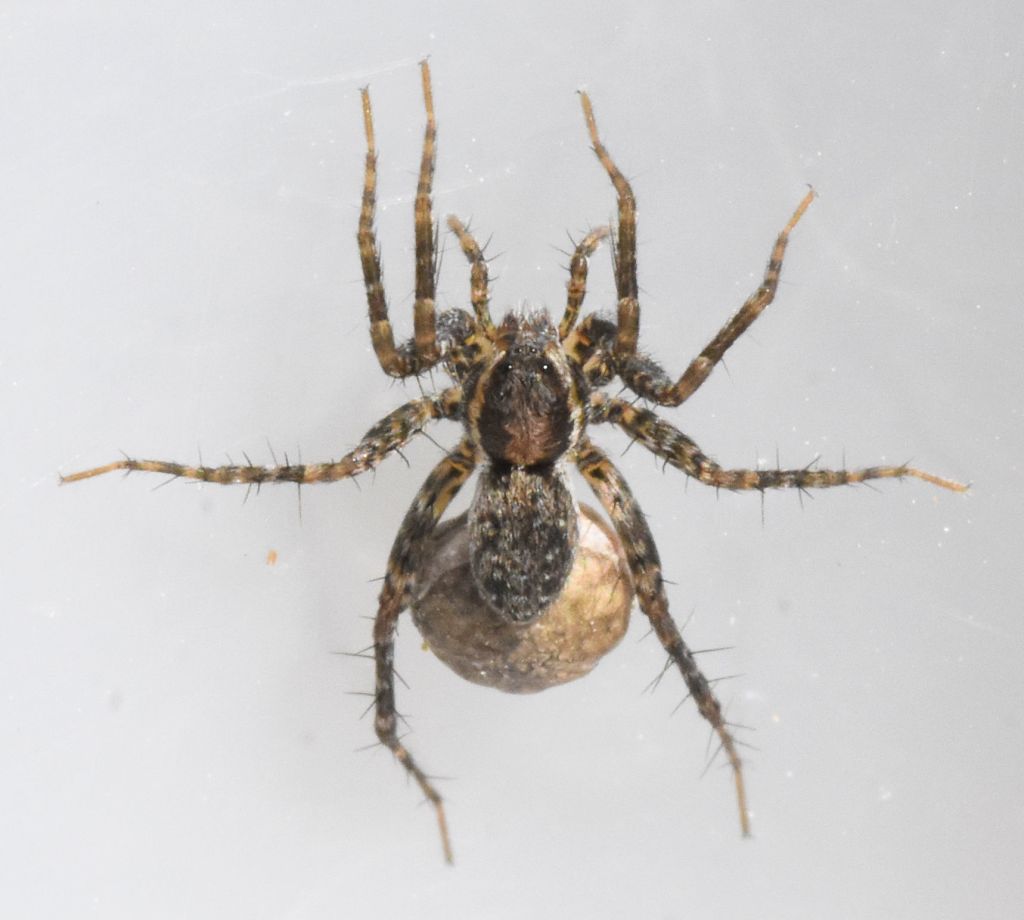
Thin legged wolf spider, genus Pardosa, with egg sac

Legs: I’ve noticed wolf spiders missing legs. Usually it’s one or two, but I have seen as many as four missing. Males are more likely to be missing legs than females. Legs can regrow, so you may notice a leg that doesn’t look like the others.

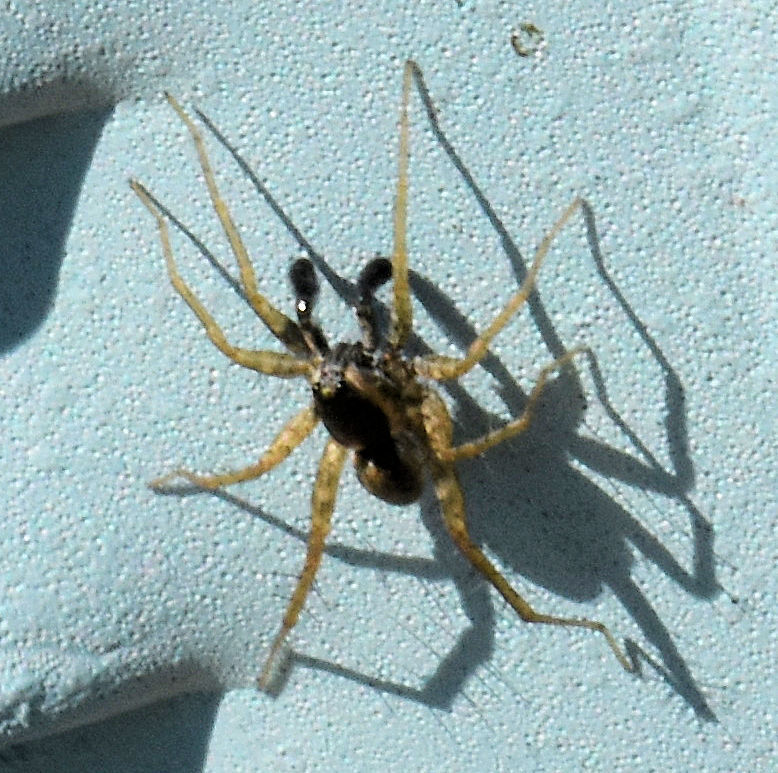
Pardosa male missing two legs, with a third that doesn’t look too good.

Recent Observation Notes from Bird and Bee Farm Trip

I continue to be surprised how finely placed the populations of wolf spiders are. At the pond dam, I found a couple of juveniles near the highest point. The first was one of my Hogna incognita (undescribed species). The other was Rabidosa rabida which seems to be species that appears everywhere in small numbers rather than being clustered in populations except perhaps around buildings. I found no more spiders until I got to the boat ramp at the far end of the dam. That’s where all the Pardosa were. The Pardosa may be all one species which would be good since most places I see them there appear to be multiple species that I haven’t been able to sort out.

I stopped at the Little River bridge north of Gause and found no spiders there. Then, I checked out the San Gabriel bridge on CR 487 east of Crossroads, which has an inspection road around and under the bridge. A bunch of spiders were in a pile of leaves that someone had dumped. I’d thought they were Pardosa at the time, but a closer look at the photos suggest Schizocosa juveniles. So, I found all four of the most prevalent genera in Milam County on my tour.

The H. incognita find was of interest. Although it seems to be mostly a Blackland species, this personally confirms it is present elsewhere, which I already figured would be true from other people’s observations. Nevertheless, its range may stop abruptly at the Brazos River. I’ll be testing that out in the next few months when they are active.

Here are some more wolf spiders to practice on. All photos by Eric Neubauer.

Horned Owl Sighting and Spider Discovery

by Eric Neubauer

Saturday, January 16:

6 AM: I currently have two Horned Owls calling at the same time from approximately the same nearby place. Typically, one starts and the second, with a slightly higher pitch, starts about a third of the way through so that the notes alternate. And, they’re still going on. This has been for at least 12 minutes.

Sunday, January 17:

Again, there was one on the power line in front of my other neighbor’s house at dusk. I watched him fly down to the ground, then up to the top of the fence, then up to the power line in front of my house. As it got too dark to see, it flew toward the back of my property and disappeared.

When interests intersect:

On Friday, I walked down to Alligator Creek for the first time in a while. On the way back, I walked slowly up the ditch looking for anything that moved. In a few places I found some tiny spiders.

I decided to go back today with a container to scoop up some the spiders for better photos. I looked carefully for about 50 feet without seeing any. Now where did I see those spiders the day before? Finally I saw one, looked around, and then it hit me: all I needed to do was follow the food chain to find the spiders.

Here were some small Texas Bluebonnet plants and other forbs, grasshopper nymphs, and tiny spiders. They were steps in the same food chain all gathered together for my convenience. On the Texas Blackland Prairie, grasshoppers and spiders seem to be the predominant arthropods. Take away the mixed vegetation of the prairie and there would be no grasshoppers, take away the grasshoppers and there would be no spiders. Take away the spiders and there would be no spider wasps, etc. I had noticed last year that the spiders’ gathering places shifted from week to week. No doubt they follow their food. Doh!

One of the Alligator Creek Spiders, identified as Dotted Wolf Spider Rabidosa punctulata by its location and subtle differences from the Rabid Wolf Spider.

Commonsense, but it took me a while to learn and understand. By the way, the spiders appeared to be a new Lycosidae species for me.

Here’s a rabid wolf spider Rabidosa rabida Eric found in another location.

And here’s his best photo of a dotted wolf spider.

Compare and contrast.

Wolf Spider Mystery

by Eric Neubauer

I’ve been watching a large population of Hogna wolf spiders growing up on my property since winter. I’ve submitted photographs to both iNaturalist and BugGuide, and people there don’t hesitate to confirm them all as Hogna antelucana.

Specimen of hogna wolf spider with the vee shape pinched shut.

Nevertheless, I found I can easily sort them into two groups from a fairly young age on. The markings on this species are quite variable in general, but one reliable difference between the two groups is in a lightly colored vee shape near the back of the head. The vee points toward the back and is open at about a 35 degree angle on one type and is pinched shut on the other.

Specimen with an open vee shape.

There are other small differences, but they are harder to define and less consistent.

At first I thought it might be a case of sexual dimmorphism, but lately I think there may be two different species.

The dark one.

The third example has the open vee, hard to see because the spider is looking up, and is very dark with none of the warmer tones these spiders usually have. It is the only one like that I’ve seen and perhaps lacks the ability to produce an orangish pigment.

It is one of several mysteries to keeping life interesting.

Who’s at the Top of the Food Chain Now?

by Eric Neubauer

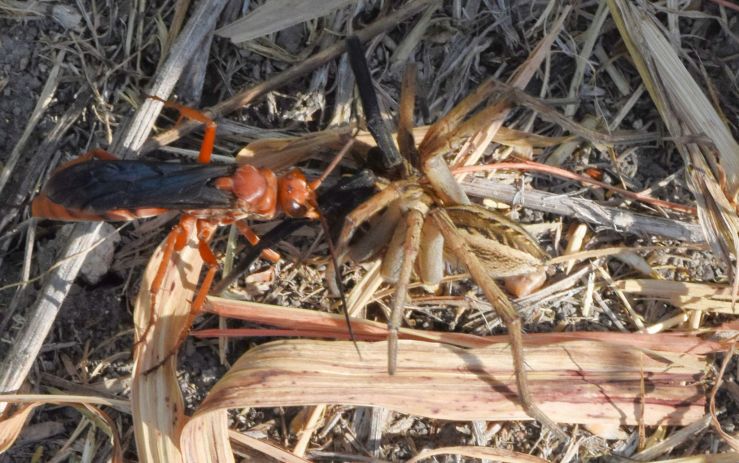
You’d think a Rabid Wolf Spider would be king of its domain. By the end of last week many had reached their prime and would be thinking about reproduction, but not this one, which was destined to become food for a spider wasp’s offspring instead.

A wasp attacking a spider
Wolf spider played by Rabidosa rabida. Spider wasp played by Tachypompilus ferrugineus. Note that The forelegs of some Rabid Wolf Spiders blacken as they become adults.

I arrived with my camera as the wasp was dragging the paralyzed spider toward its nest. Unfortunately the early morning light was bad and the wasp was fast, so most of the photos were poorly lit and out of focus. Thus, I have to tell most of my story with words.

This is what I saw. The wasp was dragging the spider along. The wasp dropped the spider several times and appeared to wander around before returning. At first I thought it saw me as a threat and was taking evasive action, but as I watched it reach its destination, I realized how entirely focused it had been on the task at hand.

Rabid wolf spider on limestone with fossils.
Bonus photo of a rabid wolf spider, by Sue Ann Kendall.

Wasps don’t have eyes in the back of their heads, so it couldn’t see where it was going while dragging the spider. Every time it dropped the spider, it had gone back to find the opening of its nest to reorient itself as it returned to the spider. It made no sense to drag the spider a long way and then find out it was in the wrong direction.

After dragging the spider about four feet and a couple of final yanks, the wasp and then the spider disappeared under the house skirting.

Making the Best Out of the Materials You Have Available

… the essence of engineering

by Eric Neubauer

I was hardly a fan of spiders, but circumstances have determined otherwise. The pandemic has kept me almost exclusively at home, and the Texas Blacklands appear to be excellent habitat for wolf spiders (Lycosidae).

In the past, getting identifications down to the species level almost always ended up in frustration, except for Rabidosa rabida. I have identified at least three other genera on my property, and there are likely to be more.

Rabid Wolf Spider Rabidosa rabida. Photo by the author.

This year, I decided to make observations of them as they grew up. My goal was to upload at least a hundred observations to iNaturalist before trying to identify them down to species level. I passed my goal by getting 23 in 43 minutes a few days ago.

This Thin-legged Wolf Spider (Genus Pardosa) is a young one. Photo by the author.

Lycosidae are generally considered nocturnal, but this isn’t entirely true. Daytime hunting is hit or miss, but a combination of high humidity after a rain, temperatures in the high 70s, and cloudy skies apparently combined to bring them out in the middle of the day.

This one is not identified yet. Photo by the author.

There is also a matter of technique. I’ve found that closely cut grass next to high grass is the best place to look and photograph them. You can just walk around slowly and watch for movement, but many will escape into the high grass. If you lead with one foot along the edge of the high grass, this flushes more of them into the low grass where they can be photographed.

There is one particular species that is so well camouflaged it’s impossible to see unless it moves. Right now, they are mostly a half to an inch long including the legs, and they are old enough to identify the genus.

Brush-legged Split Wolf Spider Schizocosa ocreata. Photo by the author.

You may also see holes of various sizes in the ground. At present, many are probably Lycosidae burrows. They can be enticed out with a blade of grass, but I’ve found they disappear back down their burrows too quickly to photograph, making it a two person job whenever that becomes an option again.

My habitat is returning prairie on blackland with paths mown through the high grass. Confirmed genera: Hogna, Pardosa, Rabidosa, and Schizocosa. Other non-Lycosidae genera including Dolomedes are encountered.