To the outside world it may seem like I’ve been in hibernation but that isn’t so. One current project is making face shots part of my wolf spider observation routine. It’s a lot harder than the dorsal and ventral views I’ve been doing for a long time. A spider needs to be encouraged to stretch up the side of a container for best results and then stay there for more than a second. It’s especially difficult with spiders small enough to balance on the head of a pin. I’m making progress but it till takes multiple attempts and a lot of prodding.
This is a typical Hogna incognita. His/her body is just over 1 mm wide and just over 3 mm long. It most likely left its mother in late October or early November and has been hanging out ever since. They have grown little over the intervening months and regardless of whether they are in captivity or wild, the only notable different is the ones in captivity are fat and the ones in the wild are skinny. In a month or two they will start to grow rapidly and most will mature in July. Sex can only be determined a little before maturity.
I rarely bother to look when it’s cold, but I did this time and found this one still moderately active at 43 degrees. By the way, Dr. Russell Pfau has started the scientific paper for this new species in earnest. I just reviewed a draft yesterday. We’ll be chasing down a several other loose ends in the same genus later this spring, but that will be another story.
There’s an unnamed wolf spider species in the remote areas of TX, NM,AZ, and probably northern Mexico, which people have infrequently observed for years.
In early October, I stopped at the Eaton Hill Nature Center and Preserve high on a limestone hill in Sonora, TX. I did some spotlighting for spiders (of course I did) and found the unnamed spider was present in significant numbers although all were still juveniles.
Fast forward to November 24. The weather forecast was good and I took a chance and drove out to Sonora. Some nature center board members and some 4-H kids with parents arrived to help as the sun set. I could argue they were essential to my success, since they found all the best spiders. On the other hand they distracted me from finding much myself. All’s well that ends well.
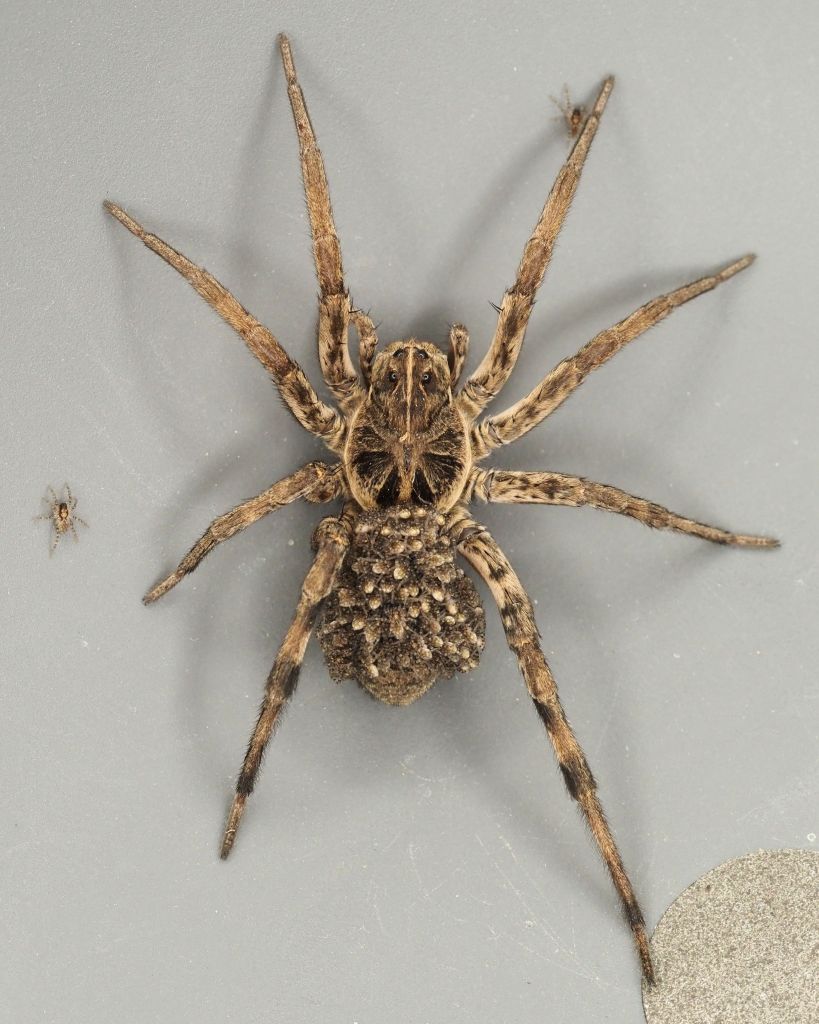
Years ago, I found that studying wolf spiders as populations in their habitat was the best way to figure out what kind they were. We found juveniles to young to sex, female and male subadults, and female and male adults.
Female
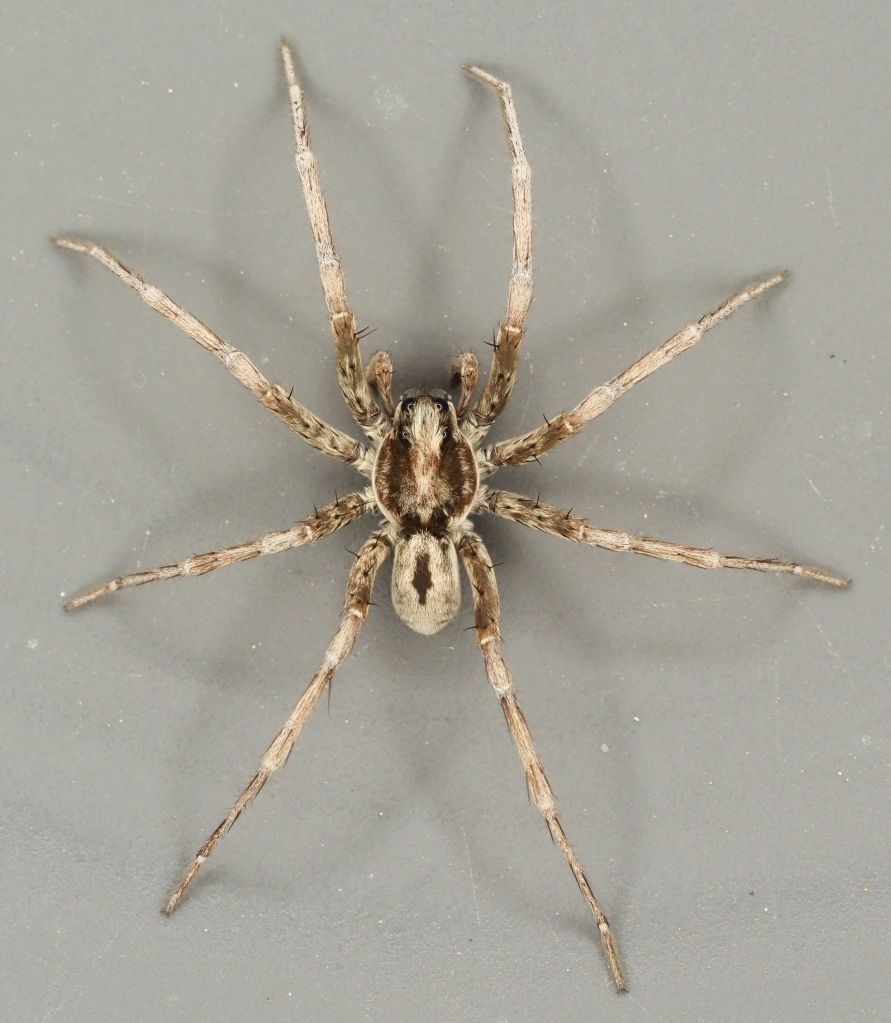
The adult male was a real shock. Initially I thought it was another unknown species. When I got a better look later, I realized it was simply a male of the unnamed species, though quite different from the juveniles and females.
Male
This species is informally known as the Big-eyed Hogna in arachnologist circles, for obvious reasons. Until now no one had connected the adult males with this species. Now any unidentified male observations on the internet have increased value because we know what they are. I already found two from New Mexico.
[Note: our most popular article on this site is Wolf Spider Identification. This article provides a brief update, plus links to Eric Neubauer’s recent presentation at the 2024 Texas Master Naturalist Annual Meeting.]
This material serves as an introduction to a new wolf spider species that is quite common in Texas and Oklahoma. It is also known in nine other states as far away as North Carolina. There is sufficient information to identify both juveniles and adults in the field as well as learn something about its life cycle. This is a departure from tradition in that a tremendous amount of information is made available to the public before publication in a scientific journal and formal acceptance of the species name.
Hogna incognita
Links to slides and explanatory text in lieu of a speaker follow:
I hope the average amateur naturalist and even professional arachnologist will find this more user friendly than the typical scientific paper.
I’m now waiting to see if any adult females make it into November. There were some with babies out there just a week ago. They outlasted my last Argiope aurantia. Someone needs to compose an “End of the Season Blues.”
Not to worry, some other wolf spider species are nearing maturity including the other undescribed Hogna west of the Edwards Plateau and another unknown I saw three adult males of last winter. I don’t want to say it’s an undescribed species until I see some adult females and do a thorough search of the possibilities. Exciting times!
Hogna incognita postscript
There’s always more to know about a species. Based on last year’s observations, adult females last though October. As the class of 2024 dwindled, it looked like some might make it into November in parts of Texas and Oklahoma. I held my breath and went out with my headlamp on as soon as the sun set on November 1st. I found one fairly quickly in the stubble of the hay field out back. She was away from her burrow and I caught her easily.
JuvenileSpiderlings attached
About a third of her family had already dispersed. Another half dozen or so decided to go off on their own while I did the photography. I collected her and the spiderlings that had disembarked and released them on higher ground next to a crack in the soil for cover if they needed it, and just in case of heavy rain.
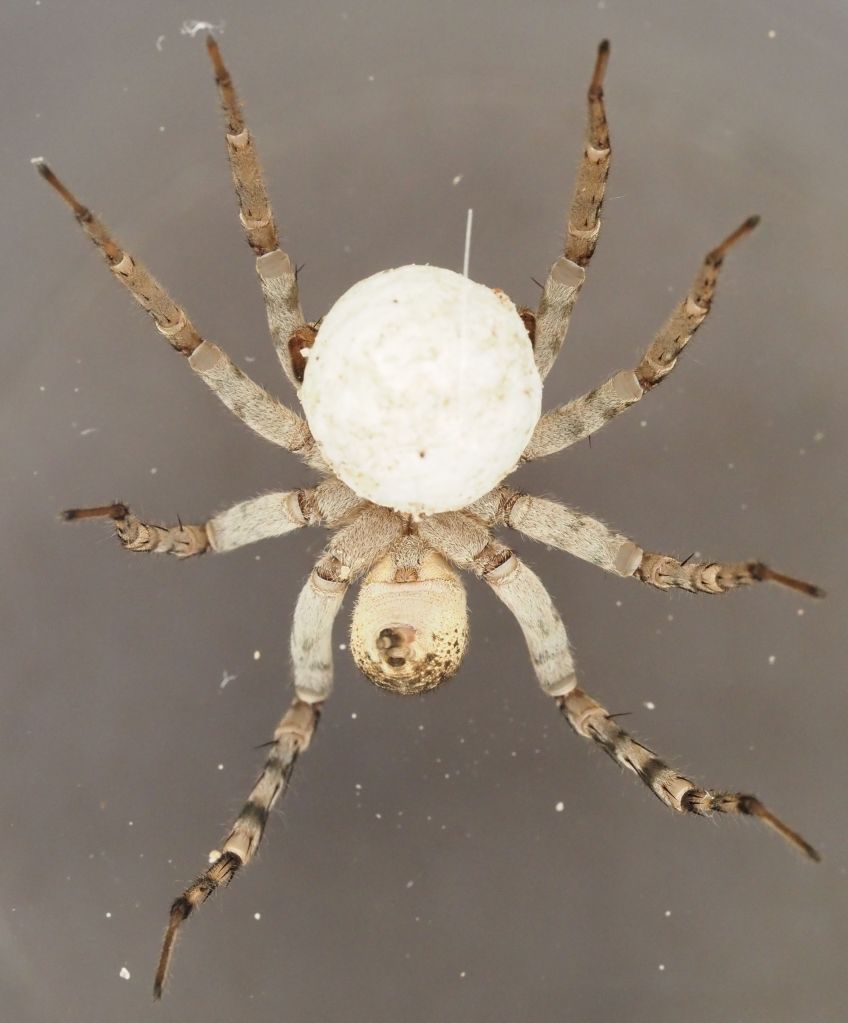
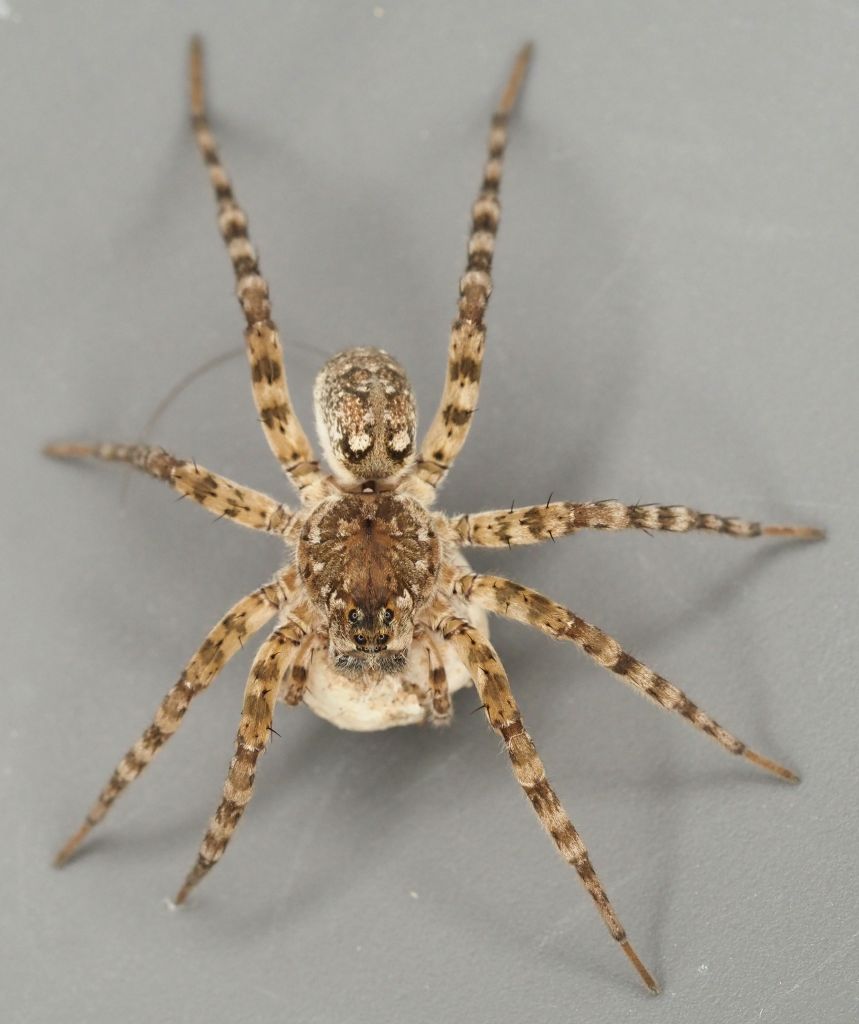
Wolf spiders usually carry egg sacs attached to the spinnerets at the back of the abdomen. They will pull the egg sac forward under their sternum to protect it when feeling threatened so I expected to see the sac still attached to the spinnerets with silk in the ventral view. What I did find was the spinnerets in a jumble and apparently not working right. Until the spiderlings emerge and climb on her back, she won’t be able to catch prey or eat without putting the sac down. She seems prepared to do whatever is necessary.
Spider courtesy of Alan Rudd/Edwards Ranch.
I suspect this species spends a lot of time preying on smaller Pardosa wolf spiders on the lake shore. Without better than average photos including a ventral view, this story would never be known. As it is, we’ll never know how it ends. Or how she managed to make the egg sac in the first place.
[This article appeared in the Cameron Herald, Thursday, April 4, 2024]
A local member of the El Camino Real chapter of Texas Master Naturalist is putting Milam County on the scientific map in spider identification. Eric Neubauer, now considered a local Rabid Wolf Spider expert, discovered a kind of Wolf Spider that has never been identified anywhere.
Eric Neubauer
Neubauer discovered the new spider and named it Hogna Incognita while studying the biodiversity of his place out near Davilla in 2019. He had just moved to Texas from Pennsylvania and bought a few acres in that area. When he realized the place was covered in what are commonly called Wolf Spiders, he felt compelled to identify all of them.
The newspaper article
There are many kinds of Wolf Spiders, but after two years of trying to identify the Hogna Incognita without success, he believed that he had found a new, unidentified, as yet unnamed spider. “It’s amazing that a spider that big, that common had not been identified already,” said Neubauer.
He started using iNaturalist, an internet vehicle to identify all living things all over the world, in 2019. Only 4 people had an active interest in Wolf Spiders on the site. Neubauer went through 13,000 Wolf Spider observations on several different identification sites. None were his spider. The first identification of Wolf Spiders in Milam County goes back to 1904 when Texas was still a popular place for biologist to study all types of living things.
Hogna incognita– photo by Eric Neubauer
After extensive studying, he came to strongly believe that he had a new one that had never been mentioned in scientific literature. The Hogna Incognita has a relative that looks similar to it, but it doesn’t look exactly like it. The “cousin” is commonly called the Hogna Antalucana. He believes the incognita was thought to be the antalucana because they had one similar trait.
Neubauer began giving presentations on Wolf Spiders to fellow Master Naturalist. In 2021, convinced it was a new one, He put up a “note” on it on the Bug Guide web site. The curator of the site agreed that it was a new species.
After some statewide presentations by Neubauer in 2023, Tarleton Professor Russell Pfau read the presentations and offered to help Neubauer with definitive evidence of its uniqueness. Pfau did extensive DNA testing on both the incognita and antalucana. Neubauer and Pfau caught some of each type in several stages of development – including all the spiderlings on the mother’s back. Pfau has managed to raise them from infancy to adulthood. The raising of them showed difference between the two from birth to adulthood.
Just weeks ago, Pfau notified Neubauer that the two spiders did indeed have different DNA. He had found an unidentified Wolf Spider.
“Hearing that the DNA test verified what I was sure I’d found – I was more excited than I thought I would be,” said Neubauer, who is normally very stoic.
Neubauer would like to stress that Wolf Spiders are harmless. They may bite, but it’s not poisonous or painful. “I’d rather be bitten by a Wolf Spider than a mosquito,” he said. They offer some benefits out in the blacklands, too. The incognita is mostly in the blacklands and some surrounding areas, so if you’re in Milam County you probably have them.
If you’d like to read the original report, you can find it on the El Camino Real Texas Master Naturalist web site https://txmn.org/elcamino/ . You also can look up Wolf Spiders on www.inaturalist.org.






 Nature Along the El Camino Real