Chasing Butterflies

by Carolyn Henderson


At just after noon on Saturday, I was standing on my patio when a Monarch butterfly flew by very close to me. Unfortunately, I didn’t have a camera to get a photo of it, but I probably wouldn’t have gotten it anyway. It flew straight by into my neighbor’s back yard. It did, however, inspire me to go chasing them.

I go to the Little River Basin Texas Master Gardeners Triangle Garden seasonally to take pictures of pollinators, and I usually see Monarchs, and many other types of butterflies, there. So I took my camera to see what I could see.

I found huge Giant Swallowtails eating from abundant Zinnias. The Fritillarys, both Gulf and Variegated, also were fond of the flowers. So was a Bold Jumping Spider that seemed to be after the Variegated Fritillary. I also found Gulf Fritillary on Tropical Sage. I am unsure if the Giant Swallowtails are Eastern or Western variety. iNaturalist thinks they are Western, but Eastern are more common here.

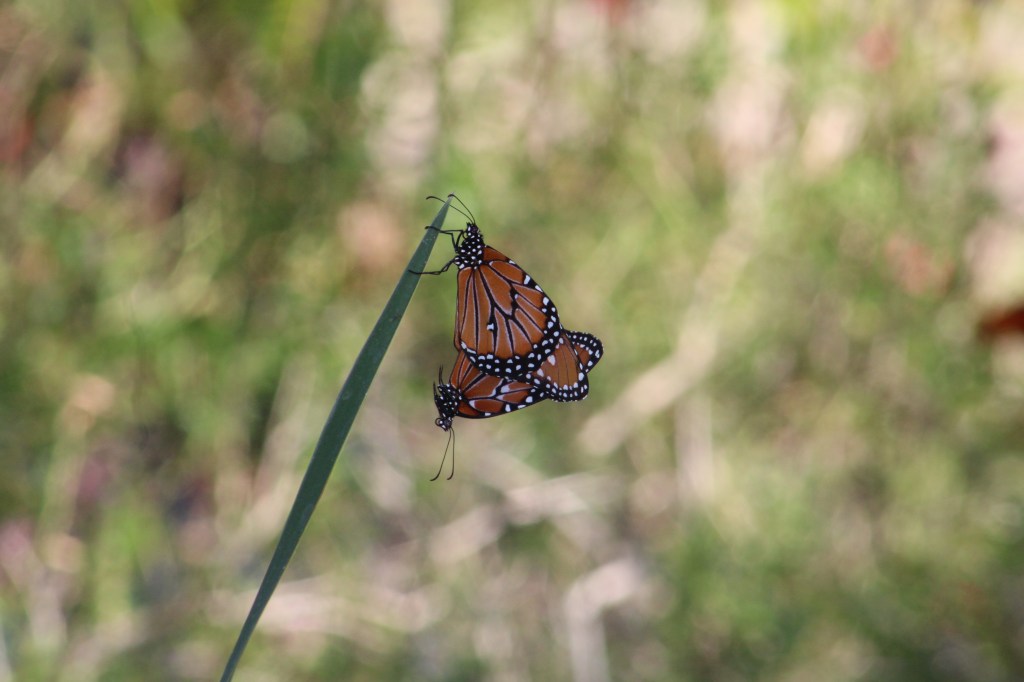
One of my favorite butterflies is Queens. They were abundant on Gregg’s Mist. I can always find them on this plant. They also were mating. I’ve seen more of them there, but it may be early in the migration. Bordered Patch and Fiery Skippers also were enjoying the Gregg’s Mist.
What is not there, at least yet, are Monarchs nor Pipevine Swallowtails. The Flame Acanthas and Tropical Sage and Gregg’s Mist are ready for them. So is the cat in residence (see photo).

I also found a few others at my house. My yard is inundated with Hackberry Emperors, and some Clouded Skippers are hanging out there. So are Carolina (or Arizona?) Praying Mantis and Spinybacked Orbweavers with an elaborate web, and grasshoppers that were abundant at the triangle garden, too. I also had a hummingbird that was interested in the Texas Purple Sage at my house.

Blackchinned Hummingbird

The iNaturalist fall project to submit as many pollinators as you can find is coming up in October. If you are participating, you might want to try the El Camino Real Wildscape which is usually full of butterflies in October – including Monarchs. Or, you also can try the Triangle Garden.

Spinybacked Orbweaver and web

The Female Hogna Appear

by Eric Neubauer

Since I knew the Hogna ‘incognita’ females were on the verge of adulthood, I went out spotlighting on my property at 5 AM this morning. Recent rains had sealed up all the cracks in the soil, and a heavy dew made picking out spider eyes harder than usual. Although I saw several promising spiders, they easily eluded me under the new vegetation caused by the rain. I was disappointed and rather wet from the knees down.

The only option left was to go down the gravel driveway and check out the margins of the gravel county road. On the way down the driveway, I found one which turned out to be my first adult female this season! Walking a quarter mile of county road in front of my and other properties filled out the eight containers I carry with me in a tub. These included an adult male and four more adult female ‘incognita‘ as well as two adult female Hogna antelucana. Oddly enough several were along the edge of the neighbor’s mowed lawn where there was little cover. The others were found bordering hay and row crop fields.

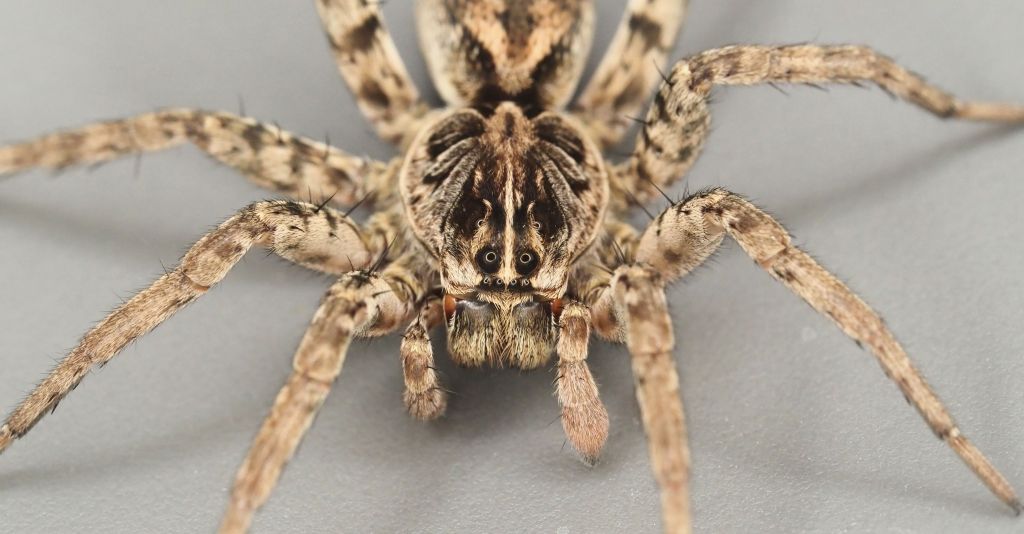
The largest was this female ‘incognita’, and she was a feisty one. Wolf spiders, especially the larger ones, may stand their ground when approached. They may raise one or even two pairs of forelegs in a threatening position. They may lay the tip of one foreleg on what has approached them to gain more information about it. Less often they’ll launch a mock attack which likely would turn lethal for edible prey. In the past they’ve attacked the toe of my boot and a finger. During the latter I felt some pressure.

A while ago I ended up with some toilet paper rolls with a center that could be pushed out. The centers became useful to have around for other purposes. I have one I’ve reduced to about a half inch in diameter and find useful to get larger spiders to go through the bottom of a funnel into an observation chamber for ventral views. The large female wasn’t happy about the process and attacked the end of the small roll. She was lightning fast of course, and I could feel a substantial blow from the other end of the roll. Best analogy would be a cat boxing the ears of a larger dog. Calling this family wolf spiders is a bit of a stretch in my opinion. They don’t hunt in packs and many other behaviors are much more like house cats. Should they be called Felicosa or kitty spiders?

Hogna ‘incognita’ reaches another seasonal milestone

by Eric Neubauer

My first adult incognita of the year. Like birds, wolf spider males are often more eye catching than the females. In the case of this species, this means a bolder pattern with greater contrasts like this one here.

Males mature ahead of the females, but I think I also observed a female with only one molt to go which means they’ll start maturing soon too.

I’m just learning how to recognize females as they approach maturity. At present I’m assuming that if they’re big enough to be recognizably male and they aren’t, then they must be females.

The timing appears to simultaneous across its range, with recent observations from Oklahoma, Kansas, and for the first time ever, Louisiana. Even those that have been lab raised since last October are on schedule with the first male molting into an adult last week.

Hogna Babies Are Teens!

By Eric Neubauer

I’ve been checking my local Hogna ‘incognita‘ spiders since late last
year and looking forward to the time when I can get some good
photographs of adults. They’ve already started to grow rapidly, and at
5:15 AM on June 15 I found my first sub-adult male. A few more molts and
they’ll be adults!

Look at that face!

Perplexa Needs Help

by Eric Neubauer

“I’m perplexa, and I’ve been lost in the scientific wilderness for nearly 90 years. Can you help me find my siblings?”

Most who have done taxonomic research have run into at least one of those “lost” species that once identified seem to be forgotten. Some are later determined to be a synonym for an earlier species. Others apparently disappear from the ecosystem. Whatever the reason, the Lycosidae family is littered with more than its share. One of those species is doing well enough in Milam County to be found in a second location early this February. It has also been found in a few scattered locations in Texas as well as one in Ohio. Is it exceptionally rare? Is it as sneaky as the Texas panther? It’s impossible to know.

Schizocosa perplexa is a medium sized wolf spider. Its tans, browns, and blacks are a bit richer than other Schizocosa species, and the legs are orange-red under the covering hairs. Its black tummy (venter) is uniquely spectacular with a thin, pale tan stripe down the middle and dozens of pale tan spots and dashes on either side. The unique venter pattern makes species identification easy, but a ventral view is needed to be see it. When I finished taking photos, I let the spider walk out of the container into my hand. I could feel him move slowly to the edge of my palm, pause for an instant, and then hop onto the ground which was about 9″ lower. An awesome experience with a “lost” species.

Here is the species history from the human perspective:

1. 3/25/1935 male only collected at Garland Swimming Pool in Dallas by S. Jones
2. 12/36 male only first described by Elizabeth B. Bryant at Cambridge, MA
3. 1937-1977 crickets?
4. 1978 C.D. Dondale and J.H. Redner decide to exclude perplexa from their revision of the Schizocosa genus, probably due to lack of information.
5. 1979-2017 crickets?
6. 4/14/2018 Sara Jane Rose finds one in Ohio
7. 5/21/2018 Sara Jane Rose uploads and observation on iNaturalist
8. 5/26/2018 Scott Snyder sees a female with egg sac near Temple and uploads observation on iNaturalist. Not identified until 2 years later by me.
9. 5/27/2020 I start seeing these and soon suspect they are perplexa based on Sara Rose’s observation.
10. 3/15/2021 I finally get a ventral view and confirm species.
11. 5/1/2021 Meghan Cassidy (who tentatively identified mine early on) finds a female at Lewisville Lake and uploads observation on iNaturalist.

An early lack of interest and/or funding was likely why it took 83 years to find out what a female looked like. The species deserved more follow up than it got, and that’s something amateur scientists have helped with. As far as I know, I’m the only one who has seen these in the wild on a regular basis. Little is known about their lifestyle, but I can speculate. Evidently, they have a huge range, but only a few locations are known. This year I found late perplexa juveniles at the edge of vernal ponds in wooded areas. A common, smaller Schizocosa species was also present. The smaller species may have been there in search of aquatic insect larvae, and perplexa in search of the smaller Schizocosa. Based on previous observations, the perplexa adults have a greater tendency to be found among died leaves and wander about. If vernal ponds in wooded areas are essential to perplexa growth, flood control projects have probably resulted in insignificantly reduced habitat for them. At the same time, the large number of ponds and lakes have greatly benefited Pardosa wolf spiders.