
By Sue Ann Kendall
There I was yesterday, sitting in my back yard, listening to birds and trying to read a book, when I heard a noise in the adjacent pasture, a few feet away from me. Usually when I hear something it’s one of the cottontails coming out of their den to munch on grass, or the cotton rat family traversing their tunnels along the fence line. Y’all, cotton rats are very cute (and no doubt delicious to hawks).

When I turned to look, I saw a massive moving blob. I took a photo of it, in case whatever it was moved away before I could get closer.

I shouldn’t have worried, because the blob turned out to be two Texas Rat Snakes (Pantherophis obsoletus lindheimeri) (our subspecies of Western Rat Snakes) engaged in their mating rituals. This is one of the most interesting things I ever saw in my life, and I’m no spring chicken and have seen many things!

I took many photos and even a two-minute video, that I hope will upload to this blog so you can watch all the undulations and pulses they go through. You can even see the female’s cloaca.
I was spellbound. What a privilege to see this behavior out in the wild, right next to my birding chair (eek).

Being the semi-scientific type that I am, I looked up what I could find out about the mating practices of Texas Rat Snakes. It wasn’t easy, because there was little literature specific to these snakes, and nothing mentioned the bit about putting one’s head in the other one’s mouth that I think I saw.

However, I did learn that rat snakes mate in May and early June, making this prime time to enjoy the spectacle. Male rat snakes have a two-pronged penis (hemipenis) that is inserted into the female’s cloaca to deposit sperm. They spend a lot of time coiled together (up to an hour), though not all of the time is actually mating. I guess it’s a good time for all.

Texas Rat Snakes lay 10-12 eggs 5 weeks after mating, and they hatch in early fall, which is, not coincidentally, when I tend to see many baby rat snakes.

On my property we have quite a few of these snakes, which eat many of our pesky rodents, and many of my chicken eggs. I found a shed skin in my chicken house that was taller than me (I’m 5’2”) which makes sense, because rat snakes are the longest snake found in North America (up to eight feet, though Texas rat snakes usually top out a bit smaller).
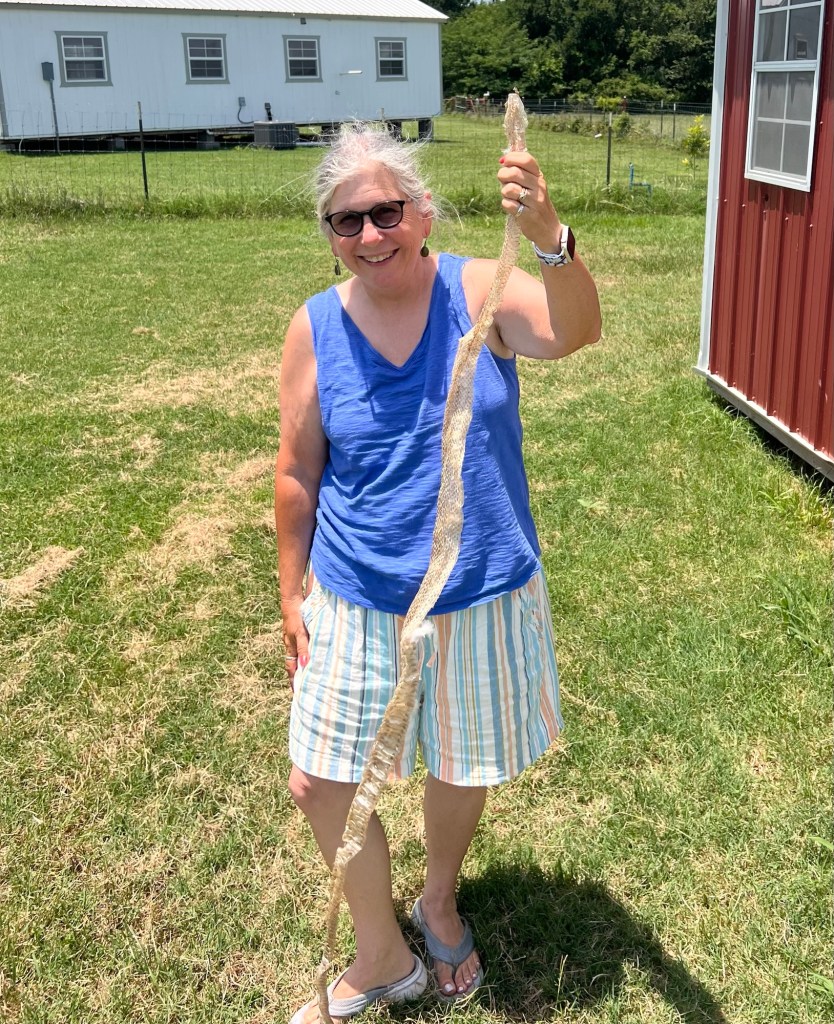
They are constrictors, so that’s how they subdue small mammals before eating them. They will eat pretty much whatever animal they find. Their predators are hawks, especially Red-tailed Hawks, and where they have them, minks. I don’t think we have minks in Milam County, so that’s one less thing for the snakes to look out for.

I really enjoy observing these snakes and consider any eggs they eat to be payment for mouse patrol. Note that they are great at climbing, and it’s fun to watch them climb walls. In fact, when we kept one as a pet for a few years, its name was Climber.

By the way, this is prime snake season. I saw two plain-bellied water snakes today, on the Walker’s Creek bridge and in Walker’s Creek, north of Cameron, Texas. My friend Pamela found one at her house in a bucket of water, too. They are non-venomous snakes, like the rat snakes, so I just watch them and let them do their thing.


Resources
Pantherophis obsoletus – Wikipedia
Texas Rat Snake – Wikipedia
 Nature Along the El Camino Real