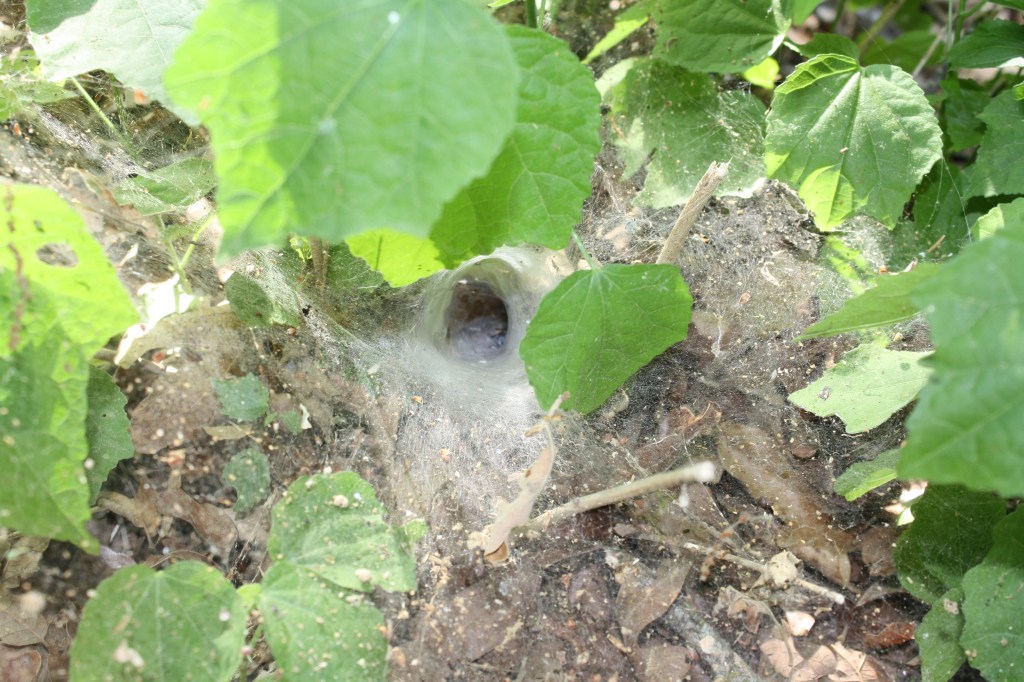
Just before it rained the other day, I saw this very interesting spider web under a tree, wound up in a Turk’s Cap plant.
I was not about to get too close as it looked like something that if I were a small insect, I would enter and never come out again. I think they make horror movies about these kinds of things.
But I was also struck by how intricate and, yes, beautiful it was. How can a tiny insect have the mind to construct something like this? Another one of nature’s secrets.
I sent the photo to Master Naturalist Eric Neubauer, who we are fortunate to have as a member of our Chapter to identify what spider made this. He said it was either in the family of Agelenopsis or Agelenidae Funnel Spider.
They look similar to a Wolf Spider. But I am not going to get that close to ask it.
The lesson is as usual, look around at nature and you will see wonderful things.
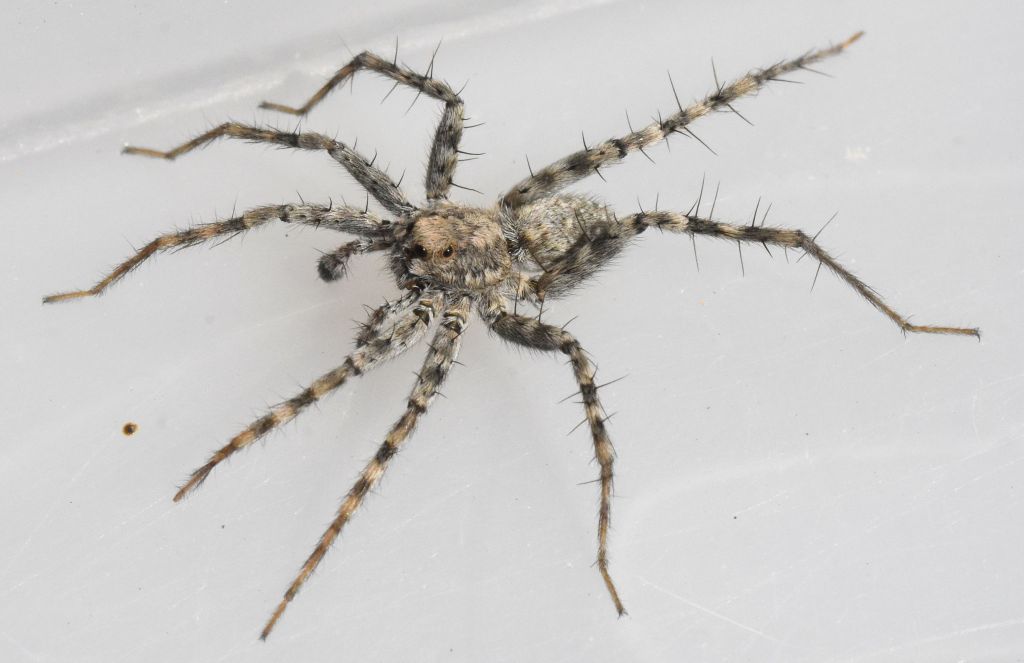
I didn’t have my usual spider accessories when I encountered this spider indoors, and the only thing I could find to use was a small glass jar. After getting the spider to run into the jar and taking it outside, I took some ventral photos followed by some dorsal photos after I released it. The lighting was harsh, but the images were adequate for identification. At the time I thought it was one of the darker Tigrosa species because I knew it was something I hadn’t seen and was expecting to eventually find some in Gause. Tigrosa is a common genus, but I’m not very familiar with it because I rarely encounter it. I soon found out my ID was wrong but didn’t feel too bad since the most recent Tigrosa helluo observed at iNat looked just like mine. After looking at all the Tigrosa options, I found that all had a narrow carapace pale medial band, which ruled mine out. I thought it might be Trochosa, but the medial band wasn’t as strong between the posterior eyes as those I’d seen before. I checked Varacosa before returning to Trochosa. Looking at the Trochosa sepulchralis observations, about a quarter looked just like mine.
Trochosa sepulchralis
So how does my observation fit into the iNaturalist world? There are 78 observations of the species of which 48 are in Texas showing how much we love our wolf spiders. The range of Trochosa sepulchralis covers most of the US east of the Rockies except for the extreme northern parts.
Trochosa sepulchralis
There are probably significantly more observations at iNat that are unidentified or misidentified. I know for sure there is at least one under Tigrosa helluo. This was my first Trochosa and the first Trochosa sepulchralis observation for Milam County. Note that my ID hasn’t been seconded yet, but I’m pretty sure I’m right.
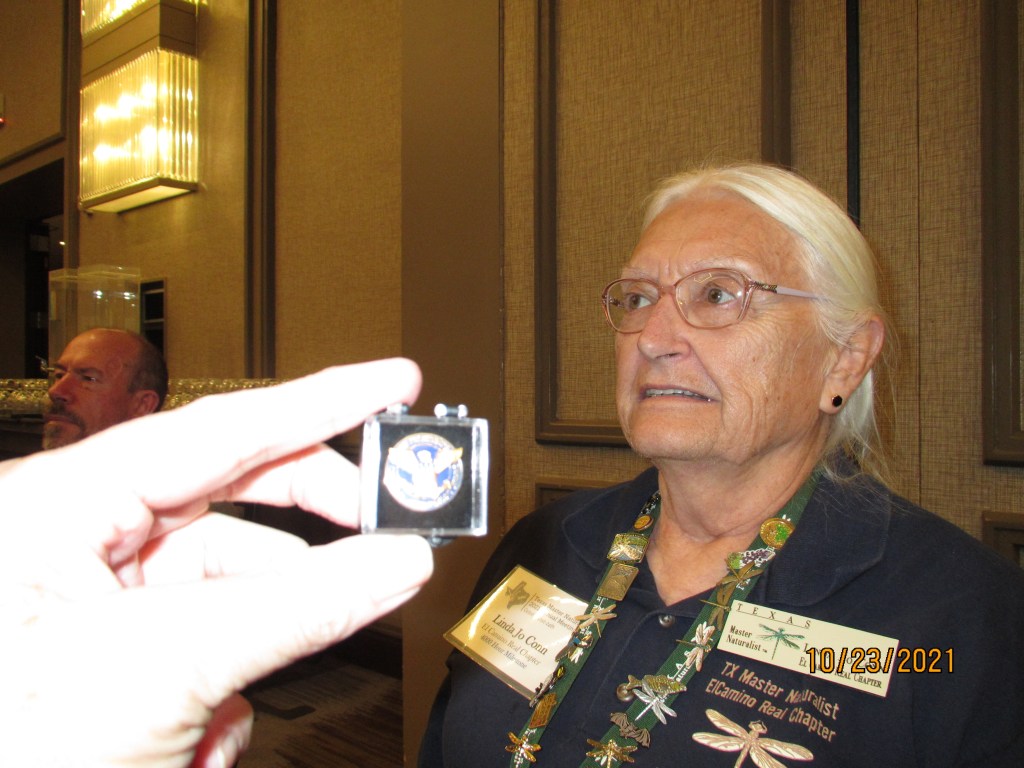
Linda Jo Conn received special recognition Saturday night at the annual meeting of Texas Master Naturalists in Dallas/Ft Worth. She has reached a milestone of 4,000 service hours. She was in very tight company. Only one other statewide member qualified.
Congratulations to Linda Jo
The award included a dragonfly pin of brushed gold with a ruby in the center and a special pin and certificate from the office of the President of the United States.
The Presidential pin
In other categories, Eric Neubauer received recognition for reaching 250 service hours. All who received initial certification from the class of 2020 were also recognized (there were many statewide).
Eric stands as his name is called.
Larry Kocian was recognized for “109!” hours of service in the Texas Water Specialist program with TPWD. Kocian and Sandra Dworaczyk were both given recertification this year.
Good job!
I attended a 3-hour session on this program, and it looks particularly interesting. If we can get a group of three interested, they can take the class and gain certification. I have a connection to it if anyone is interested. If you’d like to find out more information, contact Melissa Felty, conservation education manager for TPWD, at Conservation Edu@tpwd.gov or go to the web site. The class counts as advanced training hours (8) and the service, which can be education, water testing, CoCoRaHs precipitation measuring, and other things, count as service hours for Texas Master Naturalist.
Yay for our folks!
The meeting had some very educational sessions. I went from water conservation, to wildscaping in the shade, to Chronic Wasting Disease, to iNaturalist advanced training, to Tarantula sex with live tarantulas in one day. That last one was particularly amusing to me, Eric, and the rest of the packed class. A few members gave play-by-play commentary. My favorite occurred on Saturday. It was an excellent program given by a fellow iNaturalist from the Blackland Prairie chapter on identifying trees. I now have a brochure to carry with me.
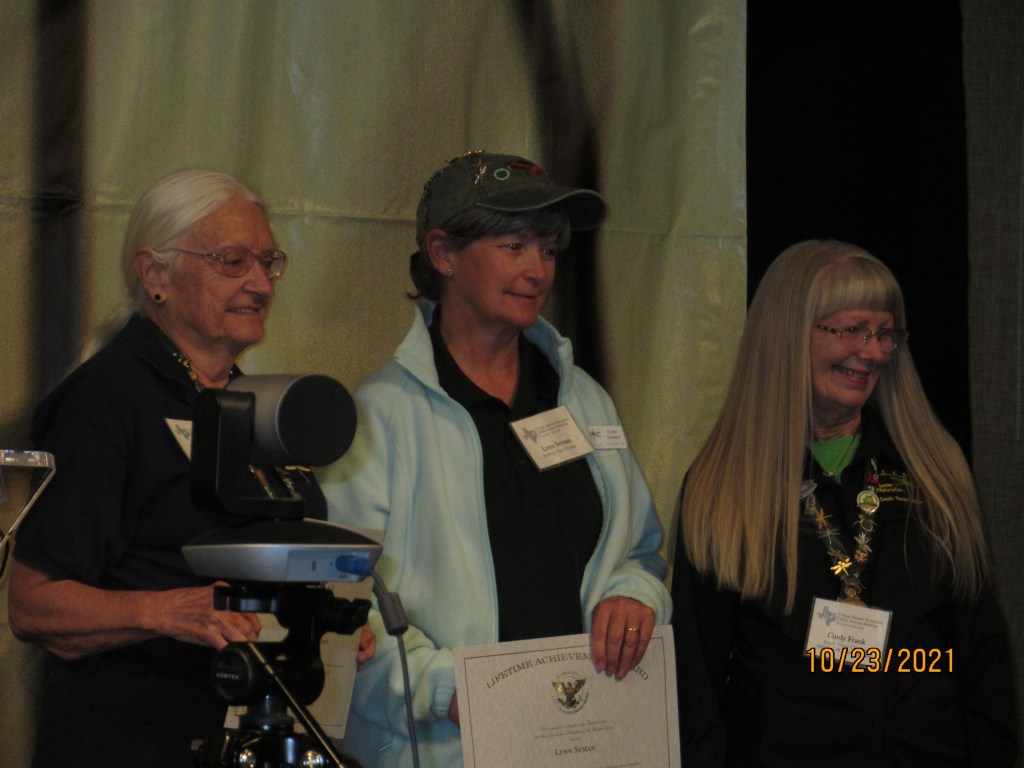
Award recipients
The meeting was educational, entertaining, and a great place to meet other TMNs. I came away with some good ideas for our chapter.
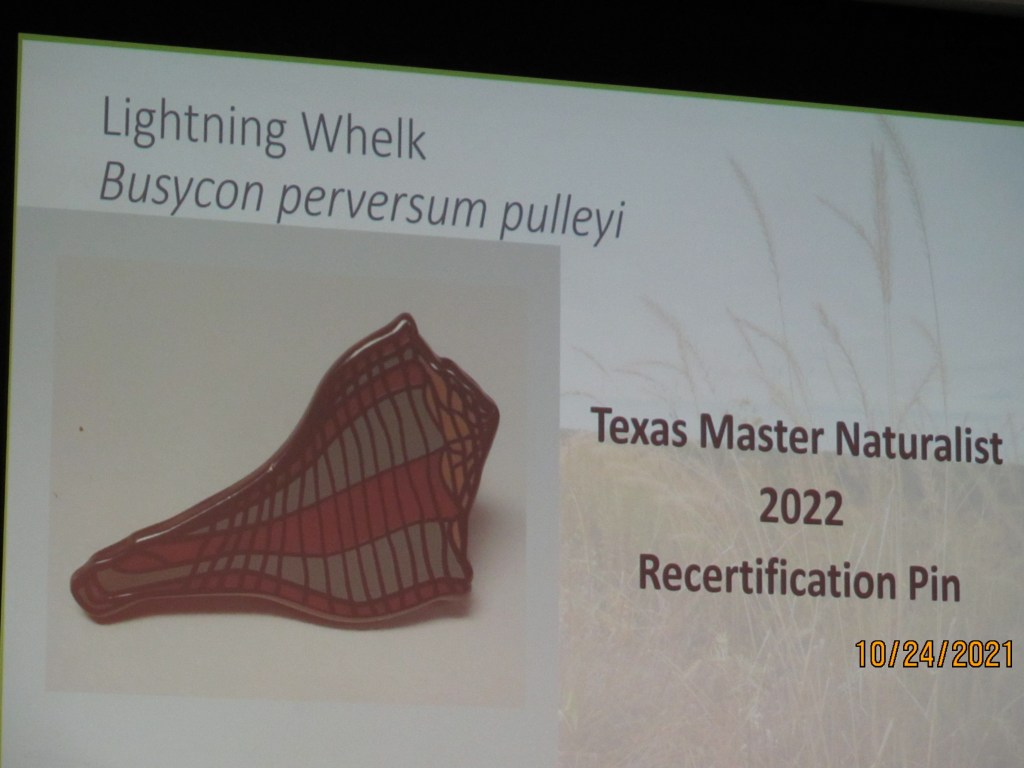
Oh, and by the way, the new TMN pin for recertification in 2022 is the Lightning Whelk.
In 2018, wheat was planted here at my property, where there was once blackland prairie. Since then, nature has taken over. A mix of native and non-native grasses and forbs quickly came up by themselves. Each year the mix changed, but by 2021 it was obvious Johnson Grass was a huge threat and would eventually outcompete and overwhelm everything else. I was reluctant to use herbicides, because they might affect the plants and animals that I wanted to keep. For example, it’s unlikely anyone tested the effect on wolf spiders. So, I was left with only mechanical means of control.
I decided to focus only on the Johnson Grass to keep it simple. I came up with several plans depending on how thick the Johnson Grass was and whether an area would be mowed. One image shows an area where I pulled the Johnson Grass and ragweed starting early in the year. It looks pretty nice now and only a few unwanted seedlings have come up since. I’ll mow this area in early spring before the bluestem comes up and after it goes to seed. You can see some Johnson Grass I haven’t gotten to lurking in the background on the right.
The other image shows where the mowed area meets the unmown area. Johnson Grass doesn’t like regular mowing. There are numerous small plants in the foreground, but these have limited root systems and will die or are easy to pull. King Ranch Bluestem tolerates regular mowing. I mowed around the plant in the foreground and now it’s going to seed. I mowed around other plants, primarily legumes, and hand pulled any Johnson Grass that didn’t get cut. In the background is a mass of Johnson Grass. I’m hand pulling this. You can see little of anything is left except leaf litter where I have pulled it to the right. Some will regrows, and I’ll have pull it again, but subsequent pulling goes much quicker than the first. In the meantime, other plants, such as asters, now have enough light to spout and grow. By the way, if you hand pull Johnson Grass, wear good gloves. Otherwise it can give you a nasty cut if your hand slips.
Other areas I’ve promoted with selective weeding are stands of goldenrod and a large patch of frogfruit where water collects sometimes.
It’s possible another threat will rise out of the several species of non-native grasses present, but for now I have a plan.
When we learned about scientific names in the training classes, we were introduced to how the name of the person that initially described them is often appended to the name. At the time, it seemed rather redundant.
As I found out recently, it can be very useful. I’ve been trying to untangle the lapidicina group of Pardosa wolf Spiders in Texas. These are the largest of the Pardosa spiders around here, and they like rocks, especially limestone outcrops. Their common name is stone spiders because of it.
I’m not aware of any in Milam County, but there are some at Granger Lake just next door. There are also some along Brushy Creek in Williamson County and several places along the lake near Belton in Bell County. In total, there are four species in Texas, which are apparently found in limited areas that don’t necessarily overlap.
Here’s one found near Granger Lake. It’s looking right at us!
Here’s what happened. P. sierra was described by Banks in 1898 from specimens collected in Baja California. P. atromedia (California) and sura were described subsequently. In 1959, Barnes decided they were all the same species, P. sierra, which had an immense range in southwestern U.S. and in Mexico. This was based on similar morphology of genitalia.
Then, in 2010, Correa-Ramirez et al. looked at the genetic code of specimens and concluded that they were indeed separate species, and that atromedia was in California, sierra was in Baja California, and sura was everywhere else. Additional studies may eventually add to these ranges, but for us it’s very likely that Texas has sura and not sierra. The other species in Texas are lapidicina, mercurialis, and vadosa. They are difficult to tell apart and all appear to come in a variety of colors and patterns.







 Nature Along the El Camino Real