Wolf Spiders of Winter

by Eric Neubauer

Finding wolf spiders during winter is a challenge since favorable temperatures are uncommon and often short lived. It’s a good time of year for me to concentrate on local species that need better photo
coverage. One such species is Gladicosa pulchra, the contrary wolf spider that dwells in the treetops. They seem to be absent from the Blackland Prairie, and I’m only aware of them being at one location in each of Burleson and Milam Counties.
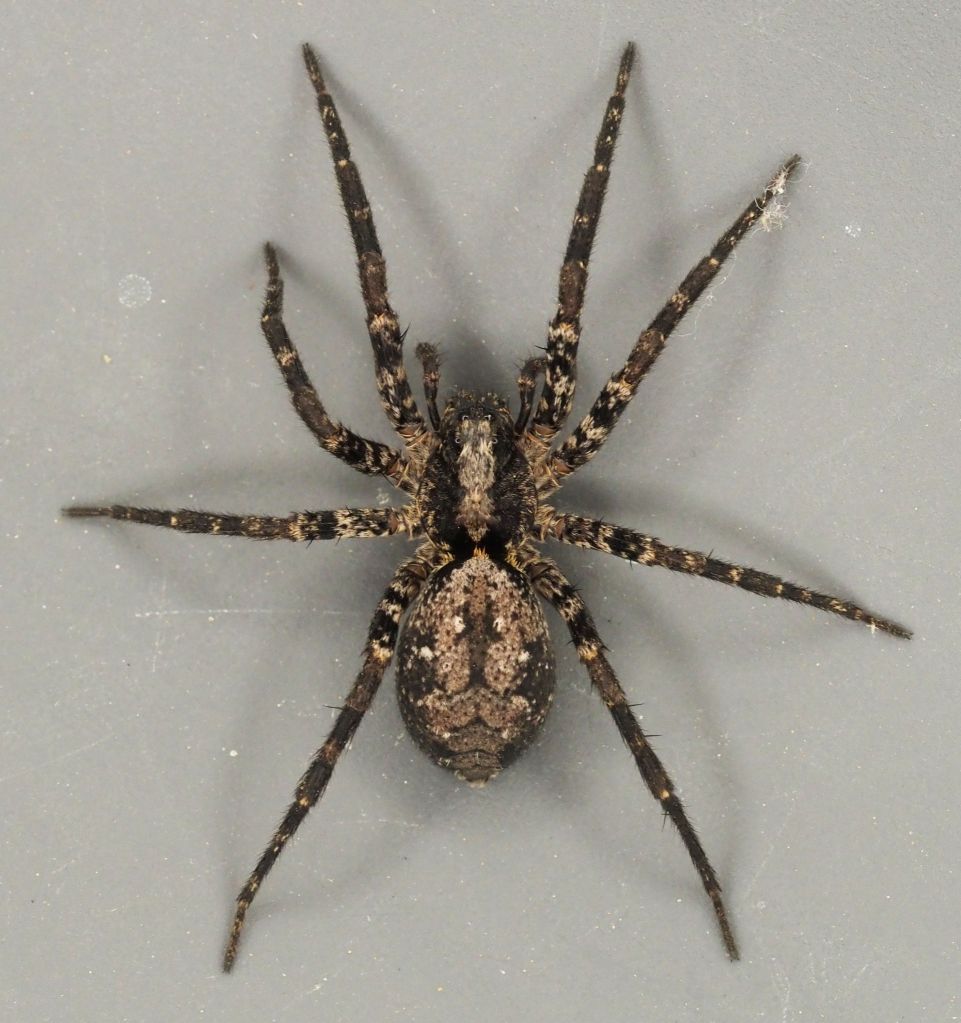
Female – dark

On December 25, I visited the Cedar Hill Nature Preserve, and on January 7 I visited Edwards Ranch. Spotlighting was the easiest way to find them. I quickly discovered they are more plentiful than I expected, and that December-January is the height of their mating season. I also found that while they live in the canopies of post oaks most of the time, they all follow the leaves down to the ground where they became a lot easier to catch for my photos of several adult females, some already gravid, and two adult males.
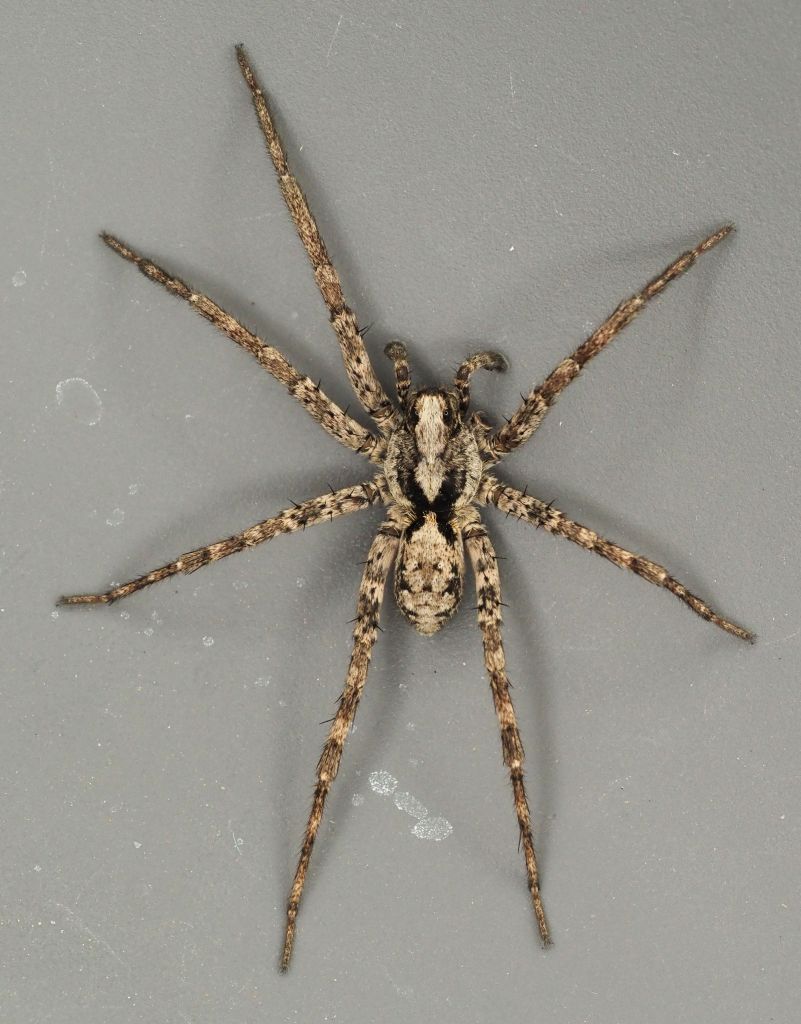
Male – light

Gladicosa pulchra was first described in 1877, spent time in several different genera, and was ultimately put into a new Gladicosa genus by Brady in 1987. Regarding the color, he wrote,

“The range of color in G. pulchra is greater than that of G. gulosa. I have noted light forms and dark forms of pulchra. These do not represent a genetic polymorphism but are the extremes in a color continuum. There is no discernible correlation between geographic locality and color pattern among the specimens examined. The darker forms are much more numerous than the light colored ones.”

With my recent observations, I believe I have a natural explanation for the two forms, and it’s most certainly genetic polymorphism though of the sexual dimorphism variety. A little field work certainly paid off. True to the last sentence, I saw more dark females than pale males which is typical of most species since males don’t live as long as females as adults. Females may even delay egg production while waiting for better conditions.


Addendum: Coincidentally, as I was getting this blog ready to upload, I looked over and there was a Hogna antelucana watching me. I took this friend outside to a warm spot — Sue Ann Kendall
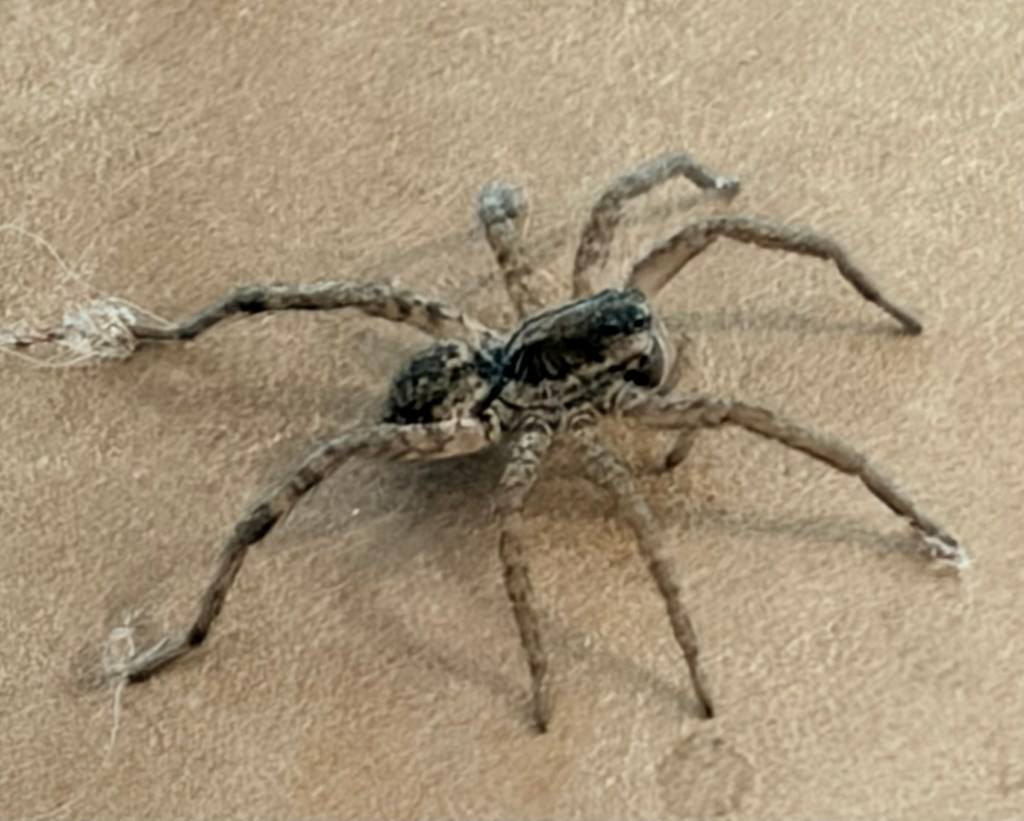
My phone doesn’t take as clear photos as Eric’s camera and lighting.

Little Brown Spiders

by Eric Neubauer

The wolf spider world never shuts down in Texas if you know where to look. About a dozen species from a number of genera mature over winter when they can hide among fallen leaves. They can be quite active at night during rare warm spells. They all look generally similar and are often hard to tell apart unless you know exactly what details to look for.

Here we have the obscure S. perplexa, which I’ve written about before. Turn it over and the white on black abdomen pattern makes identification easy. This is a juvenile male just one molt away from adulthood.

The other is Varacosa avara. I had found some a couple of weeks earlier and speculated they were this species mostly because of the strongly pinched carapace medial band at the posterior lateral eyes. This time it was another adult male, and I was able to confirm it from the spine lengths on the underside of tibia I thanks to a better image. The pinched medial band is a lot easier to see than the translucent spines, but the medial band pinching isn’t mentioned in the literature. Body lengths of both spiders are a little over 8 mm (a third of an inch).

Also seen was a much larger Tigrosa georgicola. The presumed female has been in about the same place for over a month. Previously she had retreated into her burrow as I approached but this time she held her ground. I didn’t attempt to capture her for photos since I already have a lot of photos of that species.

New and Unusual Wolf Spider Observations

by Eric Neubauer

Here are two spiders I’ve recently observed in my quest to identify all Texas wolf spiders

Do wolf spiders intentionally lie on their backs?

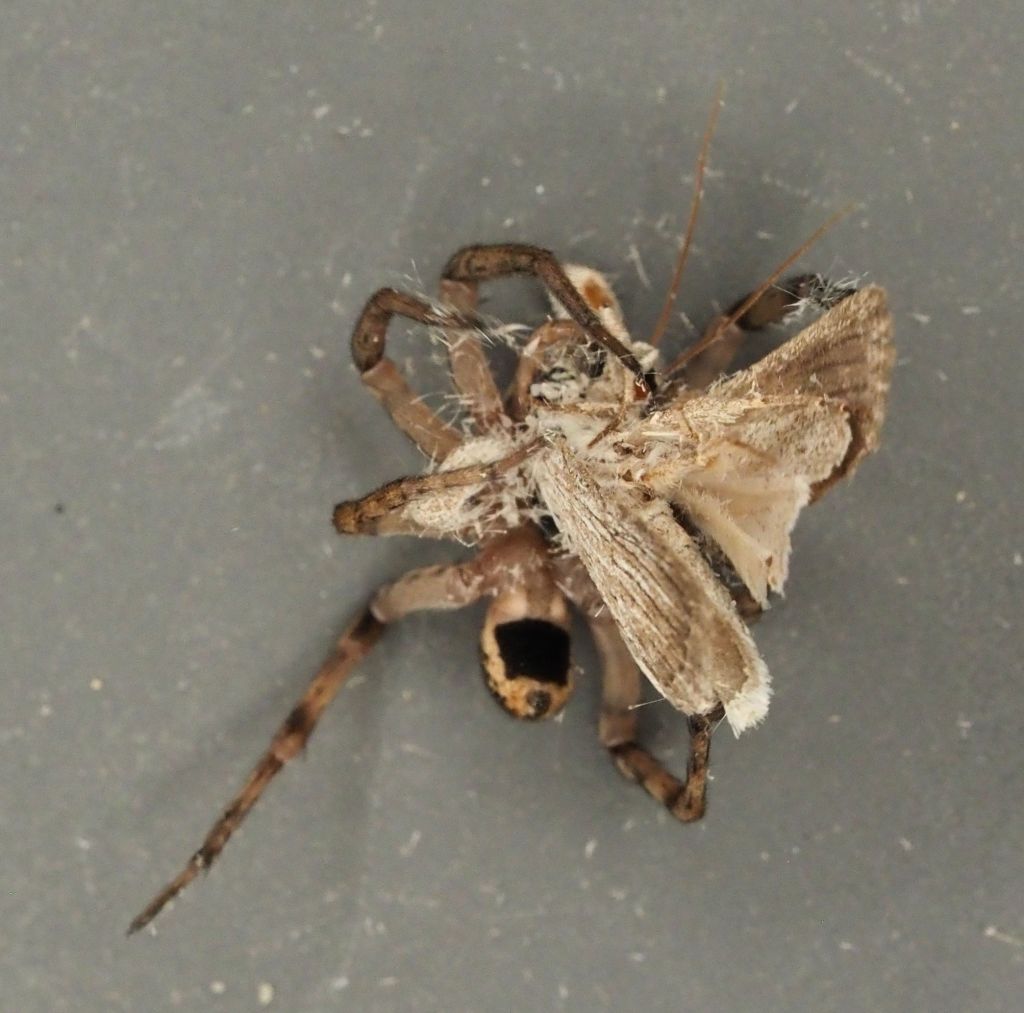
Yes! Here a juvenile Hogna baltimorina does just that while subduing a moth it captured a
second earlier and just seconds after I finished photographing it. It has all legs free to hang on to the moth. After the struggle ended, the spider quickly flipped over, prey and all.

The spider was released later and took its dinner with it.

A few years back I saw a wolf spider pounce on a grasshopper about the same size. The grasshopper jumped a couple of feet into the air, taking the spider with it. The grasshopper immediately made a much smaller second jump with the spider still hanging on. Then it was all over.

Moral of the story: If you meet a really big wolf spider, don’t try wrestling with it. You won’t win.

New Hogna Species Spotted

For years I’ve been trying to sort out the various Pardosa species in Texas. There are over a dozen of them and many are very difficult to tell apart by either appearance or genitalia. One common species in Texas appears to be a more southern species (Mexico and Central America), and the species it’s supposed to be is actually many miles east Texas. Others have sketchy ranges or none at all. It would be easy for an unnamed species to be hiding in Texas but I’ve been avoiding this possibility, which could seriously complicate an already messy situation.

Well apparently here’s one that is fortunately different enough from others to not be confused with them. It also has the most shocking appearance of any. There are at least 5 details besides pattern boldness that set it apart from others. Ostensibly it’s in the lapidicina species group which is known for its evenly banded legs, at least as juveniles and females. They also love rocks of all sizes and often sun on them. Steep clay slopes will do in a pinch.

 I’ll be working with a professor at UT on this. I was visiting his ranch surveying wolf spiders and these just popped up out of nowhere. I’ve been working on that genus for years with only middling success but instantly knew this was something that was different than anything I’d seen in Texas in person or on iNat. Funding for domestic taxnomic research is scarce, so being able to interest professors in that area is important. 

Nighttime Photobombers

by Eric Neubauer

Since I do photography in the dark with artificial lighting, I’m often get photobombing visitors. On the last trip, my experience at Monahans Sandhills State Park was especially hideous with a multitude of some kind of wasp which even stung me three times, once when I sat on one. By the time I got to Oasis State Park I had learned to keep my headlamp set to red lightand only turn on the lighting for photography as briefly as possible.

Some of the photobombing insects become meals for my subject spiders, which is a good thing. I like sending them away with something to show for it. I also got a couple of nice adult antlion observations this trip.

Brachynemurus hubbardii

Then there was this moth from Oasis State Park just across the border near Portales, NM. I put a species ID on it, then someone put a different ID on it, and then we agreed both were wrong. After a search of observations around the entire country, I finally found a pretty good match. Lacinipolia vicina is primarily found in the Northeast although there are several observations scattered around the country. The closest two are in California.

So, you never know what might drop in. The 55 observations on iNaturalist peak in September so that checks out OK.

Encounter with a Black Witch

by Eric Neubauer

I recently got back from the TX/NM border region including Monahans Sandhills State Park. Not great timing for wolf spiders because only a few species were in or nearing their breeding season, but I was still able to add two species to my life list. There were other compensations:

Ascalapha odorata (Black Witch) is a huge moth. I had seen a couple of very worn ones in a dark alcove at Devils River last fall where they couldn’t be readily photographed. As I made my way down into a sand dune blowout, I flushed one that flew around for a while before settling down about 5′ away. Unbelievably it let me approach quite close. The photos were amazing and were a credit to the Olympus camera. Light levels were very low and the setting sun had already left most of the
blowout in shadow.

Not far away was a Euploca convolvulacea (Phlox heliotrope) which had only the bare essentials of a mature plant. Many plants were covered with hundreds of bloom.

I’ve known about the Black Witch for decades but never expected to see one, so never looked up the details. The range map on iNat is amazing and includes all of North and South America except the coldest extremes. It has even turned up on Wake Island in the eastern Pacific. It is quite a flier and apparently has some sort of northward migration in the fall.

Mine was in perfect condition, so it must have matured nearby rather than migrating there. There had been 8 previous observations scattered around Ward County, all in good condition suggesting there is a healthy local breeding population there.